Makita’s 18V LXT and 40V max XGT systems serve different kinds of work. Here is how to choose by workload, fatigue, battery investment and the tools you actually need.
Choose 18V LXT for breadth, lighter everyday tools and existing batteries. Choose 40V max XGT when sustained high-load output is worth a separate, heavier battery system.
Start with the job, not the voltage
For most buyers, LXT is still the easier Makita platform to live with
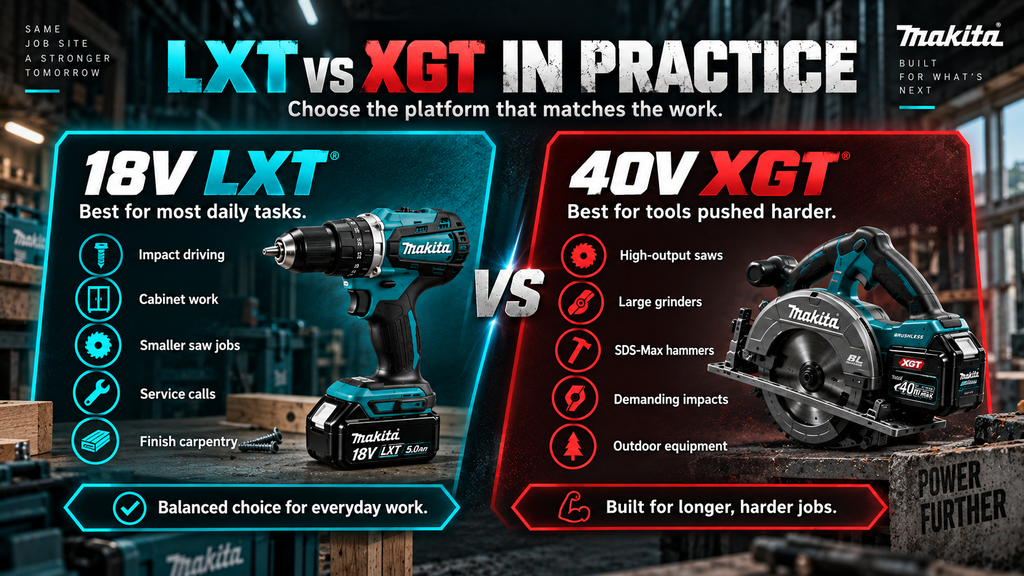
Makita 18V LXT remains the practical default for a huge share of drilling, fastening, trim, maintenance and general construction work. Its mature U.S. range exceeds 350 products, and its single-battery tools are usually the more compact option when you are climbing ladders, working overhead or carrying a kit across a site.
40V max XGT is not simply “LXT, but better.” It is a separate high-output system with 170+ products, aimed at demanding applications where a tool must keep cutting, drilling, grinding or blowing hard for longer. That advantage can matter enormously—but only if your work exposes the limit of a lighter platform.
| Category | 18V LXT | 40V max XGT |
|---|---|---|
| Best fit | Everyday trade work, portable kits and broad tool ownership | Sustained heavy-duty, industrial and commercial outdoor work |
| Tool range | 350+ products in Makita’s current U.S. lineup | 170+ products in Makita’s current U.S. lineup |
| Battery cross-use | LXT packs fit LXT tools, including 18V X2 / 36V machines | XGT packs fit XGT tools, including 40V X2 / 80V max machines |
| General trade-off | Lower entry cost, broad choice and typically less fatigue | More sustained output, but larger packs and separate investment |
Power is more than a voltage label
XGT has a clearer advantage when the load stays high

A higher platform voltage does not guarantee that every 40V max tool will outperform every 18V tool. Motor design, electronics, battery capacity, blade or accessory choice and the material all influence results. Compare the exact tools you are considering—not platform labels in isolation.
Where XGT earns its place is sustained demand. Its higher-voltage architecture can deliver comparable power at lower current, which is valuable in large saws, high-torque fastening, rotary hammers, grinders and commercial outdoor equipment. On repetitive heavy cuts or difficult drilling, preserving output can mean less waiting and fewer tool swaps.
If your current LXT tool finishes the job without bogging down or forcing breaks, moving to XGT may improve capability—but not necessarily your day.
LXT in practice
Plenty of output for the majority of daily tasks
For impact driving, cabinet installation, smaller saw work, service calls and finish carpentry, a quality 18V LXT brushless tool is often the more balanced choice.
XGT in practice
Built for the tools that spend longer at the limit
The case is strongest for high-output saws, large grinders, SDS-Max hammers, demanding impact wrenches and serious outdoor power equipment.
The cost of more runtime
Weight matters most when the tool is in your hand all day.
LXT’s compact packs range from about 0.85 lb for 1.5Ah and 2.0Ah batteries to roughly 1.35 lb for 3.0Ah through 6.0Ah packs, according to Makita’s support information. That difference is easy to feel during overhead fastening, trim work and long runs of drilling.
XGT batteries are physically larger. Makita lists a 40V max 2.5Ah BL4025 with a 1.65 lb shipping weight, and tool weight varies widely once the bare tool and battery are combined. For example, the XGT GSH05 6-1/2 in circular saw is listed at 7.8 lb with a 4.0Ah battery. Compact XGT is manageable—but matching an XGT tool to a comparable LXT tool often means accepting more mass in exchange for output.
The battery decision is a platform decision
LXT and XGT batteries do not fit each other’s tools
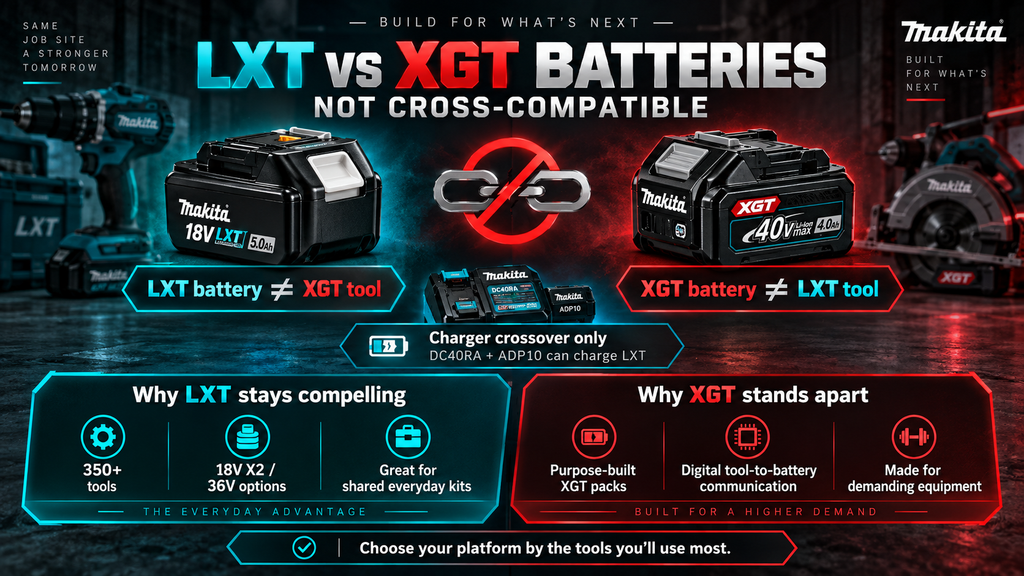
This is the key buying reality for existing Makita owners: 18V LXT and 40V max XGT are separate systems. Their battery rails, voltage and electronics are different. An LXT battery cannot run an XGT tool, and an XGT battery cannot run an LXT tool.
There is one useful charging crossover. Makita says its DC40RA XGT Rapid Optimum Charger can charge 18V LXT batteries when used with the ADP10 adapter. That can reduce charger clutter for a mixed fleet, but it does not make the platforms battery-compatible. Build your first kit around the family of tools you will use most often.
Why LXT stays compelling
Its 350+ product range makes it easier to share packs across specialist tools, lights, vacuums and jobsite essentials. It also offers 18V X2 / 36V equipment for users who need more capability without immediately adding XGT batteries.
Why XGT justifies its own lane
Its 2.5Ah, 4.0Ah, 5.0Ah and 8.0Ah packs are designed for demanding XGT equipment, with digital tool-to-battery communication for thermal, overload and discharge monitoring.
Make the platform fit the workload
Which Makita platform should you buy?
The useful answer is not “which is best?” It is “which system removes the biggest bottleneck from my work without adding a new one?” Use the following profiles as a practical starting point.
Choose this when
18V LXT
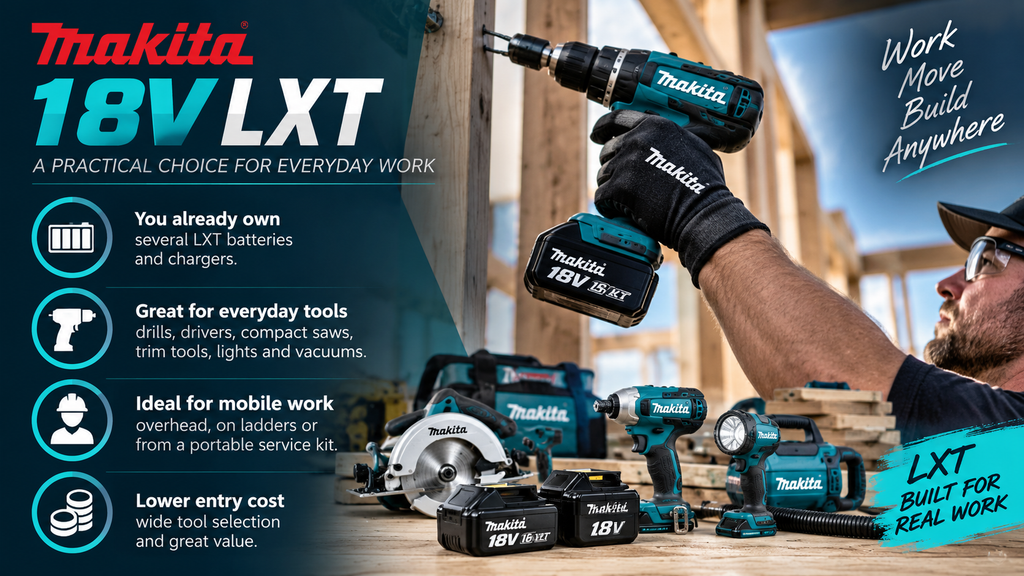
- You already own several LXT batteries and chargers.
- Your work prioritizes drills, drivers, compact saws, trim tools, lights and vacuums.
- You regularly work overhead, on ladders or from a portable service kit.
- Tool selection and lower entry cost matter more than peak sustained output.
Choose this when
40V max XGT
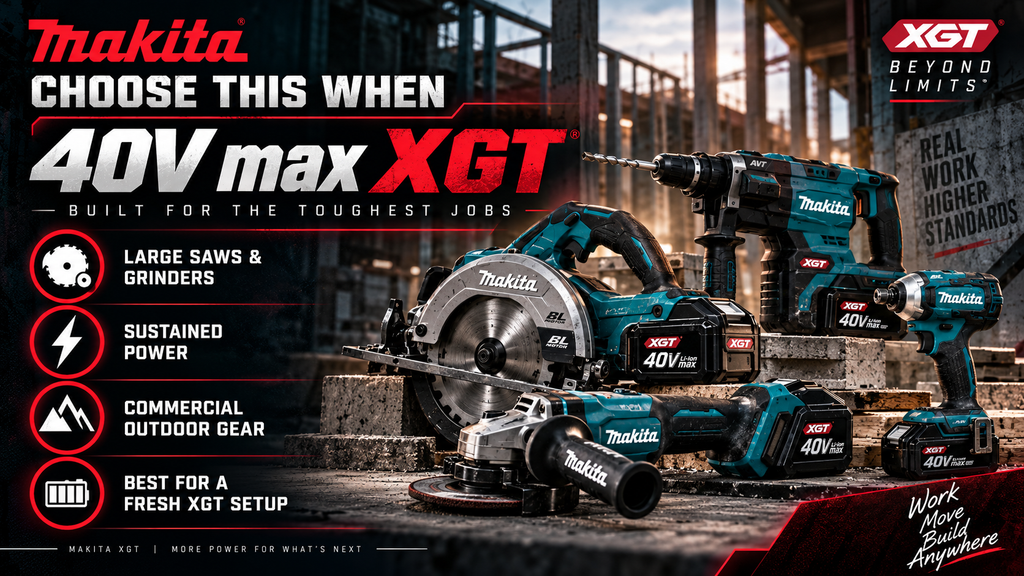
- You frequently run large saws, heavy grinders, rotary hammers or high-torque impact wrenches.
- Cordless performance under sustained load affects your productivity.
- You need commercial-grade outdoor equipment or expect your work to grow in that direction.
- You are buying fresh and can budget for a separate battery ecosystem.
Common buying questions
Makita LXT and XGT FAQ
Can I use Makita 18V batteries in 40V XGT tools?
No. LXT and XGT batteries are not interchangeable in tools. They use different rails, electronics and voltage. LXT packs are for LXT tools, while XGT packs are for XGT tools.
Can an XGT charger charge LXT batteries?
Makita states that the DC40RA XGT Rapid Optimum Charger can charge LXT batteries with the ADP10 adapter. This is a charger crossover only; it does not make LXT and XGT tool batteries compatible.
Is 40V max XGT always heavier than 18V LXT?
Not in every individual comparison, but XGT packs are generally larger and comparable XGT tools commonly weigh more once a battery is fitted. Check the complete listed weight with the exact pack, rather than relying on voltage alone.