💡 Key Takeaway
Yes, “Logisths” is a common misspelling of “logistics” — the process of planning, implementing, and controlling the efficient flow of goods, services, and information from point of origin to point of consumption. It encompasses supply chain management, warehousing, transportation, and inventory control.
📌 Section Summary: Logistics is the backbone of global commerce — it’s how products get from factories to your front door.
What Is Logisths (Logistics)?
Logistics (often misspelled as “logisths,” “logisitics,” or “logistcs”) refers to the detailed coordination and management of complex operations involving the movement of people, facilities, or supplies. In a business context, logistics is the management of the flow of goods between the point of origin and the point of consumption.
The term originates from the Greek word logistikē, meaning “the art of calculating.” Originally a military term for moving armies and supplies, it has evolved into a multi-trillion-pound global industry.
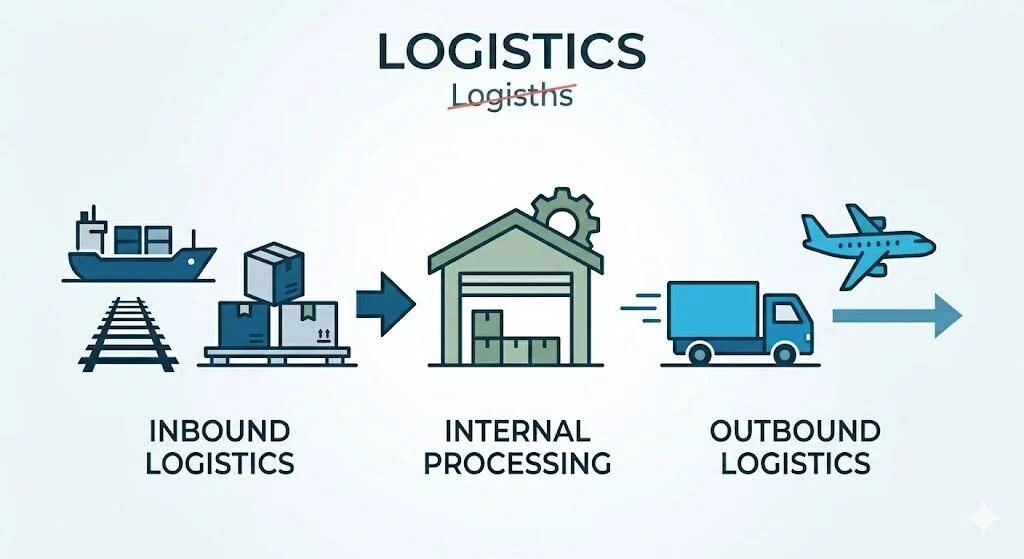
📦 Inbound Logistics
Receiving, storing, and distributing raw materials internally. Includes supplier management, transportation from vendors, and warehouse receiving.
📤 Outbound Logistics
Moving finished products from the company to the customer. Includes order fulfillment, shipping, delivery, and returns management.
💡 For your assignment: The Council of Supply Chain Management Professionals (CSCMP) defines logistics as “the process of planning, implementing, and controlling procedures for the efficient and effective transportation and storage of goods.” This is a citable definition.
📌 Section Summary: Modern logistics involves 6 core functions that work together as an integrated system.
Core Capabilities & Features
Whether you’re evaluating logistics platforms or understanding the discipline, these are the essential capabilities that define modern logistics operations:
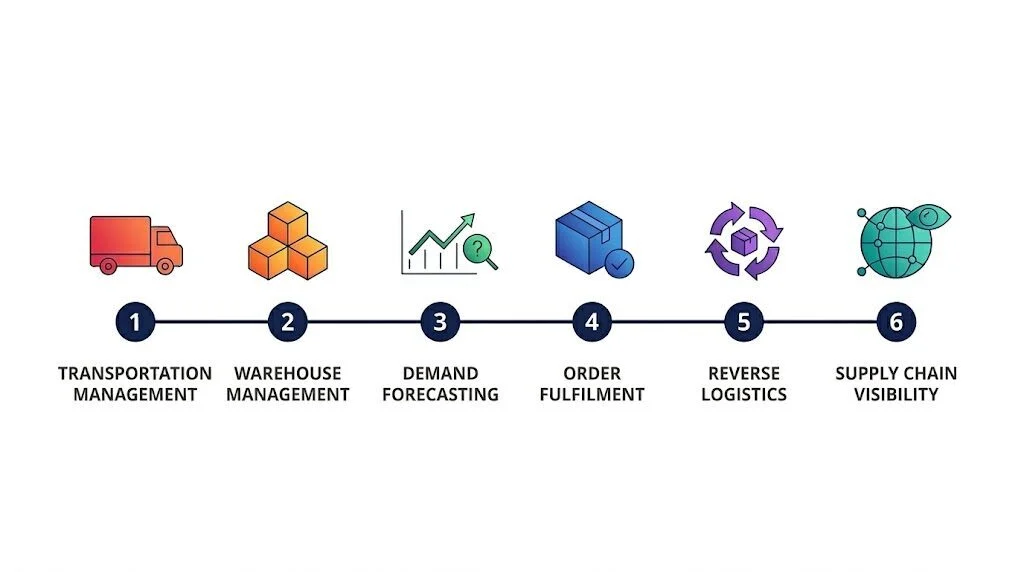
1 Transportation Management
Route optimisation, carrier selection, freight auditing, and multi-modal transport coordination. This is typically the largest cost component (40-60% of total logistics spend).
2 Warehouse Management
Inventory control, slotting optimisation, pick-pack-ship operations, and space utilisation. Modern WMS systems use barcode/RFID for real-time tracking.
3 Demand Forecasting
Predicting future demand using historical data, market signals, and machine learning. Reduces overstock by 20-30% and stockouts by 50%+ when implemented effectively.
4 Order Fulfilment
End-to-end process from order receipt to delivery confirmation. Includes order processing, picking, packing, shipping, and last-mile delivery.
5 Reverse Logistics
Managing product returns, recycling, refurbishment, and disposal. Increasingly important with e-commerce return rates averaging 20-30%.
6 Supply Chain Visibility
Real-time tracking and transparency across the entire supply chain. IoT sensors, GPS tracking, and blockchain for provenance verification.
📌 Section Summary: AI is transforming logistics through predictive analytics, autonomous vehicles, and intelligent automation.
AI in Modern Logistics
Artificial intelligence is the single biggest technological shift in logistics since containerisation in the 1950s. Here’s how AI is being applied today:
| Predictive Analytics | Demand forecasting, ETAs | 15-25% cost reduction |
| Computer Vision | Quality inspection, damage detection | 99.5% accuracy rate |
| Route Optimisation | Dynamic routing, fuel efficiency | 10-15% fuel savings |
| Robotics (AMRs) | Warehouse picking, sorting | 3-5x throughput increase |
| NLP Chatbots | Customer service, tracking queries | 70% query resolution |
🏢 For operations managers: If you’re evaluating AI for your warehouse or transport network, start with demand forecasting — it has the highest ROI with the lowest implementation complexity. Most TMS platforms now include AI routing as a standard feature.
📌 Section Summary: A supply chain control tower is a central hub providing end-to-end visibility and decision support.
Supply Chain Control Towers
A supply chain control tower is a centralised platform that provides real-time visibility, analytics, and decision-making capabilities across the entire supply chain. Think of it as the “air traffic control” for logistics.
Visibility
Real-time tracking across all tiers of suppliers
Analytics
Predictive insights and prescriptive recommendations
Action
Automated responses to disruptions and exceptions
Types of Control Towers
- •Transportation CT: Focuses on shipment tracking, carrier performance, and delivery ETAs
- •Inventory CT: Monitors stock levels across all locations, triggers replenishment
- •End-to-End CT: Unified view from raw material sourcing to final delivery — the gold standard
Key vendors: SAP IBP, Blue Yonder, project44, FourKites, o9 Solutions. Most require £100K+ annual investment for enterprise deployments.
📌 Section Summary: Logistics offers diverse career paths from entry-level to executive, with growing demand for tech-savvy professionals.
Career Roles in Logistics
Logistics Coordinator
Entry-level · Scheduling, documentation, tracking
£22-28K
Warehouse Manager
Mid-level · Operations, team leadership, WMS
£30-45K
Supply Chain Analyst
Mid-level · Data analysis, forecasting, reporting
£35-55K
Transport Manager
Senior · Fleet management, compliance, budgets
£40-60K
Head of Supply Chain
Executive · Strategy, P&L ownership, digital transformation
£70-120K
🎓 For students: Key certifications that boost employability: CILT (Chartered Institute of Logistics and Transport), APICS CSCP, Six Sigma Green Belt. Most employers value practical ERP/WMS experience over additional degrees.
📌 Section Summary: 2026 logistics trends include AI-first operations, sustainability mandates, and nearshoring.
Latest Industry Updates (2026)
EU Carbon Border Adjustment (CBAM) Expansion
From January 2026, logistics providers must report embedded carbon in transported goods. Companies are scrambling to implement carbon tracking across supply chains.
Autonomous Last-Mile Delivery Goes Mainstream
Waymo, Nuro, and Starship Technologies expanding autonomous delivery in 25+ US cities. UK trials underway in Milton Keynes and Northampton.
Nearshoring Accelerates Post-Red Sea Disruption
Houthi attacks on shipping in late 2023/2024 pushed companies to nearshore manufacturing. Mexico, Turkey, and Eastern Europe are benefiting most.
Generative AI in Supply Chain Planning
LLMs now used for scenario planning, supplier communication, and exception management. SAP, Oracle, and Blue Yonder all launched gen-AI features in 2024.
Frequently Asked Questions
Is “logisths” a real word or just a typo?
It’s a common misspelling of “logistics.” There is no separate concept called “logisths.” If you’ve seen it in a document or slide, it was almost certainly a typo. The correct spelling is logistics (or “logistik” in German, “logistique” in French).
What’s the difference between logistics and supply chain management?
Logistics is a subset of supply chain management. Logistics focuses specifically on moving and storing goods. Supply chain management (SCM) is broader — it includes logistics plus procurement, manufacturing, demand planning, and supplier relationships. Think of logistics as the “how we move it” and SCM as “how we plan, source, make, and deliver it.”
What qualifications do I need to work in logistics?
For entry-level roles: a degree in business, supply chain, or operations (or equivalent experience). For progression: CILT Level 3-5 qualifications, APICS CSCP, or Six Sigma certification. Increasingly, employers value data skills (Excel, SQL, Power BI) and experience with ERP systems (SAP, Oracle) over traditional qualifications alone.
Is logistics a good career in 2025?
Yes. The UK logistics sector employs 2.7 million people and faces a chronic skills shortage, particularly in technology-literate roles. Salaries have risen 8-12% since 2022. E-commerce growth, sustainability regulation, and AI adoption are creating new roles that didn’t exist five years ago. The sector is recession-resistant — goods always need moving.
What software is used in logistics?
Key categories: TMS (Transportation Management Systems) — e.g., SAP TM, Oracle OTM, MercuryGate. WMS (Warehouse Management Systems) — e.g., Manhattan Associates, Blue Yonder, SAP EWM. ERP — SAP S/4HANA, Oracle Cloud. Visibility platforms — project44, FourKites, Shippeo. For smaller operations: ShipStation, Shippo, Linnworks.