If your car shakes at high speed — typically above 60 mph — you’re dealing with one of the most common complaints we see in the shop. The vibration might pulse through the steering wheel, the seat, or the entire cabin. The good news: in most cases, the fix is straightforward and affordable once you identify the root cause. This guide will help you figure out why your car is vibrating at high speed, what you can check yourself, and when you need a professional mechanic.
1. Unbalanced or Damaged Tires (Most Common Cause)
About 70% of the time when a car vibrates at high speed, the culprit is tire-related. Unbalanced tires create a wobble that intensifies as speed increases. You’ll typically notice the car shaking at high speeds starting around 55–65 mph and worsening from there. A lost wheel weight, uneven tire wear, or a separated belt inside the tire are the usual suspects.
The fix: Have all four tires balanced (costs $40–$80 at most shops). While they’re off, inspect for bulges, flat spots, or cupping wear patterns. If a tire has a broken belt — you’ll feel a rhythmic thump — it needs replacing. I also recommend a four-wheel alignment if it hasn’t been done in the last year, as misalignment accelerates uneven wear that causes future vibration.
💡 Pro Tip: If the vibration is mainly in the steering wheel, the front tires are likely the issue. If you feel it in the seat or floor, check the rears first. This simple test helps narrow down the problem before you even visit a shop.
2. Warped Brake Rotors
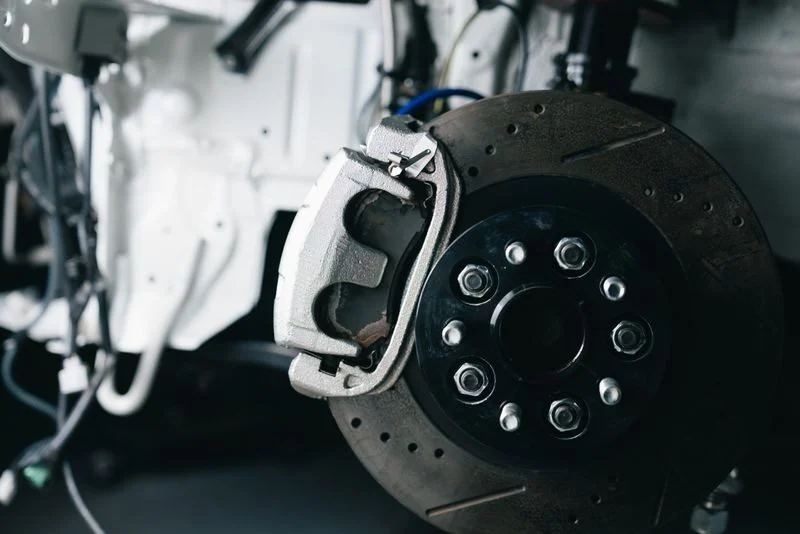
If your car shakes specifically when braking at high speed, warped rotors are almost certainly to blame. Heat cycling from aggressive braking causes the rotor surface to become uneven. You’ll feel a pulsation through the brake pedal and sometimes the steering wheel. This is different from constant vibration — it only happens when you press the brake pedal.
The fix: Rotors can sometimes be resurfaced (machined flat) if they’re still thick enough. Otherwise, replacement is the way to go — budget $150–$400 per axle for parts and labor. I always replace pads at the same time to ensure even contact on the new surface. Avoid riding the brakes on long downhill stretches to prevent future warping.
3. Worn Suspension & Steering Components
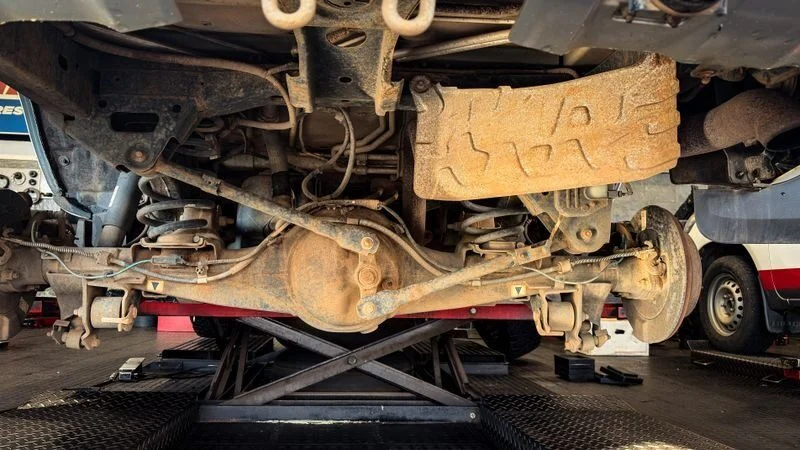
Worn ball joints, tie rod ends, control-arm bushings, or wheel bearings allow play in the wheel assembly. At highway speeds, even a small amount of looseness amplifies into noticeable vibration. This is more common in vehicles with 80,000+ miles. You might also hear clunking over bumps or notice uneven tire wear.
The fix: A thorough suspension inspection on the lift will reveal the worn part. Ball joints and tie rods are relatively inexpensive ($80–$200 per side with labor). Wheel bearings run $150–$400. Don’t ignore these — a failed ball joint at speed is a serious safety hazard that can cause you to lose steering control.
4. Car Shakes at Idle but Smooths Out While Driving
This is a different problem entirely. If your car shakes at idle but smooths out while driving, the issue is usually engine-related — not wheels or suspension. Common causes include worn motor mounts (rubber cushions that hold the engine in place), misfiring cylinders, a dirty throttle body, or vacuum leaks.
The fix: Start with a scan for misfire codes. Check motor mounts by putting the car in drive with the brake held — excessive engine movement means a mount is failing. A throttle body cleaning ($20 DIY, $80–$120 at a shop) solves many idle vibration issues. Motor mount replacement typically costs $150–$300 per mount.
5. Vibration During Acceleration Only
If the car only vibrates when you press the accelerator — especially during hard acceleration or at specific speeds — the driveshaft or CV joints (constant-velocity joints) are the most likely cause. CV joints transfer power from the transmission to the wheels while allowing for suspension movement. When their protective boots crack, grease leaks out and the joint wears.
The fix: A worn CV joint usually makes a clicking sound during turns in addition to the vibration. Replacement costs $150–$500 depending on the vehicle. Driveshaft balance issues (more common on rear-wheel and four-wheel-drive vehicles) require a specialized shop with balancing equipment. Budget $100–$300 for driveshaft service.
6. Shaking After Tire or Wheel Work
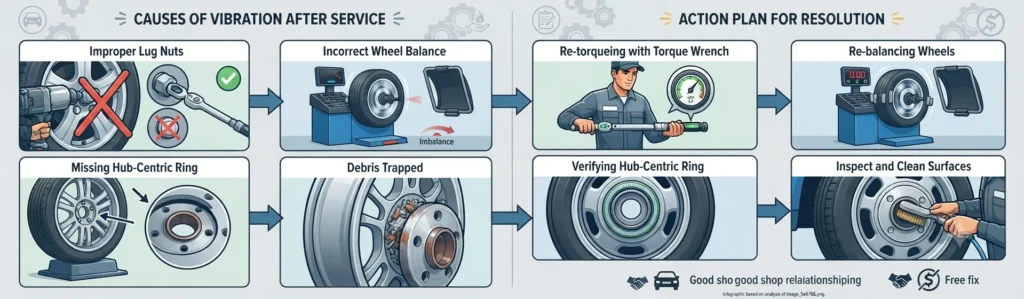
If your car started shaking right after a tire rotation, new tires, or any wheel work, the cause is almost always something that went wrong during the service. Improperly torqued lug nuts, incorrect wheel balance, a missing hub-centric ring, or debris trapped between the wheel and hub can all cause immediate vibration.
The fix: Go back to the shop that did the work — most will re-check at no charge. Ask them to verify lug nut torque with a torque wrench (not an impact gun), re-balance all four wheels, and inspect for any debris behind the wheels. This is usually a quick fix and shouldn’t cost you anything if the shop caused the problem.
7. When Should You Worry?
Any vibration that gets worse over time, produces unusual noises, or affects your ability to control the vehicle should be inspected immediately. A shaking steering wheel combined with a pull to one side could indicate a failing wheel bearing or separated tire — both are dangerous at highway speed. If you see visible tire damage, wobble in a wheel, or hear grinding, stop driving.
My rule of thumb: if the vibration started suddenly or has changed character recently, get it checked within a day or two. Gradual vibrations that only appear above 70 mph are usually balance-related and less urgent — but still shouldn’t be ignored for more than a couple of weeks. Remember: proper diagnosis requires a physical inspection. No article can tell you exactly what’s wrong with your specific vehicle.
Quick Diagnostic Summary
| Symptom | Likely Cause | Urgency | Typical Cost |
| Steering wheel shakes above 60 mph | Front tire imbalance | Low–Medium | $40–$80 |
| Seat/floor vibrates at highway speed | Rear tire imbalance or damage | Medium | $40–$200 |
| Shaking only when braking | Warped brake rotors | Medium–High | $150–$400/axle |
| Vibration + clunking over bumps | Worn suspension (ball joints/tie rods) | High | $80–$400/side |
| Shakes at idle, smooth at speed | Engine mounts or misfire | Medium | $80–$300 |
| Vibration during acceleration only | CV joint or driveshaft | High | $150–$500 |
| New vibration after tire/wheel work | Improper torque or balance | Medium | Free–$80 |
Frequently Asked Questions
Why does my car shake at high speeds but not at low speeds?
Speed amplifies imbalances. A tire that’s a fraction of an ounce off-balance barely matters at 30 mph, but at 70 mph it creates significant centrifugal force. That’s why the vibration typically appears in a specific speed range and worsens as you go faster. The same principle applies to slightly bent wheels or worn suspension parts.
Is it safe to drive my car if it’s vibrating at high speed?
It depends on the severity. A mild vibration from a tire balance issue is annoying but not immediately dangerous. However, any vibration accompanied by pulling, noise, wobble in the steering, or visible tire damage should be inspected before driving at highway speeds again. When in doubt, slow down and get it checked.
How much does it cost to fix a car that shakes at high speed?
Tire balancing runs $40–$80. Brake rotor replacement is $150–$400 per axle. Suspension parts range from $80–$400 per component. In my experience, about 60% of vibration complaints are solved with a simple balance and alignment for under $150 total. The key is getting an accurate diagnosis first so you don’t pay for parts you don’t need.
Can I diagnose car vibration at home without special tools?
You can narrow it down. Note whether the vibration is in the steering wheel (likely front end) or seat (likely rear). Check if it happens at constant speed, only during braking, or only during acceleration. Visually inspect tires for bulges, uneven wear, or damage. However, confirming the exact cause usually requires a lift inspection or road-force balance machine that only a shop has.