

What a CMP sensor does, how a fault can feel behind the wheel, and how to test the circuit before buying a replacement.
What does a camshaft position sensor do?
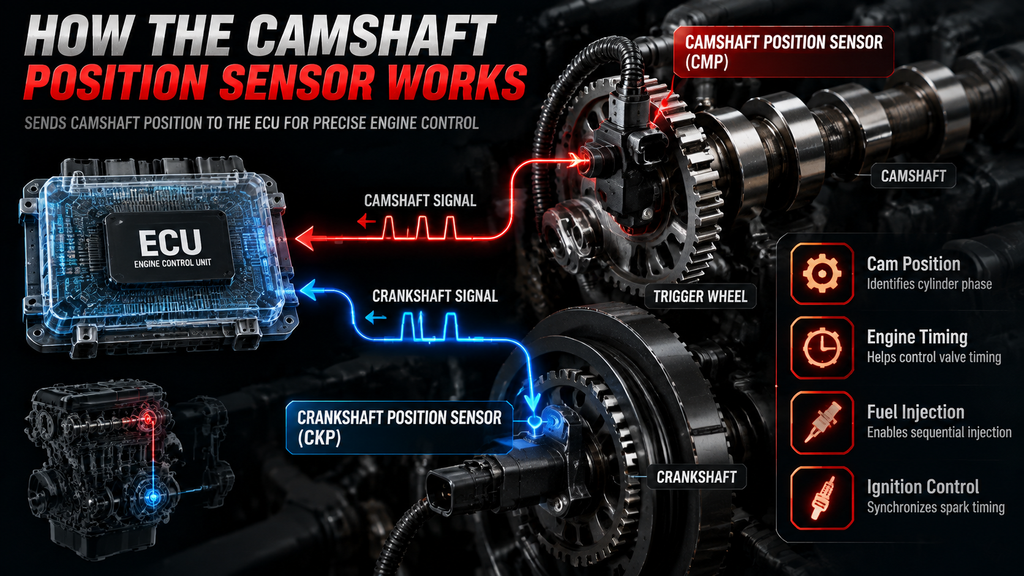
The CMP sensor tells the engine computer where the camshaft is and which cylinder is on its compression stroke.
Working alongside the crankshaft position sensor, the CMP sensor helps synchronize fuel injection, ignition timing, variable valve timing on equipped engines, and the starting strategy. Most modern systems use a Hall-effect sensor that produces a digital signal as a target wheel passes the sensor.
That information matters because the engine computer needs to know not only how fast the engine is turning, but also where it is in the four-stroke cycle. If the CMP signal is missing or implausible, the computer may use a backup strategy, set a warning light, or struggle to keep the engine running correctly.
Common symptoms of a bad CMP sensor
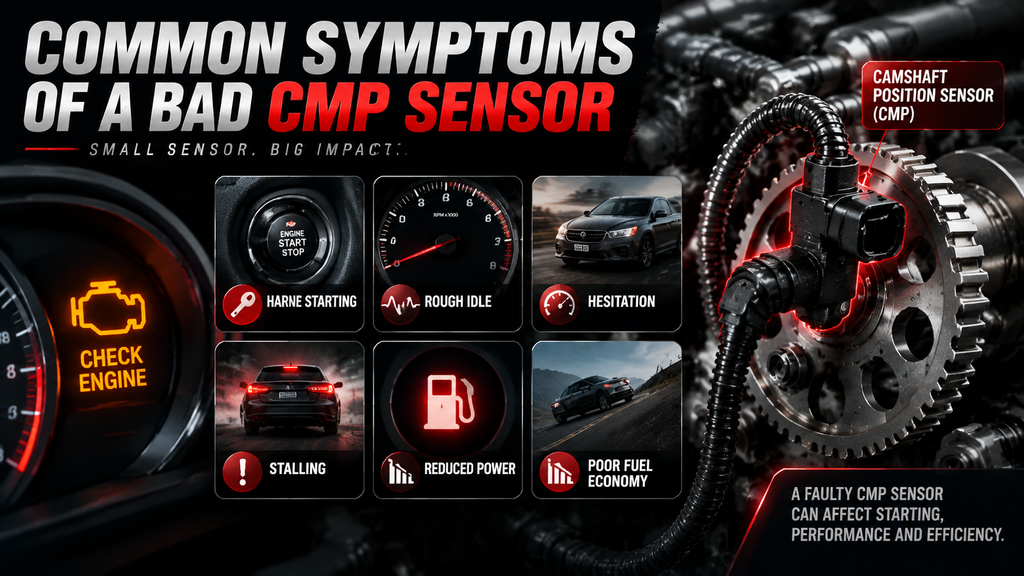
A CMP sensor fault can make an engine difficult to start or run poorly, but the same complaints can also come from ignition, fuel, wiring, crankshaft-sensor, VVT, or mechanical-timing problems. Treat these as diagnosis clues—not a parts list.
Symptoms that deserve diagnosis
- Check Engine Light with a camshaft-position or cam/crank correlation code.
- Long cranking, hard starting, or an intermittent no-start condition.
- Rough idle, hesitation, surging, misfires, or reduced power.
- Stalling that may be intermittent and followed by a restart.
- Poor fuel economy or a reduced-power / limp-mode message.
CMP sensor vs. crankshaft position sensor
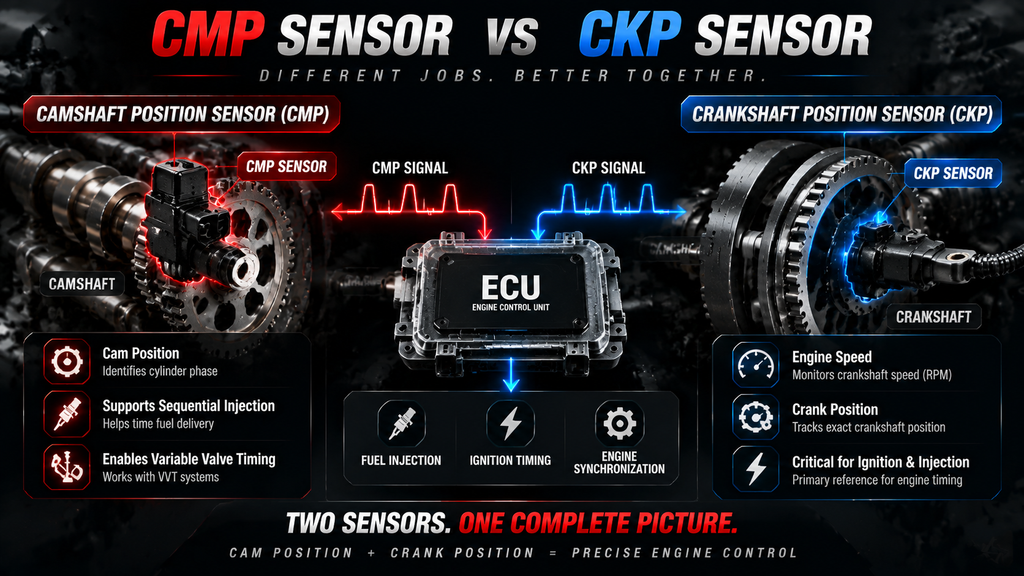
These sensors work as a pair. The crankshaft sensor tracks engine speed and crank position, while the camshaft sensor helps identify the correct phase of the engine cycle. This is why their symptoms and fault codes can overlap.
CMP
Camshaft position sensor
Reports camshaft position and cylinder phase. It supports sequential injection, ignition events, and variable valve timing strategies.
CKP
Crankshaft position sensor
Reports crankshaft speed and position. A crank-sensor failure often has a more immediate effect on spark, injection, and engine starting.
P0340 and P0341: what the codes can mean
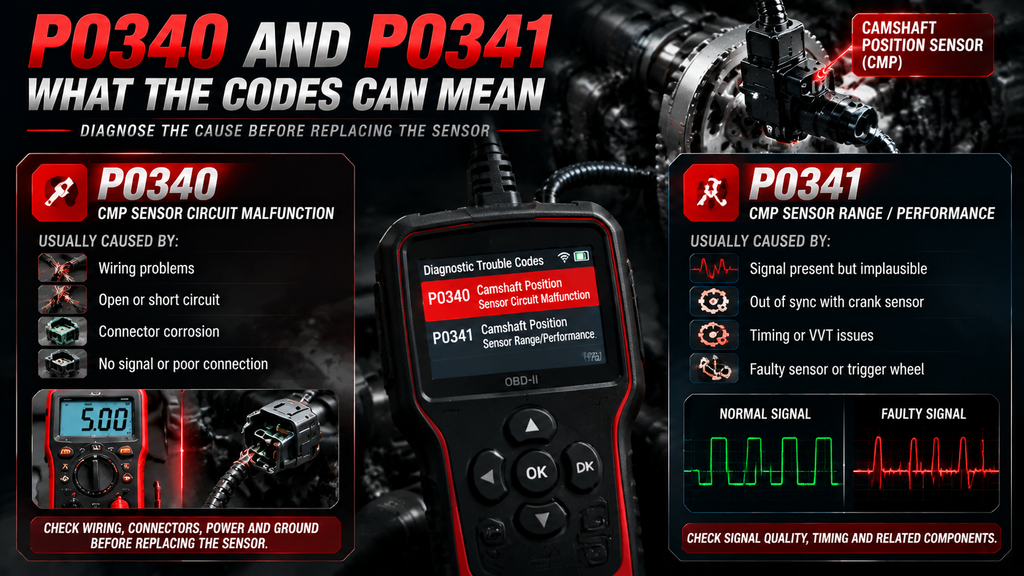
Generic code definitions are useful starting points, but sensor naming and location vary by manufacturer.
P0340
Circuit malfunction
This is primarily a circuit-fault code. Check the sensor, connector, supply voltage, ground, signal wire, and harness for opens, shorts, corrosion, or damaged terminals before replacing the sensor.
P0341
Range / performance
The signal is present but implausible or out of sync. Check signal quality, sensor seating, the target wheel, VVT operation, wiring interference, and mechanical valve timing.
How to test a camshaft position sensor
Always follow the manufacturer’s procedure and connector pinout for the exact vehicle. Supply voltage, resistance expectations, and waveform patterns vary by engine and sensor type.
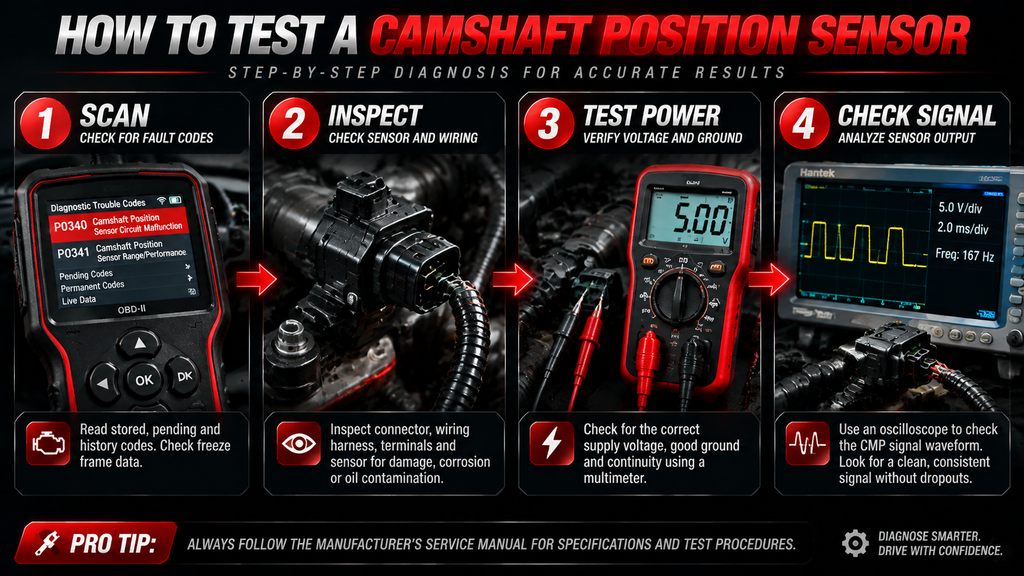
STEP 1
Scan for related faults
Read stored, pending, and history codes. Save freeze-frame data, then look for crankshaft-sensor, misfire, VVT, or cam/crank correlation codes that may explain the complaint.
STEP 2
Inspect the sensor and harness
With the ignition off, inspect connector locks, terminals, seals, and the harness where it bends near the sensor. Look for oil contamination, corrosion, chafed insulation, heat damage, or poor terminal fit.
STEP 3
Verify power, ground, and continuity
Use vehicle-specific wiring information. A three-wire Hall sensor commonly has a supply, ground, and digital signal wire; a two-wire magnetic sensor produces AC voltage while cranking or running.
STEP 4
Check the signal and timing clues
An oscilloscope is the best way to judge a fast-changing CMP signal. Watch for a clean waveform without dropouts, and compare cam and crank patterns when correlation or timing faults are present.
Should you replace the CMP sensor immediately?
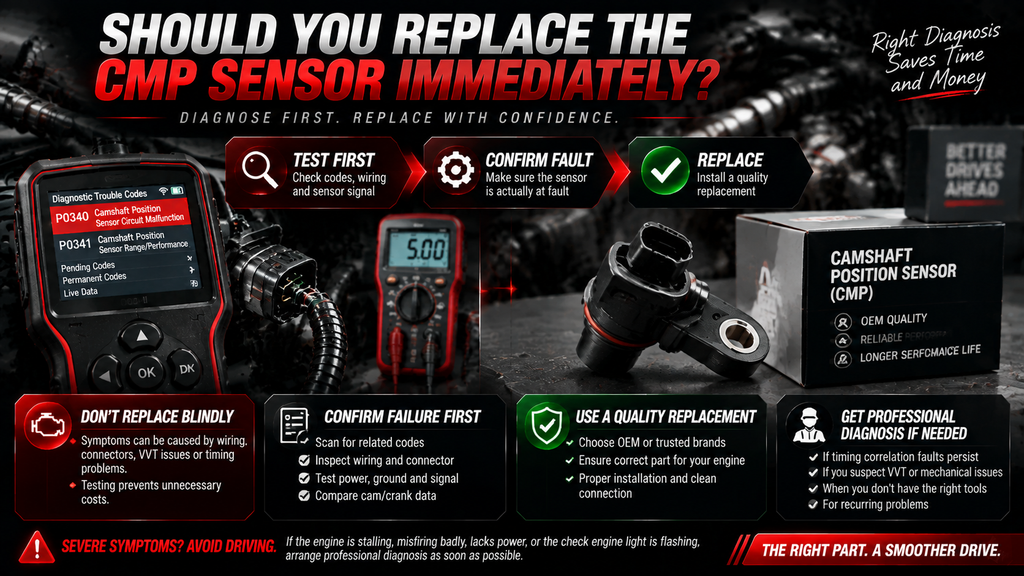
Replace the sensor when test results support a sensor failure and the connector, power, ground, and wiring are known to be sound. Use a quality part that matches the vehicle’s engine and sensor location.
Avoid driving if the engine stalls, misfires badly, lacks power, or the Check Engine Light is flashing. Arrange professional diagnosis if timing correlation faults persist or you suspect a stretched chain, slipped belt, VVT fault, or damaged trigger wheel.
When professional diagnosis is the better value
A technician with manufacturer-level scan data and an oscilloscope can compare cam and crank patterns, inspect timing correlation, and rule out expensive mechanical causes before you spend money on parts.
Camshaft position sensor FAQ
Can a bad CMP sensor prevent a car from starting?
It can. Some engines may crank for longer, start poorly, or fail to start when the CMP signal is missing. Other vehicles can estimate cam position from crankshaft information for a limited time.
Where is the camshaft position sensor located?
Location varies by engine. It may sit in the cylinder head, valve-cover area, timing-cover area, or near a camshaft housing. Some engines have more than one CMP sensor.
Can I test a CMP sensor with a multimeter?
A multimeter is useful for checking supply voltage, ground, and wiring continuity. For the most reliable signal diagnosis, use an oscilloscope and compare the waveform to the manufacturer specification.