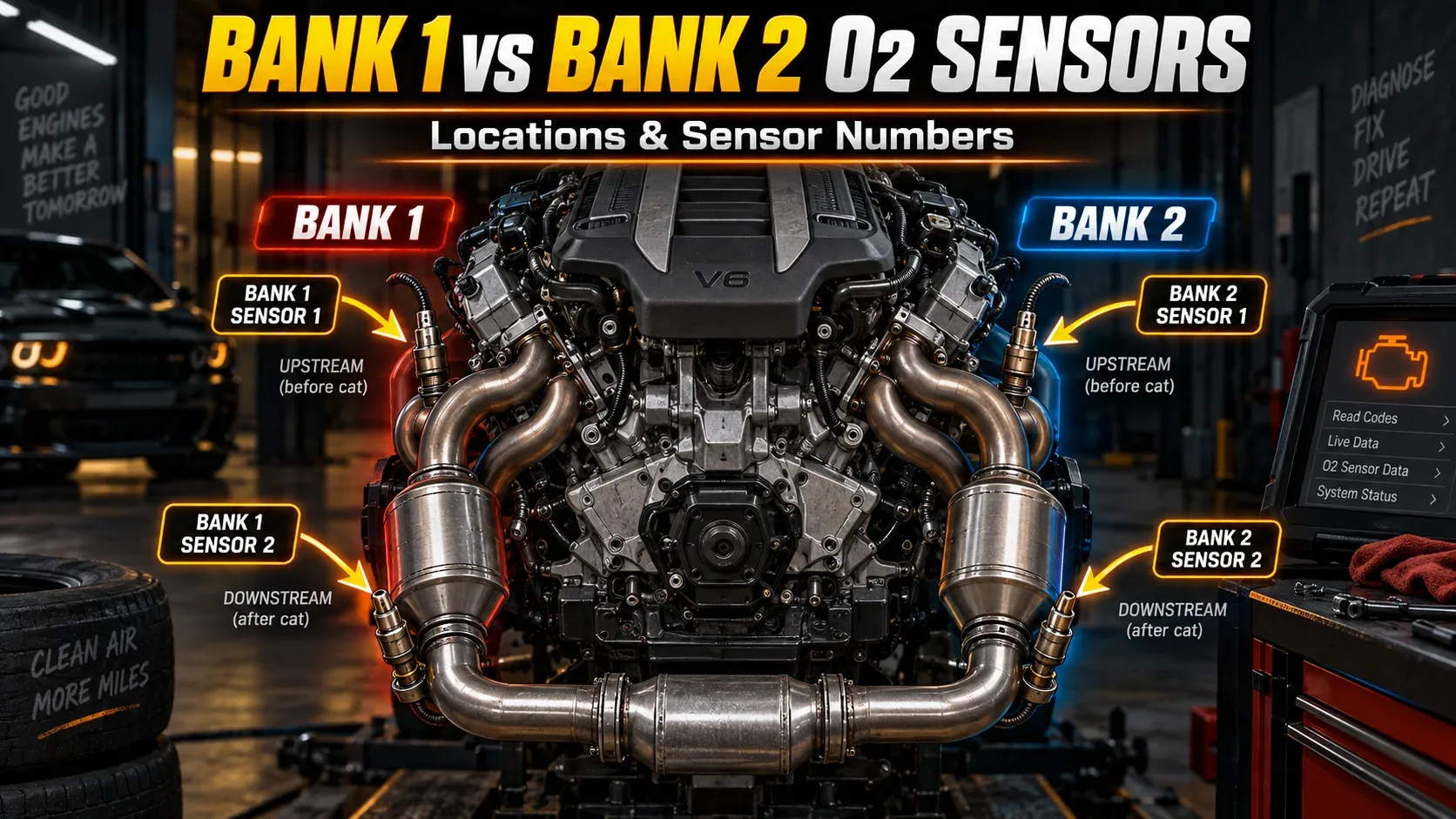

Bank 1 Sensor 1 is the first oxygen or air-fuel sensor in the exhaust path of the bank that contains cylinder No. 1. Learn how to find B1S1, B1S2, B2S1, and B2S2 before buying the wrong part.
Read the bank first. Then read the sensor number
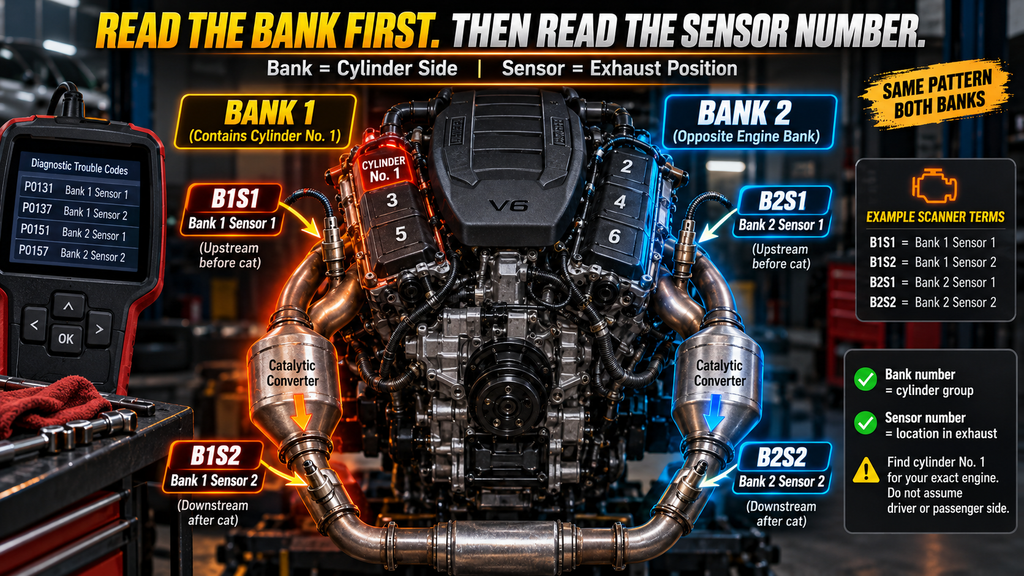
A scanner description is a location code, not a universal left-or-right instruction. Once you know which bank contains cylinder No. 1, follow that bank’s exhaust path from the engine toward the tailpipe.
Scanner language translated
| Scanner description | Typical meaning |
|---|---|
| Bank 1 Sensor 1 (B1S1) | The first, usually upstream, sensor on the bank containing cylinder No. 1. |
| Bank 1 Sensor 2 (B1S2) | Usually the downstream or post-catalyst sensor on the cylinder No. 1 bank. |
| Bank 2 Sensor 1 (B2S1) | The first, usually upstream, sensor on the opposite bank of a two-bank engine. |
| Bank 2 Sensor 2 (B2S2) | Usually the downstream or post-catalyst sensor on the opposite engine bank. |
Sensor 1 comes before the catalyst. Sensor 2 comes after it
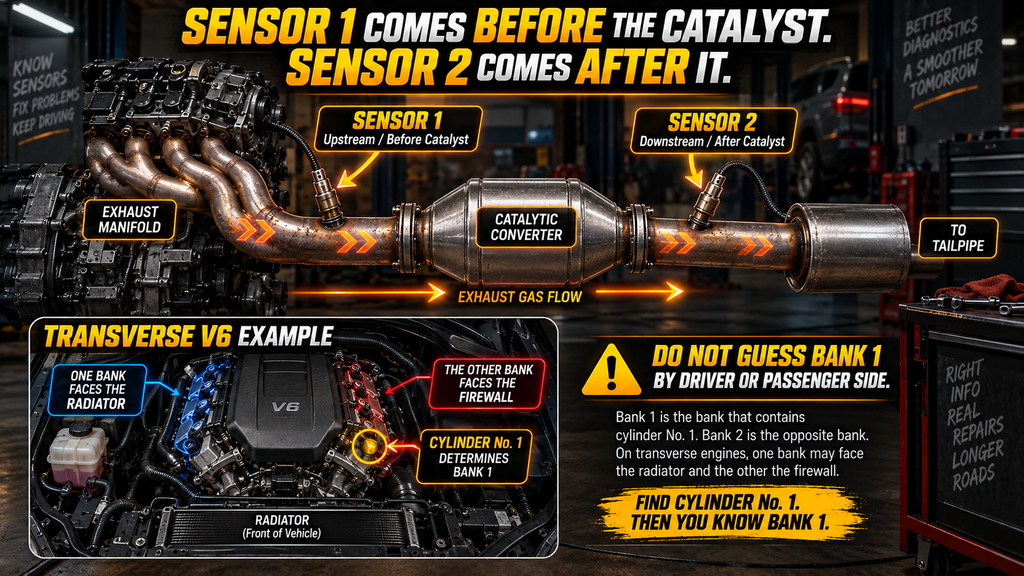
This is the usual OBD-II naming pattern. Some vehicles use more than two sensors per bank or route exhaust differently, so confirm your exact engine and catalyst layout before removal.
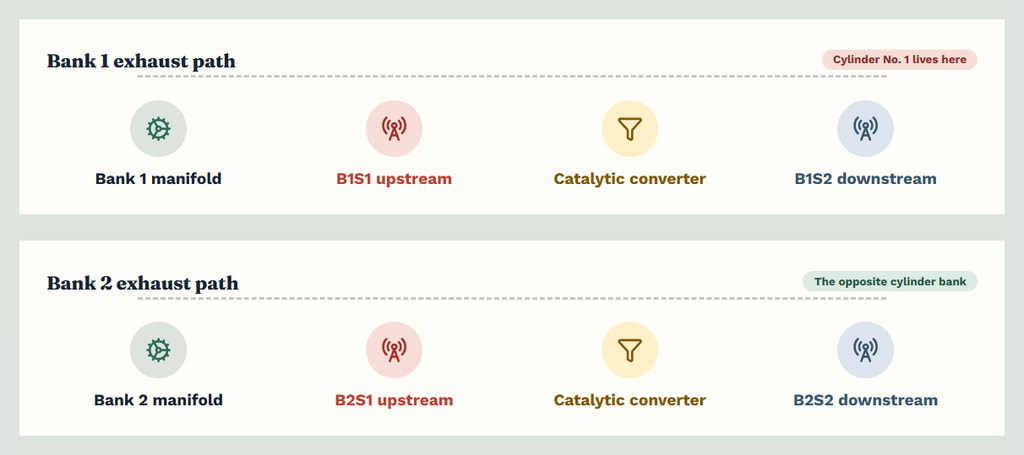
Do not guess the side of the engine.
On a transverse V-engine, one bank may face the radiator and the other the firewall. On a longitudinal engine, the banks may be left and right. Neither orientation tells you Bank 1 by itself—cylinder No. 1 does.
Use this four-step path before picking up a wrench
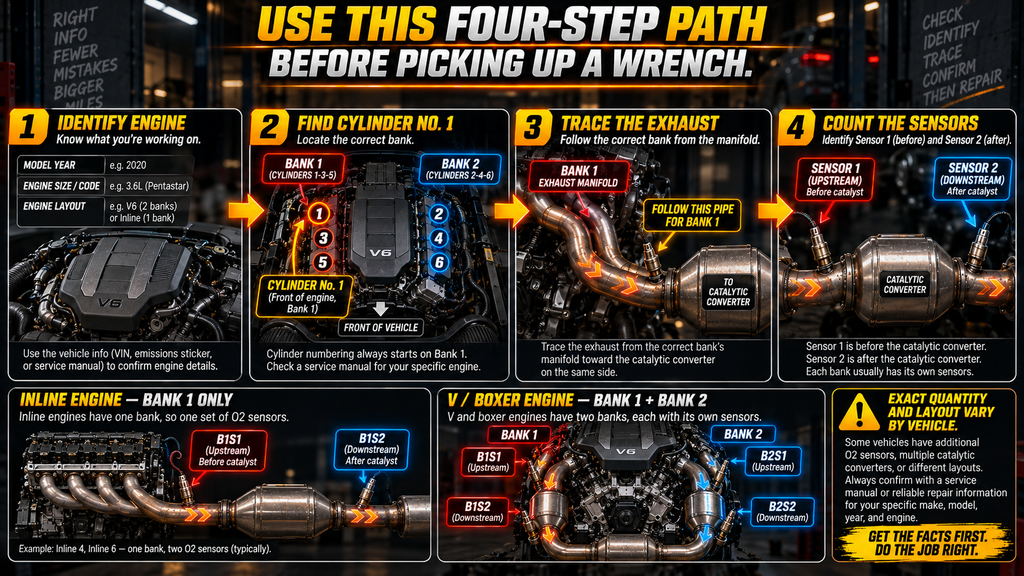
The safe workflow is cylinder No. 1 → correct bank → exhaust manifold → sensor order. It takes a little longer than guessing, but it can prevent an unnecessary part purchase and a difficult return job.
- Identify your exact engine.Confirm the model year, engine displacement or engine code, and whether the engine is inline, V-shaped, or horizontally opposed. Exhaust layouts can differ within the same vehicle nameplate.
- Find cylinder No. 1.Use the manufacturer’s service information, an engine diagram, or a reputable vehicle-specific repair manual. The bank containing cylinder No. 1 is Bank 1.
- Trace that bank’s exhaust path.Follow the exhaust manifold or header from the chosen cylinder bank toward its catalytic converter. The first threaded sensor you encounter is normally Sensor 1.
- Count sensors along the same path.After the catalyst, the next sensor on that same Bank 1 exhaust path is typically Bank 1 Sensor 2. Repeat the process for Bank 2 only if your engine has a second cylinder bank.
Inline-four and inline-six engines
Most inline engines have Bank 1 only.
A typical inline engine has one row of cylinders, so it has no Bank 2. It may still have an upstream B1S1 and a downstream B1S2, depending on the catalyst and exhaust design.
V6, V8, and boxer engines
Two cylinder banks can mean two exhaust paths.
These engines commonly use Bank 1 and Bank 2. Each bank may have its own upstream sensor, catalyst, and downstream sensor, though the exact number and placement depend on the vehicle’s emissions system.
Where to look for Bank 1 Sensor 1, Bank 1 Sensor 2, and Bank 2 Sensor 1
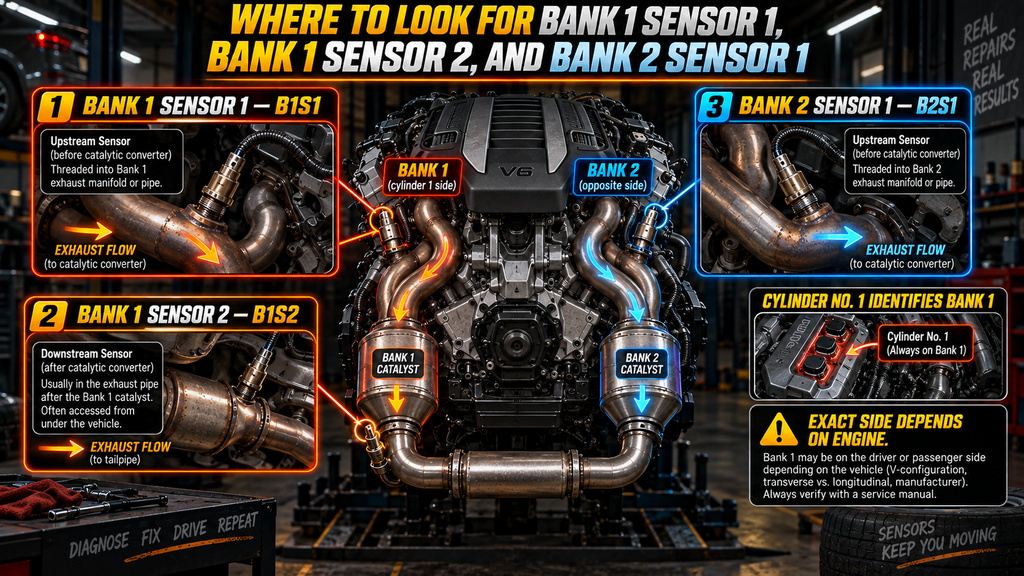
Bank 1 Sensor 1 location
Look on the exhaust manifold, header, or pipe before the Bank 1 catalytic converter. It is the first sensor in the exhaust stream from the bank containing cylinder No. 1.
Bank 1 Sensor 2 location
Follow the Bank 1 exhaust past its catalytic converter. The sensor after that converter is typically B1S2. It may be accessible from above, below, or through a wheel-well opening.
Bank 2 Sensor 1 location
First find which side of your exact engine is Bank 2. Then look before that bank’s catalyst for the first sensor in the exhaust path. It is not automatically the driver-side or passenger-side sensor.
A sensor code points to a location. It does not automatically condemn the sensor
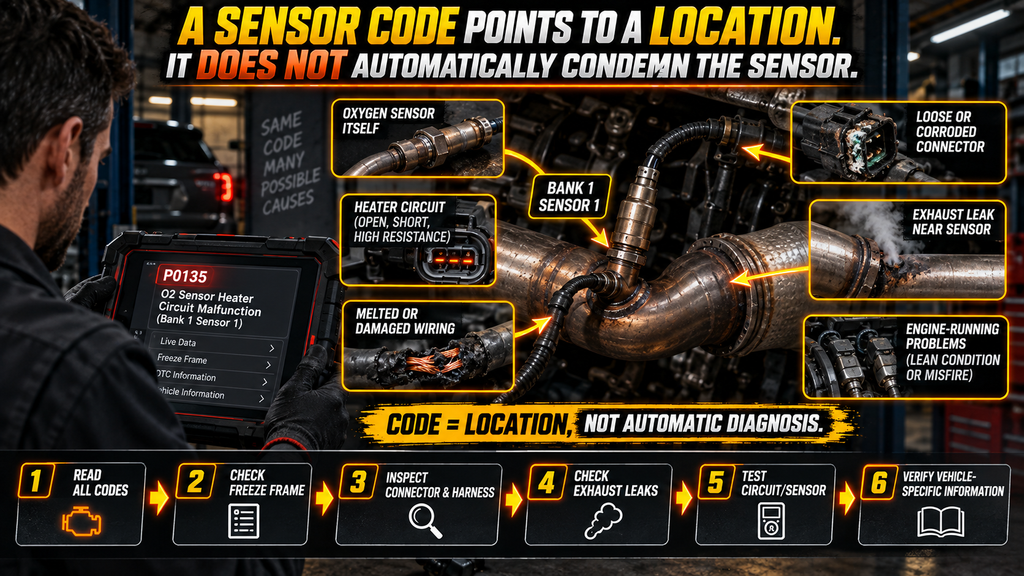
Codes such as P0031 or P2237 can identify Bank 1 Sensor 1 circuitry, but the cause can involve the sensor, its heater circuit, the connector, damaged wiring, exhaust leaks, or an engine-running condition. Read the full code definition for your vehicle.
Treat the DTC as a starting point.
Write down all stored and pending codes, plus freeze-frame data if your scan tool provides it. A lean-condition, misfire, catalyst-efficiency, or heater-circuit code may require a different test path than a basic sensor-response code.
Inspect the connector and harness first.
With the exhaust cool, inspect for melted insulation, rubbed-through wiring, loose connectors, corrosion, and exhaust leaks near the sensor. Compare connector shape and wire routing with the replacement part before disconnecting anything.
Use vehicle-specific information for the final check.
OEM service information, manufacturer wiring diagrams, and reputable repair manuals are the authority for your make, model, year, engine, and exhaust package. Generic diagrams teach the naming convention; they do not replace a model-specific location chart.
Bank 1 and Bank 2 sensor FAQ
Is Bank 1 Sensor 1 always upstream?
In the normal OBD-II naming convention, Sensor 1 is the first sensor along that bank’s exhaust path and is usually upstream of the catalytic converter. Confirm the layout when a vehicle uses unusual exhaust routing or multiple catalysts.
Does Bank 1 mean driver side or passenger side?
No. Bank 1 is the bank with cylinder No. 1. Depending on engine design and mounting direction, that bank can be on either side, toward the radiator, or toward the firewall. Verify cylinder numbering for your exact engine.
Why does my inline-four scanner mention only Bank 1?
An inline-four normally has one cylinder bank, so it is Bank 1. It can still use Sensor 1 and Sensor 2 when the vehicle has upstream and downstream sensors around a catalytic converter.
Can I replace an O2 sensor without testing it?
You can physically replace one, but replacement is best based on a confirmed diagnosis. A location-specific code may result from wiring damage, a connector problem, heater-circuit fault, exhaust leak, or fueling issue rather than a failed sensor element.