What is rack and pinion steering?
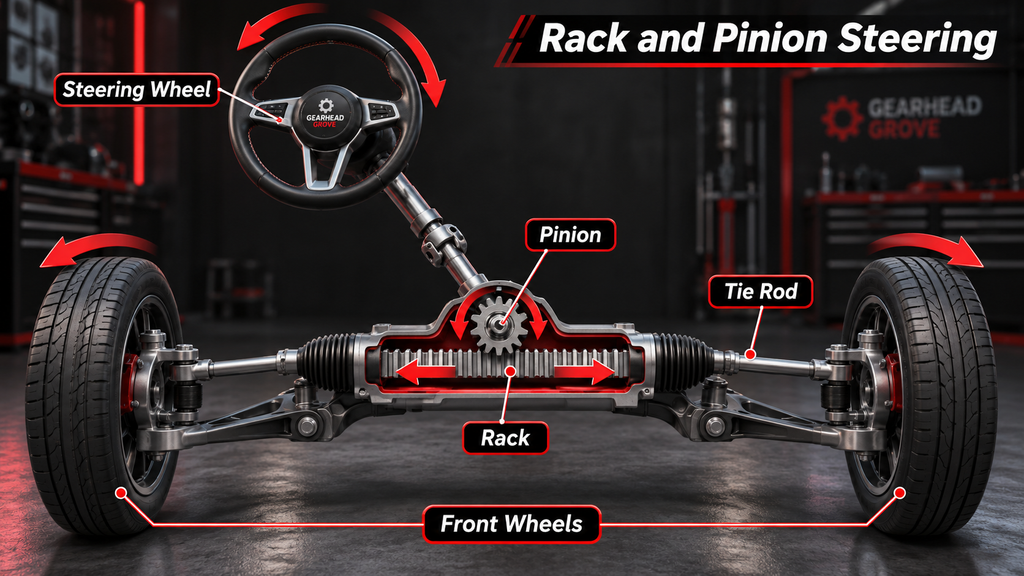
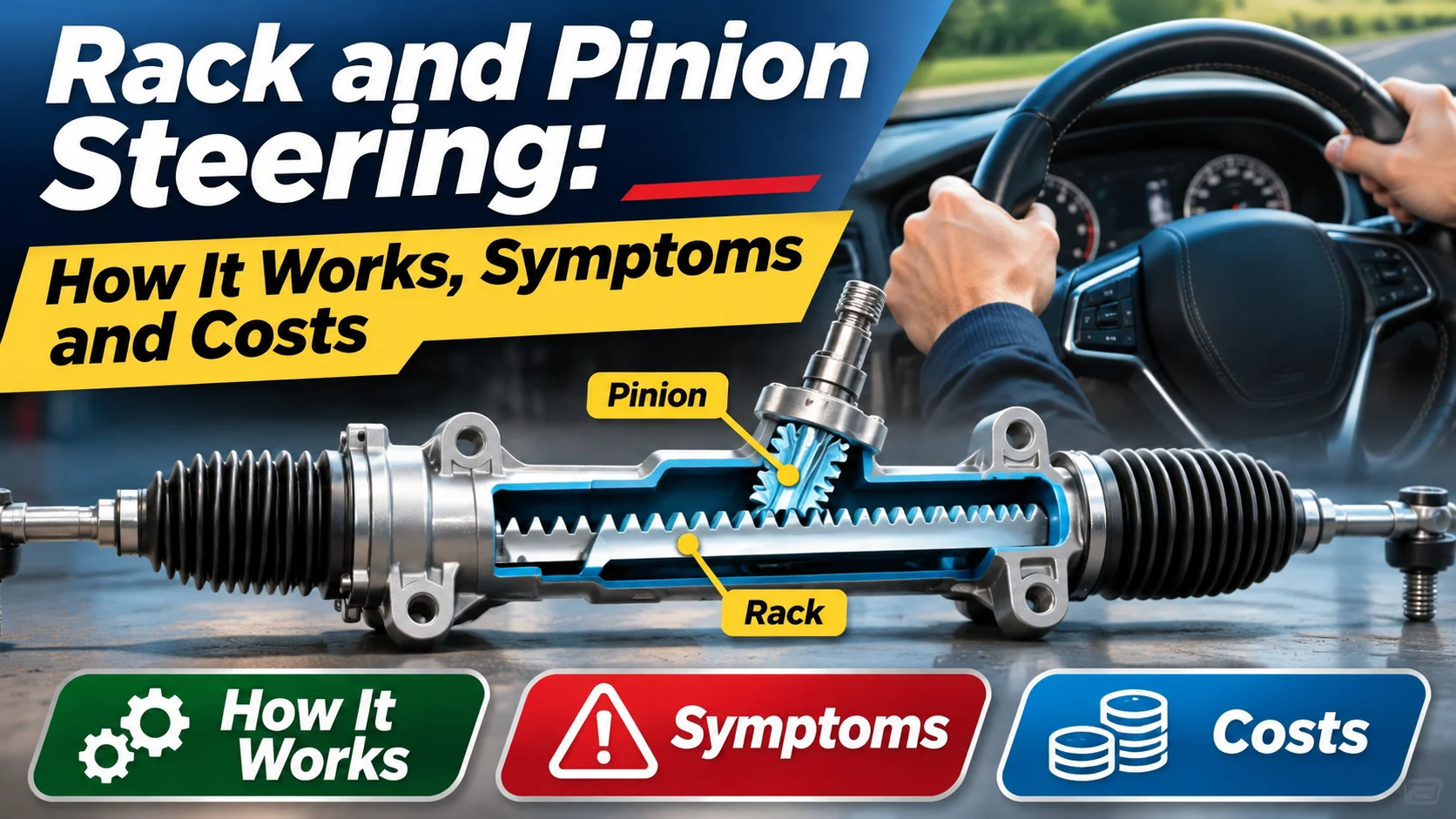
Rack and pinion steering turns the steering wheel’s rotation into side-to-side movement that points the front road wheels. The pinion is a small round gear. It meshes with teeth on a straight bar called the rack.
The rack connects to the wheels through tie rods. Many vehicles add power assistance to make turning easier, but the basic gear-and-rack action is the same. The term “steering rack” may refer to the rack itself or the larger assembly, depending on context.
How does rack and pinion steering work?
Think of it as a change from a turning motion to a sideways push or pull:
Simplified steering path
Steering wheel & shaft→Pinion gear→Toothed rack→Inner & outer tie rods→Road wheels
This is a motion diagram, not a vehicle-specific parts layout. Power assistance helps the driver turn but does not replace the mechanical path shown here.
- You turn the steering wheel. The steering shaft carries that rotation toward the pinion.
- The pinion rotates against the rack’s teeth. As the gear turns, it moves the rack left or right inside its housing.
- The tie rods move with the rack. Inner tie rods connect to the rack; outer tie-rod ends connect to the steering knuckles.
- The road wheels change direction. The knuckles pivot, pointing the wheels for the turn.
Main parts of the steering system
Steering wheel & shaft
Carry the driver’s turning input toward the steering gear.
Pinion
A round gear that engages the rack’s teeth and drives its sideways movement.
Rack & housing
The toothed bar moves inside a housing that supports and protects the assembly.
Inner & outer tie rods
Link the rack to the steering knuckles while allowing the suspension and wheels to move.
Rack boots
Flexible covers that help keep water and grit away from the inner joints and rack ends.
Power-assistance system
Depending on the vehicle, a hydraulic system, electric motor, or both reduce steering effort.
The exact layout and serviceable parts vary by make, model, and year.
Manual, hydraulic, electric, and electro-hydraulic steering
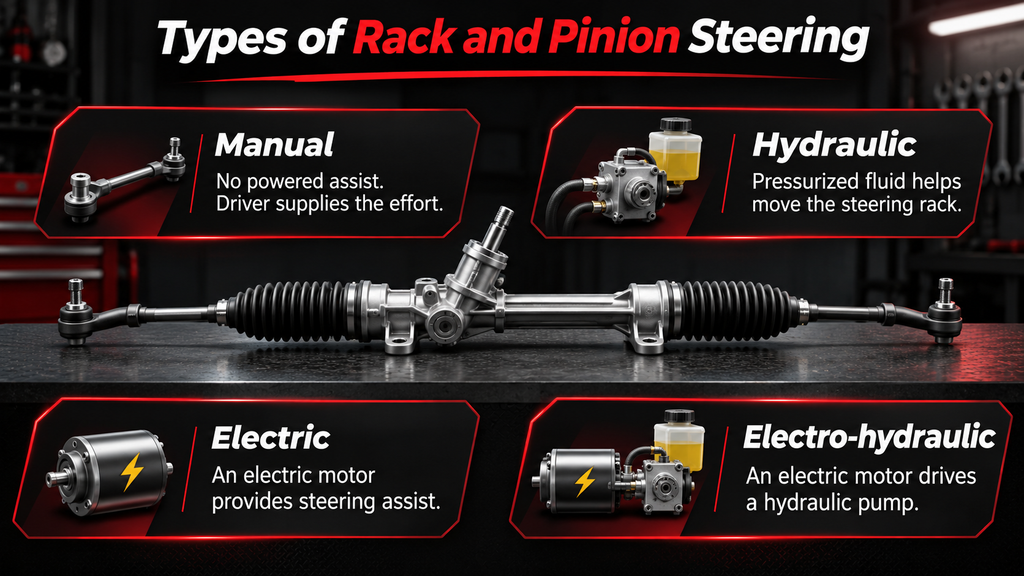
Manual
There is no powered assist. The driver supplies the steering effort through the mechanical linkage.
Hydraulic power-assisted
A pump supplies pressurized fluid to help move a power steering rack. It has fluid lines and seals that can leak.
Electric power-assisted
An electric motor adds help based on system inputs. An electric power steering rack may have its motor on the rack, while other designs place assist elsewhere. These systems do not use hydraulic power-steering fluid.
Electro-hydraulic
An electric motor drives a hydraulic pump. The steering assist still uses fluid, even though the pump is electrically powered.
Check the owner’s manual or manufacturer information before looking for a fluid reservoir or assuming a warning light means a particular part failed.
Bad rack and pinion symptoms—and other possible causes
These are reasons to investigate, not proof of rack failure. Note when each symptom happens and whether it is getting worse.
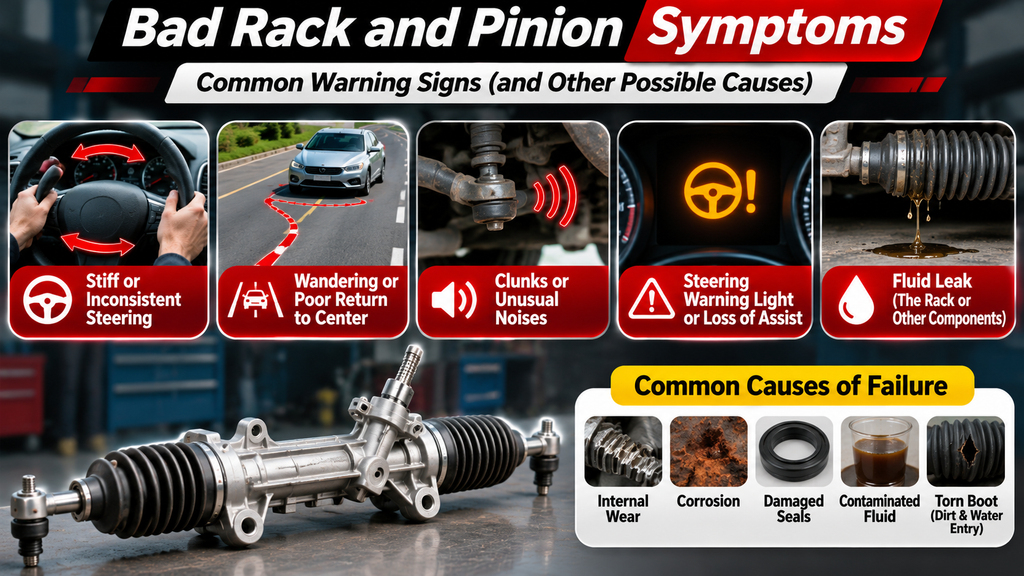
Stiff or inconsistent steering; binding or catching
Assist failure, low hydraulic fluid, a pump or belt issue, electrical faults, a steering shaft problem, or mechanical damage may be involved. Binding or catching is urgent.
Wandering, poor return to center, or excessive play
Tire pressure and condition, alignment, tie rods, suspension, steering shaft joints, or rack wear can affect how the car tracks.
Clunks or unusual whining, groaning, or knocking
Noise may come from tie rods, suspension joints, rack mounts, a hydraulic pump, or other components. Sound alone cannot locate the fault.
Steering warning light or loss of assist
Electrical power, sensors, wiring, or control modules may be at fault in an electric system; a warning does not automatically condemn the rack.
Fluid beneath the vehicle or around a boot
A rack and pinion leak is possible on a hydraulic system, but hoses, fittings, and other vehicle fluids can look similar. An electric-only steering system has no hydraulic steering fluid to leak.
What causes rack and pinion failure?
Internal wear, corrosion, damaged seals, and contaminated hydraulic fluid can contribute to rack problems. A torn boot may let water and grit reach the rack ends and inner joints; a curb or pothole impact may damage steering components.
These are possible causes, not a diagnosis. A technician should identify the failed part and the reason it failed before recommending a new rack.
How to diagnose rack and pinion problems
Your preliminary check: Park safely. Note dashboard warnings, when the steering feels different, and whether you see fresh fluid beneath the vehicle. Check tire pressure and visible tire damage using the vehicle’s specified guidance. If the car has hydraulic steering, consult the owner’s manual for the correct fluid-check procedure. Do not reach under an unsupported vehicle or touch moving components.
A qualified inspection can separate a rack fault from nearby steering and suspension faults. Image is illustrative.
A professional diagnosis: A qualified technician can review the complaint, inspect tires and related joints, check for looseness or damage, locate any leak, and test the assist system using the manufacturer’s procedure. Depending on the design, that may include hydraulic checks or electrical fault-code and circuit checks. Ask which finding points to the rack rather than a tie rod, hose, pump, sensor, wiring, or control module.
Diagnosis before parts: A heavy steering wheel, clunk, or wet spot is a clue. Replacing the rack without confirming the source may leave the real problem unsolved.
Can you drive with a suspected bad rack and pinion?

Do not keep driving if steering binds, catches, has substantial play, feels unpredictable, or requires more effort than you can safely control. The same applies to a major hydraulic leak or a steering component that may be loose or damaged. Stop in a safe place and arrange a tow rather than testing it on the road.
If power assistance suddenly fails while driving, slow down and stop safely. Steering may still be mechanically connected, but it can require much more effort. Follow your vehicle manual and obtain immediate inspection before driving again.
For a milder new symptom with otherwise predictable steering, do not assume it is harmless. Arrange a prompt qualified inspection and follow vehicle-specific guidance. An article cannot determine whether your particular car is safe to drive.
Rack and pinion replacement cost in 2026
RepairPal’s national estimate, updated September 3, 2026, is $2,307–$2,572 for rack and pinion replacement. Its estimated parts portion is $1,770–$1,784 and labor is $537–$787. These figures exclude taxes and fees and may not include related repairs.
Vehicle examples show why a national range is not a quote: RepairPal lists $1,401–$1,640 for a Toyota Corolla and $3,224–$3,488 for a Honda CR-V. Your actual rack and pinion replacement cost can differ by vehicle, part choice, labor rate, location, taxes, fees, and additional work.
Compare written estimates line by line. Ask whether the price includes diagnosis, tie rods or other steering work, alignment, hydraulic fluid and bleeding where applicable, or programming and calibration where required. These may be included, excluded, or not needed for your vehicle.
Request the exact part being replaced, the reason it failed, and the warranty terms. A vehicle-specific estimate is more useful than a national average.
Can a rack be repaired instead of replaced?
Sometimes a separate problem—such as a hose, fitting, tie rod, boot, mount, or electrical issue—can be fixed without replacing the rack assembly. Some rack designs can be rebuilt or serviced by a capable specialist. Other designs, damage, or parts shortages make replacement the practical choice.
Confirm the failed component first. Repairability depends on the design, the location and extent of damage, available parts, and the technician’s capability. Ask whether the proposed part is new, remanufactured, or used, and whether alignment or calibration is needed afterward. Do not treat a leak or clunk alone as a replacement order.
How long does a steering rack last?
There is no universal mileage or guaranteed lifespan for a rack and pinion. Design, road conditions, impacts, corrosion, boot condition, fluid care where applicable, and the condition of related parts all matter. A rack may serve for years without trouble, while another needs attention sooner.
Use the manufacturer’s maintenance guidance and address new steering changes promptly rather than replacing a rack at an invented mileage interval.
Practical ways to protect the steering system
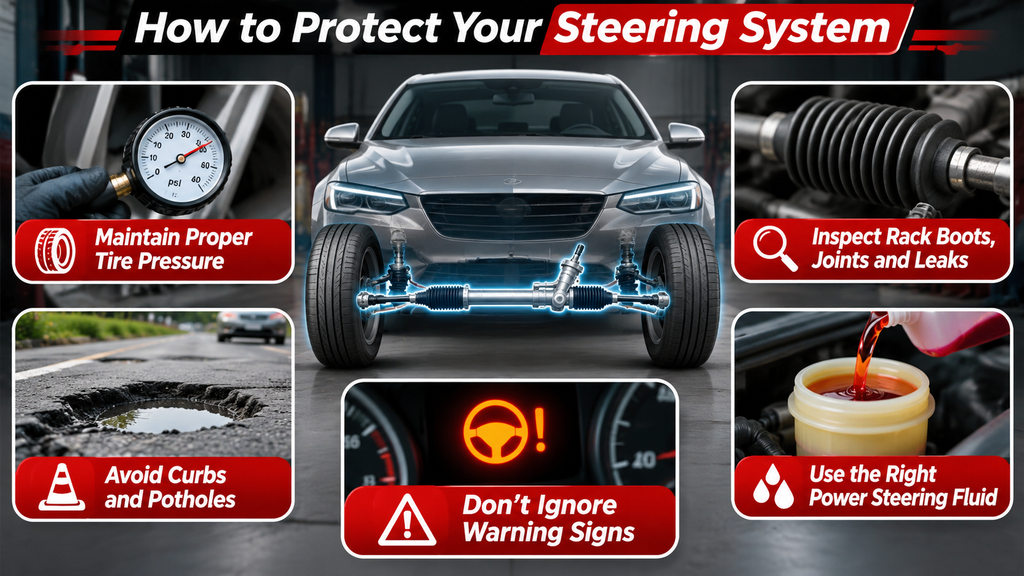
- Keep tires at the vehicle’s specified pressure and address uneven wear or alignment concerns.
- Avoid striking curbs and deep potholes when it is safe to do so; have the steering checked after a significant impact.
- Have torn rack boots, loose joints, and leaks inspected before dirt or fluid loss causes further damage.
- For hydraulic systems, use only the specified fluid and follow the manufacturer’s service instructions. Do not assume an electric system needs steering fluid.
- Do not ignore a new warning light, unusual effort, or a change in steering feel.
Used-car steering test-drive checklist
- Before driving, check tire condition and look for obvious fluid spots or damaged boots you can see safely.
- At low speed, notice whether steering effort is smooth and consistent in both directions.
- On a safe road, notice wandering, excessive play, clunks, pulling, or a wheel that does not return as expected.
- Check for steering-system warning lights and ask about past repairs, alignment, and service records.
- Do not perform abrupt or risky maneuvers to “test” a fault. If steering feels unsafe, end the drive.
A short drive cannot prove the rack is healthy. Arrange an independent pre-purchase inspection by a qualified technician if you have concerns.
Rack and pinion FAQ
What does “rack and pinion” mean?
A pinion is a round gear. It turns against a toothed straight bar, the rack, to change steering-wheel rotation into side-to-side movement.
Can a bad rack and pinion cause clunking?
Yes, a worn or loose part of the assembly may clunk. Tie rods, mounts, suspension joints, and other parts can also make similar noises, so have the source checked.
Does every steering rack use fluid?
No. Hydraulic and electro-hydraulic assist systems use fluid. Electric-only assist does not use hydraulic power-steering fluid, and a manual rack has no powered assist.
Does a leak always mean the rack has failed?
No. A hydraulic hose, fitting, pump, or another vehicle system may be leaking. Have the fluid and exact source identified before approving rack replacement.
Can I drive with a bad rack and pinion?
Do not drive if steering binds, catches, has substantial play, feels unpredictable, demands unsafe effort, or a component may be loose or damaged. Stop safely and arrange a tow. Any new steering concern deserves prompt inspection.
What is included in rack replacement?
It depends on the vehicle and written estimate. Ask about the assembly and tie rods, diagnosis, alignment, hydraulic fluid or bleeding, and any programming or calibration. Some items may be separate or unnecessary.
Can the rack be repaired instead of replaced?
Possibly. A separate hose or tie-rod fault may be repairable, and some racks can be rebuilt. Design, damage, parts availability, and technician capability determine the options.When should I seek a second estimate?