You move the shifter, release the clutch, and the car goes. But what actually happens between the engine and the wheels? This guide makes the mechanics understandable—and helps you care for the car without guessing at a diagnosis.
The short answer:
A manual transmission lets the driver choose a gear ratio, changing how engine speed and turning force are delivered to the drive wheels.
What does a manual transmission do?
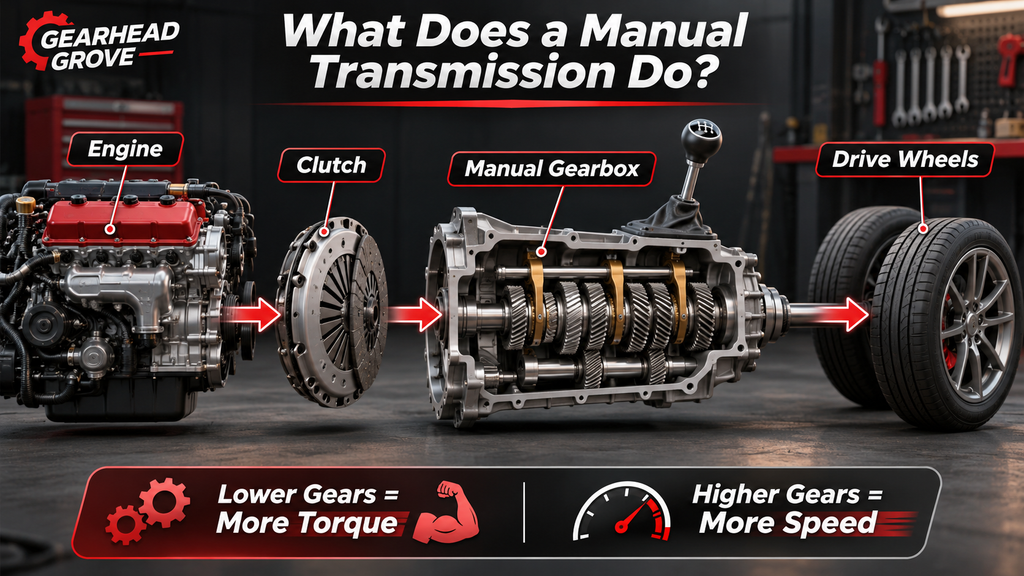
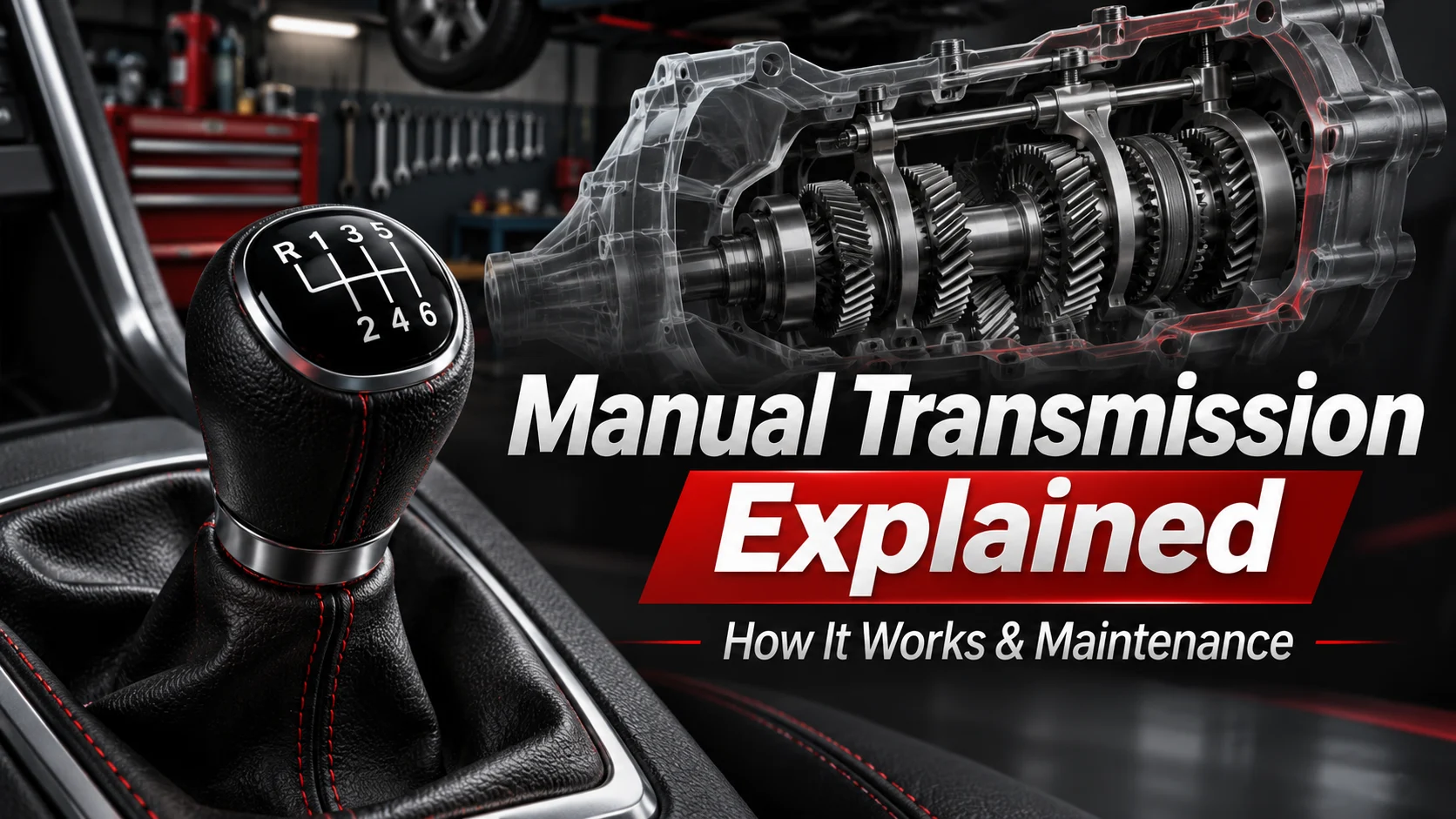
A manual transmission, also called a manual gearbox, gives the driver control over which gear carries power from the engine toward the wheels. Its different gears trade wheel speed for turning force, or torque. Lower gears help the car start moving and climb; higher gears let it travel faster without requiring the engine to spin as quickly.
Most manual cars also have a clutch pedal. The clutch connects or disconnects the spinning engine from the transmission so you can start smoothly and change gears.
How engine power reaches the wheels
Think of the drivetrain as a chain of connections. The exact layout differs between front-, rear-, and all-wheel-drive vehicles, but the basic job is the same:
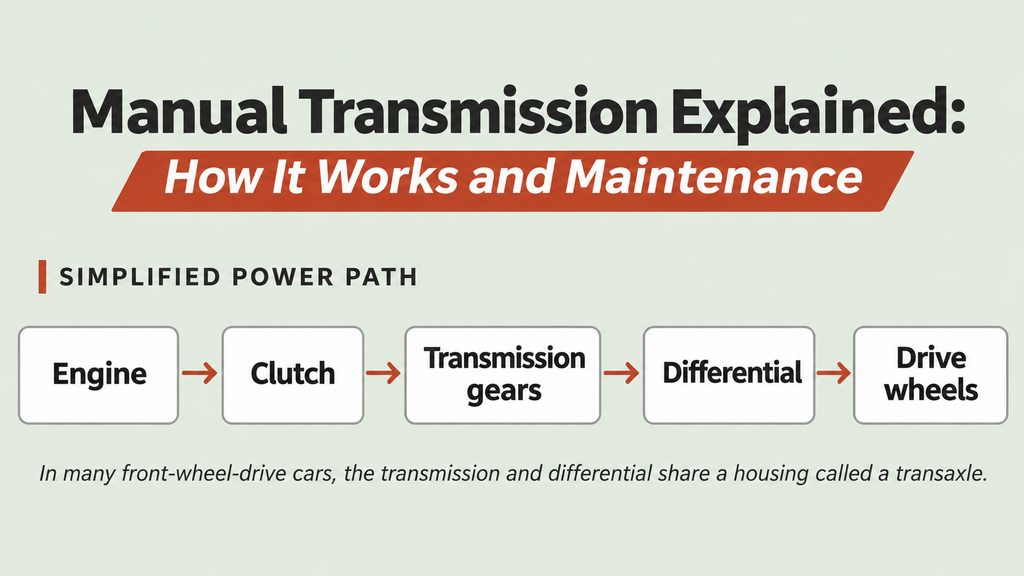
- The engine turns. Its crankshaft produces rotation.
- The engaged clutch passes that rotation on. With your foot off the pedal, the clutch normally grips and sends power into the transmission.
- The selected gear changes the relationship between engine and output speed. Meshing gears carry power through the gearbox at the chosen ratio.
- The output drives the wheels. Power travels through the rest of the drivetrain, including the differential, which allows left and right drive wheels to rotate at different speeds when turning.
The main parts, in plain English
Clutch
A friction connection between engine and gearbox. Pressing its pedal releases that connection so a shift can happen.
Synchronizers
Devices that help match the speeds of parts about to engage, making many modern manual shifts smoother.
Input shaft
The shaft that receives rotation from the engine through the clutch.
Selector mechanism
The shifter, linkage or cables, and internal forks that move the appropriate gear-engaging parts.
Gears
Different-sized gear pairs provide different ratios for starting, accelerating, climbing, and cruising.
Output shaft & differential
The output shaft sends power onward; the differential divides it between drive wheels while allowing different wheel speeds in turns.
Gearbox designs vary. These are the main jobs to recognize, not a parts diagram for every vehicle.
What happens when you press the clutch and shift?
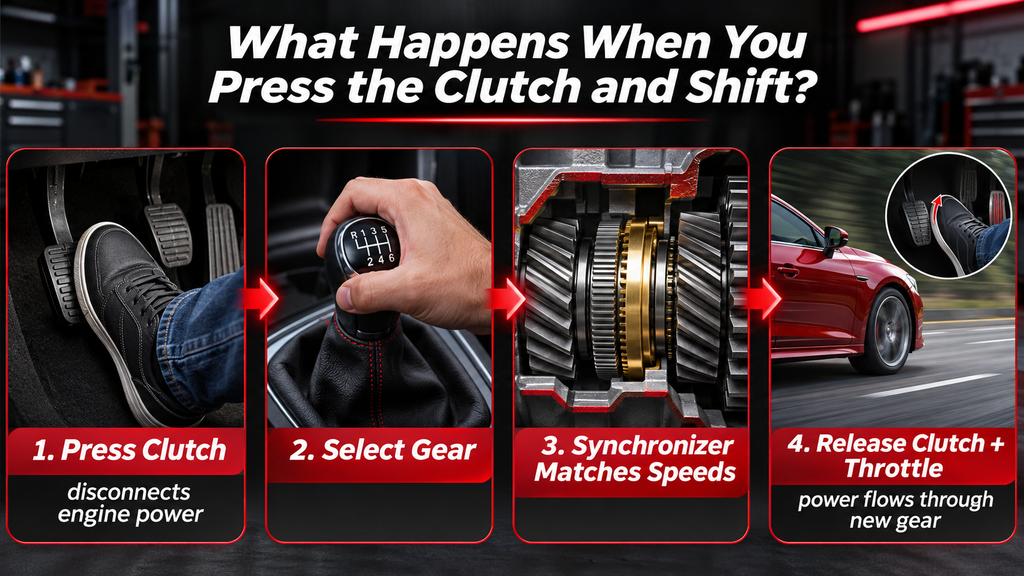
- Ease off the accelerator and press the clutch pedal. The clutch releases its grip, interrupting most engine power to the gearbox.
- Move the shifter to the next gear. The selector mechanism moves the internal engagement parts toward your chosen gear.
- The synchronizer helps match speeds. On a typical synchronized forward gear, it helps the parts reach compatible speeds before they lock together. Reverse and some older designs may work differently.
- Release the clutch smoothly while adding appropriate throttle. The engine and transmission reconnect, and power flows through the newly selected ratio.
Practical example: When moving off from a stop, first gear gives the wheels more turning force at a low road speed. As the car speeds up, shifting into a higher gear allows a more suitable relationship between engine speed and road speed.
Gear ratios without the math headache
A gear ratio describes how many times an input turns relative to an output. In a lower gear, the engine can turn several times for one output turn. That multiplies turning force at the expense of road speed. In a higher gear, the output turns more per engine revolution, which suits cruising but provides less torque multiplication.
Imagine riding a bicycle: an easy gear helps you start up a hill, while a harder gear makes more sense once you are rolling on level ground. A car’s gearbox works on the same trade-off. The best gear depends on speed, load, road grade, and the vehicle’s engine—not just the number on the shifter.
Manual vs. automatic: a balanced comparison
Manual
You choose gears and operate the clutch. Many drivers enjoy the direct involvement and control, but stop-and-go traffic and hill starts take more practice. Clutch components can wear and need service.
Automatic
The vehicle handles gear changes for you, which is convenient in traffic. Designs vary widely, and modern automatics can be efficient and quick. They still need maintenance according to their own specifications.
Neither type is universally more reliable, cheaper to own, or more fuel-efficient. Vehicle design, condition, use, and maintenance matter more than a broad label.
What maintenance does a manual transmission need?
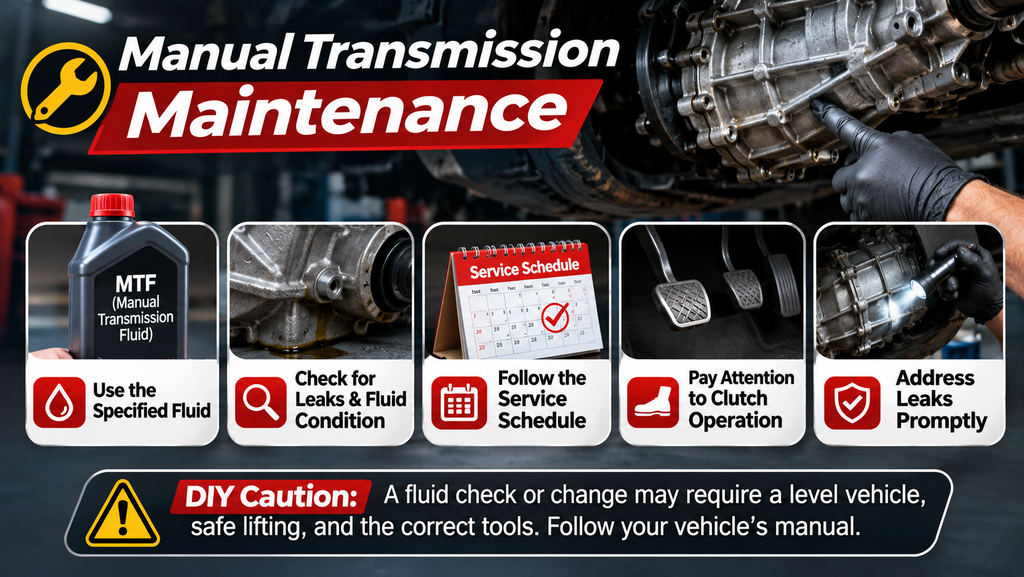
Start with your owner’s manual and manufacturer service information. Fluid specifications, checking procedures, and service intervals vary by vehicle and transmission. Do not assume that any product labeled “gear oil” is suitable: viscosity and additive requirements matter, and the wrong fluid may affect shifting or component life
Inspection and service procedures depend on the vehicle’s drivetrain and manufacturer guidance.
- Use the specified fluid. Match the manufacturer’s exact fluid specification, not only a familiar brand or a general viscosity number.
- Check for leaks and fluid condition as directed. Look for fresh wetness beneath the car or around the transmission and axle seals. Some vehicles have no simple dipstick; follow the specified level-check procedure rather than guessing.
- Follow the applicable service schedule. Replacement timing can change with vehicle model and driving conditions. If records are missing, consult the manual or a qualified mechanic about an appropriate inspection or service.
- Pay attention to clutch operation. The clutch and its hydraulic or cable controls may require separate checks or service. Consult the vehicle’s maintenance guidance.
- Address leaks promptly. Low fluid can damage components. Have a suspected leak located and repaired instead of repeatedly topping off without finding its source.
DIY caution: A fluid check or change may require a level vehicle, safe lifting equipment, a particular fill procedure, and the correct fluid. If you cannot verify those requirements, ask a qualified mechanic.
Which symptoms call for an inspection?
Symptoms are clues, not proof of one failed part. Their timing, road speed, engine speed, temperature, and whether the clutch is pressed can help a qualified mechanic narrow down the cause.
Grinding during a shift
Could involve shifting technique, incomplete clutch release, a synchronizer, or another issue. Repeated grinding deserves inspection.
Hard or inconsistent shifting
Possible contributors include clutch operation, linkage adjustment, fluid suitability or level, and internal wear. Don’t force the shifter.
New whining, humming, or rattling
Different noises can come from the transmission, clutch-related parts, or elsewhere in the drivetrain. Note when the sound occurs.
Fresh fluid under the vehicle
A leak may come from a transmission seal, another drivetrain component, or a different vehicle system. Have the source and fluid level checked.
Engine revs rise without matching acceleration
This can suggest clutch slip, though proper inspection is needed to confirm the cause.
If a gear will not engage, the car behaves unpredictably, a leak is substantial, or a noise is severe, stop driving when safe and arrange professional assessment. Continuing to drive may worsen damage or create a safety risk.
Common mistakes—and what helps instead
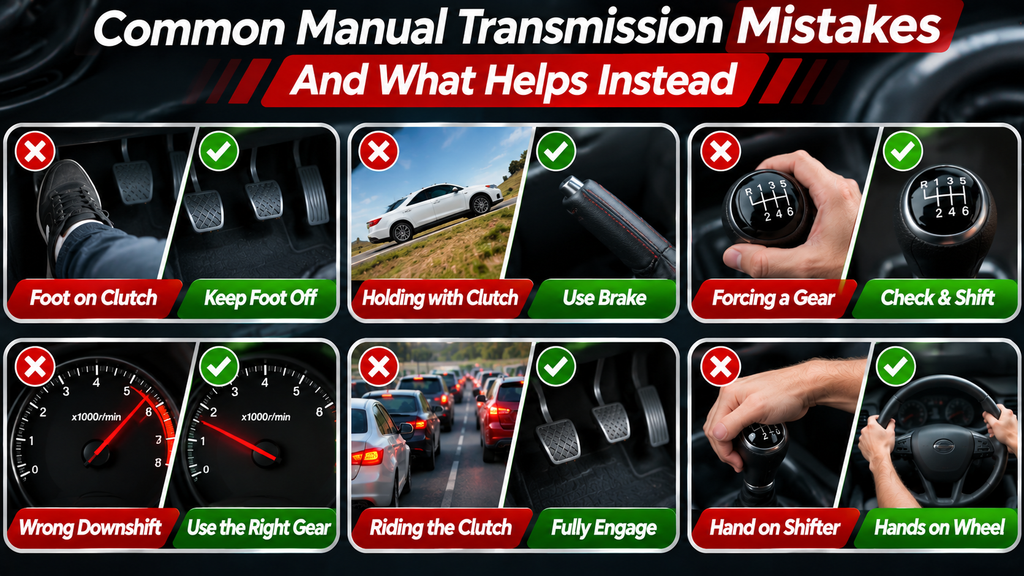
- Resting a foot on the clutch pedal: Keep your foot off it between shifts so the clutch can stay fully engaged.
- Holding the car on a hill with the clutch: Use the brake or parking brake instead of deliberately slipping the clutch for an extended time.
- Forcing a reluctant gear: Pause and investigate recurring resistance rather than pushing harder.
- Downshifting into an unsuitable gear: Choose a gear appropriate for road speed; an overly aggressive downshift can over-rev the engine.
- Riding the clutch in traffic: Avoid prolonged partial engagement when you can safely stop or move with the clutch fully engaged.
- Using the shifter as a hand rest: Keep your hand on the wheel except when selecting a gear.
What affects service life?
Driving habits, fluid condition and specification, leaks, load, terrain, climate, vehicle design, and previous maintenance all matter. A well-maintained transmission may last a long time, but there is no guaranteed lifespan that applies to every car.
Used-car test-drive considerations
Ask for service records and check the manufacturer’s maintenance guidance for that model. On a safe test drive, notice whether the clutch engages predictably, whether each gear selects smoothly without forcing, and whether grinding, new noises, vibration, or apparent slip occurs. Try normal low-speed driving, cruising, and appropriate shifts—not abusive tests.
A brief drive cannot confirm internal condition, and symptoms can have more than one cause. If you have concerns, arrange an independent pre-purchase inspection by a qualified mechanic familiar with the vehicle.
Manual transmission FAQ
Does pressing the clutch stop the engine?
No. It separates the engine from the transmission so the engine can keep running while power to the gearbox is interrupted for a shift or stop.
Do manual transmissions need fluid changes?
Some manufacturers specify a replacement interval or conditions that call for service; others give different guidance. Check the exact vehicle’s owner’s manual and service information for the correct fluid and schedule.
Is grinding always a bad synchronizer?
No. Clutch release, shift technique, linkage, and other faults can also contribute. Repeated grinding should be inspected rather than diagnosed by sound alone.
Is a slipping clutch the same as a slipping transmission?
Not necessarily. If engine speed rises without corresponding acceleration, the clutch may be slipping, but a mechanic should verify the cause. The clutch is a separate connection between the engine and gearbox.
Can I drive with a transmission fluid leak?
A suspected leak should be checked promptly. If fluid loss is significant or shifting changes suddenly, stop driving when safe and seek professional help; operating with too little fluid can cause damage.