

That printout the mechanic just handed you? It’s not as scary as they want you to think. Here’s how to read every number on it—and spot the three most common alignment scams before you hand over your credit card.
Are You in the Waiting Room Right Now?
If a mechanic just told you that you “desperately need an alignment” during an oil change, here’s the short version:
- If your car drives straight and your tires wear evenly, you almost certainly do not need one today.
- A slight “yellow” reading on an alignment printout is normal it does not mean danger.
- You can always say no, take the printout home, and get a second opinion.
What to say right now:
“My car drives straight and my tires look fine. I’ll pass on the alignment today, but I’d like a copy of that printout to take home. Thanks.”
Keep reading below to understand exactly what every number on that printout means.
In This Article
- What Alignment Actually Is (30-Second Version)
- The Three Angles: Camber, Caster, and Toe
- How to Read Your Alignment Printout
- Scam #1: The “Red Printout” Panic
- Scam #2: The “Toe-and-Go” Shortcut
- Scam #3: The “Non-Adjustable Parts” Charge
- The Text-Your-Kid Checklist
- When You Actually DO Need an Alignment
1. What Alignment Actually Is (30-Second Version)
Wheel alignment is the angle of your wheels relative to the road and to each other. That’s it. No magic. No mystery.
Think of it this way: if you looked at your car from the front, side, and above, you’d see that each wheel points at a slightly different angle. Manufacturers set these angles at the factory to optimize tire life, handling, and fuel economy.
An alignment service measures these angles with a machine and adjusts them back to factory spec if they’ve drifted. The entire job takes 30–60 minutes on most cars.

Key Takeaway
Alignment is about angles, not about tightening bolts or replacing parts. If someone tells you they need to “replace your alignment,” that’s a red flag—alignment is an adjustment, not a part.
2. The Three Angles: Camber, Caster, and Toe
Every alignment printout shows three measurements. Here’s what each one actually means in plain English:
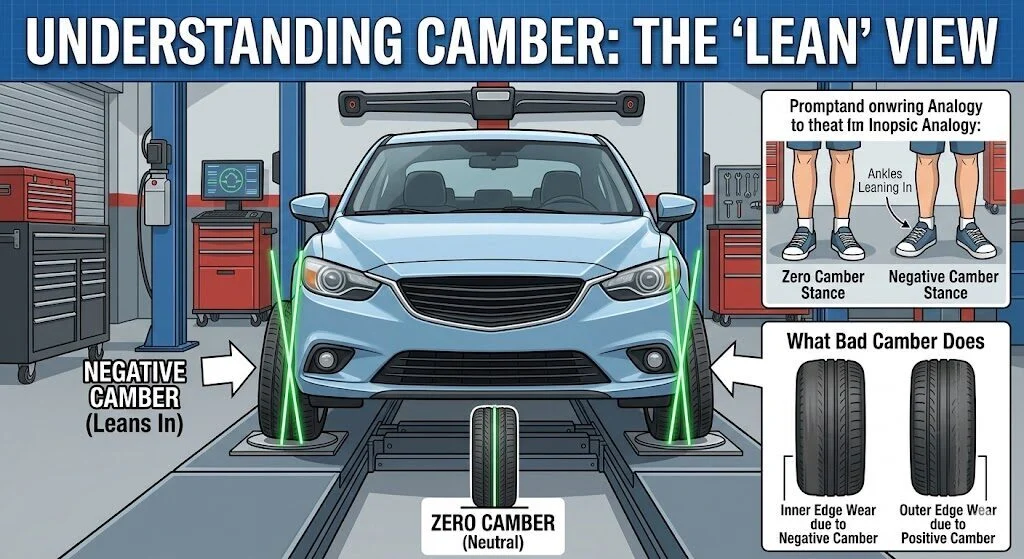
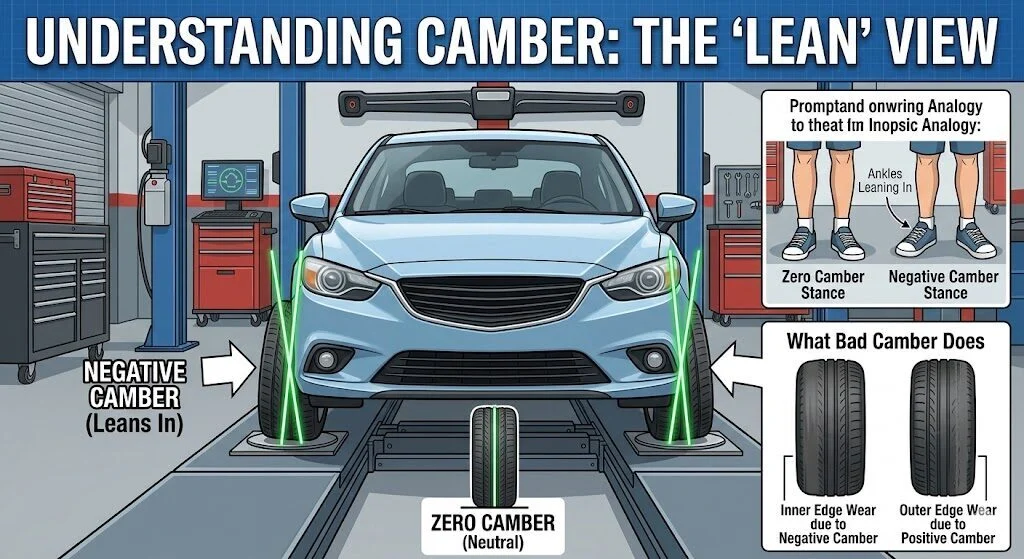
Camber — The “Lean”
View: Looking at your car from the front.
What it is: Whether your wheel leans inward (negative camber) or outward (positive camber) at the top.
Analogy: Stand with your feet shoulder-width apart. Now tilt both feet so the tops of your ankles lean inward—that’s negative camber. Stand with them perfectly vertical—that’s zero camber.
What bad camber does: Wears the inside edge or outside edge of your tire unevenly. If only one side of your tire tread is bald, camber is usually the culprit.
Why this matters:
If a shop charged you for a “full alignment” but your tires are still wearing on one edge, they probably never touched the camber.
Caster — The “Tilt”
View: Looking at your car from the side.
What it is: The forward or backward tilt of the steering axis.
Analogy: Think of a shopping cart wheel. The metal fork that holds the wheel is tilted backward—that’s positive caster. It’s why shopping cart wheels naturally straighten out when you push forward.
What bad caster does: Makes the car pull to one side or makes the steering feel unstable at highway speed. It does not usually cause uneven tire wear.
Important: Caster is not adjustable on most standard passenger cars. If your printout shows caster out of spec, it usually means something is bent.
Toe — The “Pigeon”
View: Looking at your car from above.
What it is: Whether the fronts of your tires point inward toward each other (toe-in) or outward away from each other (toe-out).
Analogy: Stand up and point your toes inward like a pigeon—that’s toe-in. Point them outward like a duck—that’s toe-out.
What bad toe does: Causes a feathery, sawtooth wear pattern across the full face of the tire. It’s the fastest tire-killer of all three angles.
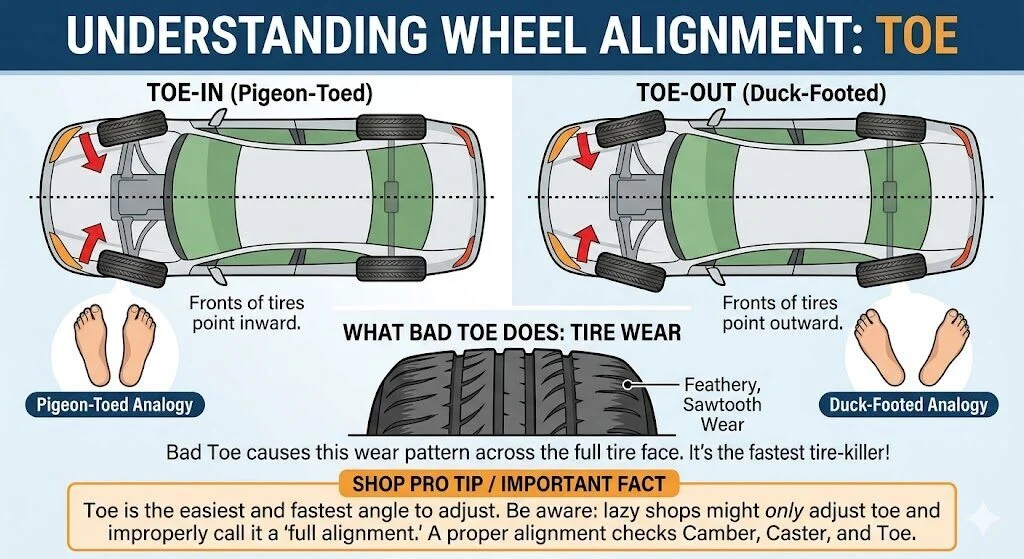
Toe is the easiest and fastest angle to adjust. This is why lazy shops only adjust toe and call it a “full alignment.”
3. How to Read Your Alignment Printout
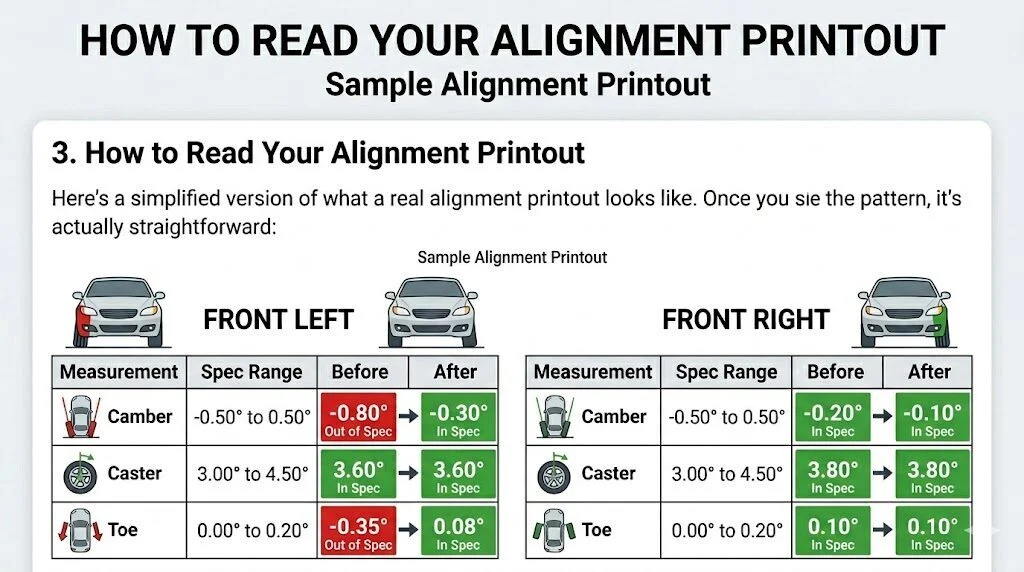
Here’s a simplified version of what a real alignment printout looks like. Once you see the pattern, it’s actually straightforward:
Sample Alignment Printout
| Measurement | Spec Range | Before | After |
|---|---|---|---|
| FRONT LEFT | |||
| Camber | -0.50° to 0.50° | -0.80° | -0.30° |
| Caster | 3.00° to 4.50° | 3.60° | 3.60° |
| Toe | 0.00° to 0.20° | -0.35° | 0.08° |
| FRONT RIGHT | |||
| Camber | -0.50° to 0.50° | -0.20° | -0.10° |
| Caster | 3.00° to 4.50° | 3.80° | 3.80° |
| Toe | 0.00° to 0.20° | 0.10° | 0.10° |
. What to Look For on YOUR Printout
- “Before” vs. “After” columns: A legitimate shop will show you readings before they adjusted anything and after.
- Spec Range: Green means within range. Yellow means close to the edge. Red means outside.
- Which angles actually changed: If only toe changed but camber stayed the same, the tech may have only adjusted toe.
- Rear measurements: A true 4-wheel alignment will show readings for all four wheels.
Pro Tip
Always ask for a printed copy of the alignment report—before and after. A reputable shop will hand it over without hesitation.
4. Scam #1: The “Red Printout” Panic
How it works:
The mechanic pulls your car onto the alignment rack during a routine oil change. They print the “Before” readings and rush the printout to you saying the alignment is way off.
“See all this red? Your alignment is way off. If we don’t fix this today, you’ll destroy your tires and it’ll cost you a lot more down the road.”
Why It’s Misleading
- Minor yellow readings are completely normal on driven vehicles.
- The color coding is designed to scare you.
- You didn’t ask for an alignment check. Many chain shops do this hoping to find something to sell.

Your Script for This Exact Situation:
- “Does my car pull to one side?”
- “Is there uneven tire wear?”
- “Can I get a copy of that printout? I’ll take it home and think about it.”
5. Scam #2: The “Toe-and-Go” Shortcut
How it works:
You pay for a “4-wheel alignment.” The technician adjusts only the toe, prints the “After” sheet, and sends you on your way.
- Camber adjustments require more time
- Caster often isn’t adjustable without aftermarket parts
- Toe is the fastest way to move the printout from red to green
How to Catch It
Look at the “Before” and “After” columns on your printout:
| Angle | Before | After | Changed? |
|---|---|---|---|
| Camber | -0.80° | -0.80° | No |
| Caster | 3.60° | 3.60° | N/A |
| Toe | -0.35° | 0.08° | Yes |
See the pattern? Only the toe moved. The camber is still out of spec.
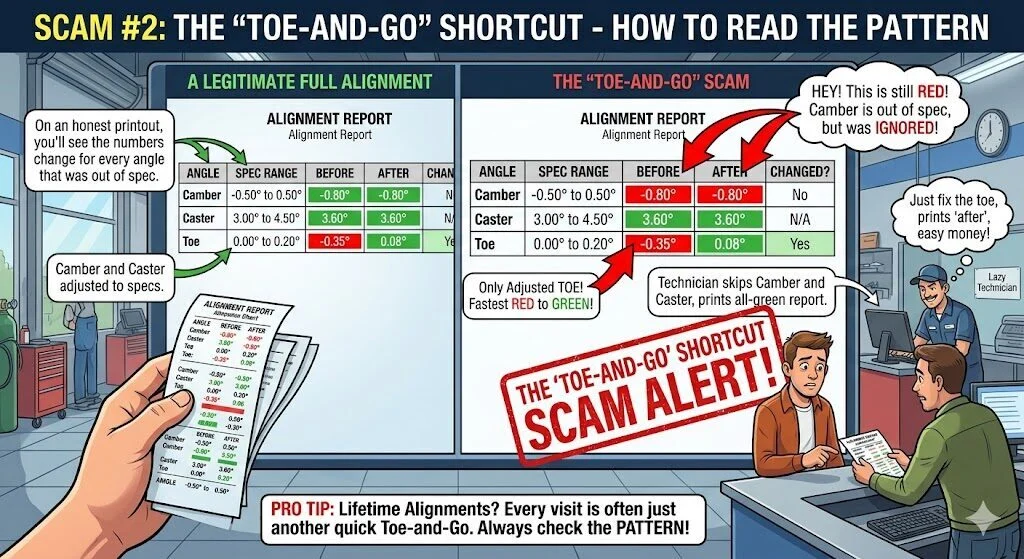
What a Legitimate Alignment Looks Like
On an honest printout, you’ll see the “Before” and “After” numbers change for every angle that was out of spec.
Lifetime Alignment Packages
Many chains sell “Lifetime Alignment” packages, but each visit may be just another quick Toe-and-Go.
6. Scam #3: The “Non-Adjustable Parts” Charge
How it works:
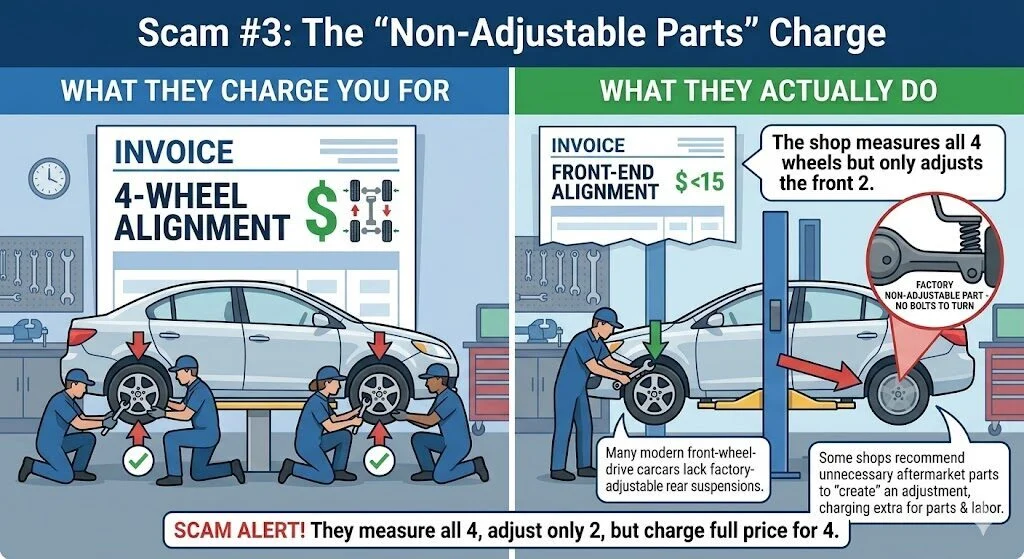
Many modern front-wheel-drive cars do not have adjustable rear suspension from the factory.
That means there are literally no bolts to turn on the back wheels. The shop charges you for a “4-wheel alignment” anyway.
What’s Actually Happening
- They measure all four wheels but only adjust the front two.
- A front-end alignment should cost less than a true 4-wheel alignment.
- Some shops recommend extra aftermarket parts that are sometimes unnecessary.
How to Protect Yourself
Ask the shop these questions before paying:
- “Is the rear suspension on my car adjustable from the factory?”
- “Which specific angles did you actually adjust—front only or all four?”
- “Can you show me the before-and-after readings for each wheel?”
7. The Text-Your-Kid Checklist
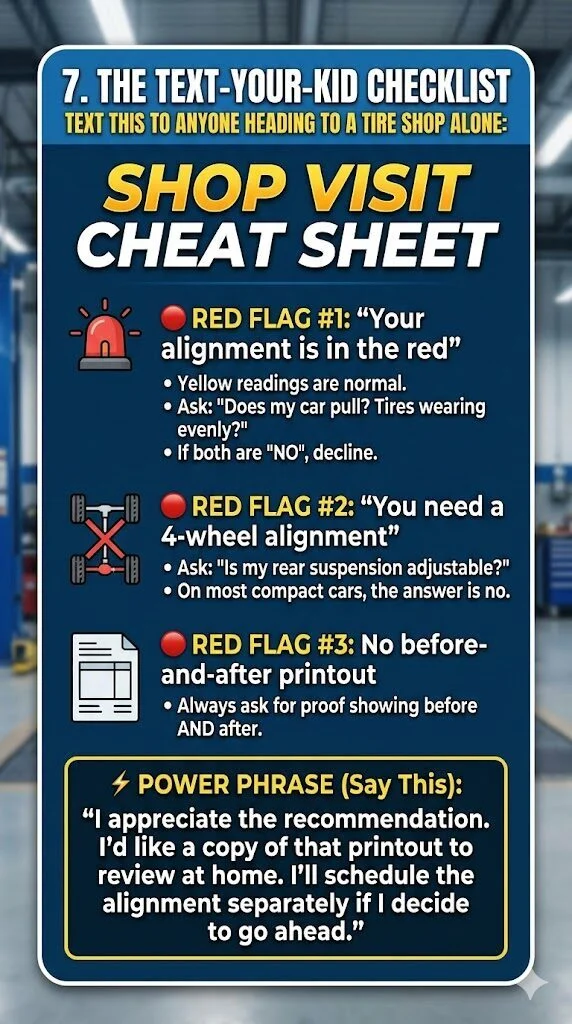
Here’s a simple checklist you can screenshot and text to anyone heading to a tire shop alone:
Shop Visit Cheat Sheet
Red Flag #1: “Your alignment is in the red”
Yellow readings are normal. Ask: “Does my car pull? Are my tires wearing evenly?” If both answers are no, decline.
Red Flag #2: “You need a 4-wheel alignment”
Ask: “Is my rear suspension adjustable?” On most compact cars, the answer is no.
Red Flag #3: No before-and-after printout
Always ask for proof showing before and after.
Power Phrase
“I appreciate the recommendation. I’d like a copy of that printout to review at home. I’ll schedule the alignment separately if I decide to go ahead.”
8. When You Actually DO Need an Alignment
We’re not saying alignments are a scam. They’re a real, important service. Here’s when you genuinely need one:
- Your steering wheel is off-center when driving straight
- Your car pulls noticeably to one side on a flat road
- You see uneven tire wear
- You just installed new tires
- You hit a major pothole or curb
- You replaced suspension parts
- It’s been 2+ years or 25,000+ miles since the last alignment
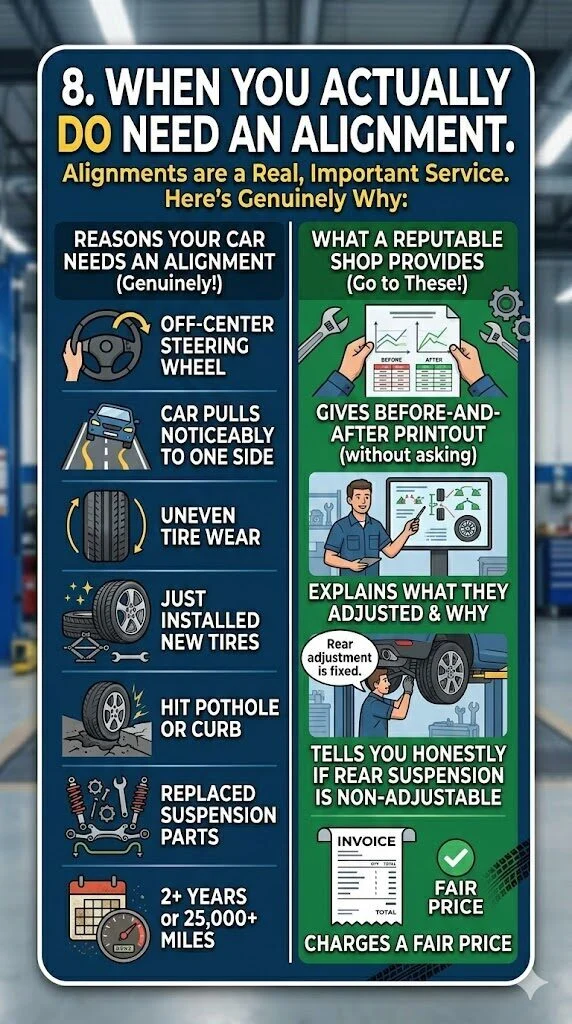
When you do get an alignment, go to a shop that:
- Gives you a before-and-after printout without you asking
- Explains what they adjusted and why
- Tells you honestly if your rear suspension isn’t adjustable
- Charges a fair price
The Bottom Line
Alignment is a legitimate service—but the way it’s sold at many shops is often dishonest. Now you know:
- What camber, caster, and toe actually are
- How to read every number on the alignment printout
- The three most common scams and exactly how they work
- What to say to decline an upsell without confrontation
Written from years of shop floor experience. No affiliate links. No sponsored content. Just the truth about what happens behind the service counter.