How long do you think you will keep the car that is sitting in your driveway right now? Most people answer that question with a guess, and then they pick a paint protection product without connecting the two, which is how a lot of drivers end up paying for protection that runs out halfway through ownership or paying for protection they did not need on a car they sold after two years.
The planning gets easier if you treat exterior protection as a decision that covers the whole time you own the car, as opposed to a one-time purchase at the dealership. The questions below are the ones worth working through, roughly in the order they tend to matter, before you book anything.
How Long Are You Planning to Keep the Car?
This is the question that decides most of the others, so it is worth being honest with yourself about it. Vehicles are being kept longer than they used to be, and S&P Global Mobility reported that the average age of light vehicles on U.S. roads reached 12.8 years in 2025 (passenger cars alone averaged 14.5 years). That figure is for the U.S. fleet, although it is a reasonable sign that many people who say “four or five years” at the time of purchase end up keeping the car for a good deal longer than that.
Here is a rough way to match the ownership period to the type of protection:
- Under three years, or a lease. A good wax or sealant routine, plus film on the front bumper and mirrors if you drive on the highway often, is usually enough. You are mainly trying to return the car without chips and without lease-end charges.
- Three to seven years. This is the range where a ceramic coating and a partial or full-front film installation start to make financial sense, because the products last long enough to cover most of the time you own the car.
- Seven years or more. Full-front or full-vehicle film, possibly with a coating on top, is worth pricing out, because you will likely want the original paint to still be intact when the car is ten years old.
If you are not sure, plan for the longer period. It is easier to sell a car with protected paint than it is to fix chipped paint after the fact.
What Does Your Driving Actually Look Like?
Two drivers with the same car can need very different protection. A car that sits in a heated garage and goes out on weekends is dealing with a different set of problems than a car that is parked outside and spends an hour a day on a highway behind gravel trucks.
The questions to ask yourself here are fairly practical:
- How much highway driving do you do? Rock chips come mostly from following other vehicles at speed, so highway commuters see far more front-end damage than city drivers.
- Where is the car parked overnight? Outdoor parking means more exposure to UV, tree sap, bird droppings, and industrial fallout.
- What do your winters look like? In much of Canada, the answer involves a lot of road salt and sand. Environment and Climate Change Canada notes that on average, 5 million tonnes of road salt are used each year as de-icers on Canadian roadways, and much of the sand and grit spread with it ends up hitting the lower panels and the front of the car.
- Do you go on gravel roads or to a cottage? Long stretches of gravel are hard on rocker panels and the area behind the wheels, which are panels that many basic packages leave uncovered.
If you answered “highway, outside, salty winters” to most of these, the case for physical film on the impact areas becomes much stronger than the case for a coating alone.
What Kind of Damage Are You Trying to Prevent?
It helps to separate the threats into two groups, because each type of product is good at one group and weak at the other.
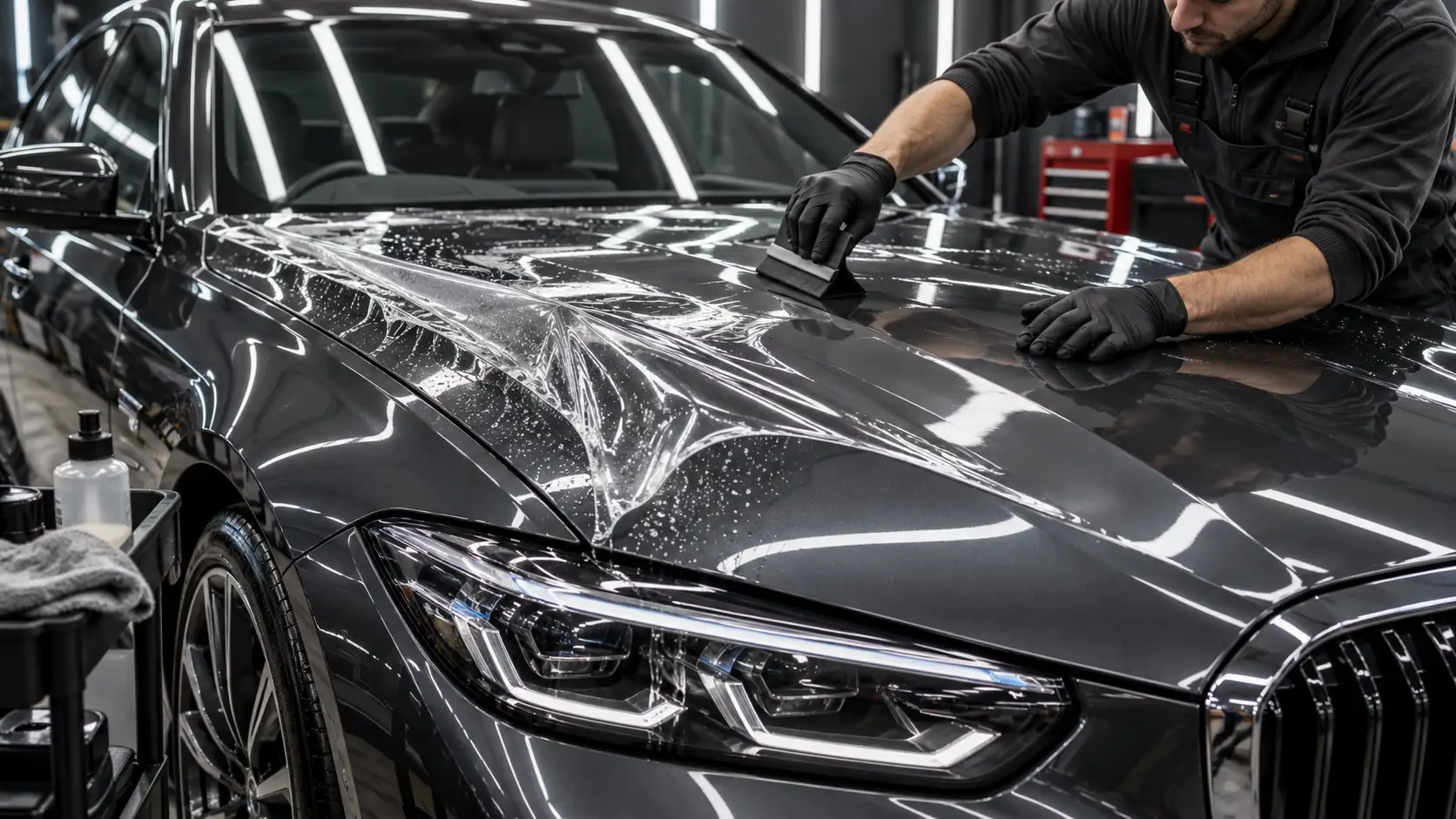
Physical damage is anything that hits the car: stones, sand, gravel, shopping carts, keys and door dings. Paint protection film (PPF) is a clear urethane film, usually somewhere between 6 and 12 mils thick (a mil is one thousandth of an inch), that is applied to the painted panels and absorbs that impact before it reaches the paint. Many current films are also described as self-healing, which means light swirl marks and fine scratches in the top layer level out when the film is warmed by sun or warm water.
Chemical and environmental damage is anything that lands on the car and sits there: bird droppings, sap, bug residue, road film, hard water spots and UV exposure. A ceramic coating is a thin liquid layer (usually based on silica or similar compounds) that bonds to the surface and makes it slick and water-repellent. It makes washing much easier and gives some resistance to staining, although it is far too thin to stop a rock chip.
Wax and sealants sit in the same group as coatings, except that they wear off much faster. They are fine as a starting point, and they are cheap, but they are a maintenance habit as opposed to a long-term plan.
Should You Combine PPF and a Ceramic Coating?
For many owners who plan to keep a car for a long time, the answer is yes, and the reason is the split described above. Film handles impacts and coatings handle what lands on the surface, so putting them together covers both groups.
The usual order is film first and coating second. The coating is applied over the film and over any painted panels that were left uncovered, which gives the whole car the same slick, easy-to-wash finish. A common middle-ground setup is:
- Film on the high-impact areas (bumper, hood, fenders, mirrors and the edges that face the road).
- A ceramic coating on top of the film and over the rest of the paint, the wheels and sometimes the glass.
One point to check before booking is whether the coating product you are considering is approved for use on top of film. Some coatings are formulated specifically for film, and the installer should be able to tell you which one they use and why.
What Will It Cost Over the Whole Time You Own the Car?
Upfront price is the number most people compare, although it is not the most useful one. The more useful figure is how much each approach costs across your ownership period, including any reapplication.
Jalopnik’s overview of the pros and cons of paint protection film puts the normal lifespan of film at five to 10 years and cites installation prices from roughly $1,300 to more than $6,000 depending on coverage. Coatings and waxes are cheaper at the start, although they need to be redone more often. The table below is a general planning guide (prices vary a lot by vehicle size, shop and region, so treat it as a way to compare approaches, not as a quote).
| Approach | Typical lifespan | Main thing it stops | How often you redo it over 10 years |
| Wax | A few weeks to a few months | Light staining, water spots | Many times |
| Paint sealant | Several months | Light staining, UV | Several times a year |
| Professional ceramic coating | Roughly 2 to 5 years, depending on product and care | Staining, UV, makes washing easier | Two to four times |
| Partial or full-front PPF | Roughly 5 to 10 years | Rock chips and scratches on the front | Once, possibly never |
| Full-vehicle PPF | Roughly 5 to 10 years | Impacts and scratches on every covered panel | Once, possibly never |
If you work through the numbers for a ten-year ownership period, the gap between a coating-only plan and a film-plus-coating plan tends to be smaller than the upfront prices suggest, because the coating-only plan gets paid for several times. It is also worth adding a realistic figure for what you would otherwise spend on touch-ups or a bumper respray, since that is the cost the protection is replacing.
Does Protection Help When You Sell?
It can, although it is worth being realistic about how much. Buyers and dealers pay attention to the front of a car, and a bumper and hood without chips make an obvious difference on a used car listing. Original paint is also easier to sell than a resprayed panel, because a buyer looking at a respray will wonder why it was needed.
That said, protection is unlikely to pay for itself through resale alone on an ordinary commuter car. The stronger financial case is for vehicles where the paint condition affects the price more (performance cars, luxury models, special colours and cars that hold their value well) and for owners who would otherwise pay for paint repairs during the time they own the car. If you are leasing, the benefit shows up at turn-in, when chips and scratches on the front end are one of the common sources of excess wear charges.
Who Is Going to Install It, and What Happens After?
This is the question that people spend the least time on, and it has a bigger effect on how long the protection lasts than the brand of film. Film that is applied over contamination, stretched too far around a curve or trimmed with a blade on the paint can lift, bubble or show its edges within a year or two. A coating applied over swirled or contaminated paint will lock those defects in underneath it.
When you are comparing shops, these are the questions that tend to separate them:
- What preparation is done before the film goes on? A proper install starts with a wash, a chemical decontamination and a clay treatment so that nothing is trapped under the film.
- Which film brands are used, and what does the warranty actually cover? Many manufacturer warranties cover yellowing, cracking and peeling, and the length varies by film line, so ask to see the terms in writing.
- How are the coverage options packaged? A shop should be able to explain the difference between a partial front, a full front and a full vehicle on your specific car, as well as which individual panels can be added.
- Is there any follow-up? Small lifted edges or a trapped bubble sometimes show up in the first week, and a shop that checks the car after install catches those before they become a warranty issue.
- What aftercare instructions do you get? You should leave with clear rules on when the first wash can happen and which products to avoid.
If you are in the Greater Toronto Area, one example of a shop that explains its installation process and coverage options is https://id-protection.ca/, a paint protection studio in Concord, Ontario, serving Toronto drivers with PPF packages ranging from partial-front coverage to full-vehicle protection. When comparing installers, look for clear preparation procedures, written warranty terms, and follow-up inspections after installation. These are important details any PPF installer should be able to explain before you hand over your keys.
How Much Upkeep Are You Willing to Do?
Every one of these products works better when it is looked after, and none of them removes the need to wash the car. The difference is in what the washing involves and how often something has to be reapplied.
- With film, the usual guidance is to wait a couple of days before the first wash, wash by hand with a pH-neutral soap and avoid petroleum or solvent-based cleaners. Pressure washer nozzles should be kept back from the film edges.
- With a coating, washing becomes quicker because dirt does not stick as well, although the coating still needs regular washing, and some products recommend a top-up spray every few months.
- With wax or sealant, you are reapplying on a schedule, which is fine if you enjoy it and less fine if the car mostly gets cleaned at a drive-through wash.
If you know you are not going to hand-wash the car regularly, it is better to plan around that, for example by putting film on the areas that take the most damage and keeping expectations realistic for the rest of the paint.
Key Takeaways
- Start with how long you will keep the car, because ownership length decides whether short-life products or long-life film make more sense.
- Look honestly at your driving, parking and winter conditions, since highway miles and road salt push the decision toward physical film on the impact areas.
- Film stops impacts and coatings handle what lands on the paint, which is why many long-term owners combine the two, with the film going on first.
- Compare cost across the full ownership period, including reapplications and the paint repairs you would otherwise pay for, instead of comparing upfront prices only.
- Spend real time on choosing the installer, because preparation, follow-up and warranty terms affect how long the protection lasts more than most other factors.
- Choose a level of protection that matches the upkeep you will actually do, not the routine you hope to do.