
A free VIN check can help you confirm a vehicle’s identity, decode key specifications, check for open recalls, and investigate certain theft or salvage records before you buy. The important part is knowing what a free lookup can actually verify—and what it cannot.
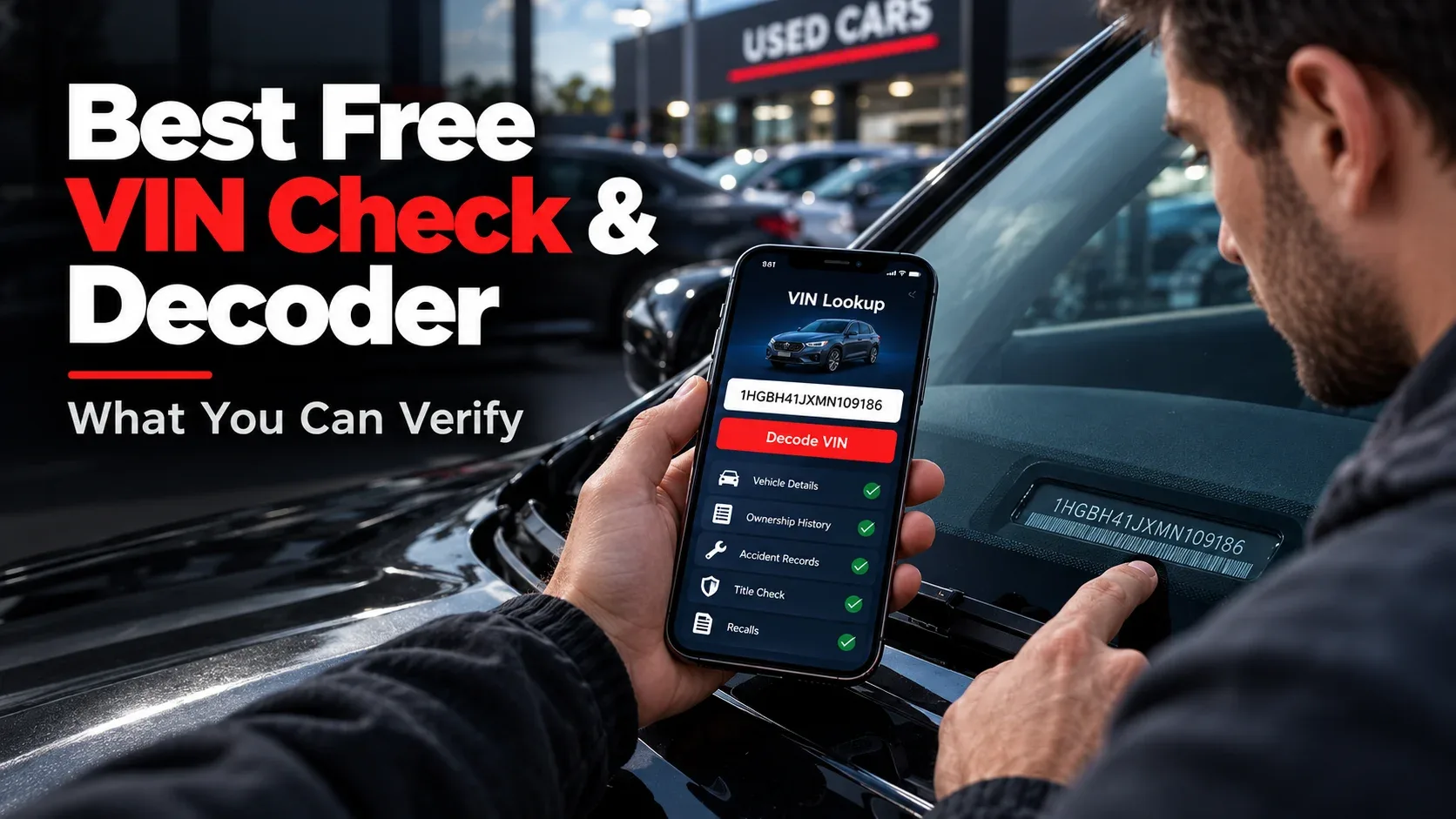
Can You Check a VIN for Free?
Yes. You can use free VIN-decoding tools and official databases to verify many basic vehicle details. Depending on the source, you may be able to confirm the make, model year, engine or body information, open safety recalls, and certain reported theft or salvage records without paying.
However, a free VIN check is not automatically a complete vehicle-history report. Accident records, title history, previous owners, mileage events, auction information, and service history may be incomplete or may require a more detailed report.
What Is a VIN and What Does It Tell You?
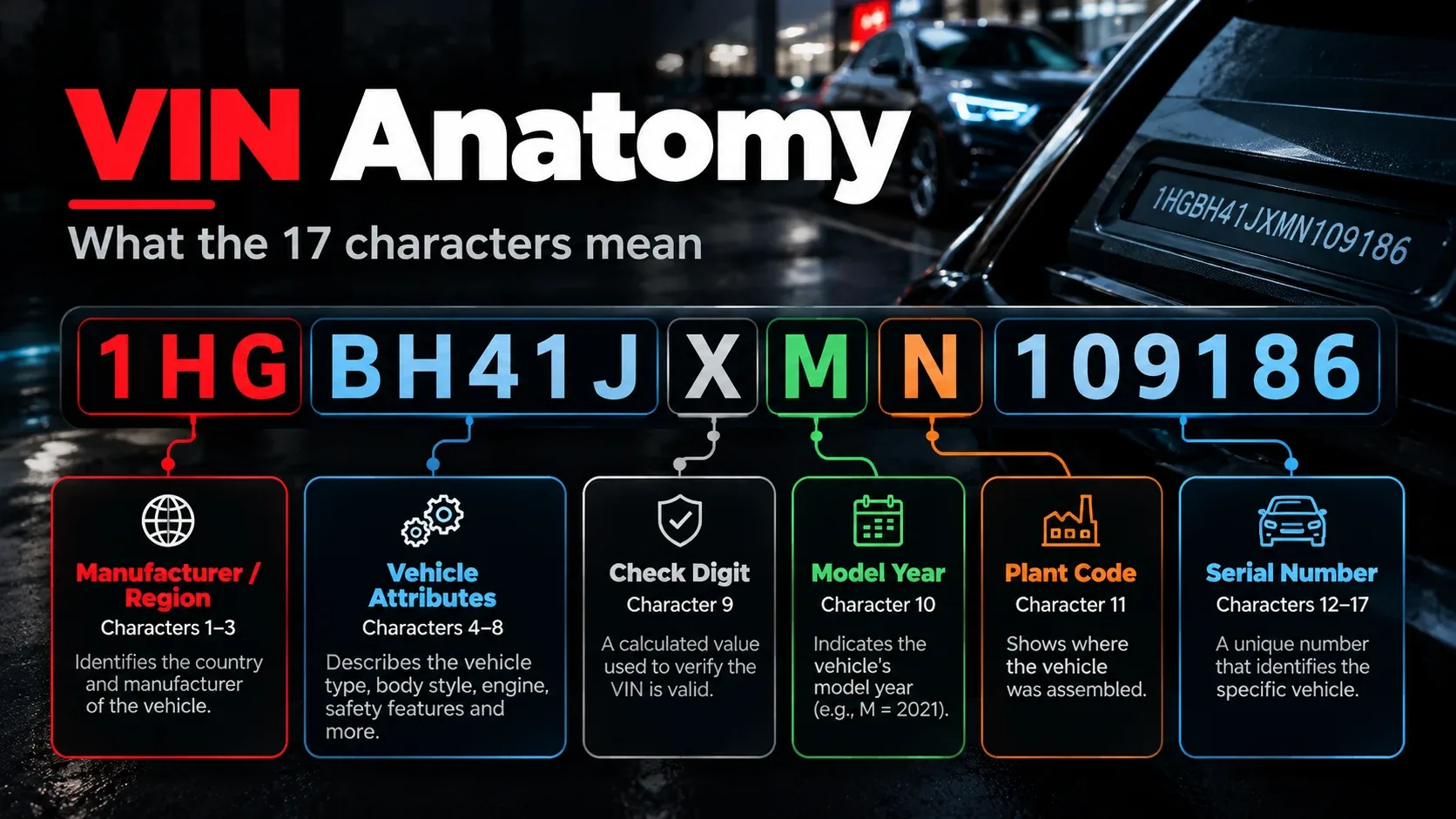
A VIN, or Vehicle Identification Number, is a unique identifier assigned to a vehicle. For modern road vehicles sold in the United States, the VIN is generally a 17-character combination of letters and numbers.
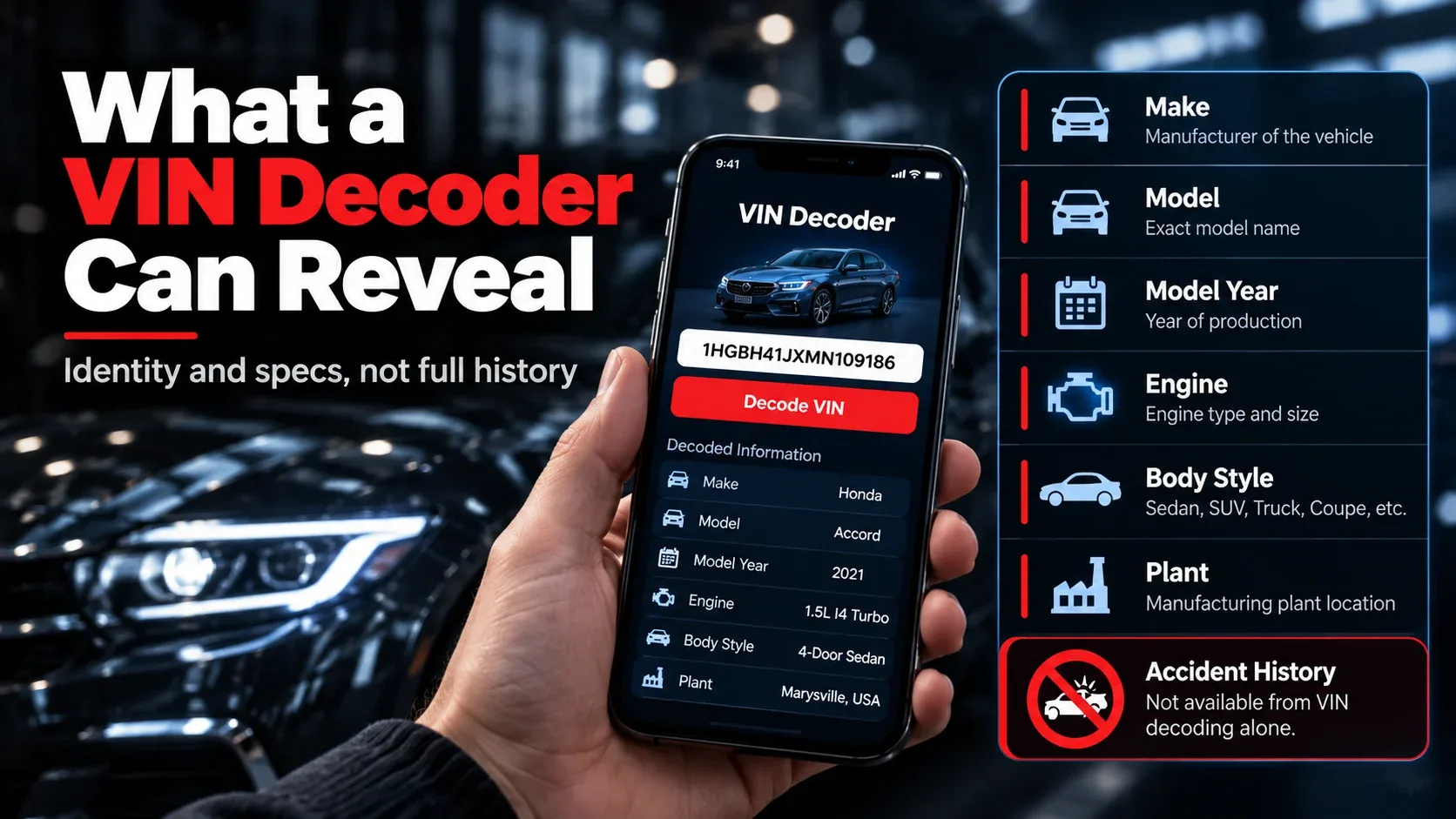
The characters can identify information such as the manufacturer, vehicle type, model year, production plant, and vehicle-specific serial sequence. Depending on the manufacturer and database, a VIN decoder may also return engine, body, restraint-system, drivetrain, or other configuration details.
Where Can You Find a Car’s VIN?
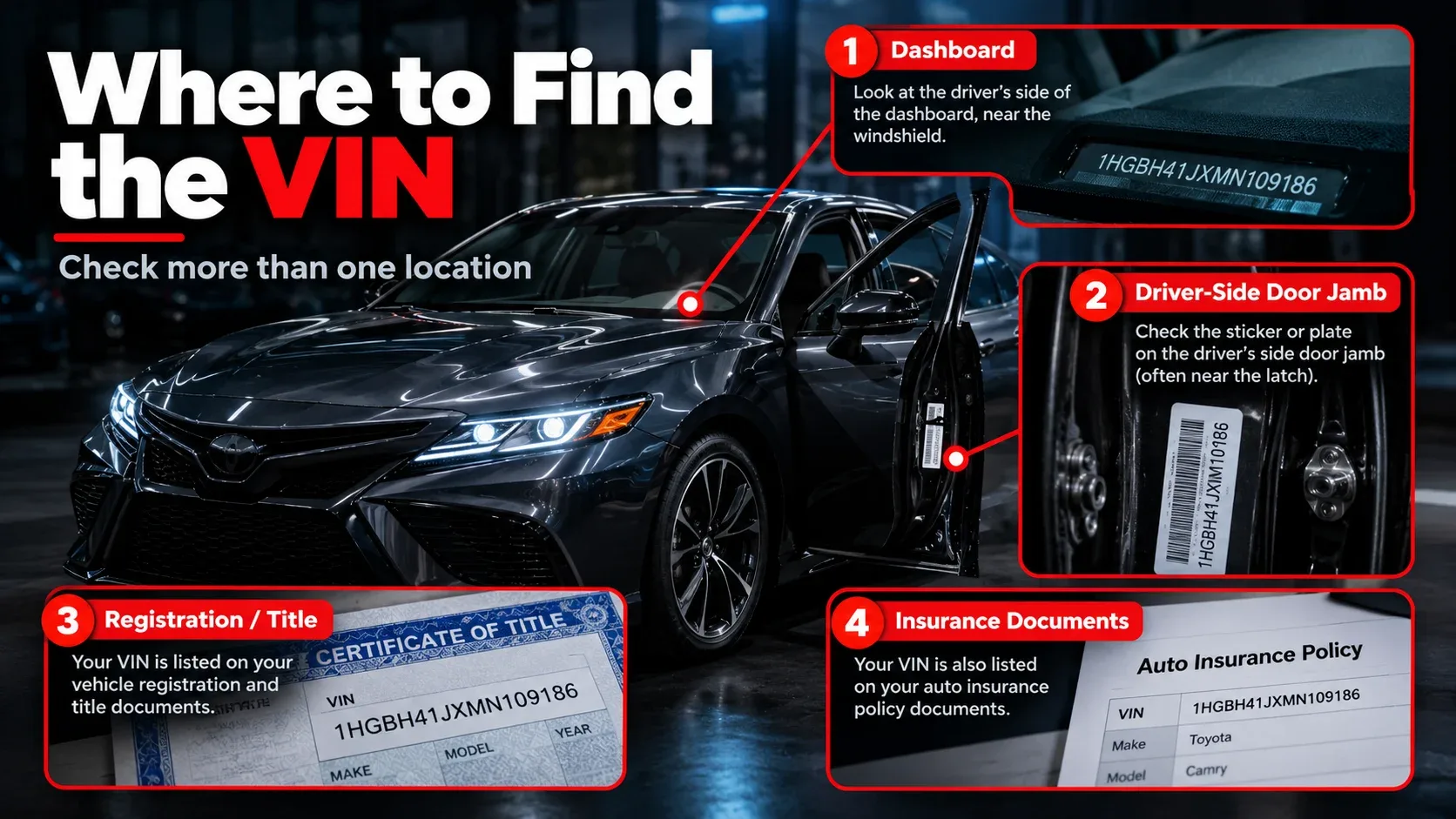
Before using the best free VIN decoder you can find, make sure you are entering the VIN from the actual vehicle or trusted documents—not only from an online listing.
Dashboard
Look through the windshield at the lower driver’s-side corner of the dashboard. The VIN is normally visible from outside the vehicle.
Driver-Side Door Jamb
Open the driver’s door and inspect the certification label or sticker on the door pillar or door-jamb area.
Registration and Title
The VIN should appear on official registration and title documents. Compare it carefully with the physical vehicle.
Insurance Documents
Insurance cards, policy documents, or online insurance records may also display the vehicle’s VIN.
How to Check a VIN Number for Free
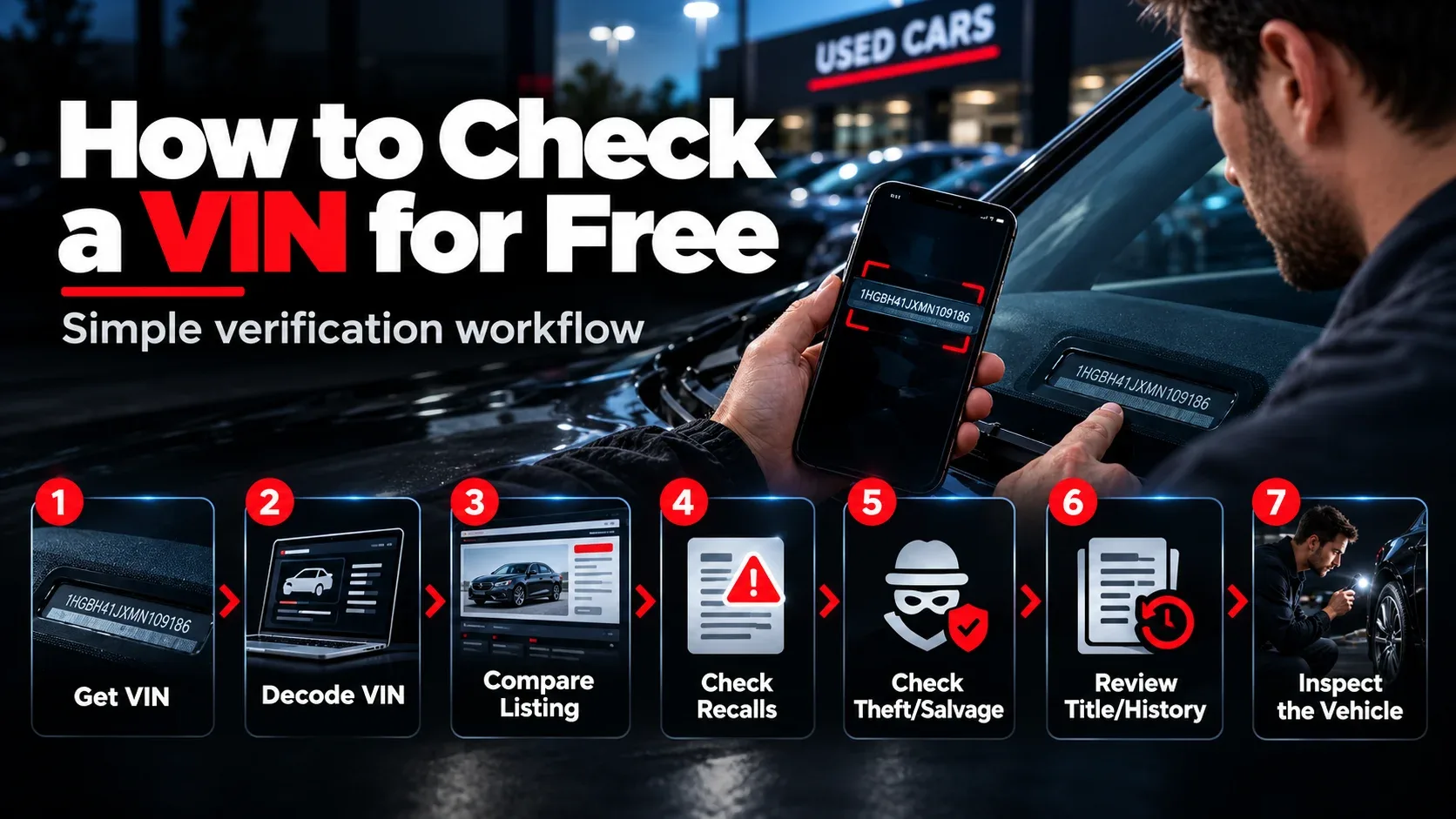
If your goal is VIN verified free research before purchasing a used car, use more than one type of check. A decoder identifies the vehicle, while other databases can reveal specific records connected to that VIN.
Copy the Full VIN
Record all 17 characters carefully. A single incorrect character can produce the wrong vehicle information or prevent a database match.
Use a Free VIN Decoder
Decode the VIN to identify the manufacturer, model year, vehicle type, engine or body information, and other specifications available for that vehicle.
Compare the Results With the Listing
Check whether the decoded year, make, model, engine, body style, and other available details match what the seller claims.
Check for Open Safety Recalls
For U.S. vehicles, use the official NHTSA recall lookup to search a VIN for unrepaired safety recalls covered by its database.
Check Theft and Salvage Records
The NICB VINCheck service can search certain insurance-reported theft, salvage, and flood records from participating insurers. Treat it as one screening source rather than a complete vehicle-history report.
Investigate Title and History Data
If you are serious about buying the car, investigate title brands, odometer information, previous title events, and other available history. The U.S. government’s NMVTIS consumer site explains how consumers can obtain NMVTIS vehicle-history information through approved providers.
Inspect the Vehicle
Do not let a clean database result replace a physical inspection. A qualified pre-purchase inspection can reveal mechanical problems, repairs, leaks, rust, structural damage, or other issues that may not appear in a VIN database.
What Can the Best Free VIN Decoder Tell You?
A VIN decoder is mainly an identity and specification tool. The exact output varies by vehicle, manufacturer, model year, and data source.
| Information | Free VIN Decoder? | What to Expect |
|---|---|---|
| Manufacturer | Usually yes | Identifies the company or manufacturing entity associated with the VIN. |
| Make | Usually yes | Often returned as a core vehicle-identification field. |
| Model | Often | Availability can vary by manufacturer and database. |
| Model year | Usually yes | The VIN includes a model-year code for standardized modern VINs. |
| Engine | Often | May show engine family, displacement, cylinders, or fuel type. |
| Body style | Often | May identify sedan, SUV, pickup, hatchback, van, or another body configuration. |
| Manufacturing plant | Often | Plant information may be decoded when supported by available manufacturer data. |
| Transmission | Sometimes | Not every VIN decoder can determine the exact transmission. |
| Exact trim/options | Sometimes | A VIN may not uniquely identify every factory option or package. |
| Accident history | No, not from decoding alone | Requires external records associated with the VIN. |
| Previous owners | No, not from decoding alone | Ownership/title data comes from separate databases. |
| Service history | No, not from decoding alone | Depends on whether service events were reported to accessible databases. |
Free VIN Check vs. VIN Decoder: What’s the Difference?
VIN Decoder
A VIN decoder answers: “What vehicle is this?”
- Manufacturer
- Model year
- Vehicle type
- Engine or body information
- Production details
Vehicle-History Check
A history check asks: “What recorded events are linked to this vehicle?”
- Title events or title brands
- Reported theft
- Salvage or total-loss information
- Odometer records
- Reported accidents or auction events, depending on the database
| Feature | VIN Decoder | Vehicle-History Check |
|---|---|---|
| Main purpose | Identify vehicle specifications | Find recorded historical events |
| Usually free? | Often | Some checks are free; detailed reports may cost money |
| Accident records | No | Possibly, if reported to the source |
| Open recalls | Not necessarily | Available through dedicated recall databases |
| Theft/salvage records | No | Available from certain specialized databases |
What Vehicle Information Can You Verify for Free?
Vehicle Identity
A free decoder can often confirm whether the VIN corresponds with the year, make, model, vehicle type, and other specifications shown in an advertisement.
Manufacturer Information
The beginning of the VIN helps identify the manufacturer or manufacturing region/entity. This can be useful when checking whether the VIN structure makes sense for the vehicle in front of you.
Engine and Vehicle Specifications
Depending on the source and vehicle, you may be able to verify engine family, displacement, cylinder count, body type, drive type, restraint system, and other technical details.
Open Safety Recalls
NHTSA’s VIN search can identify certain unrepaired safety recalls for a specific U.S. vehicle. Recall information is especially valuable because it concerns safety defects for which manufacturers are generally responsible for providing the recall remedy.
Reported Theft Records
NICB VINCheck can identify certain vehicles reported stolen and not recovered when the relevant record is available from participating member insurers. NICB explicitly warns that its search is not comprehensive, so a “no record” result should not be treated as proof that the vehicle has never been stolen.
Reported Salvage or Flood Information
NICB VINCheck also searches participating insurers’ salvage-related records and may identify certain flood-damaged vehicles. Coverage is limited to the information available to NICB from participating sources.
VIN Consistency
One of the most useful free checks costs nothing at all: compare the VIN and decoded specifications with the physical car, title, registration, door label, and seller’s listing. Inconsistencies are a reason to investigate further.
What a Free VIN Check May Not Show
Free tools are useful screening tools, but there are important gaps. Depending on the database, a free check may not show:
- Every accident or collision
- Damage that was repaired privately
- Complete ownership history
- Every title event
- Complete odometer history
- All auction listings or photographs
- Every insurance claim
- Complete maintenance or service history
- Mechanical condition today
- Damage that was never reported to an included source
Can You Find a Car by VIN for Free?
If by “find a car by VIN free” you mean identify the vehicle, a free decoder can often tell you the year, make, model, vehicle type, engine information, and other specifications.
If you mean finding the current private owner, home address, or other personal information, a normal public VIN decoder is not designed to provide that information. Vehicle ownership and registration records are subject to privacy and access rules.
For shopping purposes, focus on using the VIN to establish vehicle identity, compare seller claims, investigate safety recalls, and search legitimate history sources.
How Do You Know Whether a VIN Is Valid?
Check the Length
For a modern standardized VIN, expect 17 characters. Very old vehicles may use earlier identification formats, so do not automatically apply modern VIN rules to classics.
Watch for Confusing Characters
Standard modern VINs avoid the letters I, O, and Q because they can be confused with the numbers 1 and 0.
Use a Decoder
If the VIN decodes successfully, confirm that the returned vehicle characteristics make sense for the vehicle you are researching.
Compare Every Accessible VIN Location
Check the dashboard VIN, door certification label, title, registration, and other legitimate vehicle records. They should agree.
Look for Physical Signs of Tampering
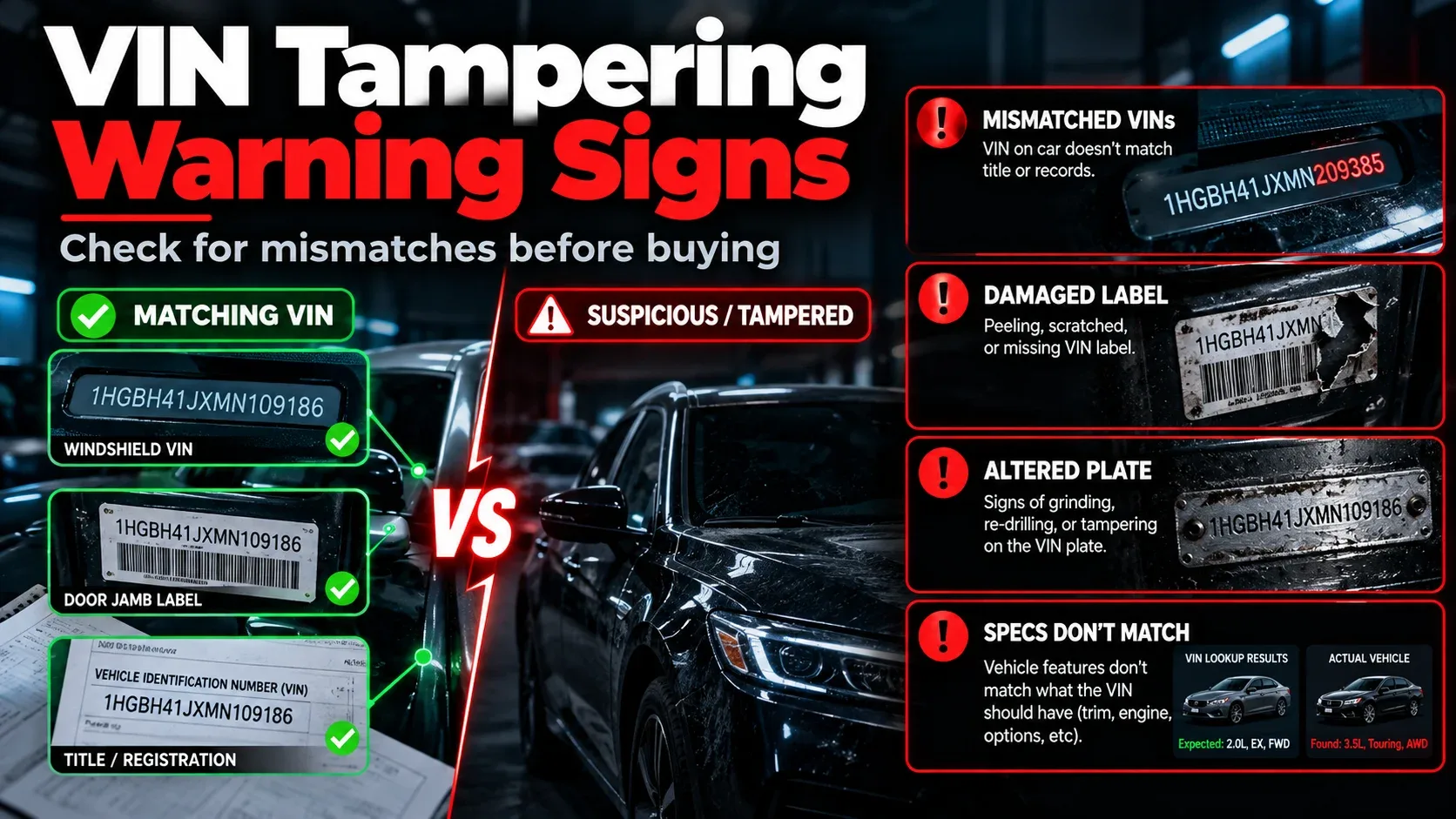
Be cautious if a VIN plate appears damaged, scratched, reattached, covered, altered, or inconsistent with other identification labels. Do not accuse a seller based on appearance alone; treat irregularities as a reason for professional or official verification.
VIN Cloning: Why Matching the VIN Matters
VIN cloning generally refers to using a legitimate vehicle’s VIN to disguise the identity of another vehicle. For a used-car shopper, the practical defense is verification rather than trying to diagnose fraud from one clue.
Investigate further if:
- The VIN differs between the dashboard and paperwork.
- The decoder identifies a different model year or vehicle configuration.
- The door label and dashboard VIN do not match.
- Vehicle documents look inconsistent with the physical vehicle.
- The seller refuses to provide a VIN before a reasonable inspection.
- The seller strongly discourages independent verification.
Example: Checking a Used Car Before Buying
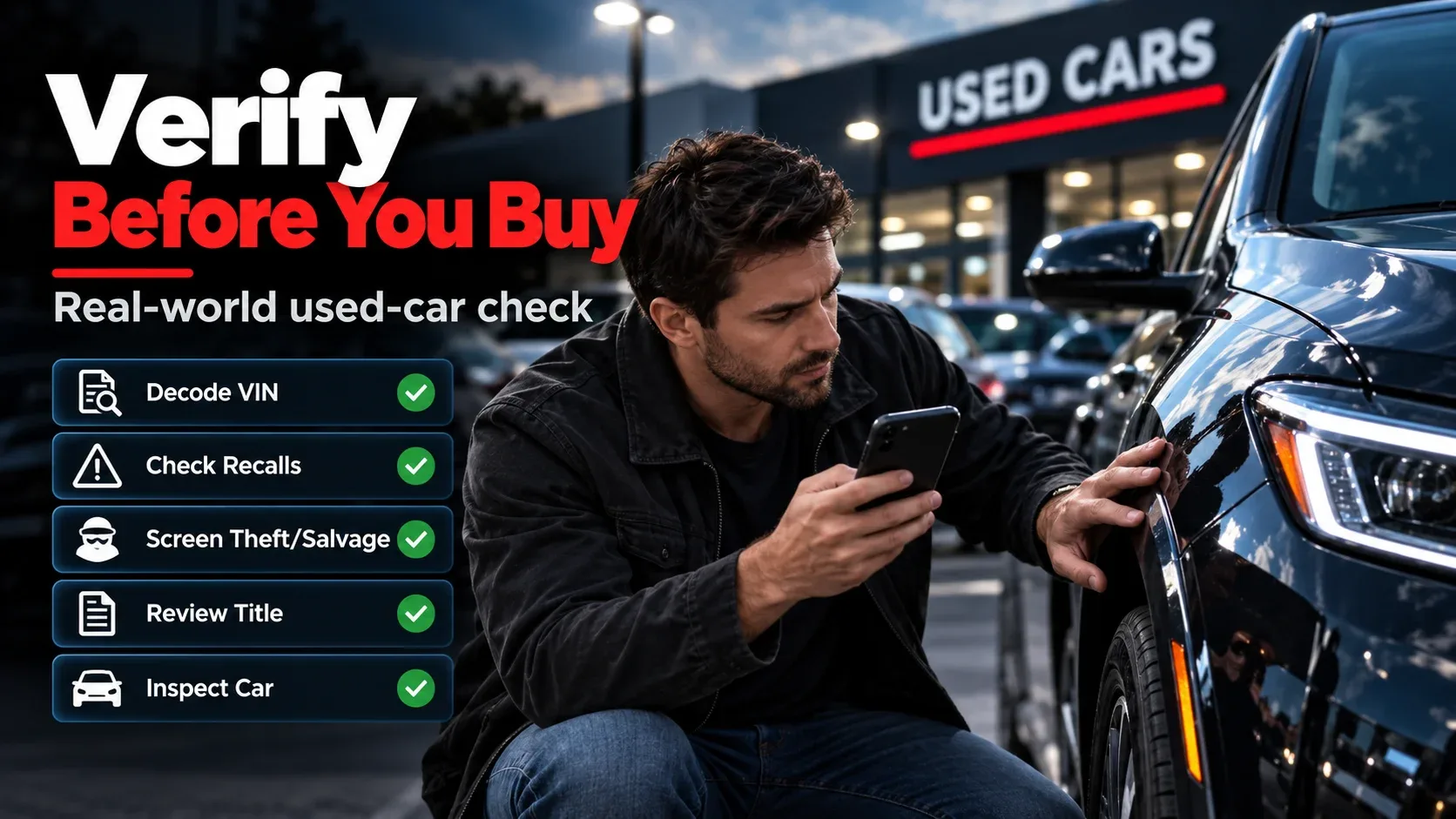
Suppose you find a 2021 SUV advertised online at an attractive price. The seller provides a 17-character VIN. A sensible verification process could look like this:
- Enter the VIN into a reputable free decoder.
- Confirm that the decoded model year, make, model, engine, and body configuration match the advertisement.
- Use NHTSA’s recall lookup to check for unrepaired recalls.
- Use NICB VINCheck to screen for certain insurance-reported theft, salvage, or flood records.
- Research title and odometer information through appropriate state or NMVTIS-related sources.
- When you see the vehicle, compare the physical VIN locations with the paperwork.
- Have the vehicle professionally inspected before purchase when appropriate.
If the seller advertises a 2021 V6 SUV but the VIN decodes as a different model year, engine, or vehicle, stop and resolve the discrepancy before moving forward.
Do You Need to Pay for a VIN Report?
Not always. Free tools can be enough for the first screening stage, especially when you are comparing multiple listings.
A Free Check Is Useful For
- Confirming basic vehicle identity
- Comparing a listing with decoded specifications
- Checking open recalls
- Screening certain theft/salvage databases
- Eliminating obviously inconsistent listings
Consider Deeper History Research When
- You are close to buying the vehicle
- The vehicle is expensive
- The title history is unclear
- The mileage appears inconsistent
- There are signs of significant previous repairs
- The car has changed states or owners several times
VIN Red Flags You Should Not Ignore
- VIN mismatch: The advertisement, title, dashboard, or door label shows a different number.
- Decoded vehicle mismatch: The VIN identifies a different year, model, engine, or body configuration.
- Damaged identification labels: VIN plates or labels appear suspiciously altered or damaged.
- Seller refuses the VIN: A legitimate seller should normally be able to provide the VIN for reasonable pre-purchase research.
- Unexpected title information: Salvage, flood, rebuilt, junk, or other title-brand information requires careful investigation.
- Unexplained mileage conflict: Odometer readings or historical records do not follow a logical progression.
- Pressure to skip inspection: The seller discourages an independent mechanical inspection or document verification.
Used-Car VIN Verification Checklist
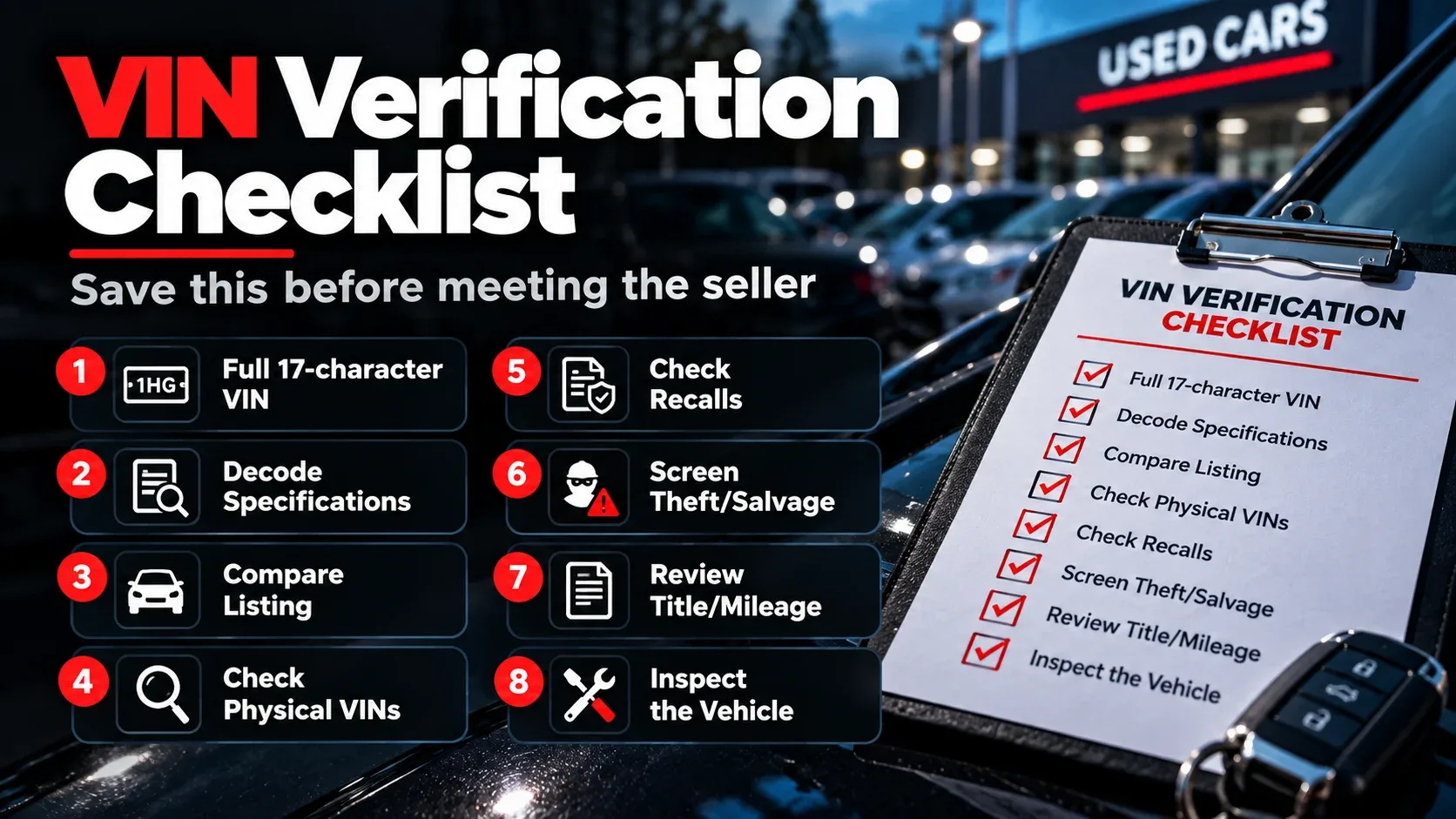
- Obtain the complete VIN
- Confirm the VIN is entered correctly
- Decode the vehicle specifications
- Compare results with the advertisement
- Check the dashboard VIN
- Check the door-jamb label
- Compare registration/title documents
- Check for open recalls
- Screen theft/salvage records
- Investigate title history
- Review available mileage records
- Inspect the vehicle physically
- Consider a pre-purchase inspection
- Resolve every major inconsistency before buying
Common Mistakes When Checking a VIN
Trusting Only One Database
No single free database should be treated as a complete record of everything that has happened to a vehicle. Different systems receive information from different sources.
Assuming “No Record Found” Means Perfect History
A database can only report information it has received and retained. An incident that was never reported—or was reported to a source outside that database—may not appear.
Entering the VIN Incorrectly
Double-check every character. If possible, copy the VIN directly from the vehicle or a clear photo rather than relying on memory.
Ignoring a VIN Mismatch
A mismatch between the physical vehicle and documents should be resolved before a purchase. Do not assume it is merely a typing error.
Skipping a Mechanical Inspection
A VIN report cannot tell you whether the transmission shifts correctly, the engine is leaking oil, the suspension is worn, or previous repairs were completed safely. Vehicle-history research and physical inspection solve different problems.
Frequently Asked Questions About Free VIN Checks
Can I check a VIN completely free?
You can perform useful free checks, including VIN decoding and certain official or nonprofit database searches. A complete history containing every available title, accident, mileage, auction, ownership, and service record is not guaranteed to be available for free.
What is the best free VIN check?
The best approach is not to rely on a single site. Use a reputable decoder for vehicle identity, NHTSA for U.S. recall information, NICB VINCheck for certain insurance-reported theft/salvage records, and appropriate title-history sources when evaluating a purchase.
What is the best free VIN decoder?
A useful free VIN decoder should identify the vehicle accurately, explain the decoded fields clearly, avoid promising a complete vehicle history from the VIN alone, and be transparent when a specification cannot be determined.
Can I find a car by VIN free?
Yes, if your goal is to identify the vehicle. A free VIN lookup can often reveal the make, model year, vehicle type, engine information, and other specifications. It normally will not provide private owner information.
Can a VIN tell me whether a vehicle was in an accident?
Not by decoding the VIN itself. Accident information must come from external records associated with that VIN, and not every collision is necessarily reported to every database.
Can I check whether a vehicle was stolen using the VIN?
For U.S. vehicles, NICB VINCheck can screen certain theft records supplied by participating member insurers. NICB states that its database is not comprehensive, so use the result as one part of a broader verification process.
Can I check recalls by VIN for free?
Yes. NHTSA provides a free VIN recall lookup for U.S. vehicles that can identify certain unrepaired safety recalls associated with a specific VIN.
Does a clean VIN report mean the car is safe to buy?
No. A clean database result does not prove the vehicle has never been damaged, improperly repaired, or poorly maintained. Combine VIN research with paperwork checks, a test drive, and an independent inspection when appropriate.
Trusted Sources for U.S. VIN Research
- NHTSA: VIN decoding, vehicle-safety information, and recall lookup.
- NICB VINCheck: Free screening for certain participating-insurer theft, salvage, and flood records.
- NMVTIS / VehicleHistory.gov: Federal consumer information about title, brand, odometer, junk/salvage, and insurance total-loss data available through approved access providers.
- State motor-vehicle agencies: State-specific title, registration, and ownership processes.
Editorial note: Database coverage and access rules can change. Check each source’s current terms and scope when researching a specific vehicle.
Final Takeaway: Start Free, Then Verify the Vehicle From More Than One Angle
A VIN verified free search is a valuable first step when researching a used car. Start by decoding the VIN, compare the specifications with the vehicle and seller’s claims, check recalls, screen available theft or salvage databases, and investigate title history before buying.
The safest process is simple: VIN → decode → compare → recall check → theft/salvage screening → title/history research → physical inspection. No single database can replace the entire process.