Comparing 0W20 vs 5W20 can be confusing because both oils carry the same SAE 20 high-temperature viscosity grade. The biggest difference is how they behave at lower temperatures. However, cold-weather performance is only one part of choosing the right oil. Your vehicle manufacturer’s viscosity recommendation, required oil specification, climate, engine design, and operating conditions should all be considered.
Quick Answer: 0W-20 vs 5W-20
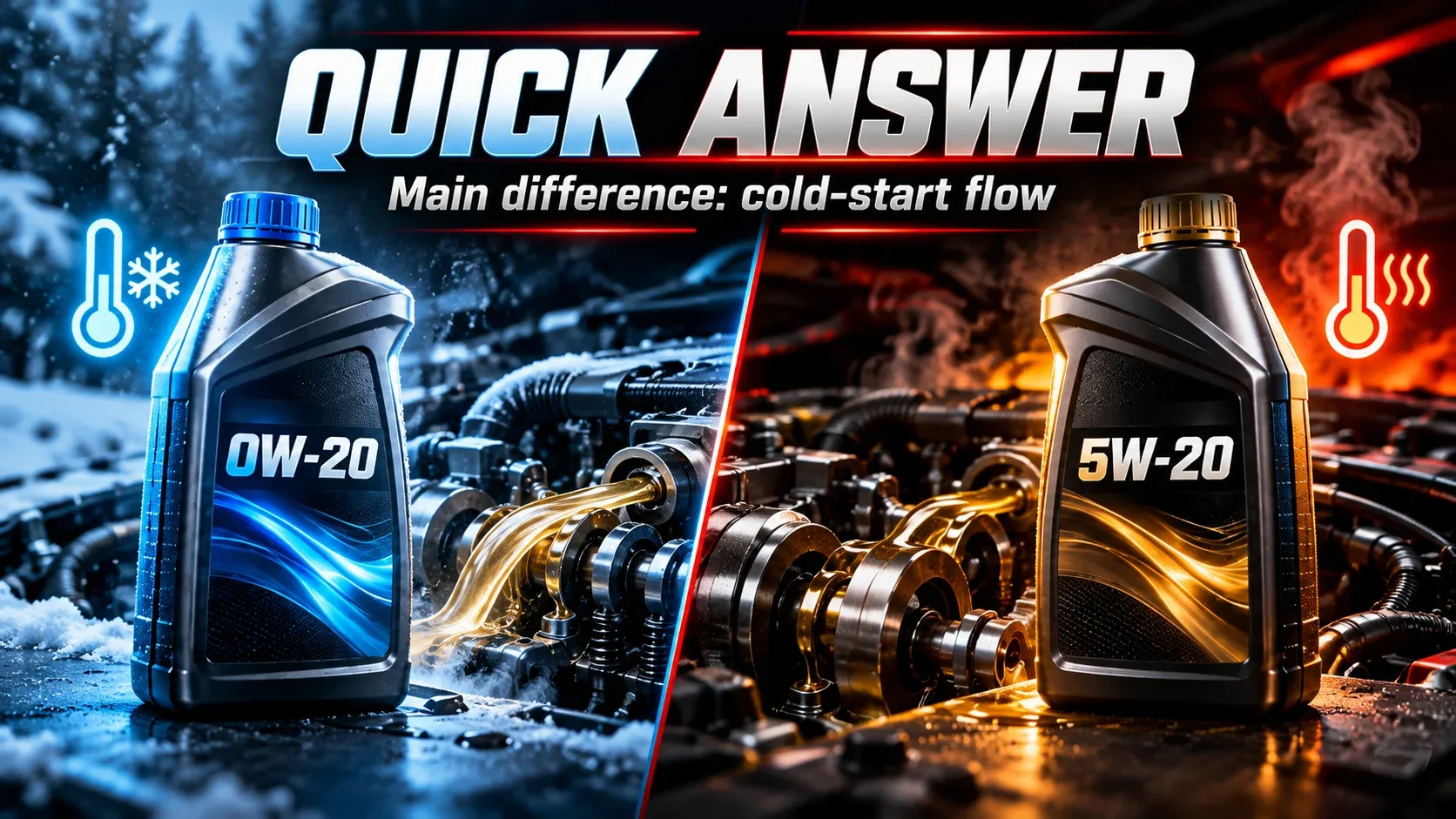
0W-20 generally offers better low-temperature performance than 5W-20 because it meets a lower winter viscosity classification. Both oils are SAE 20 grades at high-temperature viscosity testing conditions.
Neither oil is automatically better for every engine. If your vehicle manufacturer specifies 0W-20, use 0W-20 unless an approved alternative is listed. If both 0W-20 and 5W-20 are permitted, climate and operating conditions can help determine which one is more appropriate.
What Does 0W-20 Mean?
The numbers in 0W-20 describe how the oil performs across different temperature conditions.
The 0W portion represents the oil’s winter viscosity classification. The “W” stands for winter. A lower number before the W indicates that the oil meets more demanding low-temperature cranking and pumping requirements.
The 20 represents the oil’s SAE high-temperature viscosity grade. Once the engine reaches normal operating temperature, the oil must fall within the specified viscosity limits for an SAE 20 grade.

What Does 5W-20 Mean?
5W-20 uses the same SAE viscosity naming system. The 5W portion describes its winter or low-temperature viscosity classification, while 20 is its high-temperature viscosity grade.
Compared with 0W-20, 5W-20 has a higher winter rating. That difference matters most when an engine is started in very cold conditions and the oil must circulate quickly through bearings, camshafts, timing components, and other moving parts.

0W-20 vs 5W-20: Main Differences
The most important difference in the 0W-20 vs 5W-20 comparison is the winter viscosity rating. Both oils are designed to fall within the SAE 20 high-temperature grade, but 0W-20 meets lower-temperature requirements than 5W-20.
| Comparison | 0W-20 | 5W-20 |
|---|---|---|
| Winter rating | 0W | 5W |
| Cold-start performance | Better low-temperature classification | Higher winter viscosity classification |
| High-temperature SAE grade | 20 | 20 |
| Very cold climates | Often advantageous when manufacturer-approved | May be less cold-capable than 0W-20 |
| Hot climates | Can still be fully appropriate | Can also be fully appropriate |
| Modern engines | Commonly specified | Also commonly specified |
| High-mileage engines | Depends on manufacturer guidance and condition | Depends on manufacturer guidance and condition |
| Best choice | Use the viscosity and oil specification approved for your engine | |
Which Is Thicker: 0W-20 or 5W-20?
The answer depends on the temperature being discussed.
At low temperatures, 5W-20 belongs to a higher winter viscosity classification than 0W-20. This means 0W-20 is formulated to meet lower-temperature cranking and pumping requirements.
At higher operating-temperature testing conditions, both oils fall within the SAE 20 viscosity grade. That does not mean every 0W-20 and 5W-20 oil has exactly the same viscosity at every temperature. SAE grades describe allowed viscosity ranges rather than one exact value.
It is more accurate to say that 0W-20 performs differently from 5W-20 when cold rather than simply calling one oil “thin” and the other “thick.”

0W-20 vs 5W-20 in Cold Weather
Cold weather is where the difference between these two oils becomes most noticeable.
When a vehicle sits overnight in freezing temperatures, the engine oil becomes more resistant to flow. During startup, the oil pump must quickly move lubricant through the engine so critical components receive protection.
Because 0W-20 meets a lower winter viscosity classification, it generally performs better than 5W-20 during extremely cold starts when both are otherwise approved for the engine.

Why Cold-Start Oil Flow Matters
When the engine first starts, oil needs to circulate through bearings, camshafts, timing components, turbocharger bearings where fitted, and other lubricated surfaces.
A lower winter viscosity grade can help with cold-start circulation, but that does not mean every vehicle should use 0W-20. Some engines require 5W-20, 5W-30, 0W-16, or another grade entirely.
0W-20 vs 5W-20 in Hot Weather
A common misconception is that 5W-20 must be better for hot climates because the first number is higher.
The first number does not describe hot-weather viscosity. Both oils carry the same SAE 20 high-temperature grade.
This means hot climate alone is not enough reason to replace a manufacturer-specified 0W-20 oil with 5W-20.

If you drive in a very hot climate, check the viscosity-temperature recommendations in your owner’s manual rather than assuming 5W-20 automatically provides better summer protection.
Does 5W-20 Protect an Engine Better Than 0W-20?
Not automatically.
Engine protection depends on much more than the viscosity numbers printed on the bottle. The oil’s additive package, API or ILSAC specification, manufacturer approvals, base oil quality, engine design, operating temperature, contamination level, and maintenance interval all matter.
A modern engine designed for 0W-20 may rely on specific oil-flow characteristics for variable valve timing systems, hydraulic components, tight bearing clearances, oil pumps, turbochargers, and fuel-efficiency targets.

Using an oil outside the manufacturer’s recommended viscosity range can change oil flow and system behavior. The correct specification matters more than choosing oil simply because it seems thicker.
Does 0W-20 Improve Fuel Economy?
Lower-viscosity oils are often used in modern engines partly because reducing internal resistance and pumping losses can contribute to efficiency.
However, the real-world fuel-economy difference between individual 0W-20 and 5W-20 oils can be small and depends heavily on the engine, temperature, driving conditions, oil formulation, tire pressure, traffic, vehicle load, and driver behavior.
Do not switch viscosity only to chase fuel economy unless the alternative grade is approved by the manufacturer.

0W-20 vs 5W-20 for Older Engines
Some drivers believe an engine should automatically move from 0W-20 to 5W-20 as mileage increases.
Mileage alone is not enough reason to change viscosity.
A well-maintained engine with 150,000 miles may still operate normally on the viscosity specified by its manufacturer. If the engine develops excessive oil consumption, low oil pressure, leaks, or unusual noises, those symptoms should be diagnosed rather than automatically treated by changing oil viscosity.
What About High-Mileage Oil?
High-mileage motor oil and higher-viscosity motor oil are not the same thing.
High-mileage formulations may include different additive packages designed for older engines, but they are available in multiple viscosity grades.
Can You Use 5W-20 Instead of 0W-20?
The safest answer is to check your vehicle manufacturer’s instructions.
Some engines may permit both 0W-20 and 5W-20 under specific temperature conditions. Other vehicles may specify only 0W-20.
If your oil cap says 0W-20, do not assume 5W-20 is automatically interchangeable simply because both oils end in 20.
Can You Use 0W-20 Instead of 5W-20?
The same principle applies in the opposite direction.
If your engine specifies 5W-20, check whether the manufacturer allows 0W-20 as an alternative. In some applications, especially where very cold temperatures occur, more than one viscosity may be approved.
Vehicle-specific manufacturer guidance should take priority over a general assumption that the oils are interchangeable.
Can You Mix 0W-20 and 5W-20?
In an emergency, topping up an engine with a compatible oil may sometimes be preferable to driving with dangerously low oil.
That does not mean intentionally mixing 0W-20 and 5W-20 should become your normal maintenance practice.
Different oils can use different additive systems, base oils, and viscosity characteristics. For a routine oil change, use one oil that meets the correct viscosity and performance specifications required for your vehicle.
0W-20 vs 5W-20: Which One Should You Use?
Instead of choosing a universal winner in the 5W 20 oil vs 0W 20 comparison, start with the requirements for your specific vehicle.
- Check your owner’s manual.
Find the recommended SAE viscosity for your specific engine. - Check the oil-fill cap.
Many vehicles print the recommended viscosity directly on the oil cap. - Look for approved alternatives.
Some manufacturers permit multiple viscosities depending on ambient temperature. - Verify the required oil specification.
Check API, ILSAC, ACEA, or manufacturer-specific approval requirements where applicable. - Consider your climate.
Lower winter viscosity ratings can help in very cold conditions, but stay within manufacturer-approved choices. - Consider engine condition separately.
Oil burning, leaks, abnormal pressure, or mechanical noise should be properly diagnosed rather than treated only by changing viscosity.
Common 0W-20 vs 5W-20 Mistakes
“0W-20 Is Too Thin”
Not when the engine is designed for it. Modern lubrication systems can be engineered specifically around 0W-20.
“5W-20 Is Better in Summer”
Both oils carry an SAE 20 high-temperature grade. The first number primarily distinguishes low-temperature behavior.
“Older Cars Need 5W-20”
Mileage alone does not determine viscosity. Follow manufacturer guidance and evaluate engine condition separately.
“Both End in 20, So They’re Identical”
They share a high-temperature viscosity grade but have different winter classifications and may use different formulations.
Frequently Asked Questions
Is 0W-20 better than 5W-20?
Not universally. 0W-20 generally provides better low-temperature performance, but the best choice is the viscosity and oil specification approved by your vehicle manufacturer.
Is 0W-20 thinner than 5W-20?
At low temperatures, 0W-20 meets a lower winter viscosity classification than 5W-20. At high-temperature testing conditions, both belong to the SAE 20 viscosity grade.
Is 0W-20 better for winter?
When both oils are approved for the same engine, 0W-20 generally offers better low-temperature starting characteristics than 5W-20.
Is 5W-20 better for hot weather?
Not automatically. Both 0W-20 and 5W-20 are SAE 20 high-temperature viscosity grades. Use the viscosity recommended for your vehicle and temperature range.
Can I put 5W-20 in a car that recommends 0W-20?
Only if your vehicle manufacturer permits 5W-20 as an alternative. Check the owner’s manual before making the substitution.
Can I use 0W-20 instead of 5W-20?
It may be acceptable in some vehicles, but only if 0W-20 is approved for that engine and operating-temperature range.
Can you mix 0W-20 and 5W-20?
An emergency top-up may sometimes be preferable to running an engine dangerously low on oil, but routine mixing is not ideal. Use the correct manufacturer-approved oil for normal maintenance.
Should a high-mileage engine switch from 0W-20 to 5W-20?
Not simply because it has high mileage. Engine condition, oil consumption, manufacturer recommendations, climate, and approved viscosity ranges should guide the decision.
Are 0W-20 and 5W-20 the same when hot?
Both oils are classified as SAE 20 at high-temperature testing conditions, but that does not mean every formulation has exactly the same viscosity or additive package.
Final Thoughts: 0W-20 vs 5W-20
The main difference in the 0W20 vs 5W20 comparison is their low-temperature viscosity classification. 0W-20 meets lower-temperature winter requirements and generally performs better during very cold starts, while both oils belong to the SAE 20 high-temperature viscosity grade.
That does not make 0W-20 universally better, and it does not make 5W-20 automatically safer in hot weather or older engines.
The correct choice is the oil viscosity and performance specification approved for your specific vehicle. Check the owner’s manual, oil-fill cap, manufacturer-approved temperature range, and required API, ILSAC, ACEA, or manufacturer specification before changing between 0W-20 and 5W-20.