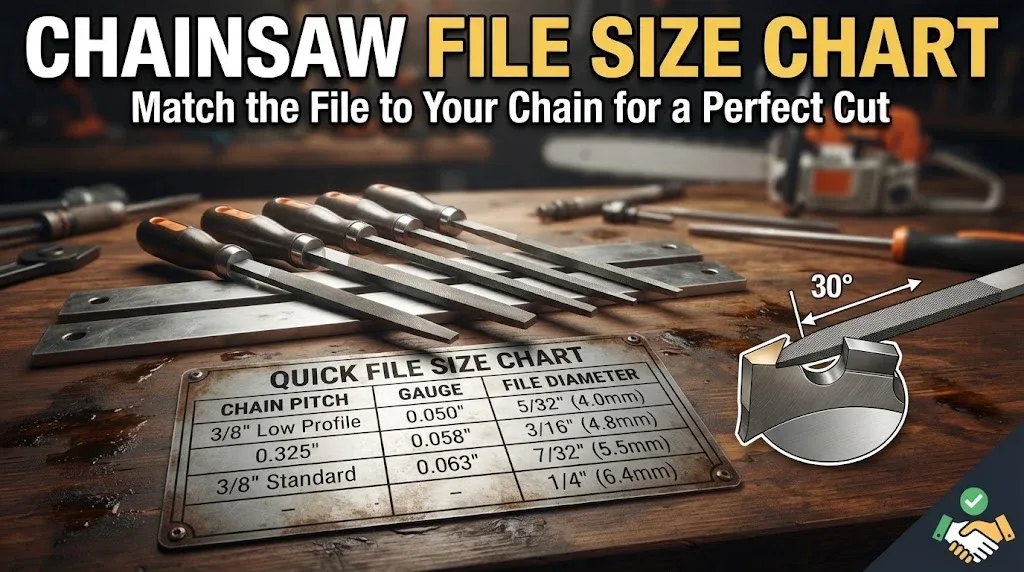

The right chainsaw sharpening angle is not a guess. Learn what the numbers mean, how to identify your chain, and why the manufacturer’s specification wins.
There is no single correct sharpening angle for every chainsaw chain. Many common chains use a top-plate filing angle around 30°, while some specify 25°, 35°, or another angle. Always follow the exact chain manufacturer’s specification.
What does a chainsaw sharpening angle actually mean?

When people say “chainsaw sharpening angle,” they usually mean the top-plate filing angle: the sideways angle you hold a round file across the top of each cutter. It is not the same as the file diameter, the file’s height above the cutter, the side-plate shape, or the depth-gauge setting.
Those details work together. A chain can have cutters filed at the stated angle and still cut badly if the file is the wrong diameter, cutters are unequal, or depth gauges have been lowered too far.
25° vs. 30° vs. 35°: the practical comparison
| Angle | What it means | Best guidance |
|---|---|---|
| 25° | A shallower top-plate angle specified on some chain designs. | Use it when your chain’s official chart calls for it—not simply because you are cutting a certain wood species. |
| 30° | Common on many general-purpose cross-cut chains. | Often a familiar default, but still verify the chain model before setting your file guide or grinder. |
| 35° | A more acute top-plate angle used on particular chains. | It may feel more aggressive in some conditions, but it is not a universal performance upgrade. |
| Official specification | The documented geometry for your exact chain. | This always overrides generic online charts, wood-type rules of thumb, and guesswork. |
How to find the correct angle for your exact chain
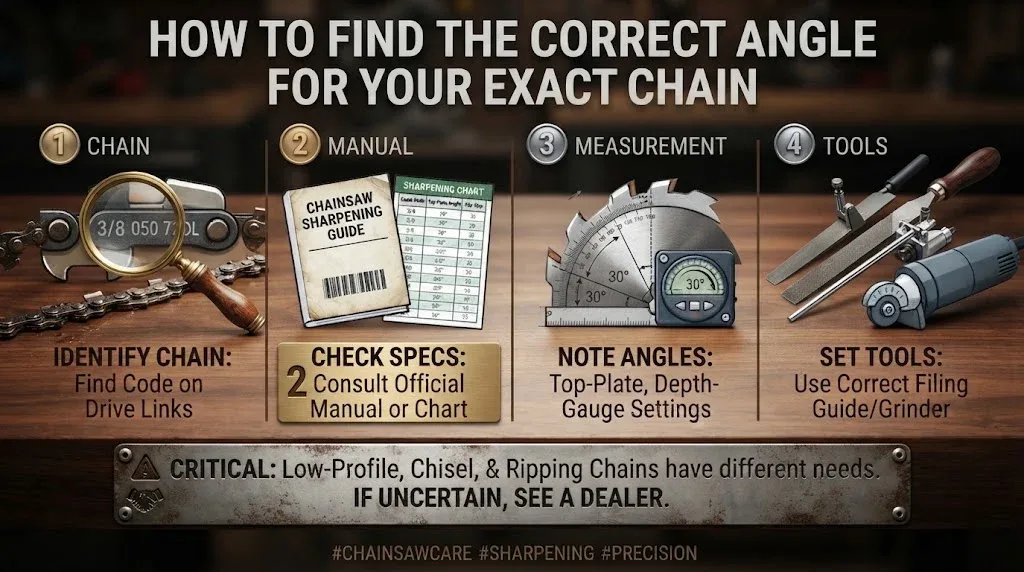
Start by identifying the chain—not just the saw. Look for a code stamped on the drive links, chain box, invoice, or owner’s manual. The saw’s bar length alone does not tell you the chain’s cutter geometry.
- Read the chain manufacturer and product code.
- Check the official product page, manual, or sharpening chart for that exact chain.
- Match the recommended top-plate angle, file diameter, and depth-gauge setting.
- Use a filing guide or grinder setup that matches those instructions.
Official references matter because low-profile, full-chisel, semi-chisel, ripping, and specialty chains may have different requirements. If an old chain’s identity is uncertain, a chainsaw dealer can often help match it before you remove more metal.
Top-plate angle, file size, and depth gauge are different settings
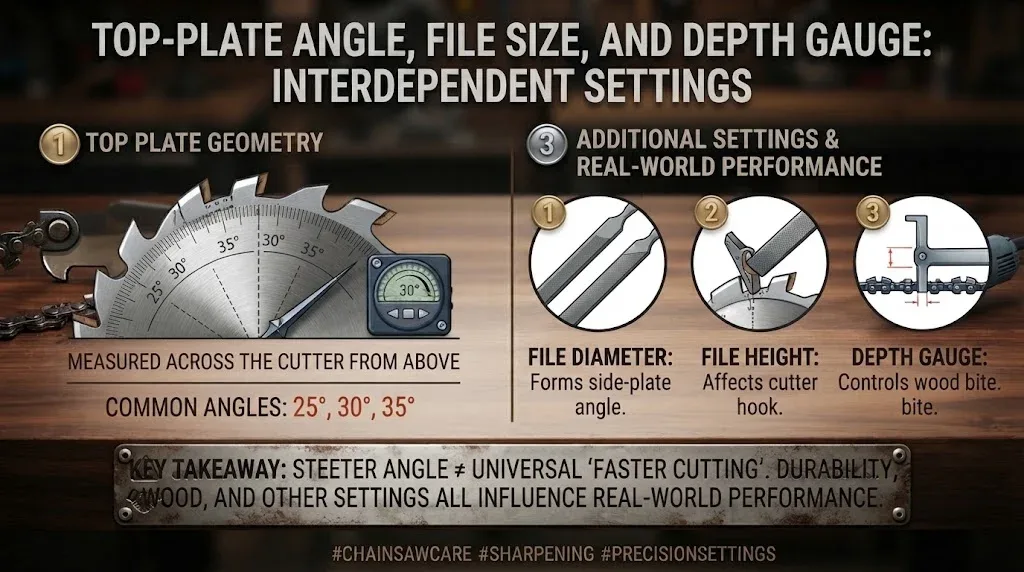
Top plate
The top-plate filing angle is the angle most guides label 25°, 30°, or 35°. It is measured across the cutter when viewed from above.
Other settings still matter
File diameter forms the cutter’s side plate. File height affects hook. Depth gauges control how much wood each cutter takes.
A steeper top-plate angle is not a universal “faster cutting” setting. It changes the cutting edge geometry, but chain durability, wood contamination, cutter type, and depth-gauge clearance all influence real-world performance.
How to keep every cutter consistent while filing
Secure the guide bar, engage the chain brake when repositioning, and choose a comfortable starting cutter. Mark it with a wax pencil so you know when you have completed the loop. File from the inside of each cutter toward the outside using smooth, controlled strokes.
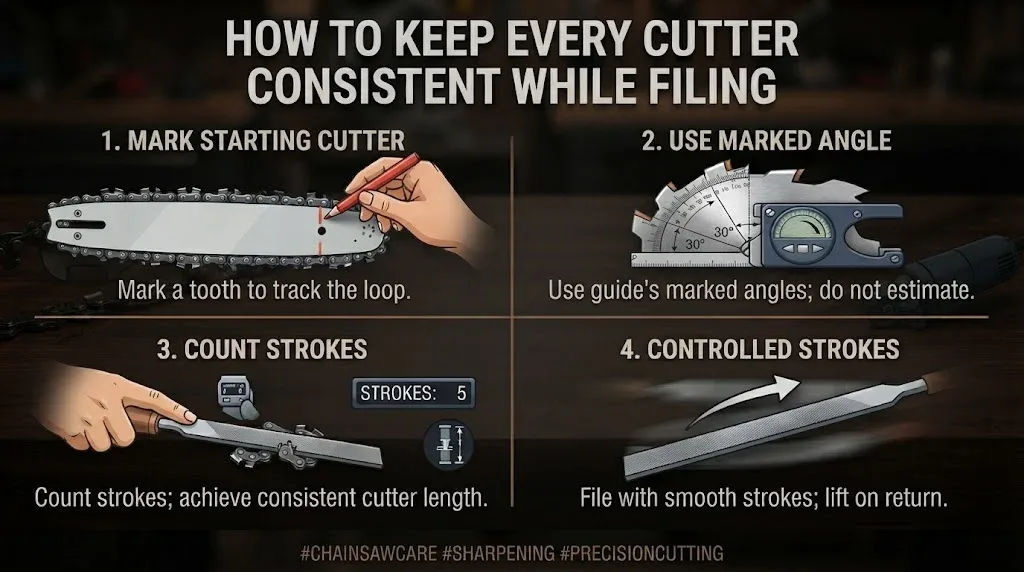
- Use the guide’s marked angle rather than estimating by eye.
- Count strokes or file until damage is removed, then give matching cutters the same treatment.
- File every cutter to a consistent length. Uneven left and right cutters can make the saw pull sideways.
- Rotate or lift the file on the return stroke to reduce unnecessary wear.
Depth gauges: why angle is not the only setting that matters
The depth gauge (also called a raker) sits in front of each cutter and determines chip thickness. Filing cutters back without checking depth gauges can eventually reduce cutting efficiency because the gauges become relatively too high. Lowering them aggressively can make the chain grab, vibrate, and increase kickback potential.
Use the manufacturer’s specified depth-gauge tool and setting. Never guess based on the sharpening angle, and never lower every gauge simply because the chain feels slow.
Do not “tune” a chain by lowering the depth gauges at random
Aggressive depth-gauge filing can create rough cutting, vibration, excessive grabbing, and a less predictable chainsaw. Use a proper gauge tool and the specification for your chain.
Signs your chain may be sharpened incorrectly
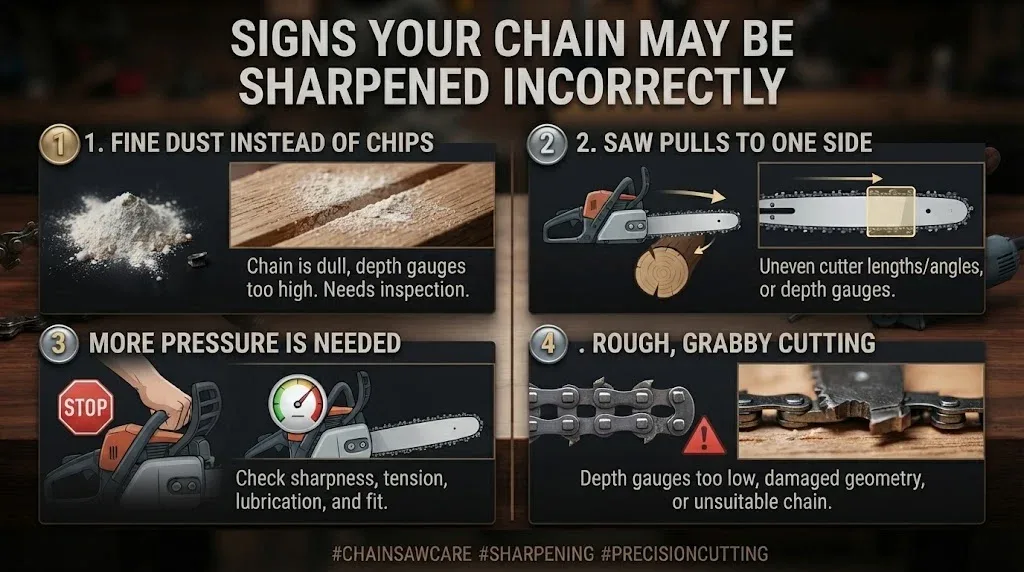
Fine dust instead of chips
The chain is dull, depth gauges may be high, or the cutters need professional inspection.
Saw pulls to one side
One side may have shorter cutters, a different filing angle, or uneven depth gauges. Bar wear can also contribute.
More pressure is needed
Stop forcing the cut. Check sharpness, chain tension, lubrication, and whether the chain is fitted correctly.
Rough, grabby cutting
Depth gauges may be too low, cutter geometry may be damaged, or the chain may be unsuitable for further filing.
When to sharpen—and when to replace—the chain
Sharpen a chain when the cutters are dull but intact. Replace it—or have it assessed by a qualified service professional—when you find cracked links, damaged drive links, severe heat discoloration, missing or broken cutters, cutters filed to their wear marks, or damage that cannot be filed out without making the cutters too short.
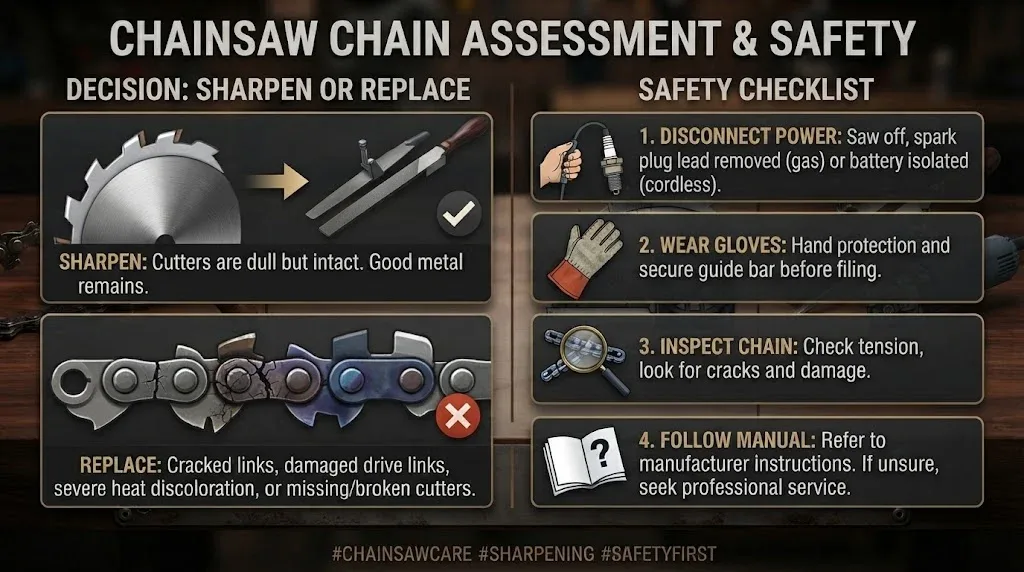
Chainsaw sharpening safety checklist
- Shut the saw off completely. Disconnect the spark plug lead where appropriate, or remove/isolate the battery on cordless models.
- Wear cut-resistant gloves when handling the chain and secure the guide bar before filing.
- Check chain tension and inspect for cracks, damaged drive links, broken cutters, or severe wear before sharpening.
- Follow the chainsaw and chain manufacturer’s instructions. Stop and seek service if you are unsure of the chain type or damage.
Frequently asked questions
Is 30° the standard chainsaw sharpening angle?
Thirty degrees is common on many chains, but it is not universal. Check the chain’s exact manufacturer specification before filing.
Does hardwood require a different filing angle?
Do not select 25°, 30°, or 35° based solely on hardwood or softwood. Chain design and manufacturer guidance should determine the angle.
What file size should I use for my chainsaw chain?
File diameter depends on the chain model and pitch. The chain package, product manual, or official sharpening chart should list the correct round-file size.