
A practical guide to vise grip pliers: how the locking mechanism works, which jaw style fits the job, and how to clamp securely without damaging the work.
The quick answer
Locking pliers are adjustable hand tools whose jaws clamp and remain locked without continuous hand pressure. “Vise grips” and “vice grips” are common informal names; VISE-GRIP is also a well-known brand associated with the tool category.
What are locking pliers?
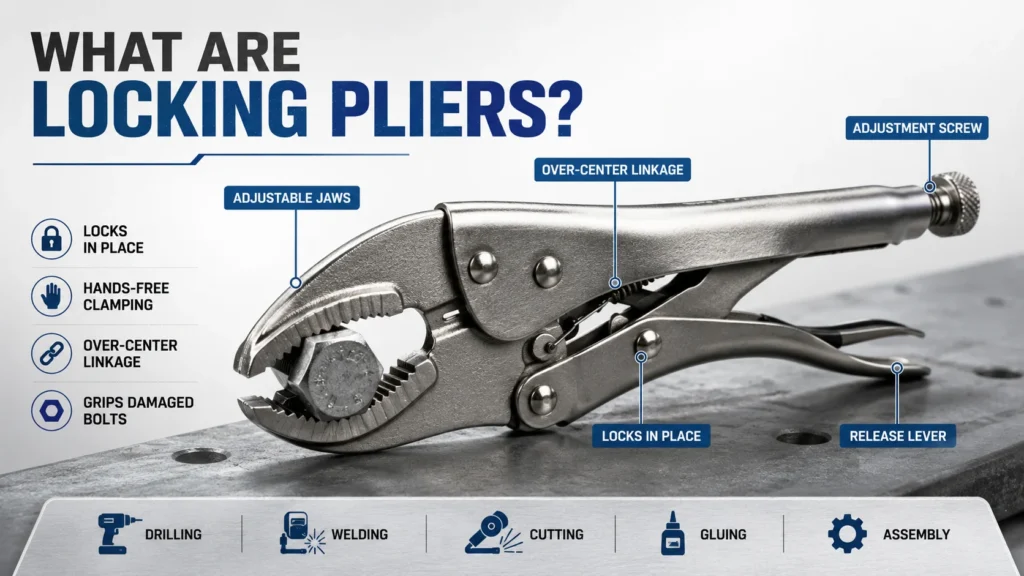
Locking pliers are hand tools with adjustable jaws and an over-center linkage that lets them clamp onto an object and remain closed. Unlike ordinary pliers, they do not depend on your hand continuing to squeeze the handles after the tool is locked.
That clamping ability makes them useful for holding parts during drilling, welding, cutting, gluing, or assembly. They can also grip an exposed damaged bolt or rounded component when a properly sized wrench no longer has enough surface to hold.
Vise-Grip, vice grip, and locking pliers: are they the same?
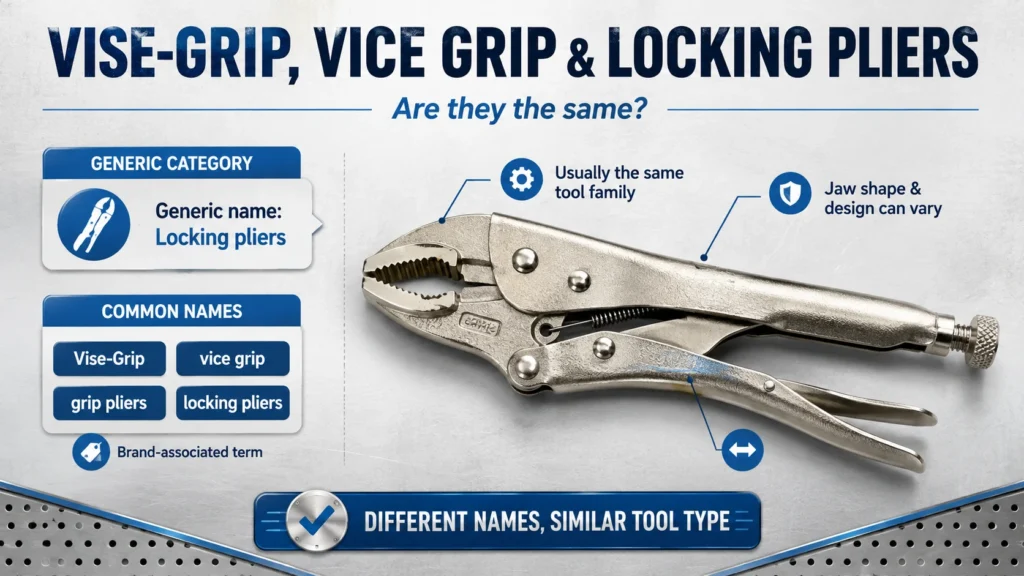
Locking pliers is the generic name for this type of tool. VISE-GRIP is an established brand name that became closely associated with locking pliers, much like other brand names that are often used conversationally for a whole product category.
In everyday workshop language, people may say vise grip, vice grips, vicegrip, grip pliers, pliers that lock, or vise grip pliers. These phrases usually mean locking pliers, but product quality, jaw shape, size, and release design can differ between manufacturers.
Brand distinction: an IRWIN VISE-GRIP locking pliers model is a specific branded product. “Locking pliers” remains the accurate general category when comparing tools from different makers.
How locking pliers work
The adjustment screw sets the approximate jaw opening and clamping force. When you squeeze the handles, the internal linkage moves just beyond its locking point. This over-center action holds the jaws closed until you pull the release lever.
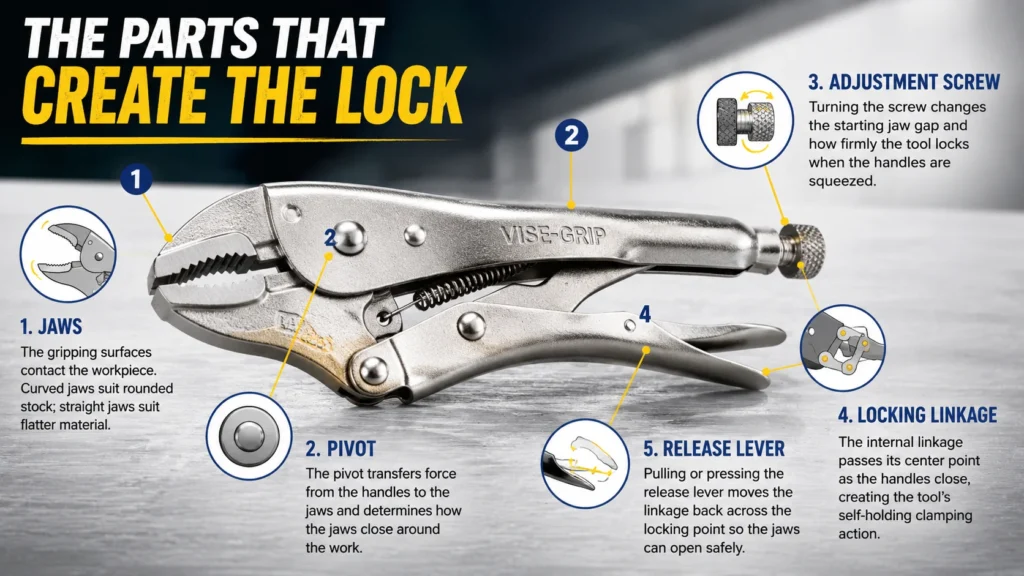
The parts that create the lock
1. Jaws
The gripping surfaces contact the workpiece. Curved jaws suit rounded stock; straight jaws suit flatter material.
2. Pivot
The pivot transfers force from the handles to the jaws and determines how the jaws close around the work.
3. Adjustment screw
Turning the screw changes the starting jaw gap and how firmly the tool locks when the handles are squeezed.
4. Locking linkage
The internal linkage passes its center point as the handles close, creating the tool’s self-holding clamping action.
5. Release lever
Pulling or pressing the release lever moves the linkage back across the locking point so the jaws can open safely.
Basic operating sequence
- Open the jaws fully and position them around the workpiece.
- Turn the adjustment screw until the jaws are slightly smaller than the object you need to grip.
- Squeeze the handles together until the tool locks with firm, controlled pressure.
- Check jaw contact before applying torque, drilling, cutting, or other force.
- Use the release lever to open the tool; do not force the handles apart.
Main types of locking pliers
Jaw shape changes where a locking plier makes contact and how securely it can hold a workpiece. Choose the jaw profile for the material first, then choose a size that gives enough reach and capacity without making the tool awkward to control.
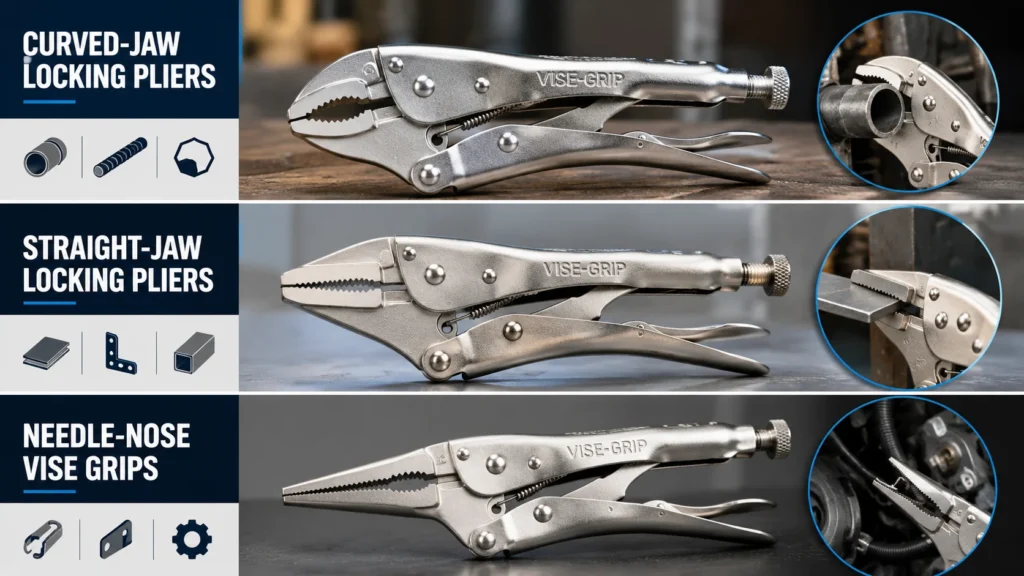
| Type | Best for | Watch for |
|---|---|---|
| Curved-jaw locking pliers | Pipes, rounded stock, general workshop gripping | Serrated jaws can mark finished surfaces |
| Straight-jaw locking pliers | Flat stock, square material, sheet metal | Less contact around round pipe or rod |
| Needle-nose locking pliers | Small parts, tight engine bays, recessed areas | Reach is prioritized over maximum clamping capacity |
| C-clamp locking pliers | Welding, fabrication, holding panels together | Bulky frame can limit access in tight areas |
| Sheet-metal locking pliers | Panel seams, bending tabs, fabrication work | Thin materials can crease if overtightened |
| Chain locking pliers | Large, irregular, or awkwardly shaped objects | Not a substitute for the correct pipe or strap wrench |
Curved-jaw locking pliers
Curved-jaw vise grip pliers are the familiar all-purpose pattern. Their rounded jaw shape wraps around pipe, rod, and irregular parts more effectively than a flat jaw. They are useful for general repair, but the teeth can bite deeply into soft metals, plating, paint, or polished fittings.
Straight-jaw locking pliers
Straight-jaw locking pliers offer broad contact on flat or square material. They are often useful for holding sheet stock, gripping small brackets, and clamping edges during layout or assembly. The key advantage is surface contact: a jaw that matches the workpiece is easier to control and less likely to slip.
Needle-nose vise grips for tight spaces
Needle nose vise grips have narrow, extended jaws for reaching small clips, thin tabs, and parts tucked behind other components. They are especially useful in crowded mechanical spaces, but the slender jaws are not intended to provide the same heavy-duty grip as a larger curved-jaw locking plier.
Common uses for locking pliers
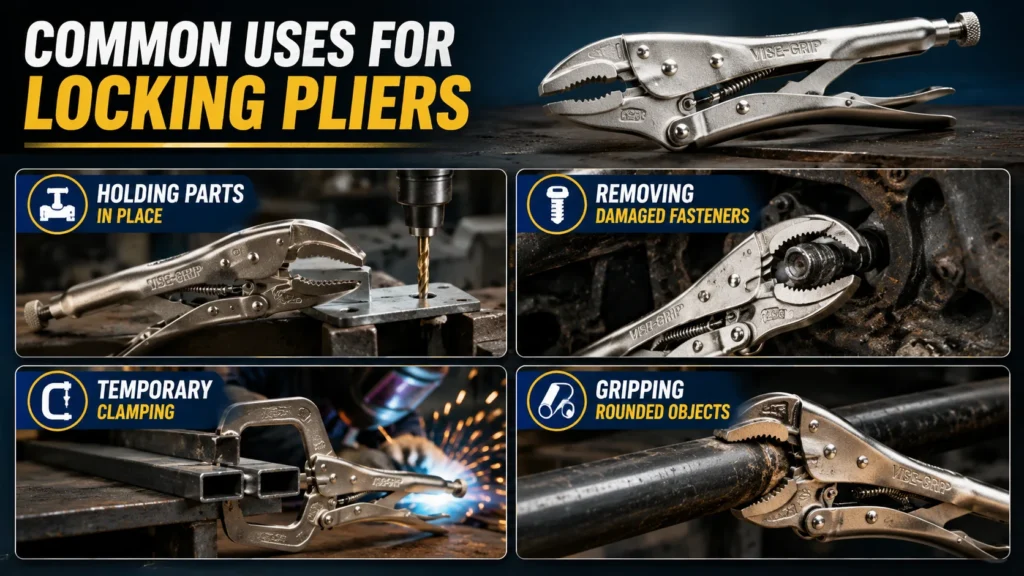
Locking pliers are most useful when a part needs to stay held in one position. They are a versatile support tool, not a universal replacement for correctly sized wrenches, clamps, or specialty pullers.
They can also help with light wire work: use a small, smooth section of the jaws to hold a wire while twisting or positioning it, and keep the grip controlled so the teeth do not nick the conductor. For a leaking pipe, locking pliers may serve as a temporary aid to hold a fitting or turn an accessible connection after the water is shut off; they are not a substitute for a proper pipe wrench, repair, or pressure test.
Holding parts in place
Clamp a bracket, small workpiece, or fastener while drilling, filing, measuring, or working with another hand tool.
Removing damaged fasteners
If enough of a rounded bolt or screw head is exposed, locking pliers may grip its outside. Success depends on access, material condition, and jaw contact.
Temporary clamping
C-clamp and sheet-metal versions can hold pieces together during welding, fabrication, gluing, or fit-up before permanent fastening.
Gripping rounded objects
Curved-jaw locking pliers can grip pipe, rod, and rounded fittings when the work does not require a surface-preserving tool.
How to adjust vise grips correctly
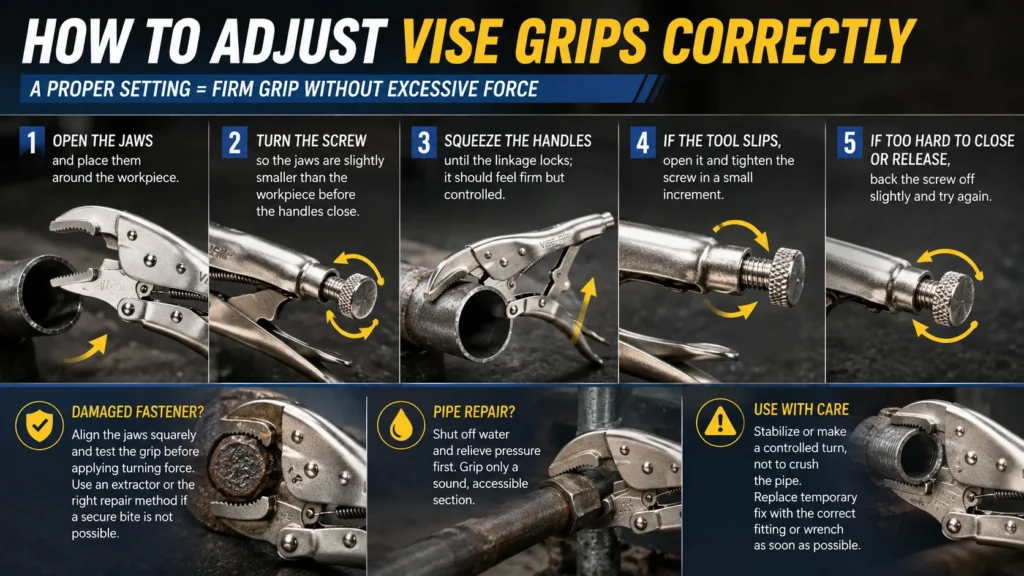
A proper setting is firm enough to resist movement but not so tight that closing the handles takes excessive force. Over-tightening makes the tool difficult to release and increases the risk of distorting thin material or damaging a finished surface.
- Open the jaws and place them around the workpiece.
- Turn the adjustment screw so the jaws are slightly smaller than the workpiece before the handles close.
- Squeeze the handles until the linkage locks; it should feel firm but controlled.
- If the tool slips, open it and tighten the screw in a small increment rather than forcing the handles.
- If the tool is excessively hard to close or release, back the screw off slightly and try again.
For a damaged fastener, align the jaws as squarely as possible and test the grip before applying turning force. If the tool cannot get a secure bite, move to a purpose-made extractor or the correct repair method rather than escalating force.
In an emergency pipe repair, shut off the water first and relieve pressure before using locking pliers. Pad finished fittings where possible, grip only a sound accessible section, and use the tool to stabilize or make a controlled turn, not to crush the pipe. Replace the temporary fix with the correct fitting or pipe wrench as soon as possible.
Locking pliers vs. regular pliers
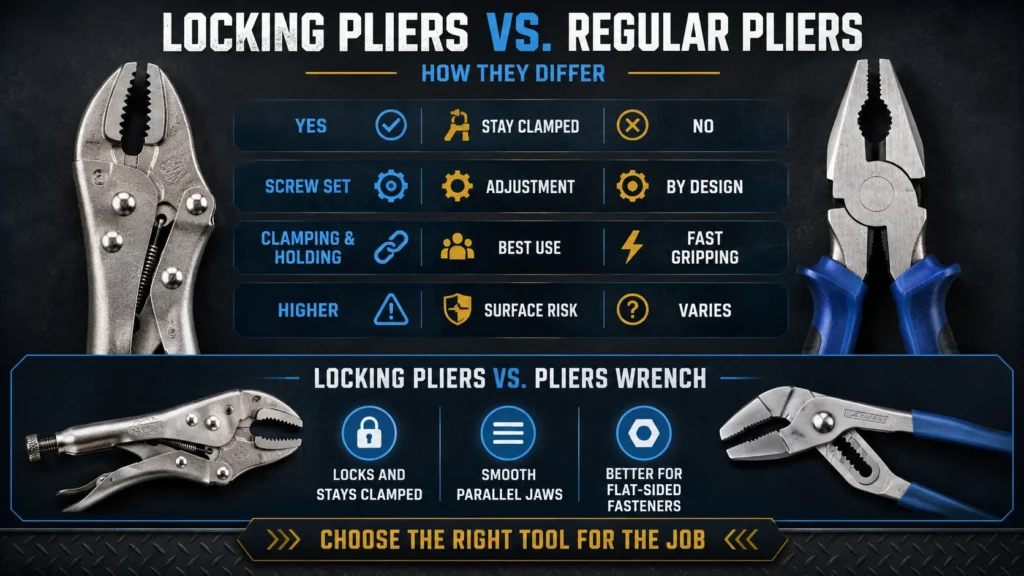
| Feature | Locking pliers | Regular pliers |
|---|---|---|
| Stay clamped | Yes, after the linkage locks | No, hand pressure is normally required |
| Adjustment | Screw sets jaw opening and clamping pressure | Depends on the plier design |
| Best use | Clamping, holding, and occasional damaged hardware | Fast, controlled gripping and repetitive hand work |
| Risk to surfaces | Higher when serrated jaws are set aggressively | Varies by jaw type and applied pressure |
Locking pliers vs. a pliers wrench
A locking wrench-style tool or pliers wrench is different from locking pliers. Pliers wrenches generally use smooth, parallel jaws and are controlled continuously by hand, making them better for flat-sided fasteners and finished fittings. Locking pliers clamp and stay locked, which is valuable for holding but can mark surfaces and round fastener corners when used as a substitute for a proper wrench.
How to use locking pliers without damaging the workpiece
Most locking pliers have serrated jaws because the teeth improve grip. Those same teeth can leave permanent marks, especially on chrome, paint, soft metals, plastic, or polished hardware. Controlled pressure and the right jaw profile matter more than simply clamping as hard as possible.

- Use only enough clamping force to hold the part securely.
- Avoid locking pliers on decorative, plated, painted, or polished surfaces when appearance matters.
- Use protective jaw covers or sacrificial material only when they do not make the grip unsafe.
- For nuts and fittings with clean flats, choose a correctly sized wrench, socket, or smooth-jaw pliers wrench instead.
Which locking pliers belong in a basic toolbox?
For general home and garage use, a medium curved-jaw locking plier is often the most versatile starting point. Add a long-nose locking plier if you frequently work in cramped spaces, or a C-clamp style if welding and fabrication are part of your projects. Compare jaw capacity, release action, handle comfort, and build quality rather than assuming any one brand is best for every task.
Common sizes are best understood by jaw capacity rather than handle length alone: small 4–5 inch models suit clips, light wire, and tight access; 7–10 inch models cover general repairs, brackets, and exposed fasteners; larger 10–18 inch or long-reach versions suit heavier stock and wider clamping. Check the manufacturer’s maximum opening and throat depth before buying, because nominal size varies between designs.
Practical buying rule
Choose the jaw shape for the jobs you actually do. A curved-jaw model is a useful all-rounder; needle-nose vise grips are an access tool; clamp styles are for holding work, not replacing a bench vise.
Safety notes for vise grip tools
Locking pliers store mechanical clamping force, so use them deliberately. The tool can release suddenly if its grip shifts, and excessive force can damage a fastener, break a component, or pinch hands in a cramped work area.
- Keep fingers clear of the jaws, linkage, and release lever while closing or opening the tool.
- Inspect the jaws, pivot, and handles; do not use cracked, bent, or badly worn locking pliers.
- Wear eye protection when cutting, grinding, welding, or working around seized and broken hardware.
- Do not use ordinary locking pliers on energized electrical conductors unless the specific tool is properly rated for that work.
- Follow vehicle, machinery, plumbing, and equipment manufacturer procedures for pressurized systems and safety-critical repairs.
Frequently asked questions
Can locking pliers remove a stripped bolt?
Sometimes. Locking pliers can help when enough of the bolt head or stud is exposed for the jaws to clamp tightly. They are less effective on recessed fasteners, severely corroded hardware, or bolts with little remaining material. Use a dedicated extractor when the tool cannot get a secure grip.
Why are my vise grips hard to release?
They are usually adjusted too tightly. Open the tool, loosen the adjustment screw slightly, and lock it again. A correctly adjusted tool should clamp firmly but still release using the built-in lever without excessive force.
What size locking pliers should I buy?
A medium general-purpose curved-jaw model is a practical first choice for household and garage work. Choose a smaller model for confined spaces and delicate parts, or a larger model only when its jaw capacity and handle length match the job.
Are locking pliers a replacement for a wrench?
No. Locking pliers can be helpful for an emergency grip on damaged hardware, but a correctly sized wrench or socket is safer for normal fastener work. Serrated jaws can slip, round corners, and damage protective finishes.