What are rivets? They are mechanical fasteners that permanently join materials by forming a second retaining head. Learn how rivets work, where they are used, and how to select the right type, size, grip range, and material.
What is a rivet, and how does it work?
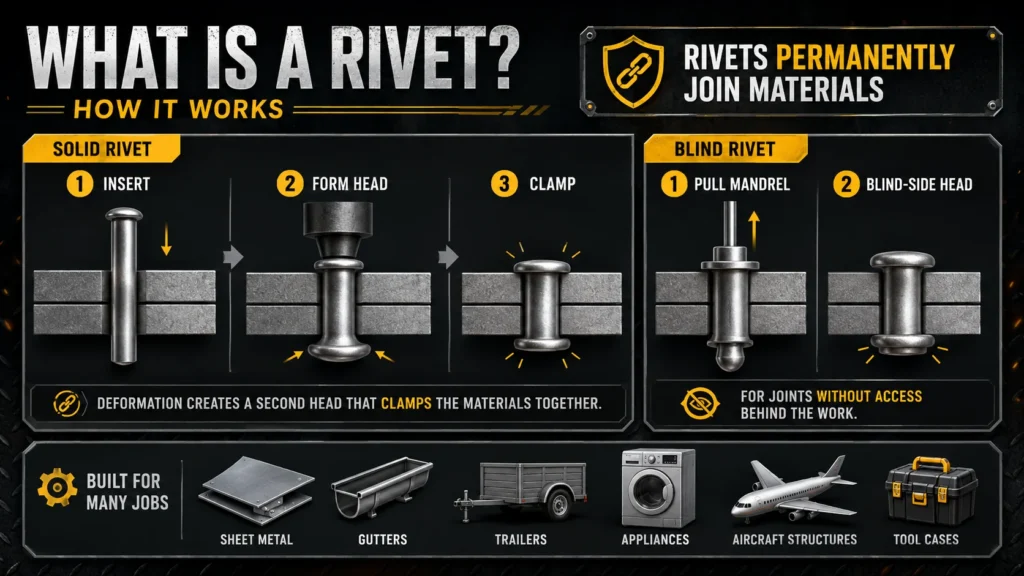
A rivet is a mechanical fastener used to permanently join two or more pieces of material. Most rivets pass through aligned holes, then are deformed so a second head forms on the opposite side. That deformation clamps the materials together and resists movement across the joint.
You will find rivets in sheet-metal panels, gutters, trailers, appliances, signs, aircraft structures, tool cases, furniture, and leather goods. Their suitability depends on the joint design: loads may try to shear the rivet sideways, pull it apart in tension, or work it loose through vibration.
The beginner-friendly picture
The rivet’s manufactured head stays on the accessible side. Installation creates a formed head—often called a shop head, on the far side. With a blind rivet, a mandrel pulls the body outward and forms that blind-side head without needing access behind the work.
Main parts of a rivet
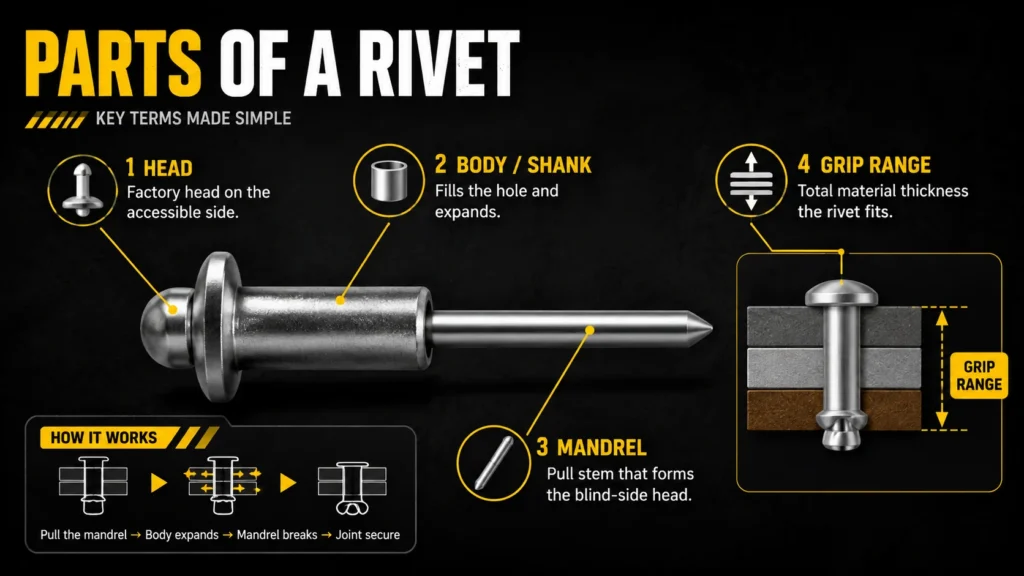
Names vary slightly by product, but understanding these terms makes manufacturer data sheets and tool instructions much easier to use.
Head
The factory-made flange or head that bears against the accessible face of the joint.
Body / shank
The shaft that fills the prepared hole and is upset or expanded during installation.
Mandrel
The pull stem inside a blind rivet. A rivet tool grips it, forms the blind-side head, then breaks it at a designed point.
Grip range
The permitted combined thickness of every layer in a blind-rivet joint. It is not the same as rivet length.
Common types of rivets
The right rivet is determined by access, load, material, environment, approved joint design, and the exact installation tool, not simply by what is cheapest or easiest to find.
| Rivet type | Access needed | Typical use | Important note |
|---|---|---|---|
| Blind / pop rivet | One side | DIY sheet metal, gutters, light panels, appliances | “Pop rivet” is common informal language; check exact product ratings. |
| Solid rivet | Both sides | Structural metalwork, aircraft, heavy fabrication | Requires suitable forming tools and a designed joint. |
| Tubular / semi-tubular | Usually both sides | Hinges, luggage, mechanisms, manufactured goods | Hollow end reduces installation force. |
| Structural blind rivet | One side | Specified higher-load blind-side joints | Not every blind rivet is structural or approved for critical work. |
What is a pop rivet?
A pop rivet is generally a blind rivet installed with a hand, battery, pneumatic, or hydraulic rivet tool. Insert the rivet through the holes, seat its head flat, and pull the mandrel until the rivet body expands behind the material and the mandrel breaks. The term “POP” may also refer to a brand, so product labeling can vary.
What is a solid rivet?
A solid rivet has a solid shank and a manufactured head. Its tail is formed into a shop head using appropriate tools, normally with access to both sides. Solid rivets can provide excellent performance in correctly engineered joints, but their use is not a shortcut for automotive, structural, or aerospace repairs that require approved procedures.
How to choose the correct rivet size
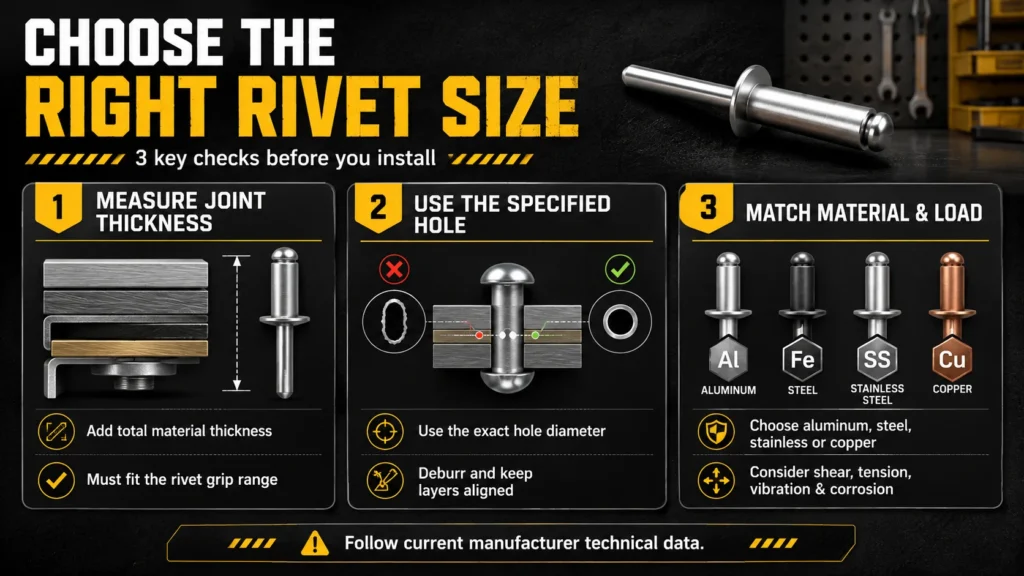
Selecting a rivet starts with the joint, not the rivet-gun nozzle. For every product, follow the manufacturer’s current technical data for approved hole diameter, grip range, shear and tensile ratings, installation tool, and substrate compatibility.
Measure the joint thickness
Add the thickness of every sheet, bracket, washer, or layer being clamped. For a blind rivet, that number must fall within the manufacturer’s grip range. A rivet with too little or too much grip can form badly or leave a loose joint.
Use the specified hole diameter
A hole that is oversized, rough, elongated, or poorly aligned can reduce support around the shank and encourage spinning or looseness. Drill or prepare the exact hole called for, deburr it where appropriate, and keep the materials firmly together.
Match material and loading
Aluminum, steel, stainless steel, and copper offer different strength, weight, and corrosion characteristics. Consider whether the joint sees shear, tension, vibration, weather, heat, or repeated service before choosing.
Installing and removing rivets
For a simple thin-aluminum-sheet repair, prepare aligned holes to the rivet maker’s specified size, remove sharp burrs, clamp the sheets tightly, insert a compatible blind rivet with the correct grip range, and keep the rivet head seated flat. Operate the correct rivet tool until the mandrel breaks as designed. Inspect both sides before putting the joint into service.
Can rivets be removed or reused?
Rivets are generally removed destructively and are not reusable. A common method is to center-punch the head, drill only enough to release it with an appropriately sized bit, then drive out the remaining body carefully. Protect surrounding material, wiring, glazing, or panels. If the hole is damaged, do not automatically install a larger rivet—use an approved repair method for that application.
Rivets vs. screws and bolts
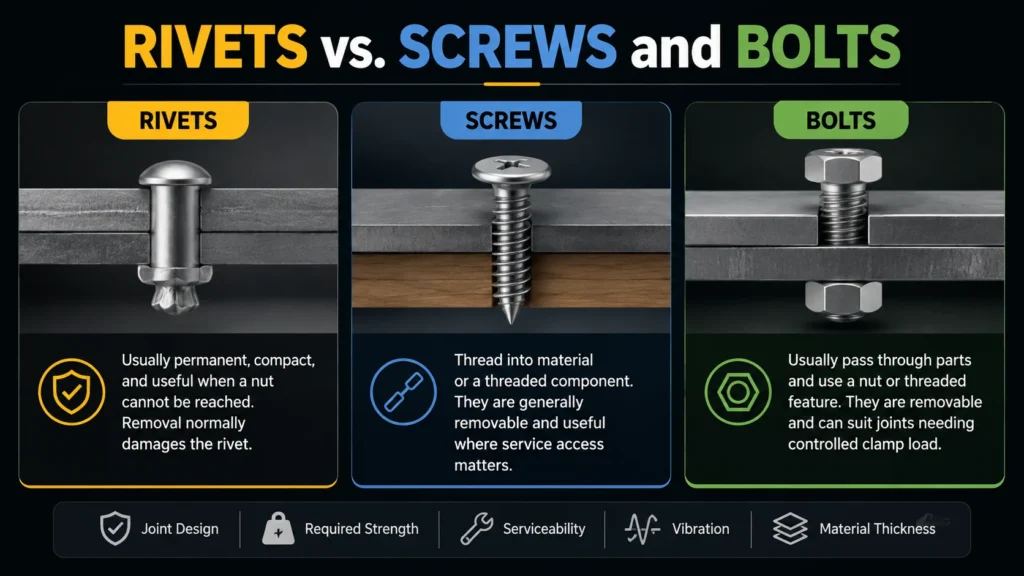
No fastener wins every job. The best choice depends on joint design, access, serviceability, vibration, material thickness, required strength, and the specifications governing the work.
Rivets
Usually permanent, compact, and useful where a nut cannot be reached. Removal normally damages the rivet.
Screws
Thread into material or a threaded component. They are generally removable and useful where service access matters.
Bolts
Usually pass through parts and use a nut or threaded feature. They are removable and can suit joints needing controlled clamp load.
Rivet FAQs and common problems
Are rivets stronger than screws?
Not automatically. Strength depends on the exact rivet or screw, diameter, material, hole quality, joint geometry, loading direction, and installation. A correctly specified rivet can be highly effective in shear, while a removable screw or bolt may be better where serviceability or clamp-load control is required. Compare manufacturer ratings for the actual products and joint.
Why did my rivet become loose or spin?
Common causes include an oversized or worn hole, wrong grip range, poor alignment, an incomplete formed head, insufficient clamping during installation, soft or damaged sheet material, or load beyond the rivet’s intended use. Remove and inspect the failed joint rather than simply pulling another rivet into the same damaged hole.
Are blind rivets and pop rivets the same thing?
In everyday workshop speech, “pop rivet” commonly means a blind rivet: a rivet installed from one side with a pulling tool and mandrel. However, blind rivets come in many materials, head styles, grip ranges, and performance classes. Check the technical data instead of assuming all pop rivets are interchangeable.