

Choose water pump pliers by jaw capacity, jaw shape, adjustment style and access—not just the number printed on the handle.
For routine maintenance and plumbing, a mid-size pair with secure adjustment and a capacity that covers your common fittings is often the sensible first buy. Add a compact pair for tight spaces and choose smooth jaws when finished surfaces must stay unmarked.
What are water pump pliers?
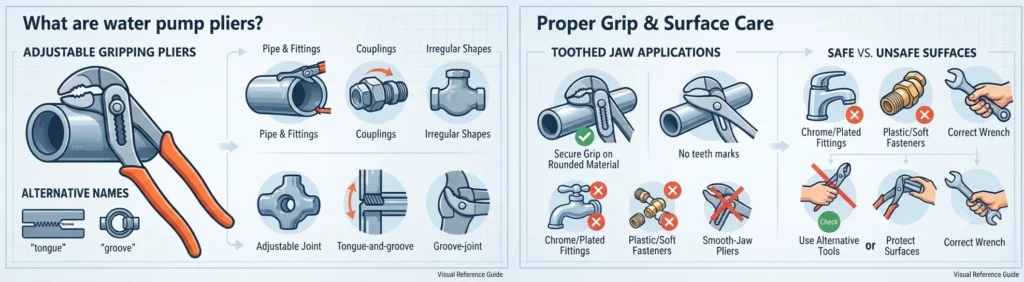
Water pump pliers are adjustable gripping pliers designed for pipe, fittings, couplings and irregular shapes. They are commonly called tongue-and-groove or groove-joint pliers. Those names describe a family of tools, not one identical jaw design or adjustment system.
Their toothed jaws can hold rounded material more securely than ordinary combination pliers. That grip is useful, but it can mark chrome, plated fittings, plastic and soft fasteners. For those surfaces, use smooth-jaw pliers, protective jaw covers, or the correct wrench instead.
Choose size by jaw capacity first
Overall length affects leverage and reach, while maximum jaw capacity tells you what can physically fit between the jaws. Check the exact manufacturer specification for the model you are considering; two pliers of similar length can have different openings and head shapes.
| Typical length | Best for | Trade-off |
|---|---|---|
| Compact: 7–8 in | Appliance work, hose clamps, under-sink access and small fittings. | Easy to position, but limited opening and leverage. |
| General purpose: 10 in | Routine plumbing repairs, HVAC work and general maintenance. | Often the most versatile single-pair choice. |
| Large: 12–16 in | Wider pipe, couplings and fittings where access is open. | More leverage, but bulky in cabinets and crowded plant rooms. |
Match the jaw shape to the workpiece
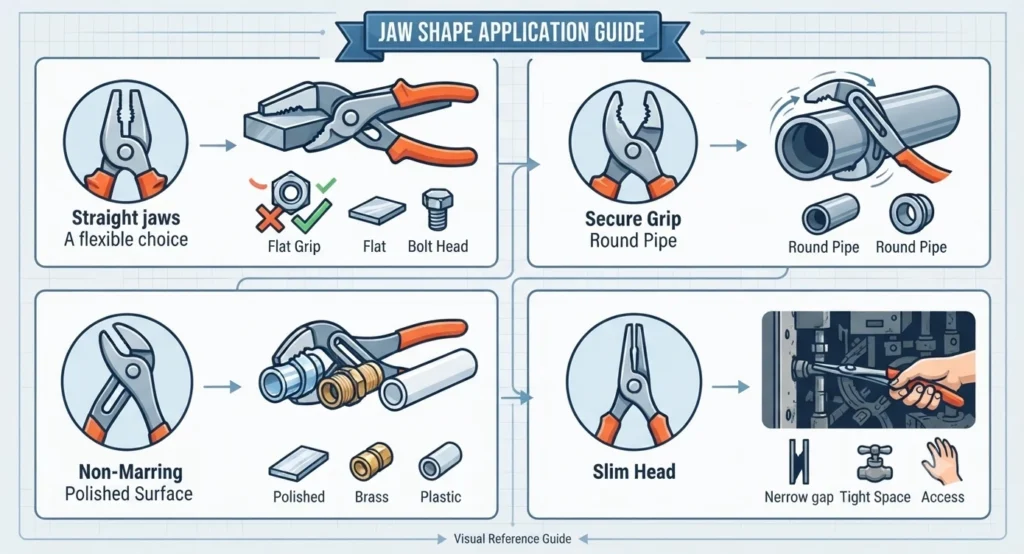
Good grip comes from full, stable contact. Position the jaws so the load sits deep in the jaw profile rather than at the tips. If the pliers rock, the teeth barely engage, or the handles need extreme force, stop and choose a better-fitting tool.
Straight jaws
A flexible choice for general gripping and flat-sided components. They can turn some nuts, but a correctly sized wrench is less likely to round a finished fastener.
Curved or V-jaws
Designed to wrap more securely around round pipe and fittings. The extra contact can reduce slipping when the selected opening and jaw position are correct.
Smooth jaws
Best where chrome, brass, PVC or painted surfaces must stay presentable. They trade aggressive bite for protection, so use controlled force and good jaw contact.
Slim jaws
Useful behind panels, near valves and in crowded service work. A slim head improves access, but does not automatically mean greater capacity.
Traditional groove joint or push-button adjustment?
Traditional tongue-and-groove designs are simple and familiar, usually adjusted by opening the handles and moving the pivot between grooves. Push-button designs can be set directly against the workpiece and may be quicker when moving between sizes. Neither mechanism is automatically better: assess how securely it holds, how easily you can operate it with gloves, and whether it remains stable under load.
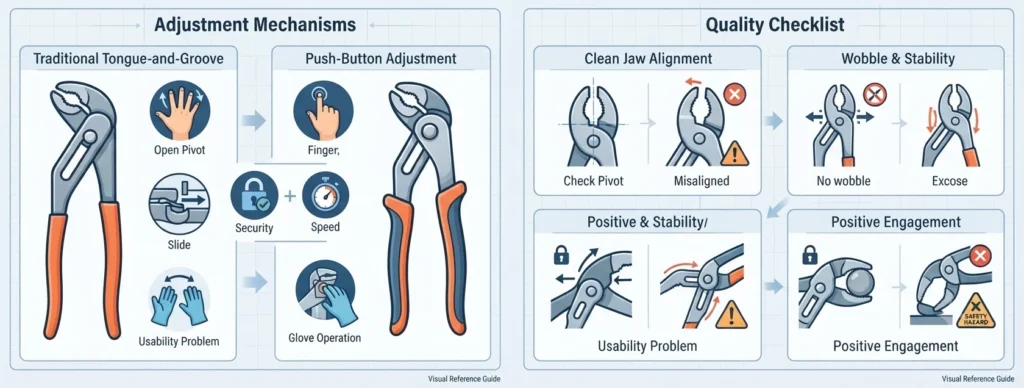
Check the joint before buying
Open and close the tool through its full range. Look for clean jaw alignment, a joint that does not wobble excessively, and positive engagement at each setting. A mechanism that shifts while gripping is a safety and usability problem—not a feature to work around.
A practical choice by job
One pair can cover many jobs, but a small set usually makes more sense for regular trade work. Think about the fittings you touch most, the finish you must protect, and the space around the work—not brand recognition alone.
Plumbing repairs
A 10-inch toothed V-jaw or curved-jaw pair is a useful general option for unfinished pipe and fittings. Keep a smooth-jaw alternative for exposed chrome and decorative fixtures.
HVAC installation
Prioritise a compact or slim-head design for tight service clearances. Confirm capacity for the clamps, fittings and hardware you actually encounter.
Automotive maintenance
Compact water pump pliers can help with hose clamps and irregular parts. Use a socket, spanner or flare-nut wrench on fasteners that need precise engagement.
General DIY
Start with a mid-size pair that feels comfortable and reaches your common opening range. Do not force it onto large pipe just because it is the only pair available.
Use, protect and maintain them properly
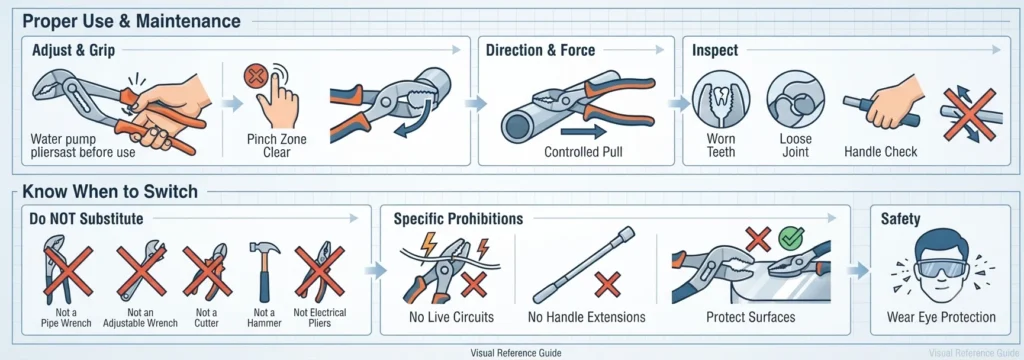
Adjust before applying force, keep fingers clear of the pinch zone, and keep the workpiece deep in the jaws. Pull in a controlled direction where possible. Inspect teeth, pivot movement and handle grips regularly; worn teeth, bent jaws or a loose joint increase the chance of a sudden slip.
Know when to use another tool
Water pump pliers are gripping tools, not a substitute for a pipe wrench, adjustable wrench, cutter, hammer or insulated electrical tool. Do not use ordinary pliers on live circuits, add handle extensions, or use toothed jaws where surface damage is unacceptable. Wear eye protection when a fitting may break or release debris.
Water pump pliers: common questions
Are water pump pliers the same as tongue-and-groove pliers?
The names are often used interchangeably. Both describe adjustable gripping pliers, but jaw profiles, adjustment methods, capacities and handle designs vary significantly between models.
Why do water pump pliers slip?
Common causes include choosing an opening that is too large, gripping at the jaw tips, using worn teeth, applying force at an awkward angle, or using a jaw shape that does not suit the workpiece. Reposition or select another tool rather than squeezing harder.
Can water pump pliers replace a pipe wrench?
Not always. Water pump pliers are versatile for lighter gripping and confined access, while a correctly sized pipe wrench is designed for higher-torque pipe work. Follow the fitting and manufacturer requirements, especially on finished or delicate materials.