
You look at your tire and see something like P225/60R16 98H — but what does it all mean? Understanding how to read tires info is easier than you think. Every number and letter on your tire sidewall tells you something important about its size, capacity, and safety limits. This guide breaks down tire numbers explained in simple terms, so you can buy the right tires, stay safe on the road, and never feel confused at the tire shop again.
Where to Find Information on Your Tire Sidewall
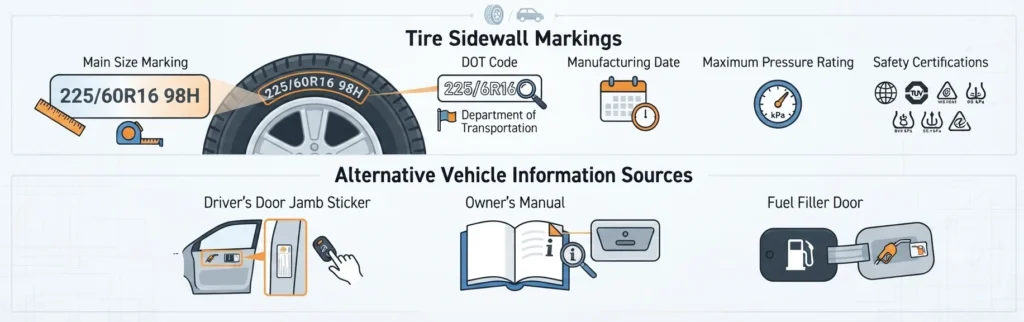
Your tire’s most important information is printed directly on the sidewall — that’s the smooth rubber surface between the tread and the wheel rim. Look for a series of numbers and letters molded into the rubber. The main size marking (like 225/60R16 98H) is usually the largest and easiest to spot. You’ll also find the DOT code, manufacturing date, maximum pressure rating, and various safety certifications.
You can also find your vehicle’s recommended tire size in three other places: the driver’s door jamb sticker (open your driver’s door and look at the frame), your owner’s manual (under ‘Tire Information’ or ‘Specifications’), and sometimes inside the fuel filler door. These sources tell you exactly what tire size your vehicle manufacturer recommends — which is the safest starting point when buying replacements.
How to Read Tire Numbers (Full Example Explained)
Let’s decode a common tire marking: P225/60R16 98H. Each part gives you specific information about the tire. Here’s what every number and letter means:
| Marking | Example | Meaning |
|---|---|---|
| P | P225/60R16 | Passenger vehicle tire |
| 225 | Width | Tire width in millimeters |
| 60 | Aspect Ratio | Sidewall height is 60% of width |
| R | Construction | Radial construction |
| 16 | Diameter | Wheel diameter in inches |
| 98 | Load Index | Maximum weight capacity (1,653 lbs) |
| H | Speed Rating | Max safe speed (130 mph) |
Once you understand this format, you can read any tire. The pattern is always the same: vehicle type prefix (optional), width/aspect ratio, construction type, wheel diameter, then load index and speed rating. Every tire sold follows this international standard, regardless of brand.
Tire Size Numbers Explained in Detail
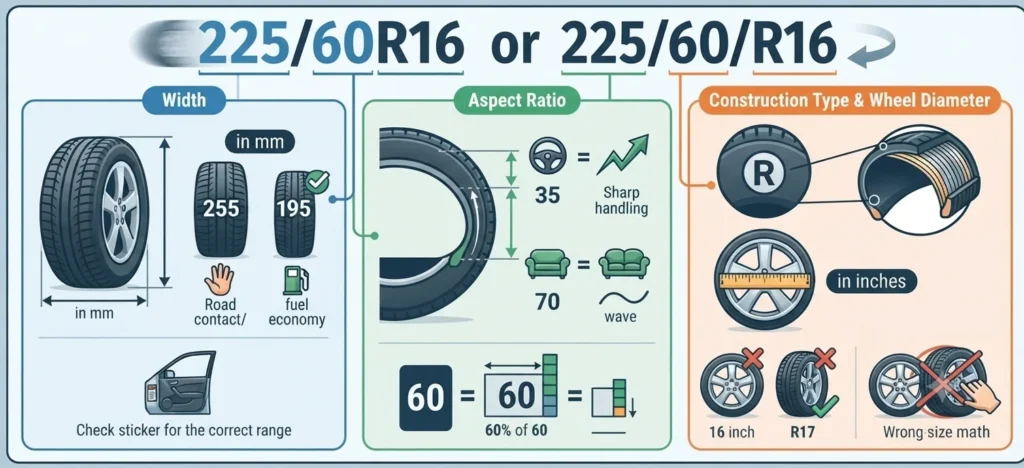
Width (first number): The three-digit number (like 225) is your tire’s width in millimeters, measured from one sidewall to the other when properly mounted. A wider tire (255) provides more road contact and grip, while a narrower tire (195) typically offers better fuel economy. Your vehicle is designed for a specific width range — check your door jamb sticker.
Aspect Ratio (second number): The two-digit number after the slash (like 60) is the sidewall height expressed as a percentage of the width. A 60 means the sidewall height is 60% of 225mm = 135mm. Lower numbers (like 35 or 40) mean a shorter, sportier sidewall with sharper handling but a firmer ride. Higher numbers (like 65 or 70) mean taller sidewalls with more cushioning and comfort.
Construction Type & Wheel Diameter: The letter R means radial construction — virtually all modern passenger tires are radial. The final number (like 16) is the wheel diameter in inches. This must match your wheel exactly. A tire marked R16 only fits a 16-inch wheel. Installing the wrong diameter is physically impossible in most cases, but always double-check when ordering online.
Tire Load Index and Speed Rating Explained
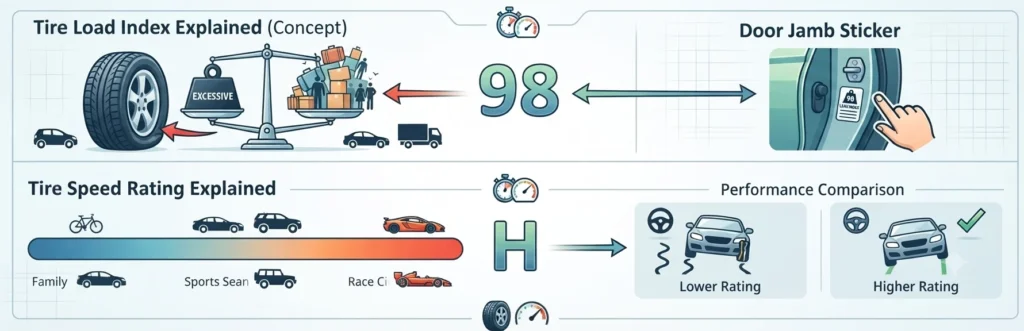
Load Index: The number after the wheel diameter (like 98) tells you the maximum weight each tire can safely carry. A load index of 98 means 1,653 lbs per tire. To find your vehicle’s minimum requirement, check your door jamb sticker. Never install tires with a lower load index than specified — this creates a dangerous overloading situation, especially when carrying passengers or cargo.
Speed Rating: The letter at the end (like H) indicates the maximum speed the tire is engineered to handle safely. Common ratings include S (112 mph), T (118 mph), H (130 mph), V (149 mph), and W (168 mph). Your replacement tires should match or exceed your vehicle’s original speed rating. A higher rating is always safe; a lower rating may compromise handling at highway speeds.
💡 Safety Tip: Never downgrade your tire’s load index or speed rating below the vehicle manufacturer’s specification. Upgrading to a higher rating is fine, but going lower compromises safety — especially during emergency maneuvers or heavy braking at speed.
DOT Code and Tire Manufacturing Date
Every tire has a DOT (Department of Transportation) code on the sidewall. The last four digits of this code reveal the manufacturing date. For example, DOT XXXX 2419 means the tire was manufactured in the 24th week of 2019. The first two digits are the week number (01–52), and the last two digits are the year.
Why does this matter? Tire rubber degrades over time, even if the tire has never been used. Most tire manufacturers and safety organizations recommend replacing tires that are 6–10 years old, regardless of tread depth. When buying new tires, check the DOT date — you want tires manufactured within the last 12–18 months. Avoid purchasing tires that have been sitting in a warehouse for several years.
Common Tire Markings You Should Know
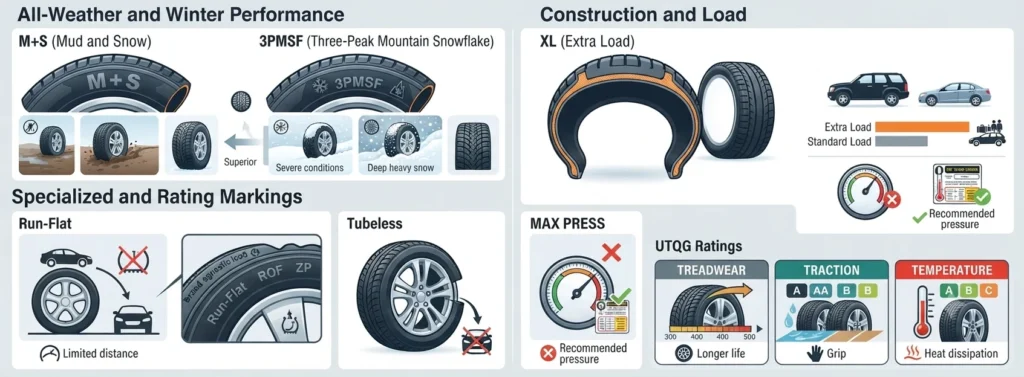
Beyond the size code, you’ll find other helpful markings: M+S (Mud and Snow) means the tire has a tread pattern designed for light mud and snow — common on all-season tires. The 3PMSF symbol (mountain with snowflake) means the tire meets severe snow performance standards — much better than M+S alone for winter driving. XL means Extra Load — the tire has reinforced construction for heavier vehicles.
Other markings include: Run-Flat (or RSC, ROF, ZP depending on brand) means the tire can travel a limited distance after losing air pressure. Tubeless means the tire doesn’t require an inner tube — nearly all modern car tires are tubeless. MAX PRESS indicates the maximum cold inflation pressure (not your recommended pressure — that’s on your door sticker). TREADWEAR, TRACTION, and TEMPERATURE are UTQG ratings that help compare tire longevity and performance across brands.
Frequently Asked Questions
Can I put a different tire size on my car?
You can change tire size within a limited range, but the overall diameter should stay within 3% of the original. Changing size affects speedometer accuracy, fuel economy, and can trigger warning lights. Always consult your vehicle manufacturer’s recommendations or a tire professional before changing from the original size.
What does the R mean in tire size?
The R stands for Radial construction. This means the tire’s internal layers (plies) run radially — perpendicular to the direction of travel. Virtually all modern passenger car tires are radial. You may rarely see D (diagonal/bias-ply) on trailer tires or vintage vehicles.
How do I know when my tires are too old?
Check the DOT date code (last four digits on the sidewall). Tires older than 6 years should be inspected annually by a professional. Most manufacturers recommend replacement at 10 years maximum, regardless of appearance or tread depth. Rubber compounds degrade with age, heat, and UV exposure, making old tires prone to sudden failure.
Does a higher speed rating mean a better tire?
Not necessarily better overall — just different priorities. Higher speed-rated tires (V, W, Y) typically offer better handling and grip at high speeds, but they may wear faster and ride slightly firmer. For everyday driving, matching your vehicle’s original speed rating provides the best balance of safety, comfort, and tire life.
Where is the recommended tire pressure for my car?
Your recommended tire pressure is on the sticker inside the driver’s door jamb — NOT on the tire itself. The number printed on the tire sidewall (MAX PRESS) is the maximum pressure the tire can handle, not your ideal pressure. Always use the vehicle manufacturer’s recommendation, which accounts for your car’s weight, handling, and comfort.