
Learn how to tell if your catalytic converter is bad, understand the tests that confirm failure, and avoid replacing an expensive part unnecessarily.
Is your check-engine light on, your acceleration sluggish, or your exhaust producing an unusual smell? If you’re asking “how do I tell if my catalytic converter is bad,” you’re not alone — it’s one of the most common diagnostic questions vehicle owners face. The challenge is that many catalytic converter symptoms overlap with other engine, sensor, and exhaust faults.
This guide covers the symptoms of a bad catalytic converter, explains the professional tests used to confirm failure, and helps you avoid an expensive replacement before ruling out other causes. Whether you’re dealing with a P0420 code or simply noticing reduced power, we’ll walk you through what to check first.
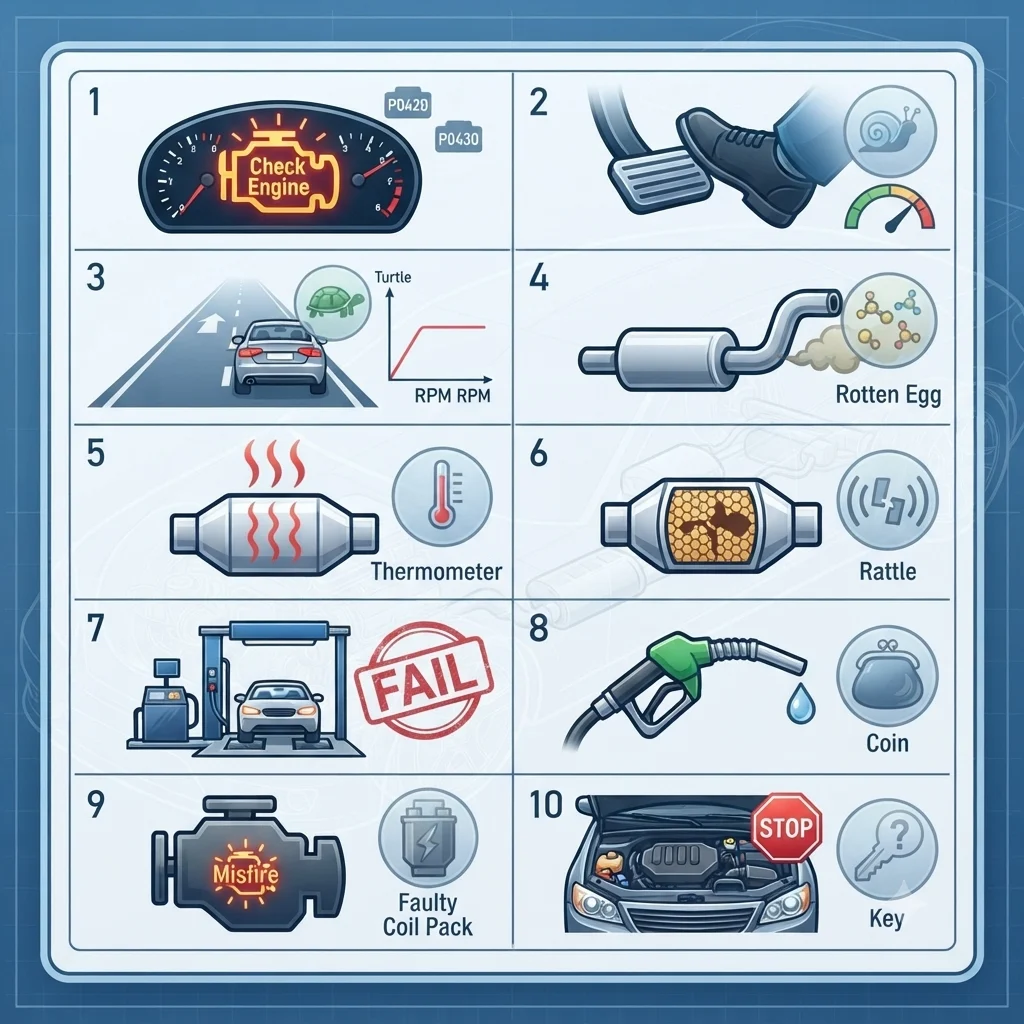
Symptoms of a Bad Catalytic Converter — Quick Checklist
- Check-engine light illuminated (often with P0420 or P0430 code)
- Weak or sluggish acceleration, especially under load
- Loss of power at higher engine speeds
- Sulphur or rotten-egg smell from the exhaust
- Excessive heat underneath the vehicle near the converter
- Rattling noise from underneath the car, especially on startup
- Failed emissions or smog inspection
- Reduced fuel economy
- Engine misfires or rough running
- Engine stalling or difficulty starting in severe restriction cases
What Does a Catalytic Converter Do?
The catalytic converter is an emissions-control device located in your exhaust system, typically between the exhaust manifold and the muffler. Inside the converter is a honeycomb structure coated with precious metals — platinum, palladium, and rhodium — that trigger chemical reactions converting harmful exhaust gases (carbon monoxide, hydrocarbons, and nitrogen oxides) into less harmful substances (carbon dioxide, water vapour, and nitrogen).
The converter must reach operating temperature (around 400–600°F) to function effectively. When the catalyst material degrades, becomes contaminated, melts, or breaks apart, it can no longer perform these chemical reactions efficiently — and your vehicle’s oxygen sensors will detect the reduced performance.
How to Tell If Your Catalytic Converter Is Bad — Detailed Symptoms
1. Check-Engine Light and Catalyst Efficiency Codes
The most common trigger is a P0420 code — “Catalyst System Efficiency Below Threshold (Bank 1).” This code means the downstream oxygen sensor is detecting activity too similar to the upstream sensor, indicating the converter isn’t cleaning exhaust gases effectively. However, this code can also be caused by a failing oxygen sensor, an exhaust leak before the downstream sensor, or an engine running rich. A P0420 alone does not confirm the converter is defective — further testing is required.
2. Poor Acceleration and Loss of Power
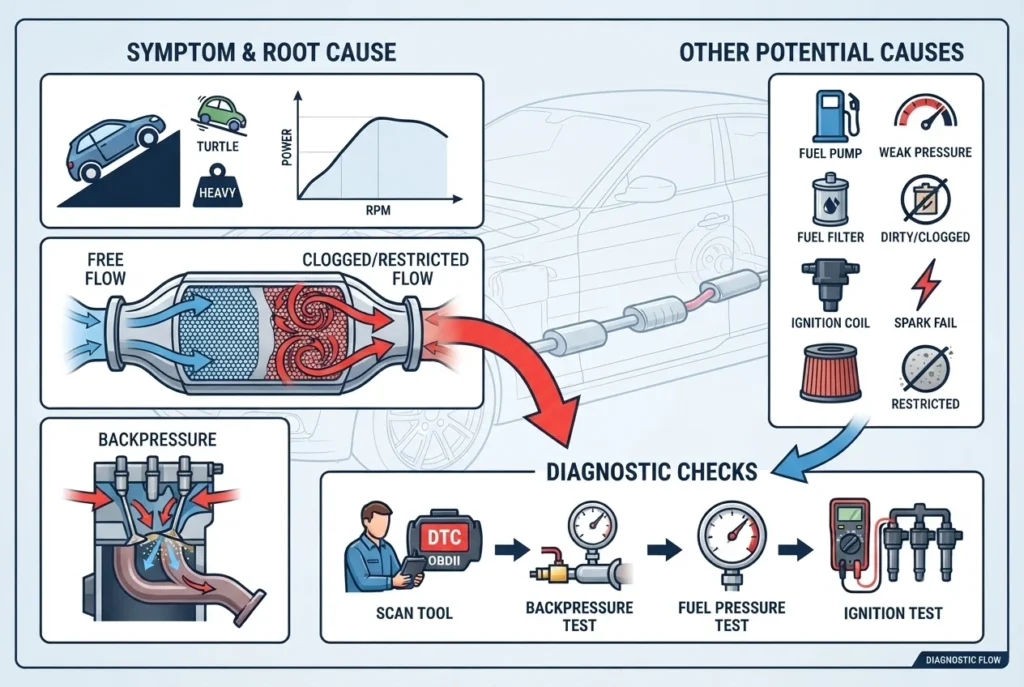
A clogged or restricted catalytic converter prevents exhaust gases from flowing freely. This creates backpressure that the engine must work against, resulting in sluggish acceleration — particularly noticeable when merging onto highways or climbing hills. The sensation feels like the engine is being “held back.” Other causes include fuel pump problems, clogged fuel filter, failing ignition components, or a restricted air filter.
3. Sulphur or Rotten-Egg Exhaust Smell
A properly functioning converter processes hydrogen sulphide into odourless sulphur dioxide. When the catalyst material degrades, it can no longer complete this conversion, allowing the sulphur smell to exit the tailpipe. This smell may also indicate the engine is running excessively rich (too much fuel), which can itself damage the converter over time. If the smell appeared suddenly, check for ignition misfires or fuel-system faults first.
4. Rattling Noise from Underneath the Vehicle
The ceramic honeycomb substrate inside the converter can crack or break apart — especially after overheating from misfires or after physical impact. Loose pieces of catalyst material rattle inside the housing, producing a metallic sound most noticeable during cold starts or when tapping the converter casing. Note that a loose heat shield can produce a similar rattle and is far less expensive to fix, so have the source confirmed before assuming internal damage.
5. Excessive Heat Underneath the Vehicle
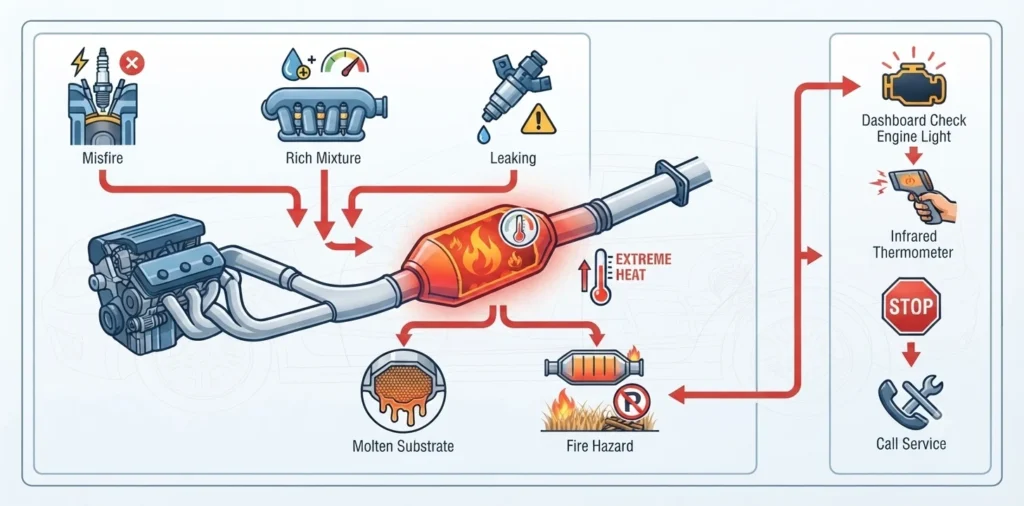
When unburned fuel enters the converter — due to engine misfires, a rich mixture, or leaking injectors — it ignites inside the catalyst, generating extreme temperatures that can glow red. This overheating can melt the substrate and is a fire hazard if the vehicle is parked over dry grass or combustible material. If you notice unusual heat or discoloration of the converter housing, stop driving and investigate immediately.
6. Reduced Fuel Economy
A restricted converter forces the engine to work harder, increasing fuel consumption. The engine management system may also enrich the fuel mixture in response to abnormal exhaust readings, compounding the problem. However, poor fuel economy has many possible causes — tyre pressure, driving habits, air filter condition, oxygen sensors — so this symptom alone is not diagnostic.
7. Failed Emissions Test
If your vehicle fails a smog or emissions inspection with elevated tailpipe readings for hydrocarbons (HC) or carbon monoxide (CO), the converter may not be performing its job. However, an engine fault causing excessive raw emissions can overwhelm even a healthy converter — so the engine must be running correctly before the converter can be blamed.
8. Engine Stalling or Difficulty Starting
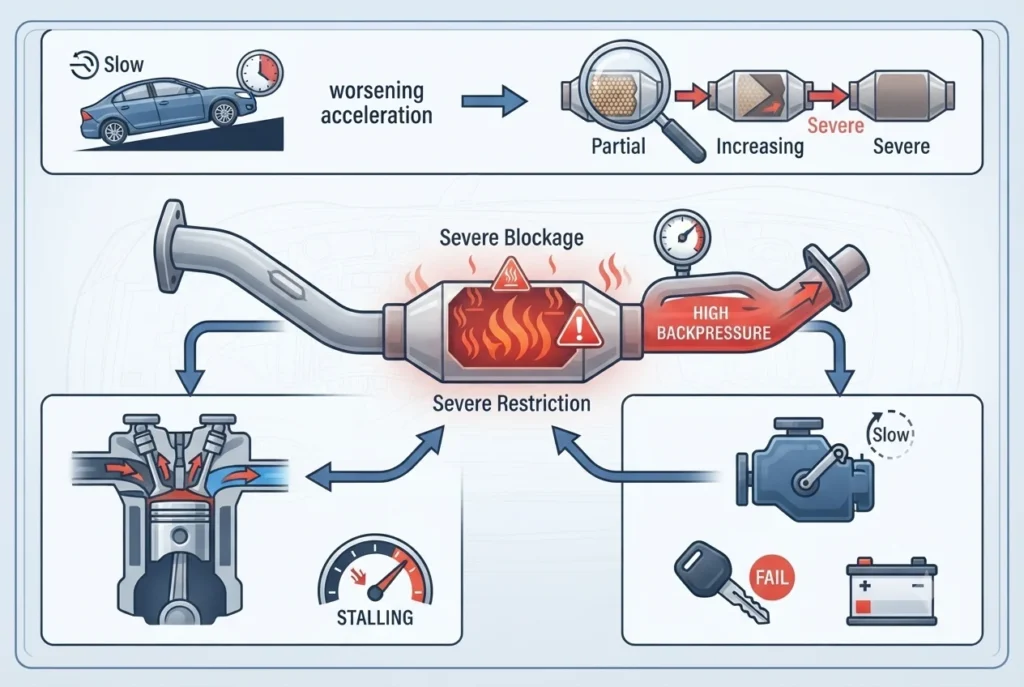
In severe cases of restriction, exhaust backpressure becomes so high that the engine cannot expel exhaust gases, causing stalling or an inability to start. This typically only occurs when the converter is nearly completely blocked — a condition that develops gradually and is usually preceded by months of worsening acceleration.
Diagnostic Comparison: Converter vs. Other Faults
| Symptom or Finding | Possible Converter Issue | Other Possible Causes |
|---|---|---|
| P0420 code | Low catalyst efficiency | Oxygen sensor, exhaust leak, fuel-control issue |
| Poor acceleration | Restricted exhaust flow | Fuel pump, ignition, airflow problem |
| Rattling underneath | Broken catalyst substrate | Loose heat shield, exhaust clamp |
| Strong exhaust smell | Poor conversion efficiency | Rich fuel mixture, engine misfire |
| Excessive heat under car | Unburned fuel igniting in converter | Ignition or injector fault |
| Failed emissions test | Ineffective catalyst | Engine management or sensor fault |
What Does “Catalyst Efficiency Below Threshold” Mean?
The ECM compares voltage patterns from the upstream (pre-cat) and downstream (post-cat) oxygen sensors. A healthy converter stores and releases oxygen, causing the downstream sensor to show a relatively stable signal compared to the rapidly switching upstream sensor. When the downstream signal begins mirroring the upstream signal, the ECM sets a catalyst efficiency code. Common causes besides converter failure include: a lazy or contaminated downstream O2 sensor, an exhaust leak between the sensors, engine misfires causing unburned fuel to skew readings, or incorrect fuel trims from a MAF or MAP sensor fault.
How to Test a Catalytic Converter — Professional Diagnostic Methods
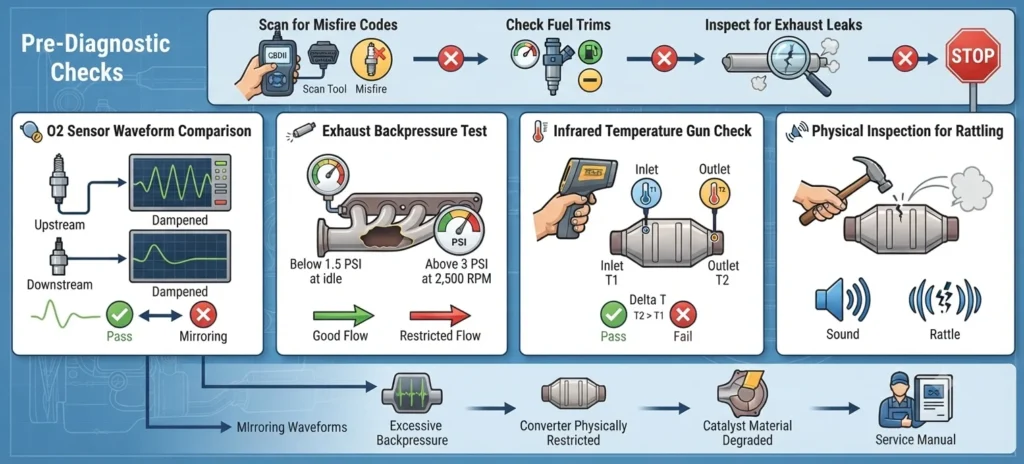
A proper catalytic converter test begins with confirming the engine is running correctly. Technicians scan for misfire codes, check fuel trims, inspect for exhaust leaks, and verify oxygen sensor operation before condemning the converter. If the engine has unresolved faults, those must be fixed first — otherwise a new converter may be damaged by the same underlying problem.
Key diagnostic methods include: comparing upstream and downstream O2 sensor waveforms on a scan tool (looking for proper signal dampening after the converter); measuring exhaust backpressure with a gauge inserted into the upstream O2 sensor port (typically should be below 1.5 PSI at idle and under 3 PSI at 2,500 RPM); using an infrared temperature gun to check that the converter outlet is hotter than the inlet (indicating the catalyst is generating heat from the chemical reaction); and physically inspecting for rattling by tapping the housing.
If backpressure is excessive, the converter is physically restricted. If O2 sensor waveforms show the downstream sensor mirroring the upstream and all other systems check out, the catalyst material has likely degraded. A vehicle-specific service manual should always be consulted for exact thresholds and procedures.
How Many Catalytic Converters Does a Car Have?
The number of catalytic converters varies by vehicle. Most four-cylinder cars have one or two (a close-coupled converter near the manifold and a main underfloor converter). V6 and V8 engines with dual exhaust banks typically have two to four converters — one or two per bank. Some vehicles also use a small pre-catalyst integrated into the exhaust manifold. Check your vehicle’s service manual or ask a technician to identify how many cat converters your specific car has, as this affects both diagnosis and replacement cost.
How to Unclog a Catalytic Converter
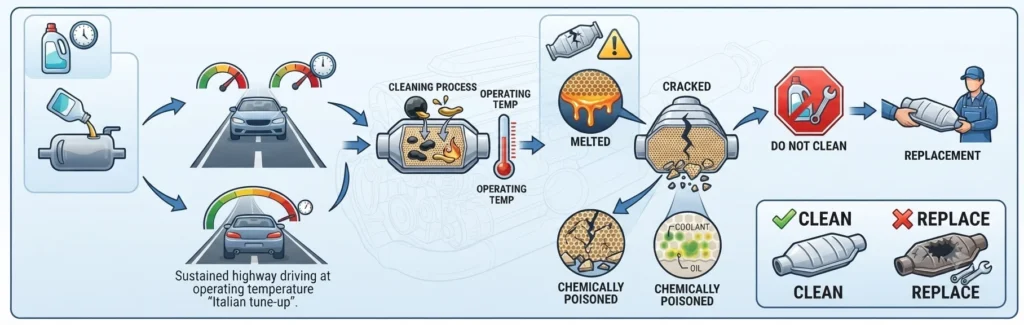
If the restriction is caused by light contamination (such as carbon or oil deposits), some drivers report improvement from catalytic converter cleaning additives (fuel system cleaners containing specific detergents) combined with a sustained highway drive at operating temperature. An Italian tune-up — driving at higher RPMs for an extended period — may help burn off light deposits.
However, cleaning cannot repair a converter that is melted, cracked, physically broken, or chemically poisoned by coolant (silicates) or excessive oil consumption (phosphorus). If the substrate has collapsed or broken apart, replacement is the only solution. Be cautious of products claiming to restore any converter — if backpressure testing shows severe restriction or rattling is present, cleaning will not help.
What Causes a Catalytic Converter to Fail?
The most common cause is engine misfires. When unburned fuel enters the converter, it ignites inside the catalyst, creating extreme heat that melts the honeycomb substrate. Prolonged rich-running conditions, oil consumption (from worn piston rings or valve seals), and coolant leaks (from a blown head gasket) contaminate the precious-metal coating and reduce efficiency over time.
Physical damage from road debris, thermal shock from driving through deep water, age-related degradation, and use of leaded fuel or certain silicone-based sealants can also destroy the catalyst. This is why technicians emphasise repairing the root cause before installing a new converter — otherwise the replacement will suffer the same fate.
Cat Delete and Catalytic Converter Removal — What You Need to Know
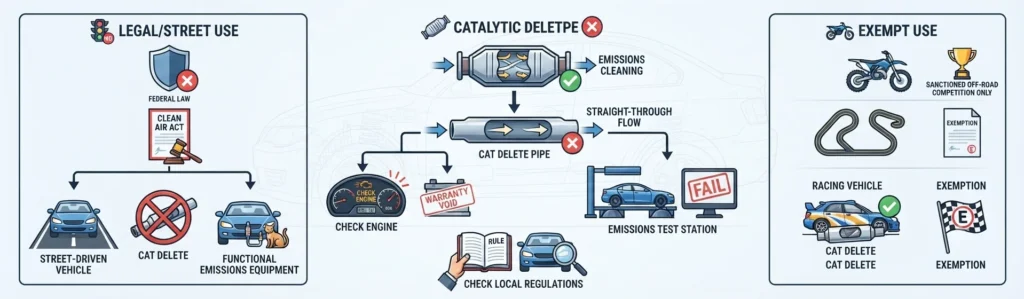
Some vehicle owners research catalytic converter delete as an option. It’s important to understand that removing or bypassing a catalytic converter is illegal under federal law in the United States (Clean Air Act) and in most other countries with emissions regulations. A cat delete will cause the vehicle to fail emissions inspections, trigger check-engine lights, and may void manufacturer warranties. Vehicles used exclusively for sanctioned off-road competition may be exempt in some jurisdictions, but street-driven vehicles must retain functional emissions equipment. Always check your local and state regulations before making modifications to your exhaust system.
Frequently Asked Questions
How do I know if my catalytic converter is bad or if it’s just an oxygen sensor?
A technician can distinguish between the two by comparing upstream and downstream O2 sensor waveforms, checking sensor response time, and measuring exhaust backpressure. A sluggish downstream sensor can trigger the same P0420 code as a failed converter. Replacing the oxygen sensor first (if it tests out of specification) is often recommended because it’s far less expensive than a converter.
Can I drive with a bad catalytic converter?
Mild efficiency loss may allow continued driving temporarily, but a severely restricted converter can cause overheating, stalling, or fire risk. If you notice extreme heat, power loss, or stalling, stop driving and have the vehicle towed. A rattling converter with loose internal material should also be inspected promptly, as broken pieces can further restrict flow.
How many cat converters does a car have?
Most four-cylinder vehicles have one or two. V6 and V8 engines typically have two to four. The exact number depends on your engine layout, emissions design, and model year. Your vehicle’s service manual or a parts lookup tool can confirm the count for your specific car.
Can a clogged catalytic converter unclog itself?
Light carbon deposits may burn off during extended highway driving at operating temperature. However, a converter that is melted, physically broken, or contaminated by coolant or oil will not recover on its own. If symptoms persist after a sustained drive, professional diagnosis is needed.
How much does catalytic converter replacement cost?
Replacement costs vary widely — from $200–$500 for aftermarket universal converters on common vehicles to $1,000–$3,000+ for OEM or CARB-compliant direct-fit converters on vehicles with multiple cats. Labour typically adds $100–$300. This is exactly why proper diagnosis before replacement is so important.
Does a catalytic converter delete improve performance?
On most stock vehicles, removing the converter provides negligible performance gains because modern converters are designed for low restriction. It will, however, trigger check-engine lights, fail emissions tests, and violate federal and most state laws for street-driven vehicles. Any marginal flow improvement does not justify the legal and environmental consequences.
Conclusion: How to Tell If Your Catalytic Converter Is Bad
If you’re wondering how to tell if your catalytic converter is bad, start with the symptoms: a check-engine light with a catalyst efficiency code, poor acceleration, sulphur smell, rattling, excessive heat, or a failed emissions test. But remember — symptoms alone cannot confirm failure. Oxygen sensors, exhaust leaks, misfires, and fuel-system faults can all mimic a bad converter.
Have a qualified technician perform backpressure testing, O2 sensor waveform analysis, and a thorough engine-health check before authorising replacement. Fix the root cause first. A properly diagnosed converter replacement protects your investment and ensures the new part lasts.