

A TIA-certified tire specialist breaks down the real differences — so you can stop guessing and start driving with confidence.
All season tires are designed for moderate climates with mild winters — dry and wet road performance is their strength. All weather tires carry the Three-Peak Mountain Snowflake (3PMSF) rating, meaning they’re certified for light snow. If your winters bring occasional snow but not extreme cold, all weather tires bridge the gap without needing seasonal swaps.
What Are All Season Tires?
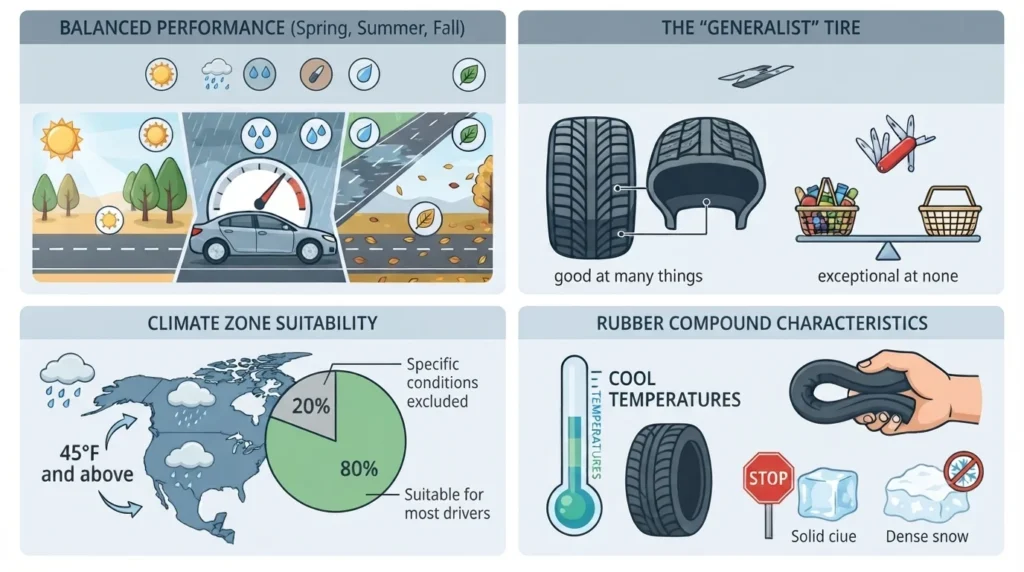
All season tires are the default tire fitted on most new cars sold in North America. They’re engineered to deliver balanced performance across spring, summer, and fall — handling well on dry pavement, providing adequate wet traction, and offering a comfortable, quiet ride. Think of them as the ‘generalist’ tire: good at many things, exceptional at none.
Having spent 12 years fitting tires across every climate zone, I can tell you that all season car tires work brilliantly for about 80% of drivers. If your winters rarely dip below 45°F and you see more rain than snow, an all season tire is likely all you need. The rubber compound stays flexible in cool temperatures but isn’t optimized for ice or packed snow.
All Season vs All Weather Tires: What’s the Real Difference?
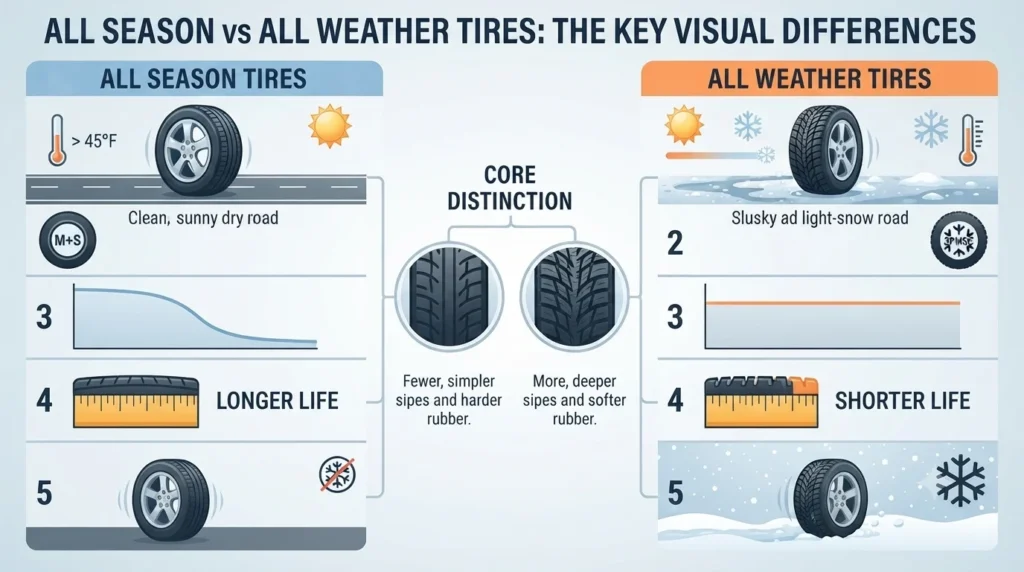
This is the question I get asked most often at the shop. The names sound interchangeable, but all season vs all weather tires represent meaningfully different engineering philosophies. The confusion is understandable — even some tire shop employees mix them up.
Here’s the core distinction: an all weather tire carries the Three-Peak Mountain Snowflake symbol (3PMSF), which means it has passed standardized snow traction testing. All season tires carry only the M+S (Mud and Snow) marking, which is a self-certified designation with no independent testing requirement. In practical terms:
- All season tires: Best in temperatures above 45°F. Excellent dry/wet grip, longer tread life, quieter ride. Struggle below freezing.
- All weather tires: Perform adequately from summer heat down to light snow conditions. Slightly shorter tread life than pure all season tires due to softer compound.
- All weather tires use a more aggressive tread pattern with deeper sipes (tiny slits) that bite into snow and slush — something all season treads lack.
- All season tires typically last 60,000–80,000 miles; all weather tires average 50,000–65,000 miles due to the softer rubber compound needed for cold-weather flexibility.
When Should You Choose Each Type?
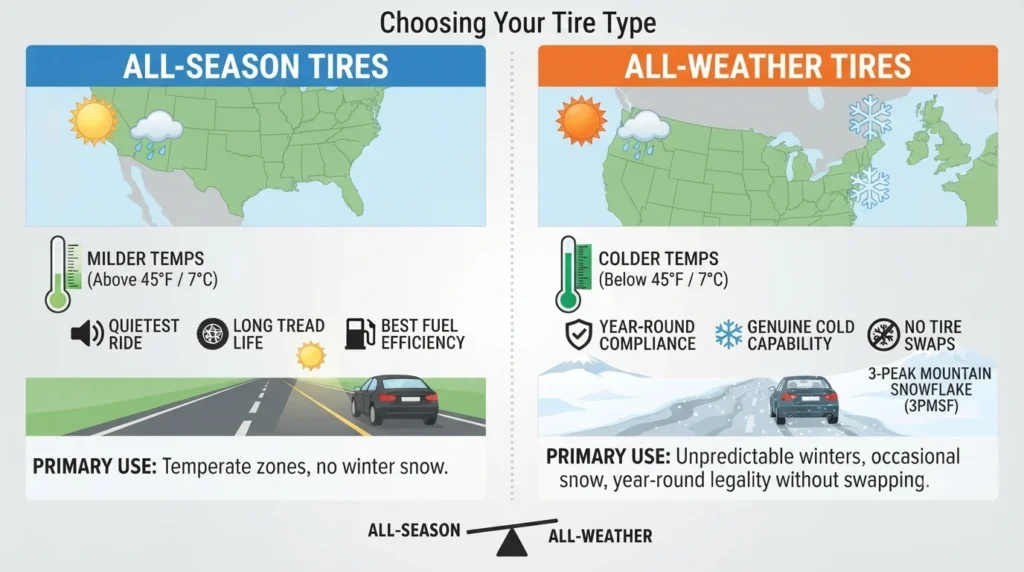
Choose all season tires if: you live in a mild climate (Southeast US, Pacific Coast, southern regions), your winters rarely see snow accumulation, you prioritize tread life and fuel efficiency, and you want the quietest highway ride. All season car tires are the economical, practical choice for the majority of drivers in temperate zones.
Choose all weather tires if: you experience unpredictable winters with occasional snow (Pacific Northwest, Mid-Atlantic, parts of the UK), you don’t want the hassle of seasonal tire swaps, or local regulations require snow-rated tires during winter months. An all weather tire gives you year-round legal compliance and genuine cold-weather capability without maintaining two sets of tires.
Performance Breakdown: Where Each Tire Excels
After testing dozens of tire models across both categories, here’s what I’ve observed in real-world driving conditions:
- Dry braking: All season tires win by 3–5 feet at 60 mph due to harder compound optimized for warm pavement.
- Wet handling: Nearly identical between categories — both use circumferential grooves to evacuate water effectively.
- Snow traction: All weather tires outperform all season tires by 15–25% in acceleration and braking on packed snow.
- Tread life: All season tires last 10,000–15,000 miles longer on average, making them more cost-effective in snow-free climates.
Maintenance Tips to Maximize Tire Life
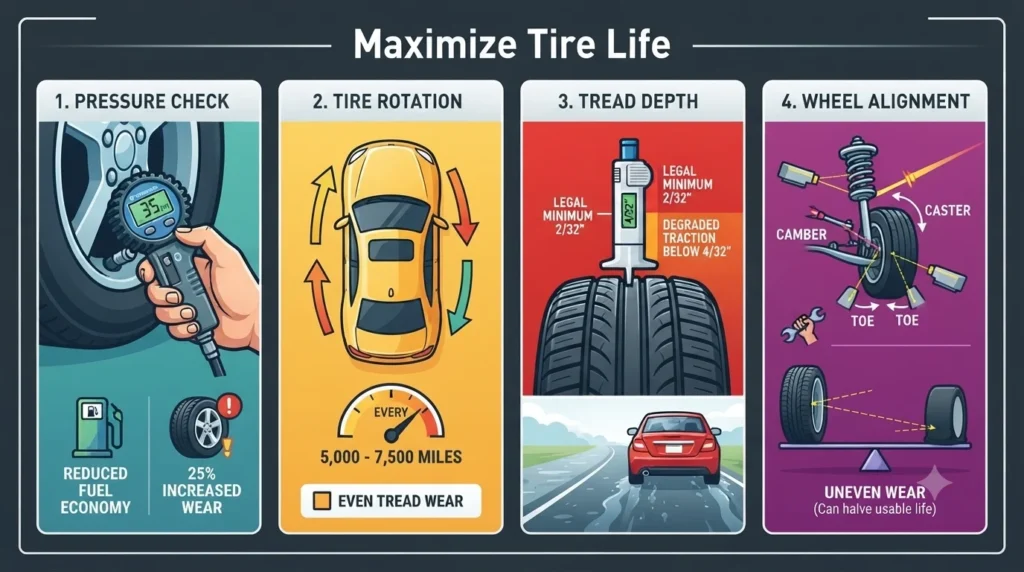
- Check tire pressure monthly — under-inflation increases wear on all season and all weather tires by up to 25% and reduces fuel economy.
- Rotate tires every 5,000–7,500 miles to ensure even tread wear across all four positions.
- Replace tires when tread reaches 4/32″ — the legal minimum is 2/32″ but wet traction degrades significantly below 4/32″.
- Align your wheels annually — misalignment causes uneven wear that can halve your tire’s usable life regardless of type.
Frequently Asked Questions
Are all weather tires good enough for heavy snow?
For light to moderate snow (a few inches), all weather tires perform well. However, if you regularly face heavy snowfall, ice storms, or sustained temperatures below 15°F, dedicated winter tires still outperform all weather tires. Think of all weather as ‘75% of a winter tire’ — great for occasional snow, not for Minnesota blizzards.
Can I use all season tires year-round in Canada?
It depends on your province. Quebec legally requires winter-rated tires (3PMSF) from December 1 to March 15. British Columbia requires them on many highways. All season tires without the snowflake symbol won’t meet these requirements — but all weather tires will, since they carry the 3PMSF rating.
Do all weather tires wear faster in summer?
Slightly, yes. The softer compound that gives all weather tires their cold-weather flexibility means they wear marginally faster in sustained heat above 90°F. In my experience, expect about 10–15% shorter tread life compared to a comparable all season tire if you live in a hot climate.
What’s the price difference between all season and all weather tires?
All weather tires typically cost $15–$40 more per tire than comparable all season models. However, factor in the savings from not buying a second set of winter tires ($400–$800+) and seasonal mounting/balancing costs ($80–$120 twice yearly). For many drivers, all weather tires are actually cheaper over a 3-year ownership period.