Learn how to change a tire safely, understand when to replace tires, discover how long tires last, and know the real cost of getting new tires — all in one practical guide.
You’re driving home and hear that dreaded flapping sound — a flat tire. Do you know how to change a tire safely on the roadside? More importantly, do you know when your tires need replacement before a blowout happens?
This guide covers everything a practical car owner needs: the step-by-step process of how to change a car tire, warning signs that mean it’s time for tire replacement, how long tires should last, how often to replace tires, and transparent tire replacement cost breakdowns. Whether you’re dealing with an emergency flat or planning ahead, you’ll find clear, safety-focused answers below.
Warning Signs You Need New Tires
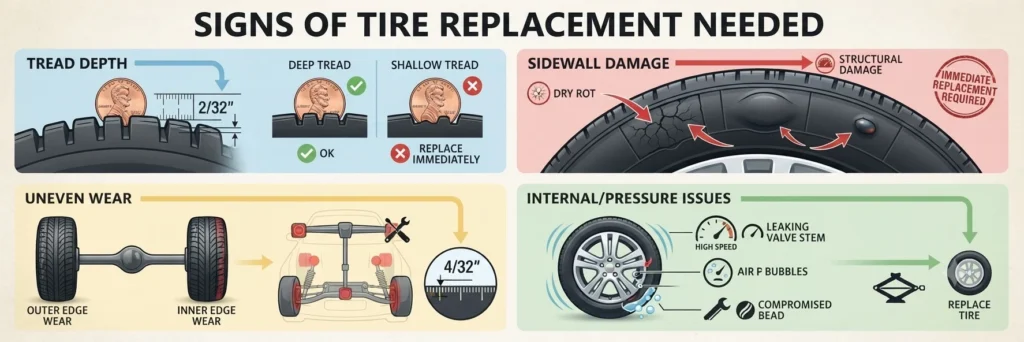
Low tread depth is the most critical indicator — insert a penny into the tread groove with Lincoln’s head facing down; if you can see the top of his head, your tread is below 2/32″ and you need to replace the tires immediately. Visible cracks, bulges, or blisters on the sidewall indicate dry rot or internal structural damage that cannot be repaired and require immediate replacement.
Uneven tire wear (one side faster than the other) signals alignment or suspension issues — get an alignment, then replace if tread is below 4/32″ anywhere. Persistent vibration at highway speeds, or frequent air pressure loss without a visible puncture, can indicate internal tire damage, a compromised bead, or a leaking valve stem — have a tire shop inspect and replace if the tire is old or worn.
How to Change a Tire: Step-by-Step
1- Safety First:
Pull completely off the road onto a flat, stable surface away from traffic. Turn on your hazard lights immediately.
2- Secure the Vehicle:
Put the car in Park (or Reverse for manual transmissions), engage the parking brake, and place wheel wedges or heavy rocks behind the opposite tires.
3- Loosen Lug Nuts:
Use the lug wrench to loosen (but do not fully remove) the lug nuts by turning them counterclockwise. Keep the tire on the ground to prevent spinning.
4- Position the Jack:
Place the jack under the vehicle’s designated frame jack point (consult manual). Raise the vehicle until the flat tire is about 6 inches off the ground.
5- Remove the Flat:
Remove the loosened lug nuts fully, pull the flat tire off the wheel hub, and slide it underneath the car’s frame as an extra safety backup.
6- Mount the Spare:
Push the spare tire onto the hub bolts and install the lug nuts by hand, tightening them gently in a star pattern.
7- Lower & Tighten:
Carefully lower the vehicle until the tire touches the ground but does not support full weight. Use the wrench to tighten the nuts fully in a star pattern.
8- Final Torque:
Lower the vehicle completely and remove the jack. Give each nut a final tightening torque check, pack up your tools, and drive slowly to the nearest tire shop.
When to Replace Tires: Key Decision Points
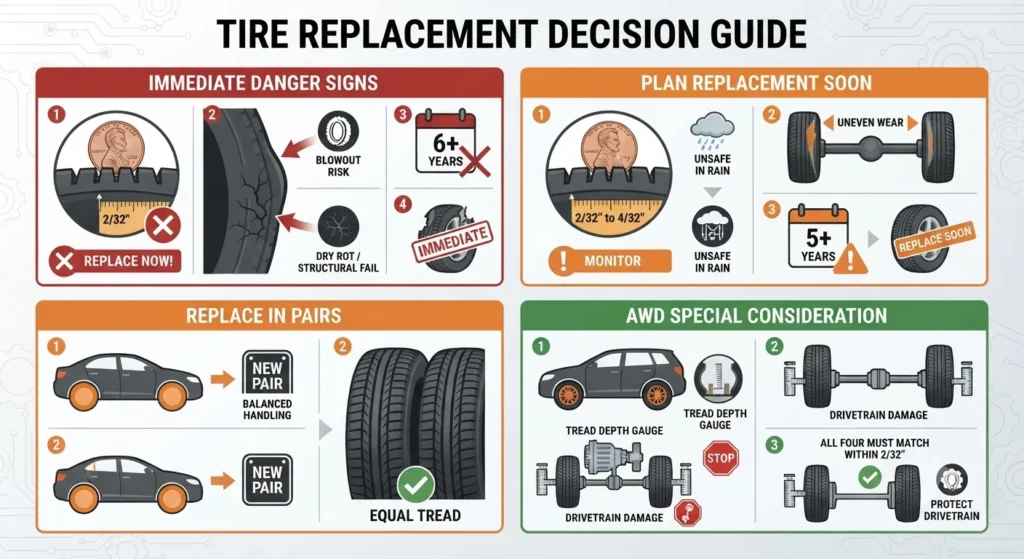
Replace immediately if tread depth is at or below 2/32″, there are visible sidewall bulges or deep cracks, the tire is over 6 years old regardless of tread, or you’ve experienced a blowout or significant impact damage. Safety always outweighs cost savings — these conditions mean the tire can fail without warning.
Plan replacement soon if tread is between 2/32″ and 4/32″ (unsafe in rain), you notice uneven wear that alignment didn’t fix, or the tire age is 5+ years. Ideally replace tires in pairs (both fronts or both rears) to maintain balanced handling; on AWD vehicles, all four should match within 2/32″ of tread difference to avoid drivetrain damage.
How Long Do Tires Last?
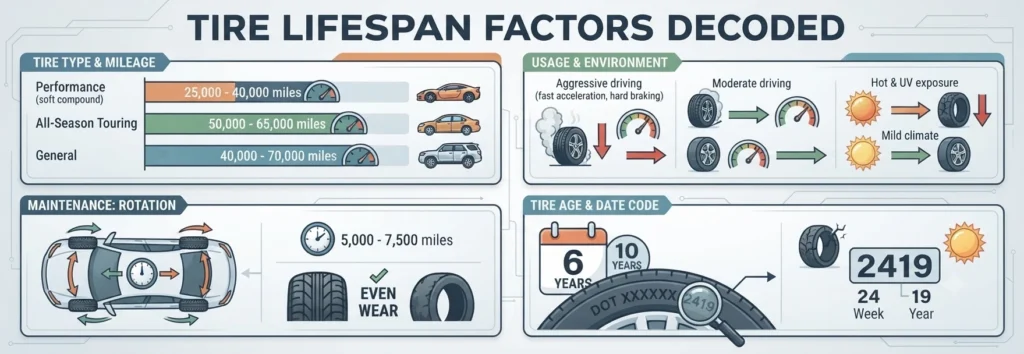
Most tires last 40,000–70,000 miles depending on the tire type, driving habits, climate, and maintenance. All-season touring tires typically offer 50,000–65,000 miles. Performance tires with softer compounds may only last 25,000–40,000 miles. Regular tire rotation every 5,000–7,500 miles significantly extends lifespan by evening out wear.
Regardless of mileage, tire manufacturers and NHTSA recommend replacing any tire older than 6 years — and absolutely by 10 years. Rubber compounds degrade from UV exposure, ozone, and temperature cycling even if the tire looks fine. Check the DOT code on your sidewall: “2419” means manufactured in week 24 of 2019. Hot climates and outdoor parking accelerate aging.
Tire Replacement Cost (2026)
Tire replacement cost depends on tire size, brand, performance category, and labor. Budget tires run $60–$120 per tire, mid-range options cost $120–$200, and premium or performance tires range from $200–$400+ — all including mounting and balancing.
A full set of four new tires typically costs $300–$800 for standard passenger vehicles. SUVs and trucks with larger tires cost more. Many shops offer package deals with alignment included, which can save $50–$100 over buying services separately.
Budget Tires
$60 – $120
Mid-Range Tires
$120 – $200
Premium / Performance
$200 – $400+
How to Make Your Tires Last Longer
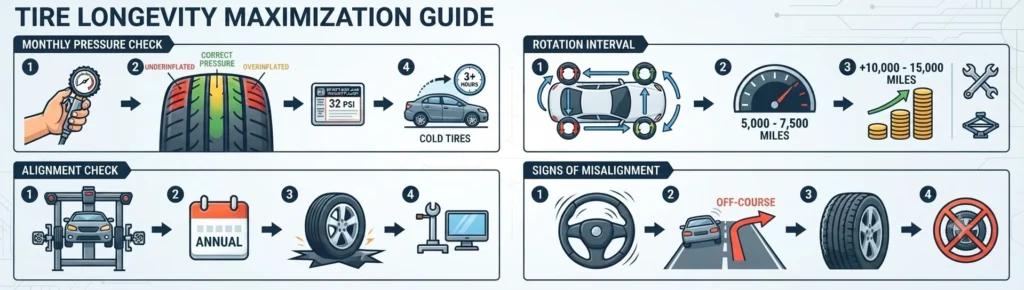
Check tire pressure monthly — underinflated tires wear the edges prematurely and overheat at highway speeds, while overinflated tires wear the center. The correct PSI is on your driver’s door jamb placard (not the number on the tire sidewall). Check when tires are cold, parked 3+ hours.
Rotate tires every 5,000–7,500 miles to distribute wear evenly, potentially adding 10,000–15,000 miles to total tire life. Get wheel alignment checked annually or after hitting a significant pothole — misalignment causes rapid, uneven wear that no amount of rotation can fix. Signs include the steering wheel being off-center or the car pulling to one side.
Frequently Asked Questions
How long does it take to change a tire?
For a beginner, changing a tire on the roadside takes about 20–30 minutes. With practice, you can do it in 10–15 minutes. At a tire shop, professional mounting and balancing of a new tire takes 15–30 minutes per tire.
How often should I replace my tires?
Replace tires when tread reaches 2/32″, which typically happens between 40,000–70,000 miles depending on the tire and driving conditions. Regardless of mileage, replace any tire older than 6 years. Check tread depth and age every 6 months.
Can I drive on a spare tire long-term?
No. Compact “donut” spares are designed for temporary use only — typically limited to 50 mph and 50–70 miles. They have minimal tread, no speed rating for highway use, and provide reduced traction. Get a permanent replacement as soon as possible, ideally the same day.
What tools do I need to change a tire?
Essential tools: a spare tire (check its pressure regularly), a car jack (scissor or hydraulic), a lug wrench that fits your lug nuts, wheel wedges or blocks, and your vehicle owner’s manual. Recommended extras: flashlight, reflective triangles, gloves, rain poncho, and a torque wrench for proper final tightening.
How much does it cost to replace all four tires?
A full set of four new tires typically costs $300–$800 for standard passenger vehicles (including mounting and balancing). Budget brands start around $60/tire; premium brands like Michelin or Bridgestone run $150–$300+ per tire. SUVs and trucks with larger tires cost more. Many shops offer package deals with alignment included.
Is it safe to change a tire on the highway?
It’s possible but risky. Pull as far off the road as you can, turn on hazards, and use reflective triangles if available. If the shoulder is narrow, has no guardrail, or you feel unsafe, it’s better to drive slowly (under 20 mph) on the flat to the nearest exit or call roadside assistance. Your safety matters more than the rim.
Should I repair a flat tire or replace it?
A tire can usually be repaired if: the puncture is in the tread area (not the sidewall), the hole is smaller than 1/4″, and there’s no internal damage. Sidewall punctures, large gashes, or damage near the bead cannot be safely repaired — replacement is required. A proper plug-patch repair costs $20–$40 and is reliable.
How do I check tire tread depth at home?
The penny test: Insert a penny into the tread with Lincoln’s head pointing down. If you can see the top of his head, the tread is below 2/32″ and the tire must be replaced. For a more precise measurement, a tread depth gauge costs $5–$10 at any auto parts store. Check multiple spots on each tire — inside, center, and outside edge.
Do I need to replace all four tires at once?
Not always. On front-wheel or rear-wheel drive vehicles, replacing in pairs (both fronts or both rears) is acceptable. Always put the newer tires on the rear axle for better wet-weather stability. On AWD vehicles, all four tires should match within 2/32″ of tread depth — check your owner’s manual for specific requirements.
What’s the difference between tire rotation and tire replacement?
Tire rotation moves your existing tires to different wheel positions (e.g., front to rear) to even out wear patterns — it extends tire life and costs $20–$50. Tire replacement means removing worn tires and installing brand new ones. Rotation is maintenance; replacement is done when tires are worn out or damaged.