
A complete guide to different types of hammers, their parts and practical uses. Whether you’re a DIY beginner or a seasoned carpenter, find the right hammer for every job.
There are over a dozen different types of hammers — from the everyday claw hammer to specialized brick hammers and dead-blow mallets — each engineered for a specific task.
Choosing the wrong hammer for a job is one of the most common mistakes DIY beginners make. It can damage materials, slow your work, or even cause injury. This guide covers the most important hammer types, explains each hammer part and its function, and helps you pick the right tool for woodworking, construction, metalworking, or home repairs.
Parts of a Hammer Explained
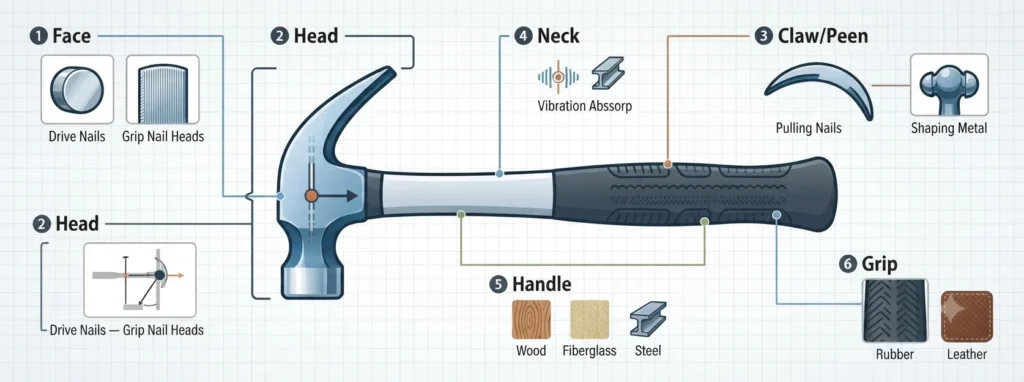
Understanding hammer parts helps you choose the right tool and use it safely. Every hammer shares six main components, though their shape varies by type.
- Face — The striking surface that contacts the workpiece. Flat faces drive nails; milled faces grip nail heads.
- Head — The weighted metal portion that delivers force. Heavier heads mean more power per swing.
- Claw/Peen — The opposite end of the face — used for pulling nails (claw) or shaping metal (peen).
- Neck — The narrow section connecting head to handle. Absorbs vibration and transfers energy.
- Handle — Made of wood, fiberglass, or steel. Longer handles provide more leverage; shorter ones offer more control.
- Grip — The textured end of the handle where you hold the hammer. Rubber or leather grips reduce slipping.
10 Common Types of Hammers & Their Uses
Here are the different kinds of hammers you’ll encounter most often, organized by their primary use — from everyday DIY to professional construction and metalwork.
1. Claw Hammer
DIY · Carpentry · General Use
The most common hammer type in any toolbox. Features a flat face for driving nails and a curved claw for pulling them out. Available in 12–20 oz weights. Best for: hanging pictures, basic carpentry, home repairs.
2. Ball-Peen Hammer
Metalworking · Auto Repair
Has a flat face and a rounded ‘ball’ peen for shaping metal, closing rivets, and striking chisels. Common in machine shops and auto body work. Typical weight: 8–32 oz.
3. Framing Hammer
Construction · Framing
A heavier cousin of the claw hammer (20–32 oz) with a longer handle and straighter claw. The milled face grips nail heads to prevent slipping. Designed for driving large framing nails quickly on job sites.
4. Sledgehammer
Demolition · Heavy Construction
A large, heavy hammer (6–20 lbs) with a flat, double-faced head and long handle. Used for demolition, driving stakes, and breaking concrete. Requires two hands and full-body swings.
5. Rubber Mallet
Woodworking · Assembly · Tiles
A soft rubber head delivers force without damaging surfaces. Perfect for assembling furniture, tapping wood joints together, setting tiles, and working with chisels on delicate materials.
6. Cross-Peen Hammer
Woodworking · Metalwork
Features a wedge-shaped peen perpendicular to the handle for starting small nails and tacks without hitting your fingers. Also used to shape metal along a narrow line. Common in cabinetry.
7. Club (Engineer’s) Hammer
Masonry · Chiseling
A short-handled, double-faced hammer (2–4 lbs) for driving masonry chisels and cold chisels. Offers more control than a sledgehammer for precision demolition and stone work.
8. Brick Hammer
Masonry · Bricklaying
One flat face for setting bricks and one sharp chisel edge for scoring and splitting bricks and blocks. An essential tool for masons, bricklayers, and anyone working with masonry units.
9. Tack Hammer
Upholstery · Delicate Work
A lightweight hammer (5–8 oz) with a small face and often a magnetized tip to hold tiny tacks. Used by upholsterers and for delicate trim work where a full-size hammer would be too heavy.
10. Dead-Blow Hammer
Automotive · Assembly · Machinery
Filled with sand or shot to absorb rebound and deliver maximum force without bouncing. Ideal for seating parts, knocking out pins, and any task where a controlled, non-marring strike is needed.
Hammer Types Comparison Chart
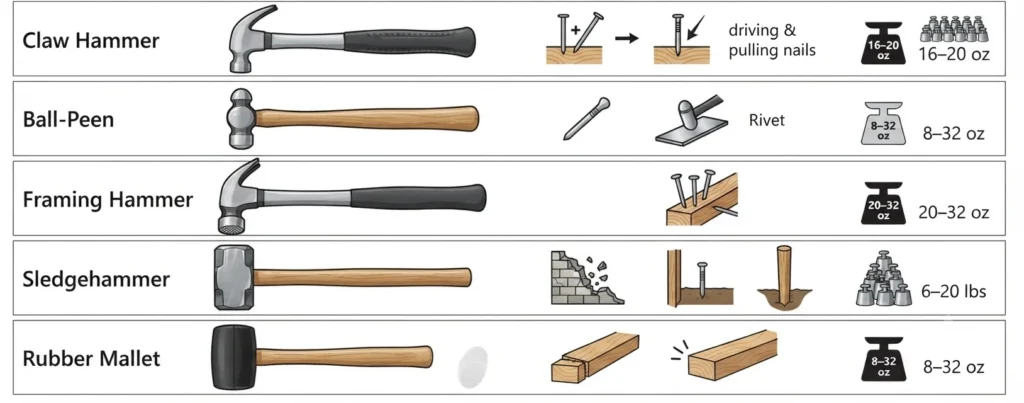
| Hammer Type | Best For | Typical Weight |
|---|---|---|
| Claw Hammer | Driving & pulling nails | 16–20 oz |
| Ball-Peen | Shaping metal, rivets | 8–32 oz |
| Framing Hammer | Heavy framing nails | 20–32 oz |
| Sledgehammer | Demolition, stakes | 6–20 lbs |
| Rubber Mallet | Assembly without damage | 8–32 oz |
Hammer Safety Tips
Always wear safety glasses when hammering — flying nail fragments or chips are a real hazard. Inspect your hammer before use: a loose head can fly off mid-swing. Match the hammer weight to the task — too heavy and you lose control, too light and you overswing. Never strike hardened steel with a steel hammer (use brass or a soft-face mallet). Keep your grip firm but relaxed at the end of the handle for maximum control and power.
Frequently Asked Questions About Hammer Types
What are the different types of hammers?
The most common types of hammers include claw hammer, ball-peen hammer, framing hammer, sledgehammer, rubber mallet, cross-peen hammer, club hammer, brick hammer, tack hammer, and dead-blow hammer. Each is designed for specific tasks from nail driving to metalworking to demolition.
What is the most common type of hammer?
The claw hammer is by far the most common and versatile hammer type. A 16 oz claw hammer with a smooth face is found in virtually every household toolbox and handles most general nail-driving and pulling tasks.
What are the main parts of a hammer?
The six main hammer parts are: the face (striking surface), head (weighted metal body), claw or peen (back of head), neck (connection between head and handle), handle (shaft — wood, fiberglass, or steel), and grip (textured end for holding).
Which hammer is best for woodworking?
For woodworking, a combination of a claw hammer (for nails), a cross-peen hammer (for starting small nails), and a rubber or wooden mallet (for tapping joints and chisels) covers most tasks. Choose lighter weights (12–16 oz) for more control.
What is the difference between a claw hammer and a framing hammer?
A framing hammer is heavier (20–32 oz vs 16–20 oz), has a longer handle for more leverage, a straighter claw for prying boards, and often a milled (waffled) face that grips nail heads. It’s built for speed on construction sites, while a claw hammer offers more control for general use.
What hammer types should every toolbox have?
For a well-rounded home toolbox, you need at minimum: a 16 oz claw hammer for general nail work, and a rubber mallet for assembly and delicate tapping. If you do more advanced projects, add a ball-peen hammer for metalwork and a small sledge or club hammer for demolition tasks.
How do I choose the right hammer weight?
Match weight to the task: light (8–12 oz) for delicate work and tacks, medium (16–20 oz) for general carpentry, heavy (20–32 oz) for framing, and very heavy (4+ lbs) for demolition. A hammer that’s too heavy causes fatigue and loss of accuracy; too light means you compensate with harder swings.
What handle material is best for hammers?
Wood handles (hickory) absorb vibration well and feel traditional, but can loosen. Fiberglass is lightweight, durable, and weather-resistant — a good all-rounder. Steel handles are strongest but transmit more shock. Many professionals prefer fiberglass with a rubber grip for the best balance of durability and comfort.