
Got a flat, a worn tire, or an uneven set on your all-wheel-drive vehicle? Here’s a plain-English guide to when you can replace one AWD wheel’s tire, when all four are safer, and how tread depth affects your drivetrain — plus a free tread-gap checker.
The short answer: on most AWD vehicles it’s safest to replace all four tires together — but not always. Because all four wheels are linked through the drivetrain, they need to spin at nearly the same speed, which means matching tire size and tread depth matters far more than it does on a regular car.
Whether you can get away with replacing one or two tires depends on how much tread difference your specific AWD system tolerates. This guide explains why matching matters, when a single replacement is realistic, how to check the tread gap yourself, and how to save money without risking expensive drivetrain repairs.
Why AWD Tires Need to Match
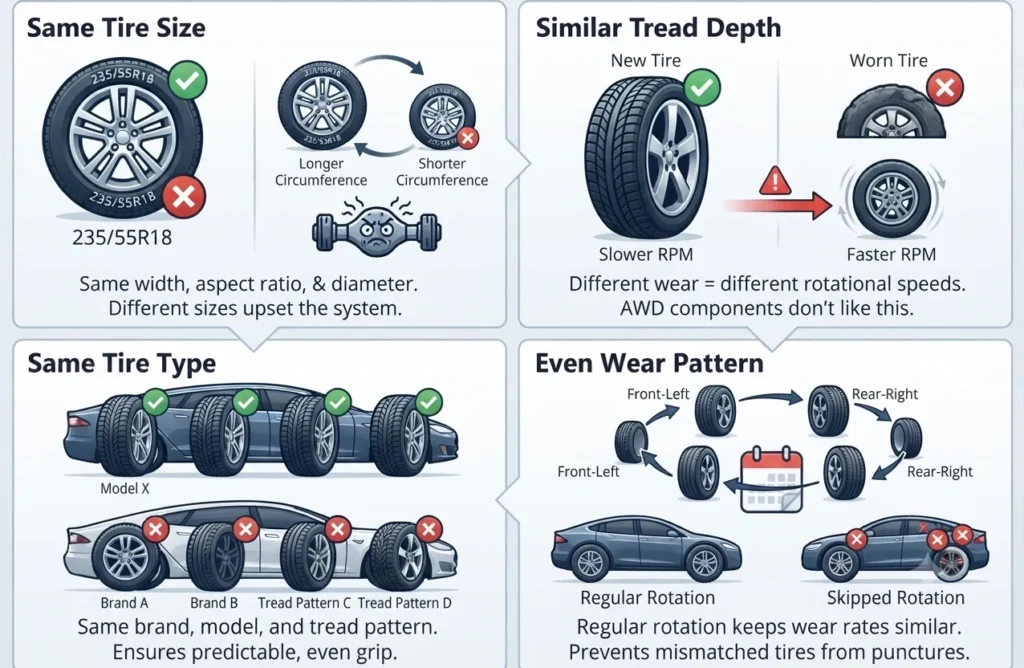
AWD systems assume all four tires roll at the same speed. Four things need to stay consistent to keep that true.
Same Tire Size
Every tire should share the same width, aspect ratio, and diameter (e.g. 235/55R18). A different size changes the rolling circumference — how far the tire travels in one turn — which upsets the whole system.
Similar Tread Depth
A worn tire is slightly smaller than a new one, so it spins a little faster. Big tread differences make the wheels rotate at different speeds — the exact thing AWD components don’t like.
Same Tire Type
Mixing brands, models, or tread patterns can mean different grip and rolling behaviour. Where possible, keep all four the same make and model for predictable, even performance.
Even Wear Pattern
Regular rotation keeps all four wearing at a similar rate. Uneven wear from skipped rotations can leave you with mismatched tires even without a puncture.
Can You Replace Just One AWD Tire?
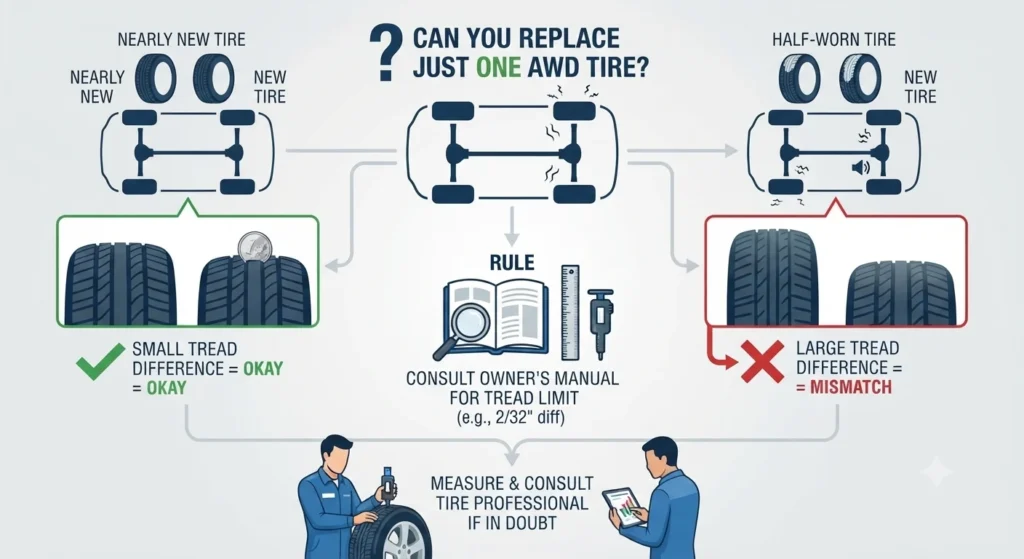
Sometimes — it depends on how worn your other tires are. If your remaining three tires are still nearly new, the tread difference may be small enough that adding one matching tire is fine. But if they’re half worn, a single brand-new tire can sit noticeably taller and create a mismatch. Many AWD owners discover this the hard way, replacing one tire and then noticing vibration or drivetrain noise.
The rule of thumb: check your owner’s manual for the maximum allowed tread difference (often expressed as a fraction of an inch or a percentage of circumference), measure your tires, and only replace fewer than four if you stay within that limit. When in doubt, ask a tire professional to compare measurements before you buy.
Quick Do’s and Don’ts
Do
- ✅ Check your owner’s manual for the allowed tread difference before replacing fewer than four.
- ✅ Measure the tread on all four tires and compare before buying.
- ✅ Rotate regularly so your tires wear evenly and can be replaced together.
Don’t
- ❌ Fit one brand-new tire alongside three heavily worn ones without checking the gap.
- ❌ Mix different sizes, brands, or tread patterns across the four corners.
- ❌ Ignore new vibration or drivetrain noise after a tire change — get it checked.
Which Situation Are You In?
General starting points, not fixed rules — your manufacturer’s tread-difference limit always has the final say.
| Situation | Recommended Action |
|---|---|
| One damaged or flat tire, others nearly new | Check the tread gap and your manufacturer’s guidance — replacing one may be fine if the difference is small. |
| One damaged tire, others noticeably worn | A single new tire may sit taller. Consider shaving the new tire to match, or replacing more than one. |
| Small tread difference (within limits) | Replacing one or two may be acceptable — confirm you stay inside the allowed difference for your vehicle. |
| Large tread difference between tires | Replace all four to protect the AWD system from uneven wheel speeds and drivetrain stress. |
| All four tires worn or aged out | Replace the full set — the simplest and safest option for AWD. |
AWD vs FWD/RWD Tire Replacement
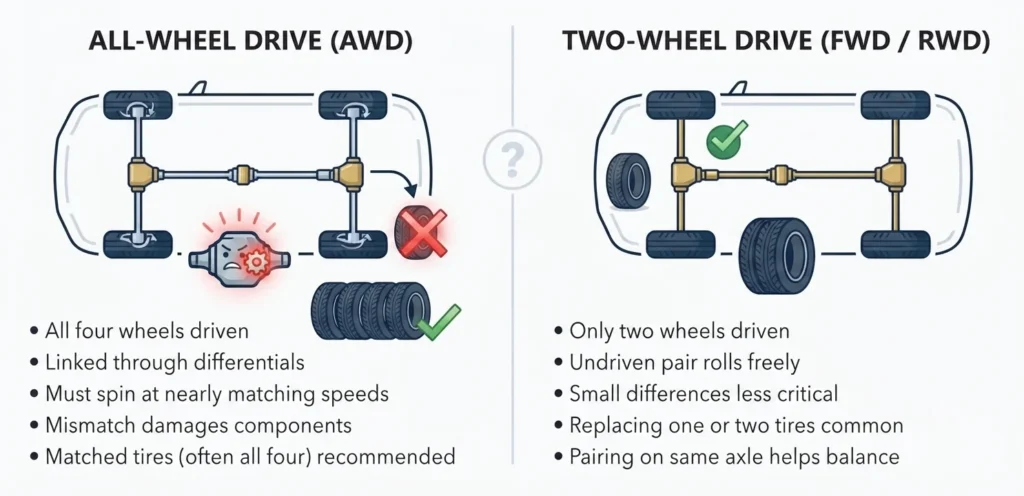
Why can a friend with a regular car replace a single tire, but you’re told to buy four? It comes down to how power reaches the wheels.
AWD (All-Wheel Drive)
All four wheels are driven and linked through differentials or a coupling. They must spin at nearly matching speeds, so a size or tread mismatch makes components work against each other. That’s why matched tires — and often all four at once — are recommended.
FWD / RWD (Two-Wheel Drive)
Only two wheels are driven, and the undriven pair simply rolls freely, so small differences between tires are far less critical. Replacing one or two tires is common — though pairing them on the same axle still helps balance and grip.
How AWD Systems Distribute Power
An AWD system splits engine power between the front and rear axles, and often side to side, using differentials, viscous couplings, or electronically controlled clutches. These parts are designed around the assumption that all four tires travel the same distance per rotation. When one tire is smaller — because it’s worn or a different size — it spins faster, and the system reads that as a wheel slipping. Over time this can add heat and stress to those coupling components. This is the mechanical reason behind the ‘match your tires’ advice: it isn’t a sales tactic, it’s about keeping wheel speeds close so the drivetrain isn’t constantly compensating.
The One-Line Takeaway
Many AWD manufacturers recommend replacing all four tires, but the exact requirement depends on your vehicle’s system and its acceptable tread difference — so measure first, check your manual, and match your tires before you decide.
How to Save Money on AWD Tires
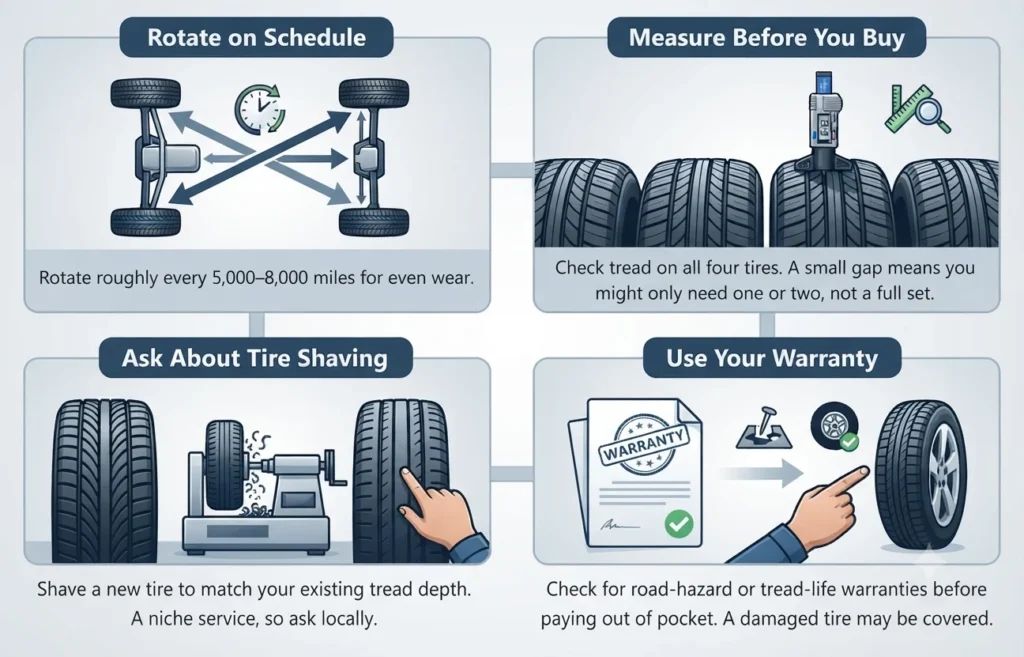
Replacing four tires is a real expense, so it’s worth reducing how often you need to. These honest habits stretch your tires’ life and help you avoid unnecessary full-set replacements — no sales pitch required.
Rotate on schedule
Rotating roughly every 5,000–8,000 miles keeps all four wearing evenly, so they reach the end of their life together — and you avoid odd-tire mismatches.
Measure before you buy
Check remaining tread on all four tires. If the gap is small and within your manufacturer’s limit, you may only need one or two — not the full set.
Ask about tire shaving
Some shops can shave a new tire down to match your existing tread depth, letting you replace one without a big mismatch. It’s a niche service, so ask locally.
Use your warranty
Check for road-hazard or tread-life warranties before paying out of pocket. A damaged tire may be covered, saving you an unplanned replacement.
AWD Tire Replacement FAQs
Do I really have to replace all four tires on an AWD vehicle?
Not always. Many AWD manufacturers recommend it, but whether you can replace fewer depends on the tread difference between your tires and your vehicle’s allowed tolerance. Check your owner’s manual and measure first.
How much tread difference is safe for AWD?
It varies by manufacturer. Some allow only a very small difference (a fraction of an inch or a small percentage of circumference), while others are more relaxed. Your owner’s manual is the authority — treat online rules of thumb as a starting point only.
Can I replace just one AWD wheel’s tire after a flat?
Possibly, if your other three tires are still nearly new so the tread gap stays small. If they’re significantly worn, a single new tire can create a mismatch, and replacing more may be safer.
What happens if I run mismatched tires on AWD?
Different-sized tires spin at different speeds, which the AWD system reads as slip. Over time this can add heat and stress to couplings and differentials, and you may notice vibration or drivetrain noise.
Can I mix different tire brands on AWD?
It’s best avoided. Different brands and tread patterns can grip and roll differently even at the same size. For predictable performance, keep all four the same make and model where you can.
Is AWD the same as 4WD for tires?
They’re related but not identical. Both drive all four wheels and benefit from matched tires, but full-time AWD systems are often especially sensitive to tread differences. Either way, matching size and tread depth is the safe approach.
Check Before You Buy
Don’t guess whether you need one tire or four. Measure your tread, compare the gap in the checker, and confirm against your manual — it could save you from an expensive drivetrain mistake.
📐 Measure all four tires first🛞 Confirm limits in your owner’s manual