
A foolproof, mechanic-approved guide for when you’re stranded with a dead battery. Works with jumper cables or a portable jump pack.
⚡ Quick Steps: Jump Starting in 60 Seconds
On your phone in the cold? Here’s the cheat sheet. Follow this exact order every single time:
Step 1
🔴 RED clamp → DEAD battery (+)
Attach the red clamp to the positive terminal (marked + or POS) on the dead battery.
Step 2
🔴 RED clamp → GOOD battery (+)
Connect the other red clamp to the positive terminal on the working (donor) battery.
Step 3
⚫ BLACK clamp → GOOD battery (−)
Attach the black clamp to the negative terminal on the good battery.
Step 4
⚫ BLACK clamp → BARE METAL (ground)
Attach the final black clamp to an unpainted metal bolt on the dead car’s engine block — NOT the dead battery.
What You’ll Need
- A set of jumper cables (or a portable jump starter pack)
- A donor vehicle with a charged battery (not needed with a jump pack)
- Safety glasses (recommended)
- A wire brush or rag to clean corroded terminals
Detailed Guide: How to Jump a Car Battery with Cables
Park the donor car nose-to-nose or side-by-side so the cables reach. Turn both cars off, engage parking brakes, and pop both hoods. Identify the positive (+) and negative (−) terminals on each battery.
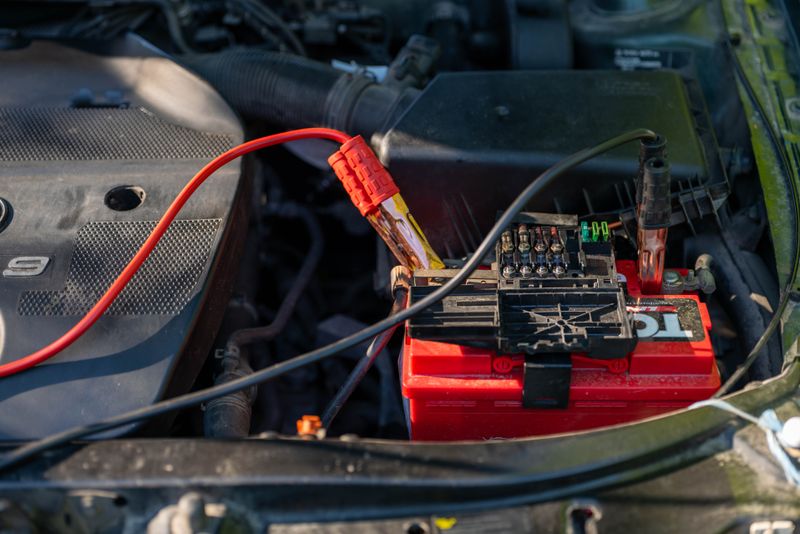
1. Connect RED to DEAD positive (+)
Clamp one red handle onto the dead battery’s positive terminal. It’s usually marked with a + symbol or a red cap. Make sure the clamp grips tightly and doesn’t touch any other metal.
2. Connect RED to GOOD positive (+)
Take the other end of the red cable and clamp it onto the donor battery’s positive terminal. Double-check that neither red clamp is touching any black clamp or unpainted metal.
3. Connect BLACK to GOOD negative (−)
Clamp one black handle onto the donor battery’s negative terminal (marked − or NEG).
4. Connect BLACK to BARE METAL on dead car
This is the critical safety step. Clamp the final black handle onto an unpainted metal surface on the dead car’s engine block — a bolt, bracket, or strut tower works well. Never attach it to the dead battery’s negative terminal.
5. Start the donor car, then the dead car
Start the donor vehicle and let it idle for 2–3 minutes. Then try starting the dead car. If it doesn’t start, wait another 5 minutes and try again. Do not crank for more than 10 seconds at a time.
6. Remove cables in REVERSE order
Once the dead car is running, remove cables in reverse: black from engine block → black from donor → red from donor → red from formerly-dead battery. Don’t let any clamps touch each other during removal.
⚠️ Why Not Connect to the Dead Battery’s Negative?
Dead batteries can emit hydrogen gas. A spark near the battery could ignite this gas, causing the battery to explode. By grounding the final clamp on the engine block — far from the battery — any spark happens safely away from flammable gases. This is the single most important safety rule when jumping a car.
How to Jump a Car Battery Without Another Car (Portable Jump Pack)
A portable lithium-ion jump starter lets you jump your car alone — no donor vehicle needed. They’re compact, affordable, and increasingly popular. Here’s how to use one:

- Make sure the jump pack is charged (most have an LED indicator).
- Connect the red clamp from the pack to your dead battery’s positive (+) terminal.
- Connect the black clamp to an unpainted metal ground on the engine block (same rule as traditional cables).
- Turn on the jump pack, wait 30 seconds, then start your car.
- Once started, disconnect black first, then red. Store the pack safely.
What to Do After Your Car Starts
Drive your car for at least 20–30 minutes without turning it off. This allows the alternator to recharge the battery. Avoid using heavy electrical loads (A/C, heated seats, phone chargers) during this time. If the battery dies again within 24 hours, it likely needs replacing — have it tested at any auto parts store for free.
Frequently Asked Questions
Can jumping a car damage my car’s electronics?
If done correctly following the sequence above, no. The risk of damage comes from connecting cables backwards (reversing polarity), which can fry the ECU or alternator. Follow the Red-Dead-First rule and you’ll be fine.
Which jumper cable goes on first — red or black?
Always red (positive) first. Connect both red clamps before touching any black clamp. When removing, do the opposite — black comes off first.How long should I let the donor car run before starting the dead car?
Let the donor car idle for 2–3 minutes. If the dead battery is severely drained, wait up to 5 minutes. This gives enough charge to turn the starter motor.