
Which color to grab, whether to dilute it, and what to do when you’re stranded with an overheating engine answered clearly.
⚡ Quick Answers
Don’t panic. A small top-off won’t immediately damage anything. Schedule a flush soon.
Pull over immediately. Turn off AC, turn on heat. If gauge enters red, shut off engine.
Do NOT open. Call roadside. This is not a DIY situation.
Jump to your situation:
NEVER open a radiator cap or overflow reservoir cap while the engine is hot. Coolant systems are pressurized to 13–16 psi. Removing the cap when hot releases scalding steam and fluid that can cause severe burns instantly. Wait at least 30–45 minutes after shutdown before touching anything. If steam is visibly rising from the hood — pull over, turn off the engine, and do not open the hood at all. Call roadside assistance instead.
The Color Confusion — Decoded
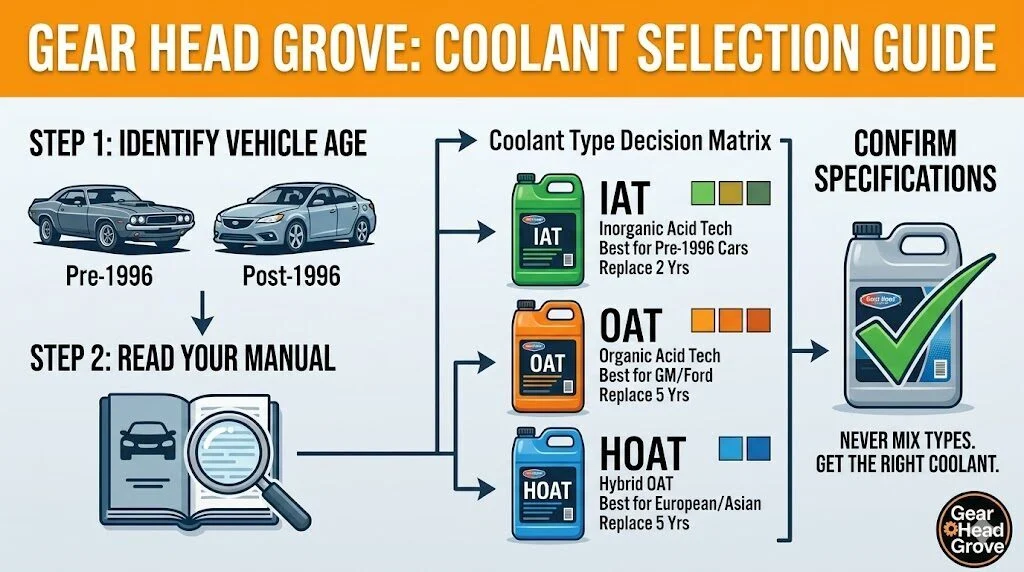
Standing in front of a wall of green, orange, yellow, pink, purple, and blue jugs is genuinely baffling — and the color-matching instinct that every driver has is also the #1 source of coolant mistakes. Here’s the truth: color is a marketing choice by each manufacturer, not a universal standard.
Two completely different coolant chemistries can share the same color. Two jugs from the same brand can be different colors across model years. This is why the single most reliable rule is:
Open your glove box. Find your owner’s manual. Look for “coolant” or “antifreeze” in the index. Your manufacturer will specify the exact type (and sometimes brand) your vehicle requires. That spec, not the color on a shelf, is what matters.
So What Do the Colors Usually Mean?
While not universal, these patterns hold true across most North American vehicles:
| Color | Chemistry Type | Typical Vehicles | Mix With Others? |
|---|---|---|---|
| Green | IAT (Inorganic Additive Technology) The “classic” formula. Silicate-based. |
Pre-2000 domestic cars & trucks | Only mix with same type |
| Orange | OAT (Organic Acid Technology) “Dex-Cool” is the GM brand name. No silicates. |
Most GM vehicles 1996–present | Never mix with green IAT |
| Yellow / Gold | HOAT (Hybrid OAT) A blend of IAT and OAT properties. |
Many European & Asian makes (Toyota, Honda, VW, BMW) | Check manual — some are exclusive |
| Pink / Purple | POAT or Si-OAT Toyota (pink = “Super Long Life”), VW/Audi (purple = G13). |
Toyota, Lexus, VW, Audi, Porsche | OEM only — do not cross-mix |
| Blue | Varies by brand Common in European (Ford, VAG), also some universal formulas. |
Ford, Subaru, various European brands | Verify with manual |
What About “Universal” Coolant?
You’ll see jugs labeled “Universal” or “All Makes / All Models.” These use an OAT or HOAT formula and are designed to be compatible across many vehicle types. They’re a practical choice for an emergency top-off when you genuinely don’t know your vehicle’s spec and your manual isn’t on hand.
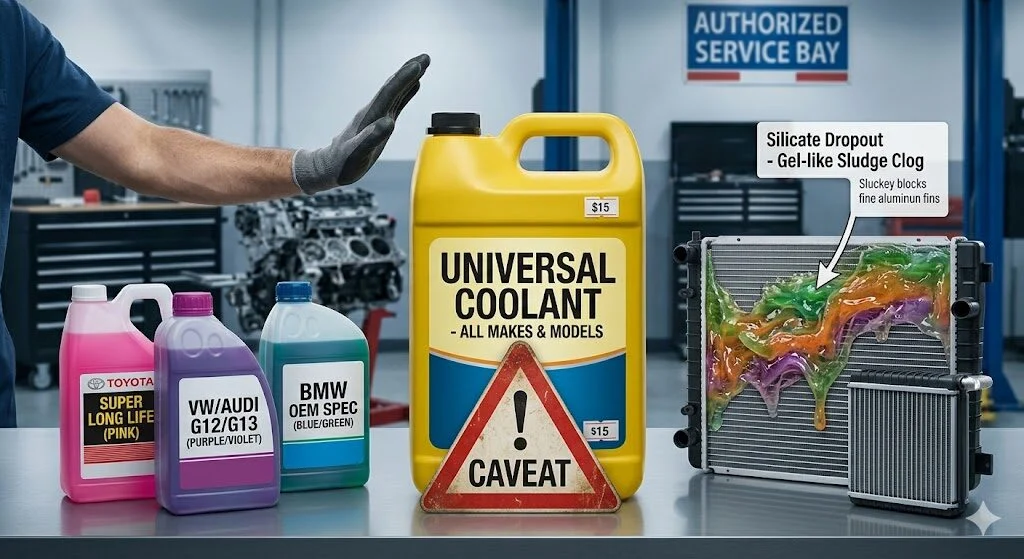
Universal formulas are not truly universal. They are not recommended for vehicles that specifically require Toyota’s Super Long Life (pink), VW/Audi G12/G13 (purple/violet), or BMW’s blue/green OEM spec. For these vehicles, use only the OEM-specified type. A $15 jug of wrong fluid can cause silicate dropout — a gel-like sludge that clogs your heater core and radiator.
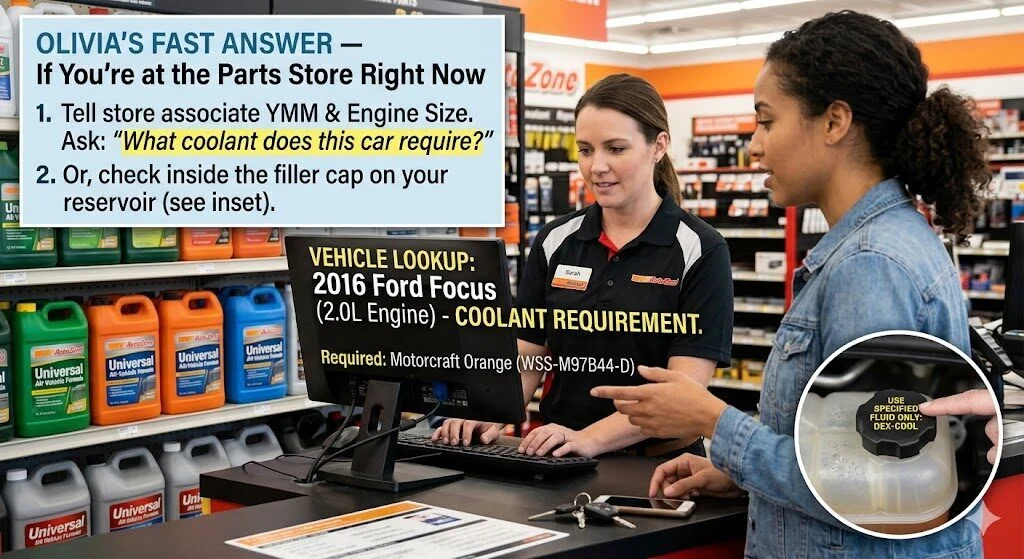
Tell the store associate your year, make, model, and engine size. Ask: “What coolant does this car require?” They have lookup tools. Alternatively, look inside the filler cap on your overflow reservoir — many manufacturers print the required spec right there. For a safe interim top-off while you figure it out, a quality “universal” or “all-vehicle” formula will protect you for the drive home, but flush and refill with the correct type within a few months.
50/50 Pre-Mixed vs. Concentrate — Which Should You Buy?
Your coolant level is slightly below the MIN line on the reservoir. Good catch — this is exactly the kind of check that prevents a $3,000 head gasket repair. Now you’re staring at two versions of the same product: a 50/50 pre-mixed jug and a concentrate jug that’s nearly the same price. Which is the right call?
50/50 Pre-Mixed
- Pour directly into reservoir — no prep
- Correct ratio already guaranteed
- Ideal for a simple top-off
- Costs more per ounce of actual coolant
- Wastes money if you’re doing a full flush
Concentrate
- Lower cost per effective volume
- Flexible — mix to 50/50 or 70/30 for extreme cold
- Best choice when doing a complete coolant flush
- Requires mixing with distilled water
- Easy to get the ratio wrong if you eyeball it
Why Distilled Water — Not Tap Water?
This is the detail most DIYers skip. Tap water contains dissolved minerals — calcium, magnesium, chlorides — that deposit inside your cooling system as mineral scale over time. That scale reduces heat transfer efficiency, narrows coolant passages, and eventually causes overheating. It also accelerates aluminum corrosion in modern engine blocks.
A gallon of distilled water costs $1–2 at any grocery store. It’s worth every cent. When mixing concentrate, the standard ratio is 1 part concentrate : 1 part distilled water for protection down to approximately -34°F (-37°C) and boilover protection up to 265°F (129°C).
Just below the MIN line and you only need to top off? Grab a 50/50 pre-mixed jug of the correct type and pour it in. If your coolant looks brown, rusty, or you can’t remember the last time it was changed — schedule a complete flush and use concentrate mixed with distilled water. Coolant should typically be flushed every 50,000–100,000 miles or per your owner’s manual schedule.
Can You Use Plain Water Instead of Coolant?
Short answer: yes, but only as a temporary emergency measure — and you should use distilled water, not tap water.
Here’s what water does well: it actually has excellent heat absorption capacity, better than most coolant concentrates on their own. In an absolute pinch, adding clean water to an overheating engine will prevent immediate engine damage.
What Water Won’t Do
Water alone creates serious long-term problems for your engine:
Pure water freezes at 32°F (0°C). When it freezes inside your engine block, expanding ice can crack the block or blow out freeze plugs — a catastrophic and expensive failure.
Water without corrosion inhibitors causes rust in cast iron components and aluminum oxidation. Modern engines have aluminum blocks, heads, and water pumps — they corrode fast without the protective additives in proper coolant.
Pure water boils at 212°F (100°C). A 50/50 coolant mix raises that ceiling to 265°F+. Engine coolant regularly approaches 230–250°F under load — meaning water alone can boil and cause vapor lock.
If it’s above freezing outside and your only goal is to safely limp home (under 30 miles), adding distilled water to a depleted cooling system will prevent your engine from seizing due to heat.
Tap Water vs. Bottled Water vs. Distilled — Emergency Ranking
If you absolutely have no coolant available right now:
🛣️ Sam’s Roadside Emergency Protocol
- 1Pull over safely. Turn off the engine. Do NOT open the hood while steam is rising — wait 20–30 minutes minimum.
- 2Once cool, carefully (using a rag or cloth over your hand) check the overflow reservoir level. The reservoir — not the radiator cap — is always your first point of contact.
- 3Top off with distilled water (or bottled water). Fill to the COLD MAX line on the reservoir.
- 4Check for obvious leaks underneath the car before restarting. A steady drip means the system won’t hold pressure.
- 5Drive to the nearest parts store or your destination — do not run the A/C, turn on the heat full blast (it uses the cooling system as a secondary radiator), and watch the temperature gauge constantly.
- 6Once you’re back on your feet, do a proper coolant flush and refill with the correct fluid. Leaving a diluted or wrong-chemistry mix in the system long-term degrades your cooling system components.
How to Check Your Coolant Level (Step by Step)
Checking your coolant level takes 2 minutes and requires no tools. Do it only when the engine is cold — ideally before your first start of the day.
Coolant doesn’t get “used up” like engine oil in normal operation. If you find yourself topping off more than once a year, you have a leak. Common sources: a weeping hose clamp, a cracked overflow tank cap (cheap fix), a leaking heater core, or in worst cases, a blown head gasket. Have a shop pressure-test the cooling system to pinpoint it.
Frequently Asked Questions
This article is provided for general educational purposes. Always consult your vehicle’s owner’s manual and a qualified mechanic for vehicle-specific advice. All recommendations are verified against current OEM specifications as of June 2025.
Also read coolant and fluid maintenance guides
Also read coolant in oil warning signs