wo completely different cars. One legendary name. Here’s the honest truth about both — from someone who’s turned wrenches on each.
Contents
⚡ Quick Verdict Classic vs Modern The Classic Era (1960–1976) The Modern Era (2013–2016) Reliability Used Pricing Should You Buy? FAQ⚡ The 30-Second Verdict
The classic Dodge Dart (1960–1976) is one of the best entry points into American muscle car ownership. Parts are plentiful, the Slant-6 engine is nearly unkillable, and clean examples are still under $20K. If you want a weekend cruiser or a restoration project, this is a genuinely great buy.
The modern Dodge Dart (2013–2016) is a tougher sell. It had promise — decent looks, a good interior for the price — but the dual dry clutch automatic transmission (DDCT) plagued the 2.0L and 2.4L models so badly that it became the car’s defining feature. If you find a manual-transmission 2.4L or the 1.4L turbo with the six-speed, it can be a solid cheap commuter. Otherwise, walk away.
Classic vs Modern Dodge Dart: Two Completely Different Cars
Before anything else, let’s get this straight. The classic Dart and the modern Dart share a name — that’s it. Different platform, different philosophy, different era. Here’s the side-by-side breakdown:
| Spec | Classic Dart (1960–1976) | Modern Dart (2013–2016) |
|---|---|---|
| Platform | Chrysler A-body (RWD) | Fiat C-Evo / CUSW (FWD) |
| Engine Options | Slant-6, 318 V8, 340 V8, 360 V8 | 2.0L I4, 1.4L Turbo I4, 2.4L I4 |
| Power Range | 101 hp – 275 hp | 160 hp – 184 hp |
| Drivetrain | Rear-wheel drive | Front-wheel drive |
| Transmission | 3-spd auto / 4-spd manual | 6-spd manual / 6-spd auto / DDCT |
| Curb Weight | ~2,700 – 3,200 lbs | ~3,200 – 3,300 lbs |
| Body Style | 2-door coupe / 4-door sedan / convertible | 4-door sedan only |
| Used Price (2026) | $8,000 – $45,000+ | $4,500 – $12,000 |
| Best For | Restoration, cruising, collecting | Budget commuter (manual only) |
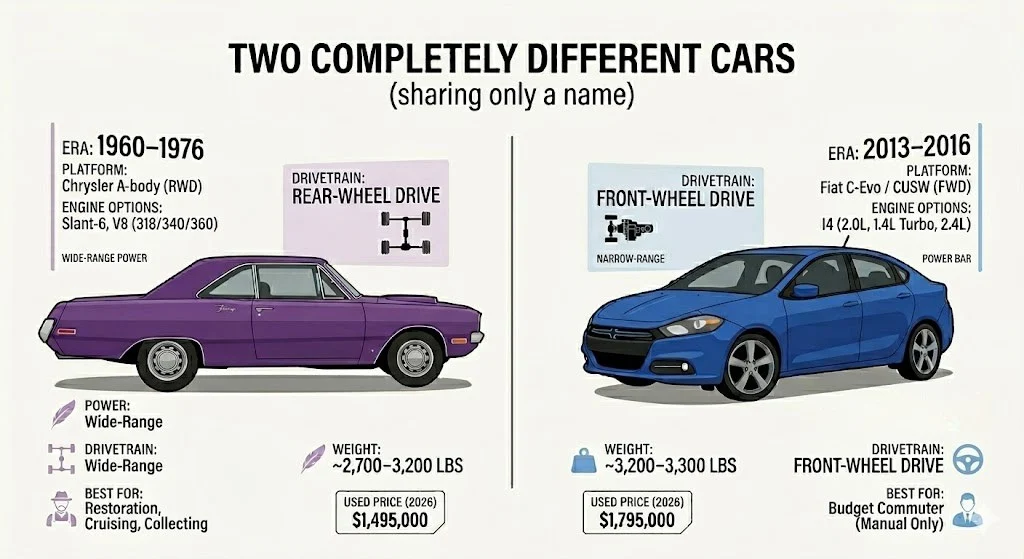
See what I mean? These are not the same car. Let’s break down each one separately.
The Classic Dodge Dart (1960–1976)
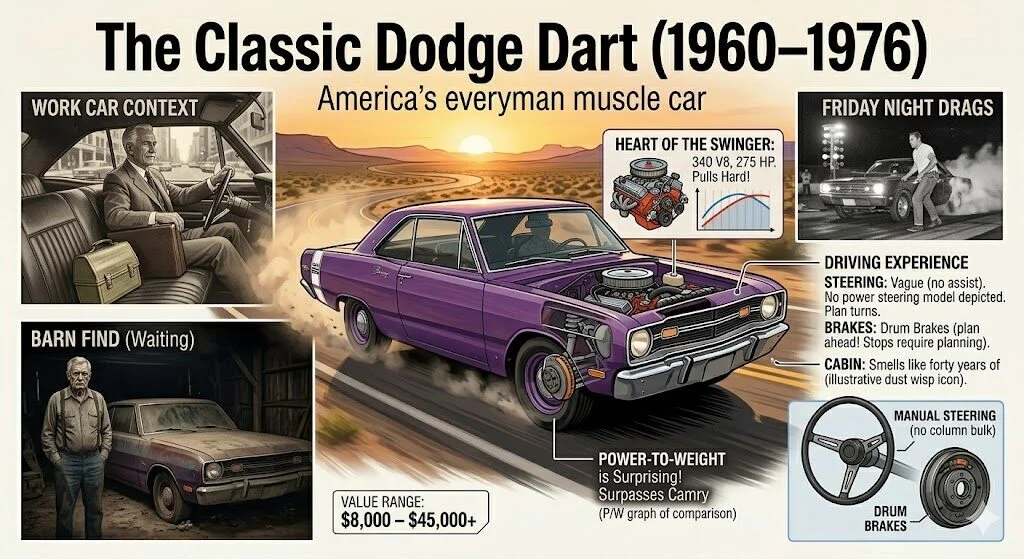
America’s everyman muscle car
The original Dart started life as a full-size car in 1960, shrank to a compact in 1963, and then spent the next thirteen years becoming one of the most versatile and beloved platforms in Mopar history. It was the car your grandfather drove to work, your uncle drag-raced on Friday nights, and your neighbor still has sitting in a barn right now.
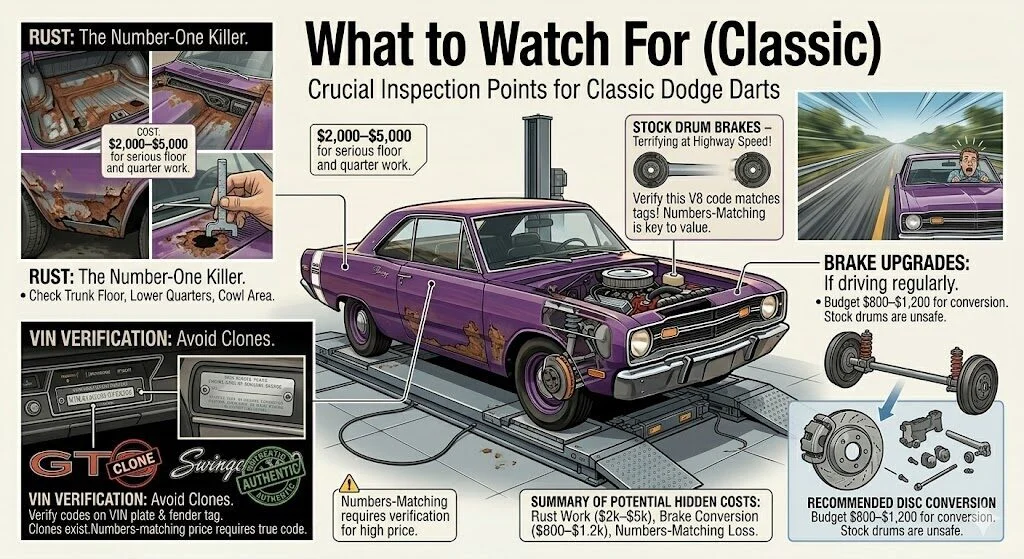
I drove a 1969 Dodge Dart Swinger at a classic car show in Phoenix two years ago — here’s what stood out. The steering is vague by modern standards (no power steering on that model), the drum brakes require you to plan your stops about a block ahead, and the cabin smells like forty years of American history. But the 340 V8 under the hood? That thing pulls. Hard. It’s a 275-horsepower engine in a car that weighs less than a modern Camry. The power-to-weight ratio is genuinely surprising.
Key Model Years to Know
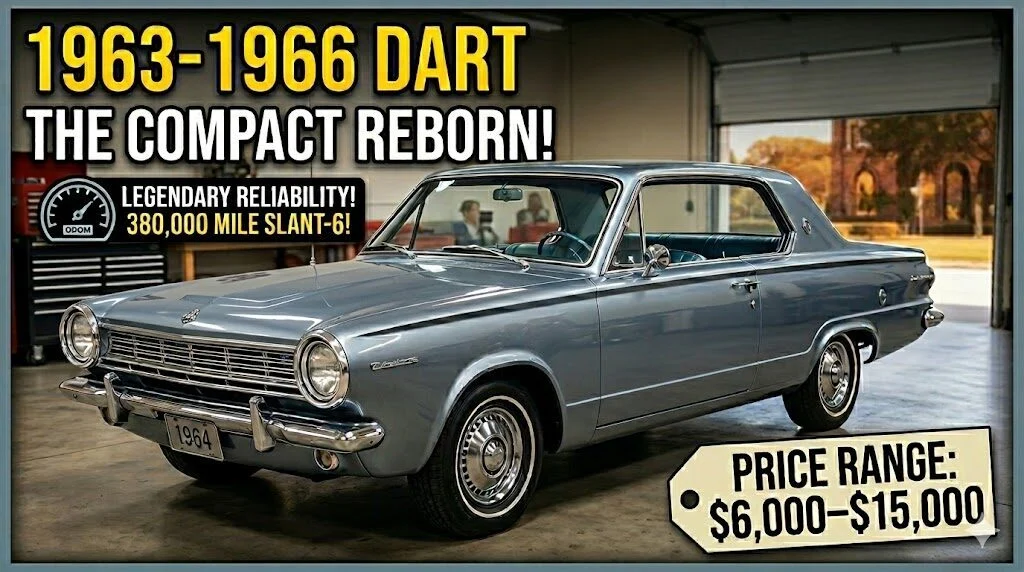
1963–1966
The compact reborn. This is when the Dart became the car we actually remember. Light, simple, and cheap. The Slant-6 engine in these is legendary for reliability — I’ve personally seen one with 380,000 miles on the original block. Great starter restoration car. Expect to pay $6,000–$15,000 for a running project, more for a clean driver.
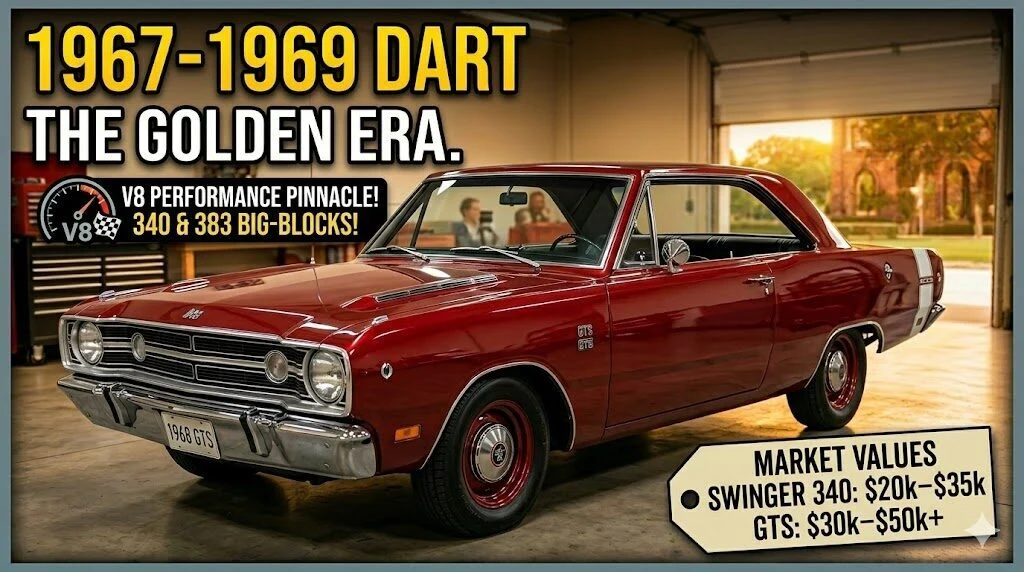
1967–1969
The golden era. The ’68 and ’69 Dart GTS and Swinger models are the ones that command real money today. These got the 340 small-block V8 — a motor that punches well above its displacement. The ’68 Dart GTS with the 383 big-block is a drag strip legend. Clean examples of the GTS now run $30,000–$50,000+. Swinger 340s sit around $20,000–$35,000.
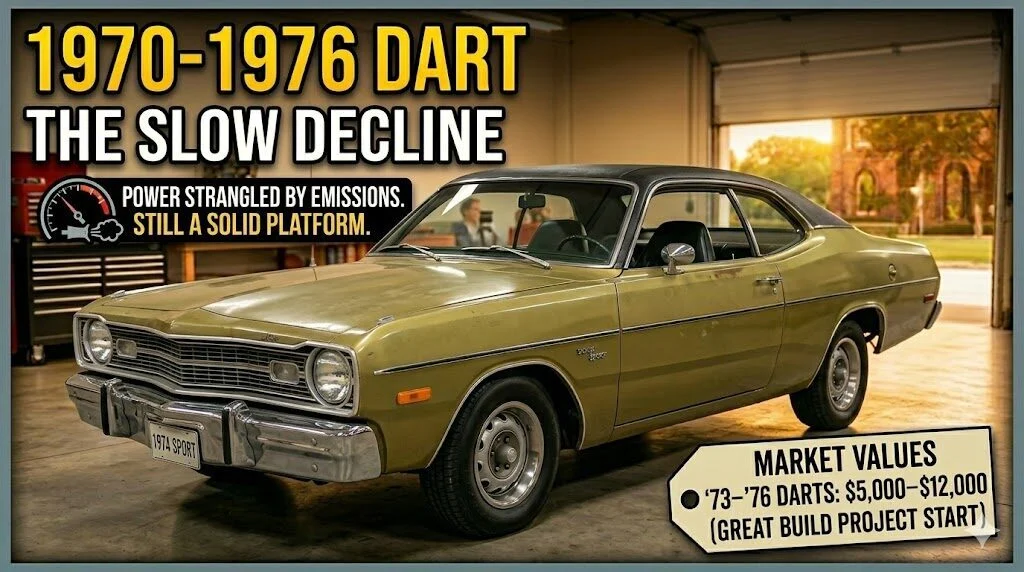
1970–1976
The slow decline. Emissions regulations started strangling power. The ’71 Demon 340 was a bright spot (basically a Dart Sport with attitude), but by 1974–76 the car had lost its edge. Still a solid platform for a build — and prices reflect the lower desirability. You can find ’73–’76 Darts for $5,000–$12,000 all day.
What to Watch For (Classic)
The Modern Dodge Dart (2013–2016)
Promise that never quite delivered
Dodge revived the Dart name in 2013 on a platform co-developed with Fiat (based on the Alfa Romeo Giulietta architecture). The idea was sound: a compact sedan with Italian bones, American styling, and a price point to compete with the Honda Civic and Toyota Corolla. On paper, it looked competitive.
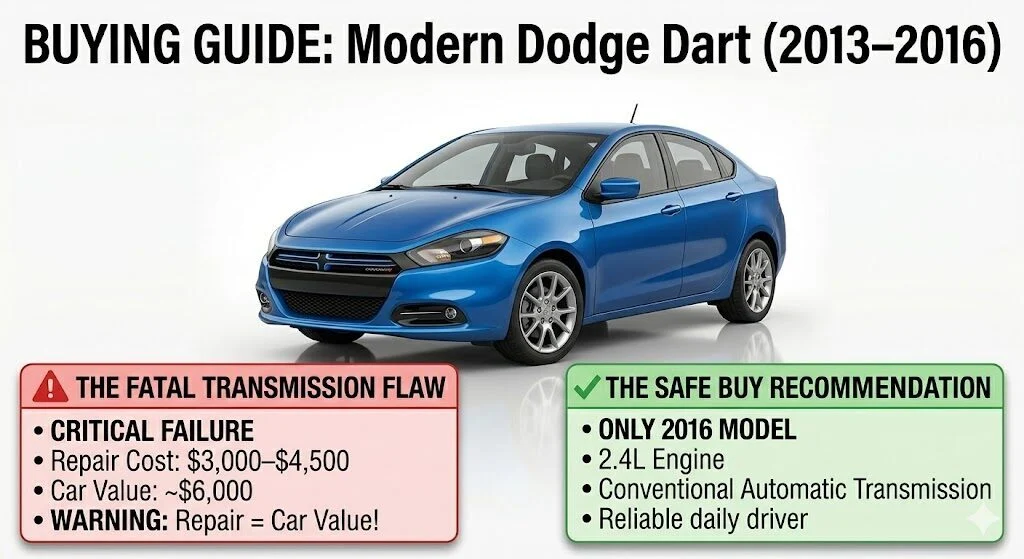
In practice, it fell short in almost every measurable way. I’ve seen this transmission issue on nearly every 2014 Dart that comes into the shop — the DDCT (Dual Dry Clutch Transmission) on the 2.0L and 2.4L models is the car’s fatal flaw. It shudders, hesitates off the line, lurches in stop-and-go traffic, and frequently needs replacement between 40,000 and 80,000 miles. A new DDCT runs $3,000–$4,500 installed — on a car that’s now worth $6,000. Do the math.
Engine & Transmission Combinations
| Engine | Transmission | HP / Torque | Verdict |
|---|---|---|---|
| 2.0L Tigershark I4 | 6-spd manual or DDCT | 160 hp / 148 lb-ft | Avoid DDCT. Manual is okay. |
| 1.4L MultiAir Turbo | 6-spd manual only | 160 hp / 184 lb-ft | Best powertrain. Buy this one. |
| 2.4L Tigershark I4 | 6-spd auto or DDCT | 184 hp / 171 lb-ft | Only with 6-spd auto (2015+). |
Dodge eventually admitted the DDCT was a problem. For 2015 and 2016 models, they swapped in a conventional 6-speed automatic for the 2.4L — and it was a massive improvement. If you’re considering a modern Dart, the 2016 model year with the 2.4L and 6-speed auto is the only one I’d recommend as a daily driver.
What the Modern Dart Gets Right
What Went Wrong
Reliability: How Do They Hold Up?
Classic Dart Reliability
Excellent (for its age)
The Slant-6 is one of the most reliable engines ever mass-produced. V8 models are straightforward to maintain. Biggest enemy is rust, not mechanical failure. Any competent shade-tree mechanic can work on these with basic hand tools.
Modern Dart Reliability
Below average
DDCT failures dominate owner complaints. The 1.4L turbo with manual is actually decent long-term. Electrical gremlins (particularly the Totally Integrated Power Module) are common. Dodge extended the DDCT warranty to 10yr/150K miles — check if coverage remains on any used example.
Used Market Pricing (Early 2026)
These are real-world asking prices based on current listings across Bring a Trailer, Cars.com, and Facebook Marketplace — not Kelley Blue Book estimates.
| Model / Year | Condition | Price Range |
|---|---|---|
| Classic Dart, Slant-6 (1963–1969) | Running project | $6,000 – $14,000 |
| Classic Dart, Slant-6 (1963–1969) | Clean driver | $14,000 – $22,000 |
| Classic Dart GTS / 340 Swinger | Driver quality | $22,000 – $45,000 |
| Classic Dart GTS / 340 Swinger | Concours / matching #s | $45,000 – $75,000+ |
| Modern Dart 2.0L (2013–2014) | DDCT auto | $4,500 – $7,000 |
| Modern Dart 1.4T (2013–2016) | 6-spd manual | $6,500 – $10,000 |
| Modern Dart GT 2.4L (2015–2016) | 6-spd auto | $8,000 – $12,000 |
So — Should You Buy a Dodge Dart?
It depends entirely on which Dart you’re talking about and what you want from it. Here’s my honest take, broken down by use case:
Weekend Cruiser / First Classic Car
Buy a 1965–1969 Dart with the Slant-6. Budget $10K–$18K for a solid driver. Parts are everywhere, the community is massive, and these cars turn heads at every cruise night. You’ll spend weekends wrenching on it with a beer in hand and a grin on your face. This is the best value in the classic American car market right now.
Restoration Project
Buy a ’68–’69 Dart if you want appreciation potential, or a ’73–’76 if you want cheap entry. The A-body platform is the most well-supported restoration project in the Mopar world. You will never be stuck waiting for a part. Budget $15K–$25K total for a Slant-6 car; $30K–$50K for a proper V8 build.
Budget Daily Driver
Consider a 2016 Dart GT with the 2.4L and 6-speed auto — but only at the right price. Under $9K with service records and under 70K miles? It’s a reasonable buy. The interior is comfortable, the trunk is spacious, and the 6-speed auto (not the DDCT) is reliable enough. But at that price point, a used Civic or Mazda3 is almost always the smarter choice. Be honest with yourself about brand loyalty versus practicality.
Collector / Investment
The modern Dart will never be collectible. Full stop. It sold poorly, it didn’t have a performance variant (the Dart SRT was canceled before production), and there’s no nostalgia factor. The classic Dart GTS and Swinger 340 models are appreciating — particularly matching-numbers cars with documentation. If you’re buying for investment, stick with the ’68–’69 GTS or the ’71 Demon 340.
Frequently Asked Questions
The Bottom Line
The Dodge Dart name carries weight — but that weight means different things depending on which car you’re looking at. The classic Dart earned its reputation through sixteen years of being the tough, affordable, adaptable compact that America needed. The modern Dart tried to recapture that spirit and stumbled badly on execution, specifically one transmission that poisoned the well for the entire car.
If you’re here because you’ve been browsing Craigslist at midnight looking at old Darts in barns — go for it. Buy the Slant-6 car. Learn to wrench. Join the A-body forums. You won’t regret it.
If you’re here because you found a cheap 2014 Dart and wondered “what’s the catch?” — now you know. The catch is a $4,000 transmission job waiting to happen. Unless it’s a manual, keep looking.