Trailers don’t usually fail all at once. They fail a little at a time. A hairline crack starts at a weld on the tongue. Rust works into a crossmember. A spring hanger flexes a few thousand times on rough roads until one day it lets go. The good news is that almost all of these problems are visible long before they become dangerous, if you know where to look.
Here’s a practical inspection routine for utility, boat, car-hauler, and livestock trailers. It also covers which problems you can handle yourself and which call for a professional welder.
Why Trailers Crack in the First Place
Trailer frames live a hard life. They flex every time you hit a pothole, carry loads that shift, and sit outside in heat, rain, and road salt. Three things cause most structural damage:
- Fatigue. Repeated flexing concentrates stress where steel changes shape, usually at welds, brackets, and bolt holes.
- Corrosion. Rust thins the metal from the inside out, especially inside tubing and under wood decks. Livestock trailers take extra punishment because manure and urine are highly corrosive to steel floors and crossmembers.
- Overloading. Running over the rated capacity, or loading too far behind the axles, strains the tongue and frame rails.
The 15-Minute Inspection Checklist
Do this before any long trip and at least twice a year. Use a flashlight and a wire brush, and wear gloves.
1. Tongue and Coupler
- Look for cracks where the tongue meets the front frame rail. This is the single most common failure point.
- Check the coupler latch for wear and make sure it closes fully on the ball.
- Inspect the safety chain attachment points. The chains are only as strong as the welds holding them.
2. Frame Rails and Crossmembers
- Scan every weld along the main rails. Rust “bleeding” from a weld line often means a crack underneath.
- Tap crossmembers with a hammer. A dull thud instead of a ring can mean rust has eaten through from inside.
- On wood-deck trailers, check under the boards where moisture collects.
3. Suspension Mounts
- Inspect spring hangers and equalizers for cracks or elongated bolt holes.
- Look for shiny metal or fresh rust lines. Both suggest parts are moving where they shouldn’t.
4. Ramps, Gates, and Hinges
- Check hinge pins and the welds holding hinges to the frame.
- Look for bent or cracked ramp supports on car haulers and equipment trailers.
5. Jack and Accessories
- Confirm the tongue jack is solidly mounted and not pulling away from the tongue.
- Check fenders. A loose fender can contact a tire at highway speed.
What You Can Handle Yourself
| Issue | DIY-friendly? | Notes |
| Surface rust | Yes | Wire-brush, treat with rust converter, prime, and paint |
| Loose bolts or U-bolts | Yes | Torque to manufacturer spec and recheck after the first trip |
| Worn coupler latch | Usually | Replacement couplers are widely available. Never weld a cracked coupler. Replace it. |
| Damaged lights or wiring | Yes | Not structural, but often what gets you pulled over |
| Cracked welds or frame steel | No | Needs proper prep, the right process, and often reinforcement |
| Rusted-through crossmembers | No | Requires cutting out and welding in new steel |
| Broken spring hangers | No | These carry the full load. A bad repair can drop the axle. |
When to Call a Welder
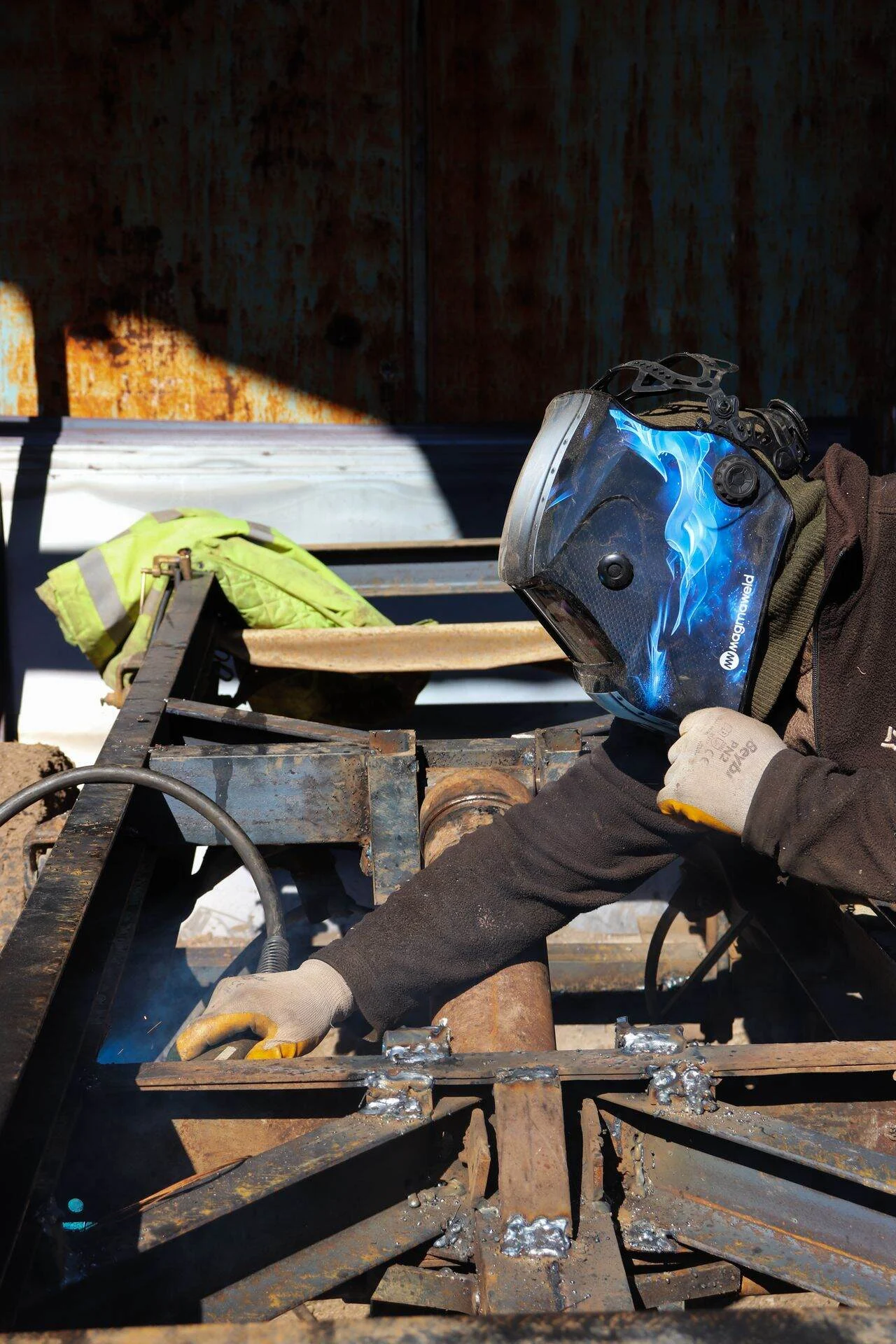
If you find a crack in structural steel, stop towing the trailer until it’s repaired. Grinding a crack and laying a bead over it is a common DIY fix, and it often fails, because the root cause stays there. A good repair usually involves:
- Finding the end of the crack, sometimes by drilling a small stop hole so it can’t keep spreading.
- Grinding out the damaged weld completely, down to clean metal.
- Re-welding with full penetration using the right wire or rod for the steel thickness.
- Adding a gusset or fish plate where the design is weak, so the same spot doesn’t crack again.
A few parts shouldn’t be welded at all. Torsion axles and many couplers are designed to be replaced, not repaired, because heat can ruin their strength or rubber components.
A mobile welder can also save you a tow. If the trailer isn’t safe to move, or is loaded with equipment or hay, having the repair done where it sits is often the simplest option. In Central Texas, for example, Georgetown Mobile Welder brings the rig to ranches, job sites, and driveways across Williamson County. Their trailer welding repair covers cracked tongues, rusted crossmembers, and broken spring hangers.
Hot-Climate Tips Worth Knowing
If you tow in a hot, sunny region like the American South or Southwest, a few extra habits help:
- Check tires more often. Heat and age crack sidewalls even when the tread looks fine.
- Repaint chipped areas fast. Intense UV breaks down paint, and bare steel rusts quickly once summer storms arrive.
- Watch ranch and caliche roads. Washboard gravel roads punish welds and suspension mounts much more than highway miles do.
The Bottom Line
A twice-yearly inspection takes about 15 minutes and catches nearly every serious trailer problem before it turns into a roadside failure. Handle rust, bolts, and lights yourself. When you find cracked steel or failed welds, park the trailer and get it properly repaired. The cost of a weld repair is small next to the cost of a trailer letting go on the highway.