Choosing the right automatic transmission fluid is one of the most important details of Toyota gearbox maintenance. If your manual specifies Toyota ATF WS transmission oil, using a different formula or an incorrect filling procedure can introduce shifting problems and potentially costly repairs.
This guide explains what Toyota ATF WS means, how it works, which vehicles might require it, when service is appropriate, how fluid levels are checked, and what a replacement may cost in the United States. Most importantly, it shows you where a model-specific manual matters more than generic advice.
Quick Answer: What Is Toyota ATF WS?
Toyota ATF WS means World Standard Automatic Transmission Fluid. It is Toyota’s specified transmission fluid for certain automatic transmissions and transaxles. It provides lubrication, hydraulic support, and friction characteristics for compatible designs. Toyota lists genuine WS fluid under part number 00289-ATFWS. It is not interchangeable with Toyota T-IV or Dexron ATF.
Before purchasing: confirm your exact model year, engine, drivetrain, and transmission requirements in Toyota’s owner’s manual or service documentation.
What Is Toyota ATF WS Transmission Oil?
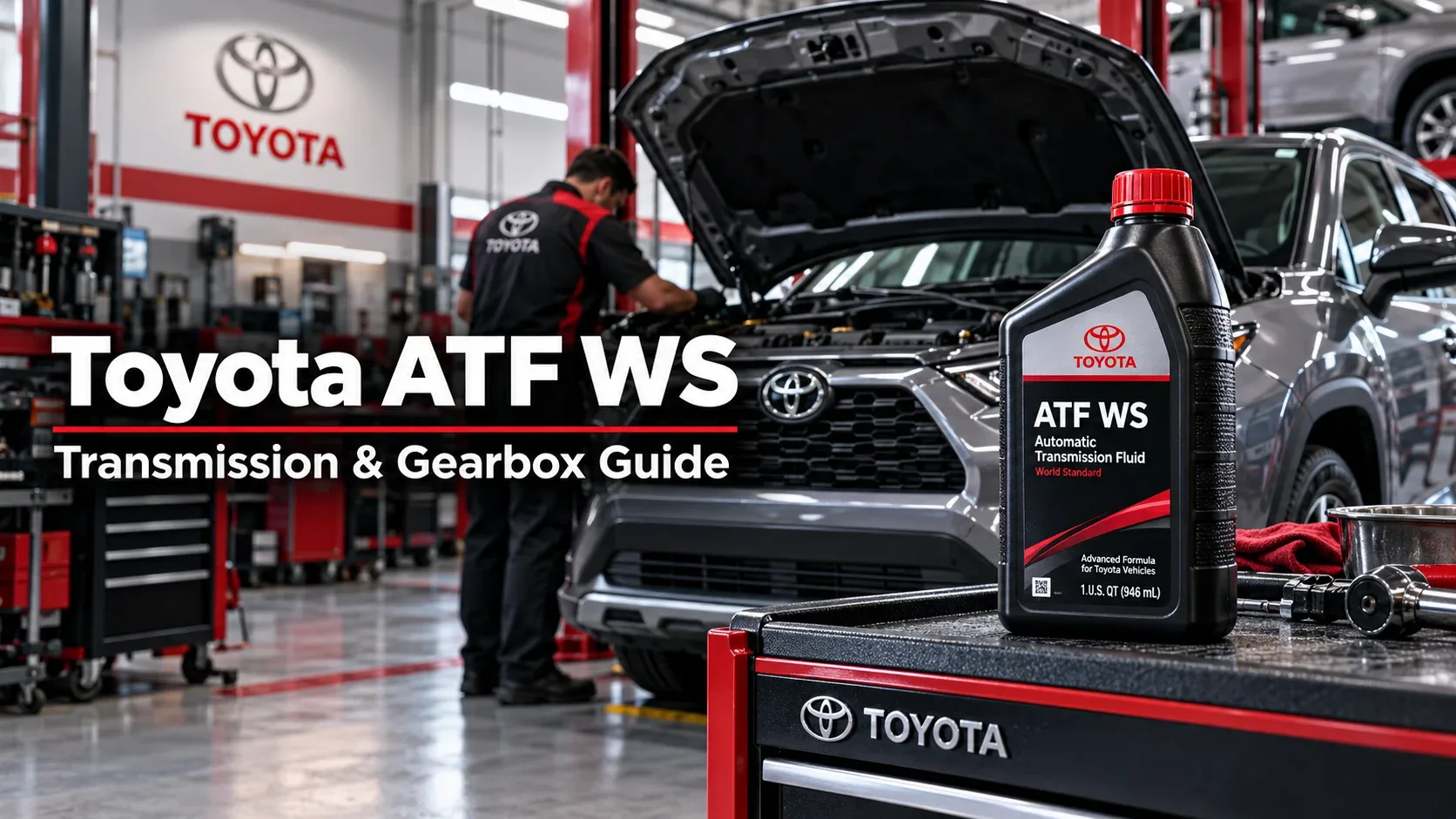
ATF stands for automatic transmission fluid, while WS stands for World Standard. Toyota introduced WS to support specific transmission designs and extend the time between routine maintenance checks. Unlike engine oil, ATF performs several tasks at once inside an automatic gearbox, so fluid properties can have a direct effect on operation.
The Toyota Genuine World Standard product is designed for specified Toyota automatic transmissions and transaxles. Toyota’s current US parts catalog identifies the product as 00289-ATFWS; however, seeing the Toyota badge on your car does not establish that WS is the right fluid.
A CVT, conventional automatic gearbox, manual gearbox, and hybrid transaxle may each have very different requirements, even when installed in vehicles with similar model names. The most dependable method is to check the transmission-fluid specification in documentation for your precise vehicle.
How Does Toyota ATF WS Work Inside a Transmission?

In a conventional automatic transmission designed for ATF WS, the fluid helps several systems operate together:
- Lubrication: reduces metal-to-metal contact between moving transmission components.
- Hydraulic operation: transmits pressure for control functions and gear engagement.
- Clutch and friction behavior: provides specified friction characteristics used by the transmission’s clutch materials and controls.
- Heat transfer: helps move heat through the transmission and associated cooling system.
- Internal protection: supports operation of seals, bearings, gears, and other fluid-exposed parts as designed.
Not all Toyota transmissions use the same mechanisms. For example, some hybrid transaxles do not shift through planetary gear sets and friction clutches in the same way as a conventional stepped automatic. That distinction is another reason to rely on Toyota’s application-specific requirements rather than the phrase “Toyota transmission fluid” alone.
Which Toyota Vehicles Use ATF WS?

ATF WS is used in numerous Toyota transmission applications, but compatibility cannot be established from the model name alone. The same nameplate can cover different transmissions, powertrains, generations, and regional specifications.
| Vehicle family | Why the exact configuration matters | What to verify |
|---|---|---|
| Camry | Powertrain and transmission designs change between years and trims. | Year, engine, transmission specification |
| Corolla | Models have been sold with different automatic and CVT configurations. | Transmission type and approved fluid |
| RAV4 | Gasoline and hybrid variants can use different drivetrains. | Powertrain, year, manual |
| Highlander | Generational and hybrid differences affect service information. | Specific transmission or transaxle |
| Tacoma / 4Runner | Gearboxes and service procedures differ by generation. | Model year and transmission code |
| Prius / hybrids | Hybrid transaxles may require different service procedures from conventional automatics. | Hybrid-specific transaxle instructions |
Toyota ATF WS vs. T-IV, Dexron, and CVT Fluid
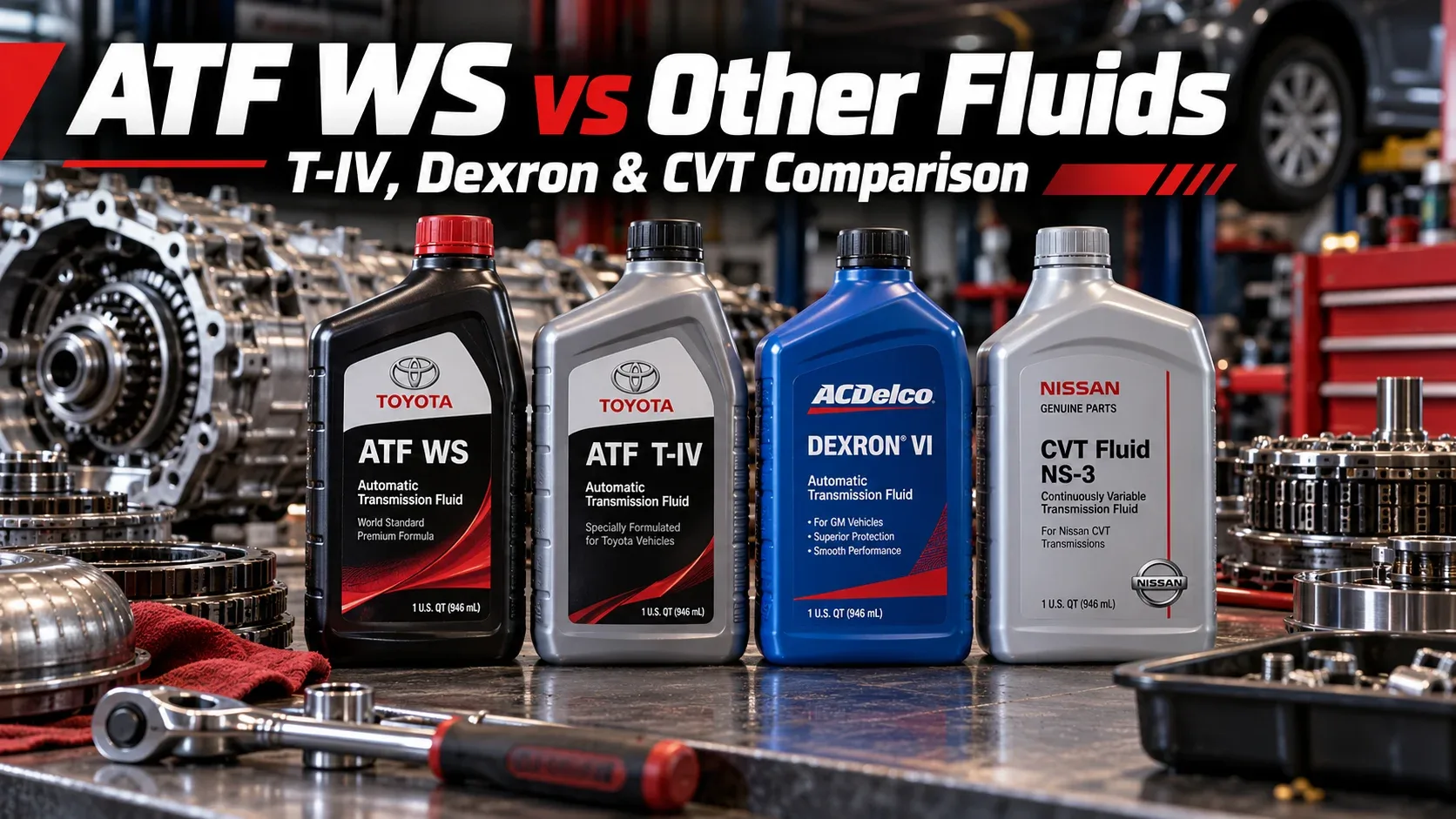
Transmission fluids are not universally interchangeable. Their friction, viscosity, and operating requirements can differ significantly.
| Fluid | Typical purpose | Can it replace ATF WS? |
|---|---|---|
| Toyota ATF WS | Specified WS-compatible transmissions and transaxles | Yes, where the vehicle calls for WS |
| Toyota ATF T-IV | Older specified Toyota automatic transmission applications | No; Toyota identifies it as incompatible |
| Dexron ATF | Transmission applications requiring a particular Dexron specification | No; not compatible per Toyota’s WS bulletin |
| Toyota CVT fluid | Designated continuously variable transmissions | Not a general WS substitute |
| Manual gearbox lubricant | Specified manual transmission applications | No; use gearbox-specific lubricant |
Can You Mix ATF WS With Another Transmission Fluid?
Do not intentionally mix ATF WS with T-IV, Dexron, or another unspecified fluid. Toyota’s bulletin explicitly warns that WS is not compatible with T-IV or Dexron ATF. If the wrong fluid may already have been added, avoid experimenting with additives or further mixtures and have a qualified technician evaluate the system.
How Often Should Toyota ATF WS Be Changed?
There is no responsible one-size-fits-all replacement mileage for all Toyota ATF WS applications. Toyota’s customer support explains that automatic transmissions using WS fluid are sealed, generally do not consume fluid, and do not need periodic fluid replacement unless an inspection indicates replacement is necessary. Toyota directs owners to their Warranty and Maintenance Guide for inspection recommendations.
A Toyota World Standard technical service bulletin also describes a 100,000-mile inspection-only recommendation for the vehicles covered by that bulletin, rather than a mandatory routine flush or change. This should not be copied as the service schedule for every model year and transmission.
What About “Lifetime” Transmission Fluid?
“Lifetime” does not mean that leaking, contaminated, overheated, or incorrectly filled fluid should be ignored. It means routine replacement may not be scheduled under specified circumstances. Service instructions and inspection needs vary with the vehicle and operating conditions.
Does Towing or Severe Use Change the Schedule?
Some Toyota maintenance guides include additional requirements for particular operating conditions such as towing or unusually demanding driving. Check your exact guide instead of assuming that either a conventional interval or a “never change it” rule applies.
Signs Your Toyota Transmission Fluid May Need Inspection

A changing transmission feel can be a reason to investigate, but symptoms do not automatically prove that the ATF is worn out. Diagnostic trouble codes, mechanical faults, wiring, control software, and other components may be responsible.
| Possible symptom | What it may indicate | Appropriate next step |
|---|---|---|
| Delayed engagement | Fluid-level, hydraulic, control, or mechanical issue | Professional inspection |
| Harsh or erratic shifting | Several possible control or transmission faults | Read diagnostic codes and verify service history |
| Wet spots beneath transmission | Potential transmission-fluid leak | Identify fluid and leak source |
| Unexpected shudder or vibration | Possible drivetrain, engine, or transmission issue | Vehicle-specific diagnosis |
| Temperature or transmission warning | Potential overheating or control fault | Safely stop as directed by the vehicle manual |
If the vehicle loses drive, exhibits severe shifting problems, or displays a serious transmission warning, minimize further operation and obtain professional assistance.
How to Check Toyota ATF WS Transmission Fluid
Many WS-equipped Toyota automatic transmissions have no conventional transmission dipstick. That design does not imply that owners should attempt to open a fill or overflow plug for a casual level check.
- Confirm the design. Identify whether your particular transmission uses a dipstick, a check plug, or an overflow-based level procedure.
- Consult the factory procedure. Some transmissions require the vehicle to be level and the ATF to be within a narrowly specified temperature range.
- Inspect for external leakage. A safe visual check for stains or fluid drops can help determine whether service is needed.
- Use appropriate diagnostic equipment. A qualified technician may need a scan tool to confirm the correct fluid-temperature range.
- Set the level by the specified method. Incorrectly measuring at the wrong temperature can lead to overfill or underfill.
How to Change Toyota ATF WS Transmission Fluid
Where inspection or repair indicates a fluid change is appropriate, the work must match the particular transmission. The outline below describes the stages of professional or properly equipped DIY service; it is not a universal step-by-step specification for all Toyota models.
- Identify the vehicle and approved fluid. Verify the transmission code and Toyota-specified ATF before opening any plug.
- Gather the specified tools and consumables. These may include a fluid filler, suitable lift or supports, fresh sealing washers, and a diagnostic temperature reading method.
- Access the proper drain and fill ports. Confirm each location in model-specific service literature to avoid removing the wrong plug.
- Drain and measure the removed fluid. Collect fluid in a clean graduated pan for reference, but do not assume the removed amount establishes the correct final level.
- Refill with fresh, correct fluid. Use the manufacturer-prescribed fill sequence and never reuse discarded fluid.
- Set the fluid level at the required temperature. If the gearbox uses an overflow system, follow the precise factory procedure and torque specifications.
- Check for leaks and confirm operation. Complete any necessary post-service inspection according to the vehicle instructions.
Drain-and-Fill vs. Transmission Flush
A drain-and-fill removes fluid that drains from the service port, whereas a machine exchange may circulate a greater quantity of fluid through the system. They are not identical procedures, and neither should be prescribed automatically for all transmissions. Toyota’s WS bulletin states that routine flushing or changing is not required for the applications it covers; a specific service should have a documented reason.
How Much Toyota ATF WS Transmission Oil Do You Need?
Transmission capacity is not a single fixed Toyota-wide number. Even two vehicles that both specify WS can have different fill volumes and fluid-level procedures.
| Quantity | What it means | Why it matters |
|---|---|---|
| Total / dry capacity | Approximate amount in an empty transmission assembly | Usually larger than a routine service refill |
| Drain-and-fill quantity | Amount normally removed through the drain procedure | Varies with transmission, temperature, and design |
| Final service level | Fluid quantity established by the correct vehicle-specific checking method | Controls underfill and overfill risk |
Example: If a transmission retains fluid inside internal components during draining, filling it with its published total dry capacity could overfill it. Consult Toyota service information for the actual gearbox and use its level-setting method.
Any model-year capacity chart should specify the transmission code and cite the applicable Toyota manual. Without these details, a broad Camry, Corolla, RAV4, or Tacoma capacity number could mislead readers.
Toyota ATF WS Price and Transmission Fluid Service Cost
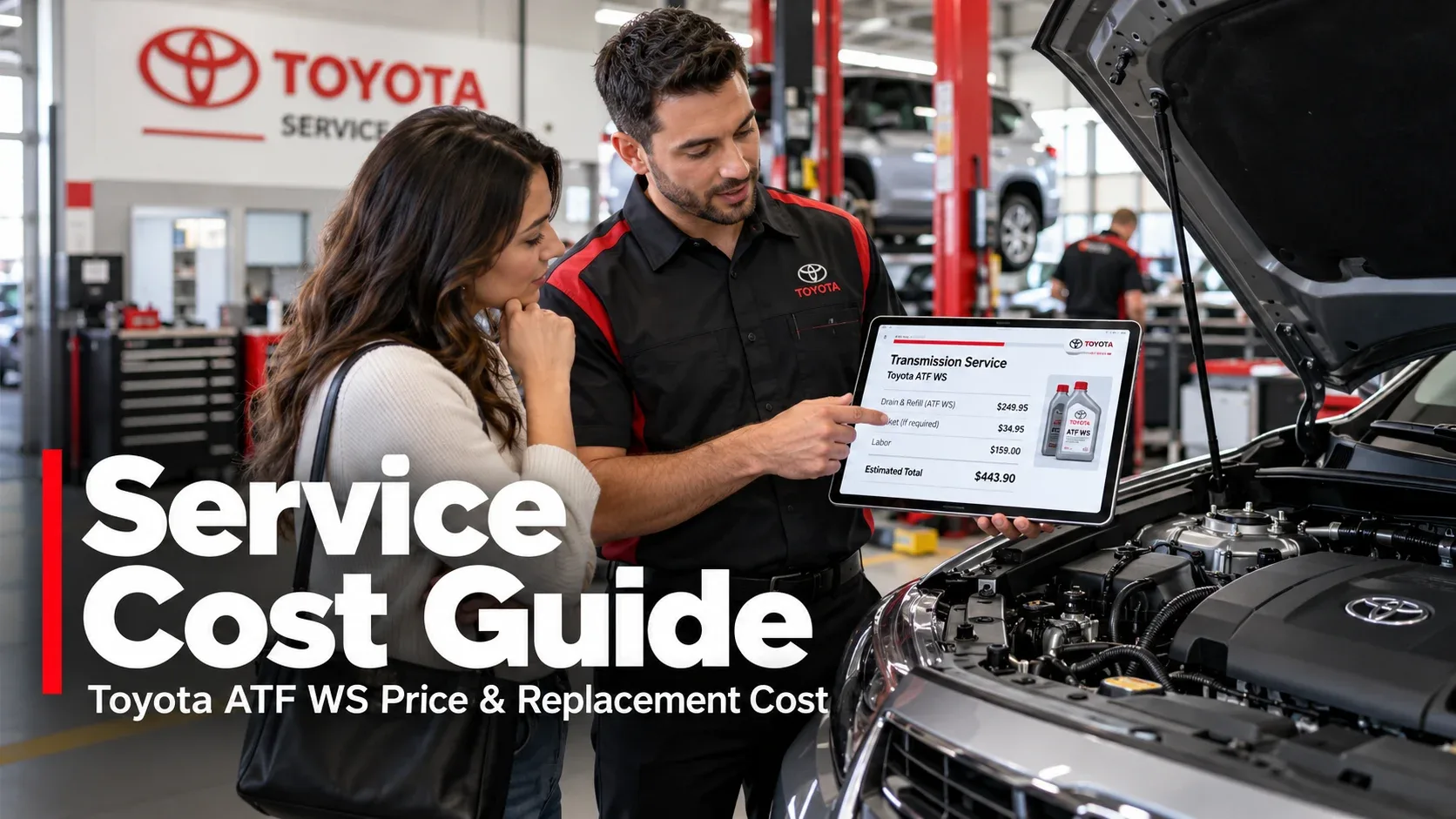
Genuine ATF WS fluid is sold through Toyota parts channels, but pricing varies by dealer, packaging, and location. A full service invoice may include fluid, labor, washers or seals, diagnostic work, and taxes.
For broader US context, RepairPal’s September 3, 2026 transmission-fluid-change estimate is $294–$356 on average, with estimated labor of $131–$192 and parts around $163. This is a general transmission-fluid-service estimate, not a Toyota ATF WS quotation. The actual quote for your Toyota could be higher or lower.
| Cost element | Budgeting advice |
|---|---|
| Genuine fluid | Ask the supplying Toyota dealer for a current per-container price and part number |
| Basic service labor | Request the exact procedure being performed and its billed labor |
| Diagnostic work | Ask whether inspection or fault diagnosis is separate from fluid replacement |
| Seals and consumables | Confirm whether new gaskets or washers are included |
| Advanced transmission repairs | Obtain a separate itemized estimate; fluid service is not a substitute for mechanical repairs |
Dealership or Independent Repair Shop?
Either can be suitable if the technician has access to correct Toyota service information, understands the fluid-level procedure, and uses the specified fluid. Compare written estimates that describe the same job rather than choosing solely by the lowest advertised service price.
Genuine Toyota ATF WS vs. Aftermarket Alternatives
Toyota recommends Genuine ATF WS and warns in its World Standard bulletin that additives or aftermarket fluids marketed as substitutes can cause shifting concerns or internal transmission damage. Aftermarket product labels sometimes list broad compatibility claims; those claims should not be treated as Toyota approval without verification.
If your transmission requires ATF WS, the most straightforward choice is genuine Toyota fluid from a reputable source. If you are evaluating a third-party product, review the exact written application guidance and warranty implications, and consult a qualified Toyota technician when compatibility is uncertain.
Also keep unused ATF in sealed containers. Toyota cautions that exposure to air can allow WS fluid to absorb moisture. Do not pour drained ATF back into the gearbox.
Common Toyota ATF WS Maintenance Mistakes to Avoid
- Assuming every Toyota uses WS: model and engine names are not enough to identify the transmission specification.
- Mixing incompatible fluids: Toyota explicitly warns against mixing WS with T-IV or Dexron ATF.
- Guessing a refill capacity: dry capacity and service fill are different quantities.
- Ignoring fluid temperature: many sealed gearbox level checks have precise temperature requirements.
- Opening the wrong plug: transmissions may have several visually similar plugs.
- Automatically flushing a healthy transmission: use the manufacturer’s applicable service guidance instead of a generic schedule.
- Using additives or reused fluid: Toyota warns of potential shift and component concerns.
- Treating a fluid change as a diagnosis: symptoms such as shudder or hard shifts may have other causes.
Frequently Asked Questions About Toyota ATF WS
What does Toyota ATF WS stand for?
ATF WS means World Standard Automatic Transmission Fluid. It is a Toyota transmission-fluid specification for designated transmissions and transaxles, not a universal fluid for all Toyotas.
Does every Toyota automatic transmission require ATF WS?
No. Fluid requirements vary by model year, transmission, engine, and drivetrain. Check the owner’s manual for the exact vehicle rather than relying on its model name.
Can Toyota ATF WS be mixed with T-IV or Dexron?
No. Toyota’s technical bulletin identifies WS as incompatible with T-IV and Dexron ATF. If incorrect fluid may have been added, seek vehicle-specific service advice rather than adding more products.
Is Toyota ATF WS considered lifetime fluid?
Toyota states that WS-equipped automatic transmissions generally do not need periodic replacement unless inspection finds it necessary. This is not permission to ignore fluid leaks, abnormal operation, or requirements in the vehicle-specific maintenance guide.
How often should I change Toyota ATF WS?
There is no single correct interval for every Toyota WS application. Consult your Warranty and Maintenance Guide and determine whether an inspection or service is prescribed for your specific driving conditions and transmission.
How much ATF WS does my Toyota need?
It depends on the actual transmission and whether you are discussing a dry fill or a drain-and-fill service. A correct final level may require a temperature-controlled procedure rather than a fixed number of quarts.
Can I check Toyota ATF WS with a dipstick?
Many WS-equipped Toyota automatic transmissions are sealed and do not provide a conventional dipstick. Use the model-specific service information to identify the approved level-checking procedure.
Can low or incorrect fluid cause harsh shifts?
Incorrect fluid or an improper level can affect operation, but harsh shifts may also come from mechanical, hydraulic, electronic, or control-system problems. Proper diagnosis is needed before choosing a repair.
Should I use an aftermarket ATF WS equivalent?
Toyota recommends its genuine WS fluid and cautions that substitutes or additives can cause problems. Review exact written compatibility requirements before considering any alternative.
What is the Toyota ATF WS part number?
Toyota’s US parts catalog currently identifies Genuine World Standard Automatic Transmission Fluid under part number 00289-ATFWS. Verify the current product and fitment with a Toyota dealer.
Can I change Toyota ATF WS myself?
DIY service may be possible for appropriately equipped and experienced owners, but sealed-transmission service can require secure vehicle lifting, special filling tools, and fluid temperature monitoring. Follow the exact repair manual or hire a qualified technician.
Final Thoughts: Use the Right Toyota Transmission Fluid
Toyota ATF WS transmission oil is engineered for specific automatic transmissions and transaxles, not every Toyota gearbox. Correct fluid selection, appropriate inspection intervals, and accurate filling procedures matter more than generic service rules or universal fluid claims.
Before buying ATF WS or booking a fluid change, confirm the exact specification in your Toyota documentation. If you see a leak, receive a transmission warning, or notice changes in shifting, arrange a proper inspection rather than assuming new fluid alone will solve the problem.
Technical References and Editorial Notes
Use these references to verify technical and price information. Vehicle-specific service manuals remain the controlling source for capacities and procedures.
- Toyota Customer Support — Sealed WS transmission fluid inspection and replacement guidance.
- Toyota technical bulletin T-SB-0006-11 Rev1 — World Standard Automatic Transmission Fluid.
- Toyota Genuine Parts — World Standard ATF part 00289-ATFWS.
- RepairPal — Transmission Fluid Change Cost Estimate (updated September 3, 2026).