A complete guide to understanding speed rating letters, load index numbers, and how to choose the right replacement tire for your vehicle.
You are looking at a tire code like 225/65R17 102H and wondering what 102H means. The number 102 is the tire load index — a standardized weight capacity code. The letter H is the tire speed rating — the maximum sustained speed the tire has been laboratory-tested to handle safely. Together they tell you critical performance limits that affect your safety on the road.
This tire speed rating chart breaks down every common speed rating code, explains how the load index works alongside it, and helps you choose replacement tires that match your vehicle’s requirements — whether you drive a family sedan, crossover, or SUV.
Decoding the Tire Size Code: 225/65R17 102H
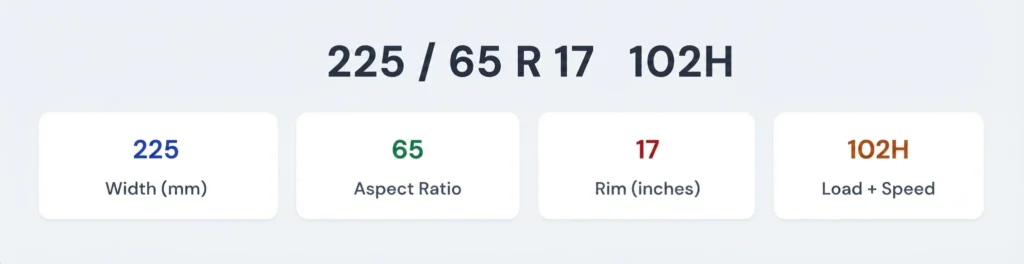
In 225/65R17 102H: 225 is the width in mm, 65 is the aspect ratio, R means radial, 17 is the rim diameter in inches, 102 is the load index, and H is the speed rating.
What Is a Tire Speed Rating?
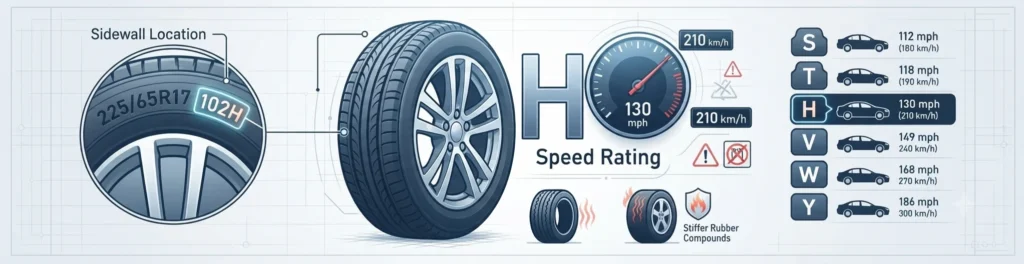
A tire speed rating is a letter assigned after controlled laboratory testing that indicates the maximum speed a tire can sustain under specified load and inflation conditions. It does not represent a recommended driving speed or permission to exceed posted speed limits.
The speed rating appears as the last character in the service description on the tire sidewall. In 225/65R17 102H, the letter H means the tire is rated for sustained speeds up to 130 mph (210 km/h). Higher-rated tires typically use stiffer rubber compounds and reinforced construction to manage heat at speed.
Complete Tire Speed Rating Chart
Use this tire speed rating chart to find the meaning of any speed rating letter on your tire. The chart lists ratings from lowest to highest maximum speed.
| Rating | Max Speed (mph) | Max Speed (km/h) | Typical Use |
|---|---|---|---|
| L | 75 | 120 | Off-road / light truck |
| M | 81 | 130 | Temporary spare |
| N | 87 | 140 | Temporary spare |
| P | 93 | 150 | — |
| Q | 99 | 160 | Winter / studded tires |
| R | 106 | 170 | Heavy-duty light truck |
| S | 112 | 180 | Family sedans, minivans |
| T | 118 | 190 | Family sedans, SUVs |
| U | 124 | 200 | — |
| H | 130 | 210 | Sport sedans, crossovers |
| V | 149 | 240 | Sports cars, performance |
| W | 168 | 270 | Exotic sports cars |
| Y | 186 | 300 | Supercars |
| (Y) | 186+ | 300+ | Top-tier supercars |
Note: H appears between U and V because it was originally designated for high-performance tires before the scale was expanded. The alphabetical gap is a legacy of the older European rating system.
Why Is H Out of Alphabetical Order?
When the speed rating system was first developed in Europe, H stood for “High Performance” and was the highest rating available at 210 km/h. As faster tires were developed, V, W, and Y were added above it. Rather than reassigning letters and confusing existing inventories, the industry kept H in its original position between U and V.
Where to Find the Speed Rating on Your Tires
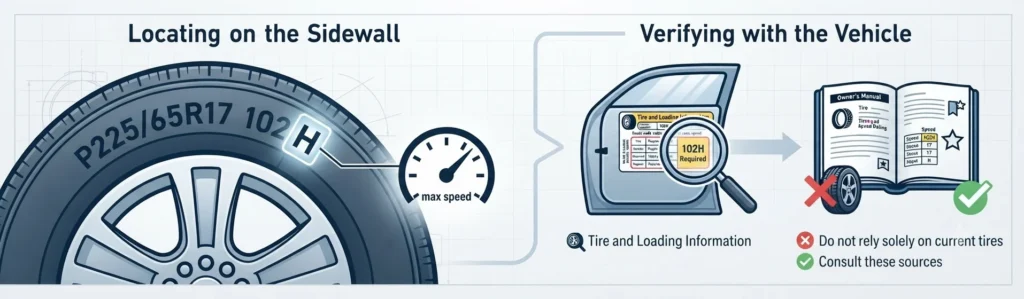
Look at the tire sidewall for the service description — the numbers and letter that follow the tire size. In a code like P225/65R17 102H, the speed rating is the final letter H. It always appears immediately after the load index number.
To find your vehicle’s required speed rating, check the Tire and Loading Information placard on the driver-side door jamb or consult the owner’s manual. Do not rely solely on the rating printed on your current tires — a previous owner may have installed tires with a different specification.
Tire Load Index Explained
The tire load index is the two- or three-digit number that appears before the speed rating letter. In 225/65R17 102H, the number 102 is the load index. It represents the maximum weight one tire can support when properly inflated — in this case, 1,874 lbs (850 kg) per tire.
Never choose a replacement tire with a lower load index than what the vehicle manufacturer specifies. NHTSA recommends matching the original-equipment load capacity to maintain safe handling, braking, and structural integrity under load.
Common Tire Load Index Chart
| Load Index | Max Load (lbs) | Max Load (kg) |
|---|---|---|
| 85 | 1,135 | 515 |
| 87 | 1,201 | 545 |
| 89 | 1,279 | 580 |
| 91 | 1,356 | 615 |
| 93 | 1,433 | 650 |
| 95 | 1,521 | 690 |
| 97 | 1,609 | 730 |
| 99 | 1,709 | 775 |
| 100 | 1,764 | 800 |
| 102 | 1,874 | 850 |
| 104 | 1,984 | 900 |
| 106 | 2,094 | 950 |
Speed Rating vs. Load Index: What’s the Difference?
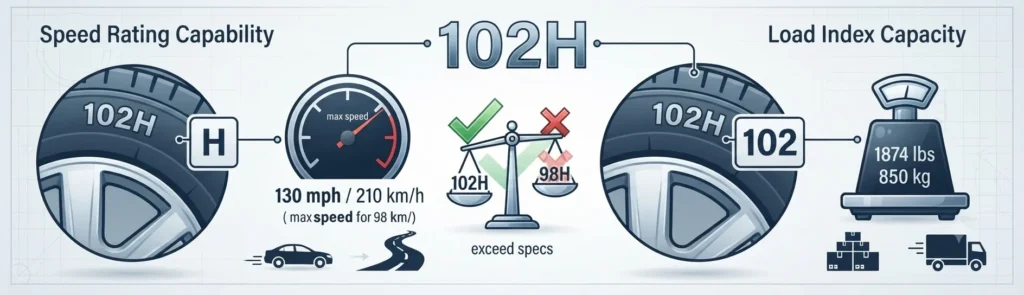
The speed rating (letter) tells you the maximum tested speed capability. The load index (number) tells you the maximum weight capacity per tire. Both appear together in the service description — for example, 102H — but they measure completely different things.
When selecting replacement tires, you must check both values. A tire might have the correct speed rating but an insufficient load index for your vehicle, or vice versa. Both must meet or exceed the vehicle manufacturer’s original specification.
Can You Use a Higher or Lower Speed Rating?
You can safely install tires with a higher speed rating than specified. For example, replacing T-rated tires with H-rated tires is acceptable. Higher-rated tires often provide better high-speed stability and cornering grip, though they may have a slightly firmer ride and shorter tread life due to softer rubber compounds optimized for heat dissipation.
Downgrading the speed rating is generally not recommended. A lower rating may compromise the tire’s ability to dissipate heat at sustained highway speeds and reduce high-speed handling stability. If you rarely drive at highway speeds (for example, in winter-only conditions), some manufacturers allow a lower-rated winter tire — but check your owner’s manual first.
Speed Ratings for 225/65R17 Tires
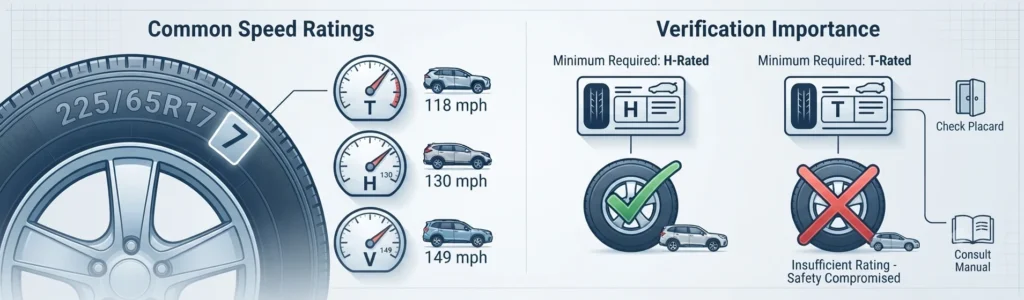
The size 225/65R17 is popular on compact SUVs and crossovers like the Toyota RAV4, Honda CR-V, and Subaru Forester. Tires in this size are commonly available with speed ratings of T (118 mph), H (130 mph), and occasionally V (149 mph), depending on the brand and model.
There is no single “correct” speed rating for all 225/65R17 tires. Your vehicle’s door placard or owner’s manual specifies the minimum required rating. A RAV4 may require H-rated tires, while another vehicle in the same tire size may only require T-rated. Always verify before purchasing.
Does a Higher Speed Rating Affect Ride Comfort?
In general, yes. Higher speed ratings often correspond to stiffer sidewalls and softer tread compounds. The stiffer sidewall improves cornering precision but transmits more road imperfections to the cabin. The softer compound provides better grip but may wear faster. For most everyday drivers, a T or H rating provides an excellent balance of comfort, tread life, and safety. Only upgrade to V or W if your vehicle requires it or you prioritize high-speed handling.
Tire Purchase Safety Checklist
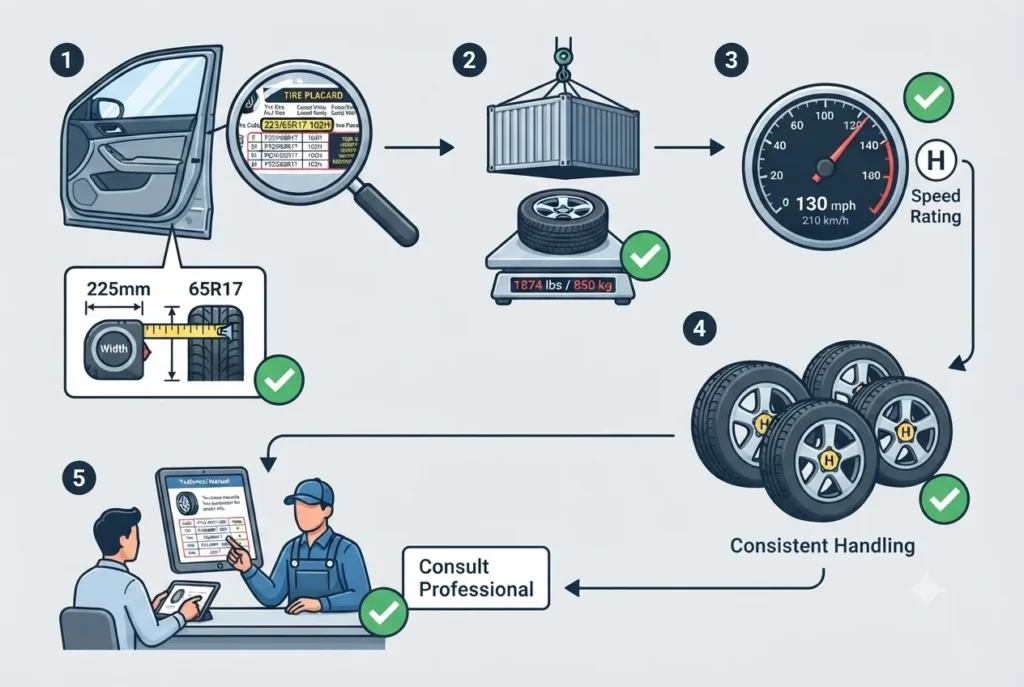
Before buying replacement tires, verify all of the following:
- ✓ The tire size matches your door placard (e.g., 225/65R17)
- ✓ The load index meets or exceeds the manufacturer’s specification
- ✓ The speed rating meets or exceeds the manufacturer’s specification
- ✓ All four tires have the same speed rating for consistent handling
- ✓ If anything is unclear, consult a qualified tire professional before purchasing
Frequently Asked Questions
What does 102H mean on a tire?
102 is the load index, meaning the tire can support up to 1,874 lbs (850 kg) per tire when properly inflated. H is the speed rating, meaning the tire has been tested for sustained speeds up to 130 mph (210 km/h).
Do all four tires need the same speed rating?
Yes, it is strongly recommended. Mixing speed ratings reduces the vehicle’s overall capability to that of the lowest-rated tire and can cause unpredictable handling during emergency maneuvers.
Is the speed rating a recommended driving speed?
No. The speed rating indicates a laboratory-tested maximum under controlled conditions. Drivers must always follow posted speed limits and drive appropriately for road, weather, and traffic conditions.
What speed rating do I need for highway driving?
For typical U.S. highway driving (65–75 mph), an S rating (112 mph) or higher is sufficient. However, always match the rating specified by your vehicle manufacturer — it accounts for the vehicle’s weight, braking, and handling characteristics.
Where can I find my vehicle’s recommended speed rating?
Check the Tire and Loading Information placard on the driver-side door jamb, or look in your vehicle’s owner’s manual. These sources show the original-equipment tire specifications including size, load index, speed rating, and recommended inflation pressure.
Summary: Choosing the Right Tire Speed Rating
The tire speed rating chart is a straightforward tool once you understand the system. Each letter from L to Y represents a progressively higher tested speed capability. Combined with the load index, these two values define the performance envelope of your tire and must match your vehicle manufacturer’s requirements.
Before purchasing replacement tires, check your door placard for the correct size, load index, and speed rating. Match or exceed all three specifications. If you are comparing options in a common size like 225/65R17, remember that different tire models may carry different ratings — always verify against your specific vehicle’s requirements rather than assuming one rating fits all.