Vehicle identification guide
A Porsche VIN tells you more than a car’s identity. Decoded correctly, it can help confirm a model year, manufacturing details, and key information before you buy.
Whether you are researching a used Porsche 911, Boxster, Cayman, Macan, Cayenne, or Panamera, this guide explains where to find the VIN, how to understand its 17 characters, and why older Porsche chassis numbers need special attention.
Quick answer
How Do You Decode a Porsche VIN?
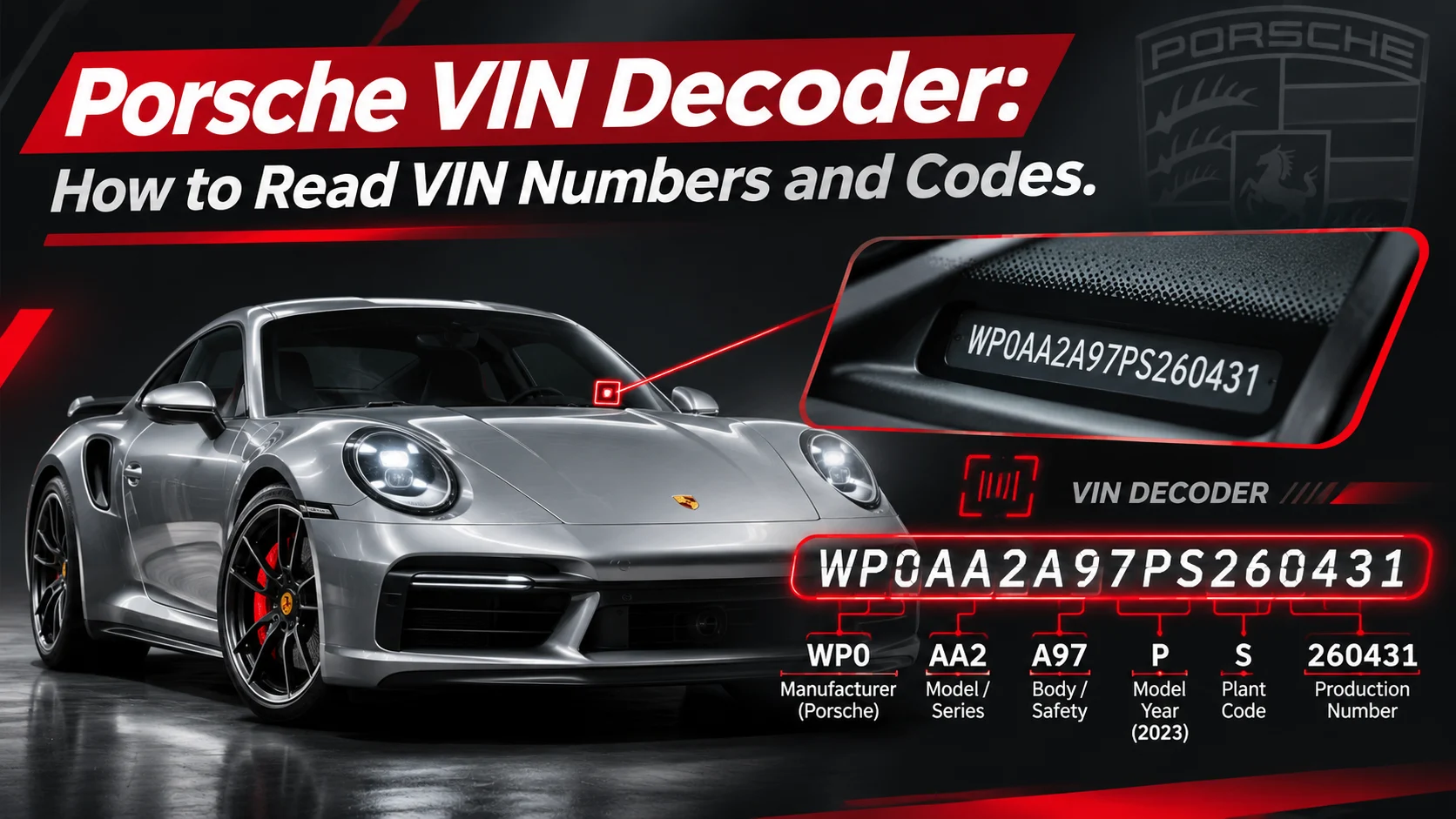
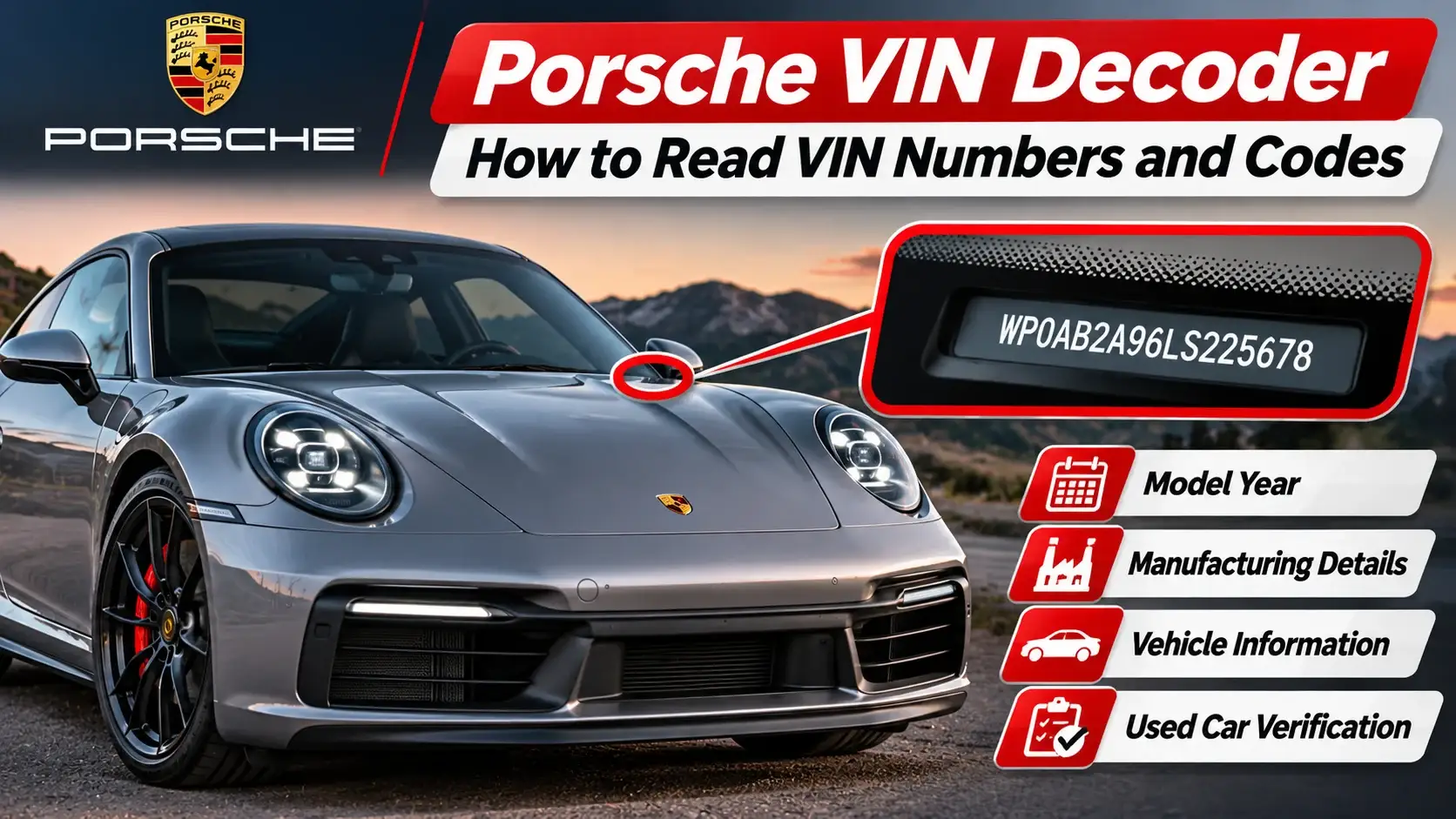
A Porsche VIN decoder interprets the characters in a vehicle identification number. Most modern Porsches use 17 characters. Positions 1–3 identify the manufacturer, positions 4–8 describe vehicle attributes, position 10 indicates the model year, and position 11 indicates the assembly plant. In U.S.-regulated VINs, position 9 is a check digit. International-market formats can differ.
What Is a Porsche VIN?
VIN means Vehicle Identification Number. Manufacturers assign it to identify an individual vehicle. It is commonly used in registration, parts catalogs, recall searches, and vehicle-history research.
Decoding can reveal manufacturer and model-year information and, depending on the system, some vehicle details. But the VIN itself does not contain accident records, complete service history, or a mechanical diagnosis.
01 / IDENTIFY
Confirm the car
Compare the number with vehicle documents.
02 / DECODE
Understand the codes
Find manufacturer, model-year, and plant details.
03 / RESEARCH
Check records
Use the number in separate history and recall searches.
04 / VERIFY
Inspect before buying
Combine identification with a specialist inspection.
Where to Find the VIN on a Porsche
On many modern Porsches, look at the lower driver’s side of the dashboard through the windshield. Other identification labels or stamped locations vary by model, production year, and market.
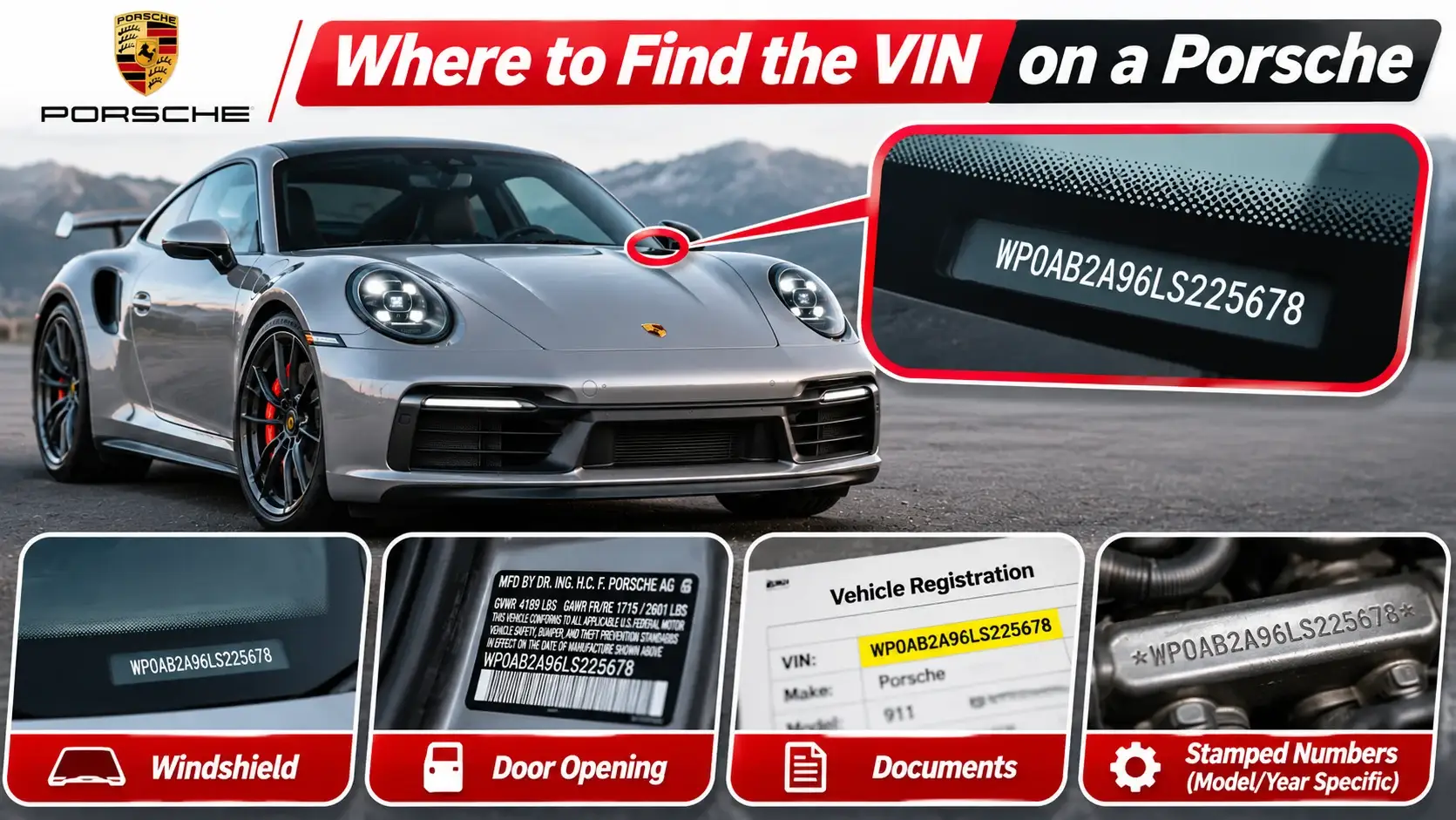
- Windshield: Check the dashboard near the driver’s side.
- Door opening: Look for identification labels where fitted.
- Documents: Check the title and registration information.
- Additional stamped numbers: Consult model-specific documentation, especially on classic cars.
Buyer tip: Investigate any number that appears altered, is missing, or does not match the paperwork. Do not rely on a seller’s typed VIN alone.
Porsche VIN Number Structure Explained
The modern 17-character format consists of a manufacturer identifier, a vehicle descriptor, and a vehicle identifier. The exact meaning of manufacturer-assigned characters depends on the Porsche model, generation, and intended market.
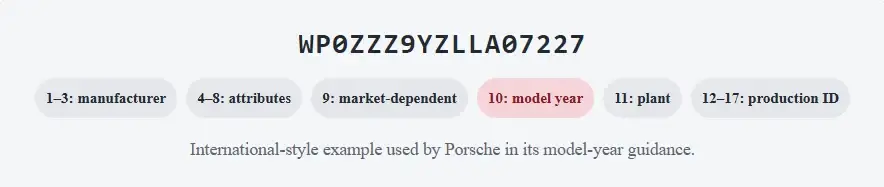
| Characters | Meaning | Important detail |
|---|---|---|
| 1–3 | World Manufacturer Identifier | WP0 is associated with Porsche passenger cars. |
| 4–8 | Vehicle Descriptor Section | Vehicle attributes interpreted with model-specific codes. |
| 9 | Check digit or other character | A check digit for U.S.-regulated VINs; international conventions may differ. |
| 10 | Model year | The assigned year, interpreted in the correct cycle. |
| 11 | Assembly plant | Manufacturer-defined plant code. |
| 12–17 | Production identification | Remaining manufacturer-assigned identification characters. |
What Does WP0 Mean?
WP0 is a manufacturer identifier associated with Porsche passenger cars. Not every Porsche vehicle uses the same WMI, and the first three characters alone do not prove the exact assembly location.
What Do the Z Characters Mean?
Some Porsche vehicles intended for markets outside the United States have Z characters in positions that U.S.-regulated VINs use for other data. For this reason, a U.S.-only decoder may not accurately interpret every imported Porsche.
What Does the Tenth Character Tell You?
The tenth character indicates the assigned model year in modern standardized VINs. The code repeats in longer cycles, so the car’s generation and production context must also be considered.
How to Decode a Porsche VIN Step by Step
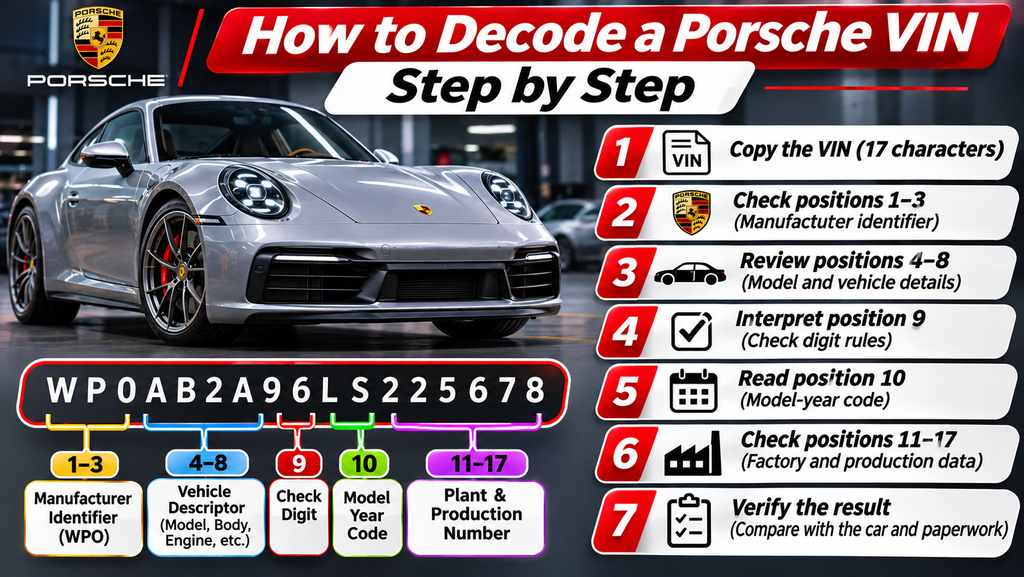
- Copy the VIN: Record all 17 characters from the car. Modern VINs omit I, O, and Q.
- Check positions 1–3: Verify the manufacturer identifier.
- Review positions 4–8: Use Porsche information appropriate to the model and market.
- Interpret position 9: Understand whether U.S. check-digit rules apply.
- Read position 10: Look up the model-year code.
- Check positions 11–17: Review factory and production identification data where available.
- Verify the result: Compare decoded details with the physical vehicle and paperwork.
Porsche VIN Model-Year Codes: 2010–2030
Use the tenth character together with the vehicle generation. Model-year codes repeat, and the assigned model year may differ from the year of manufacture or first registration.
| Code | Year | Code | Year |
|---|---|---|---|
| A | 2010 | M | 2021 |
| B | 2011 | N | 2022 |
| C | 2012 | P | 2023 |
| D | 2013 | R | 2024 |
| E | 2014 | S | 2025 |
| F | 2015 | T | 2026 |
| G | 2016 | V | 2027 |
| H | 2017 | W | 2028 |
| J | 2018 | X | 2029 |
| K | 2019 | Y | 2030 |
| L | 2020 | — | — |
Classic Porsche Chassis Numbers vs. Modern VINs
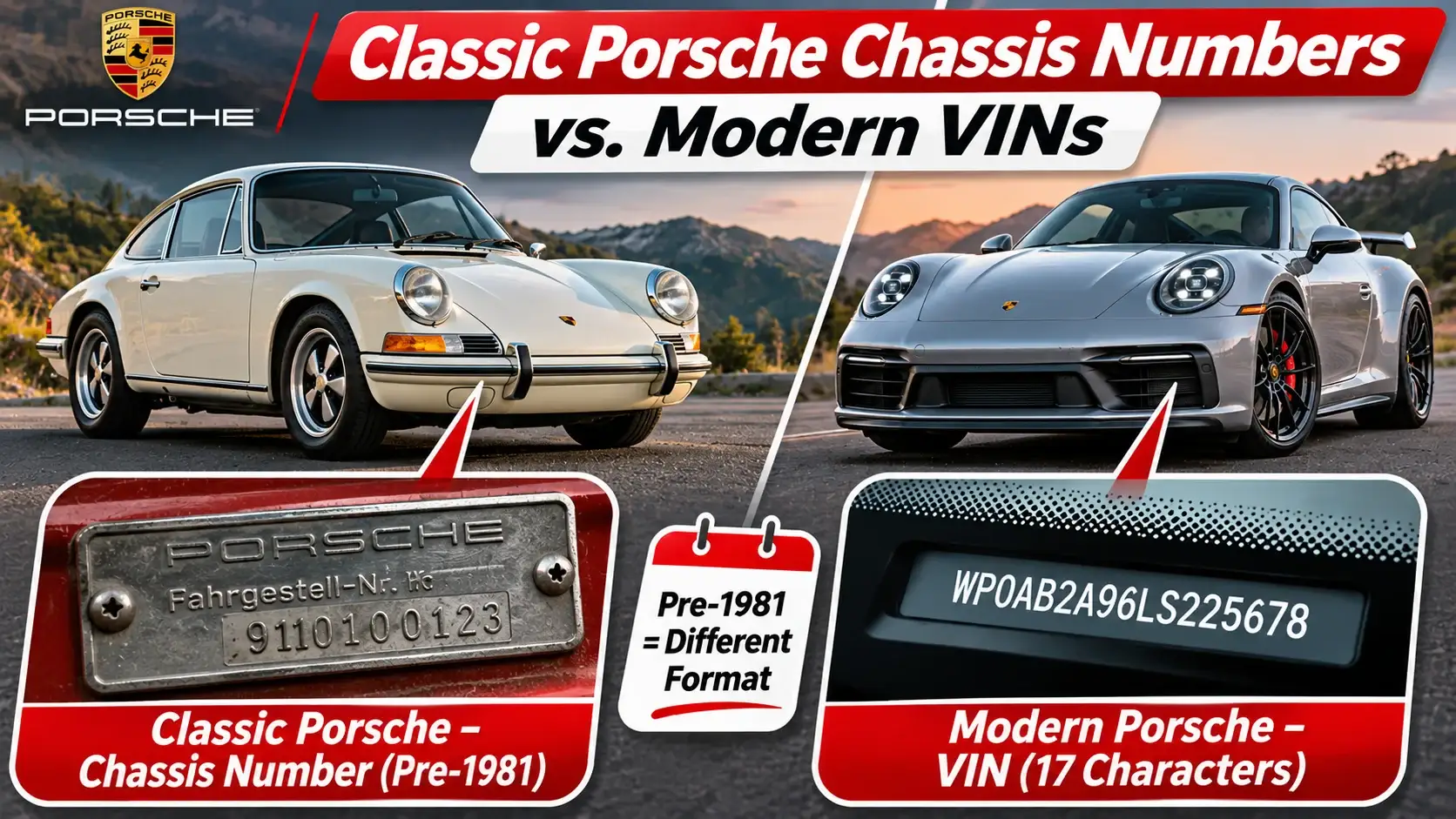
For newer vehicles, people often use chassis number and VIN interchangeably. Classic Porsches may use an older manufacturer-specific identification system instead of a standardized 17-character number. Vehicles made before 1981 can have different formats.
| Feature | Modern VIN | Classic chassis number |
|---|---|---|
| Length | Generally 17 characters | Varies by model and year |
| Year identification | Modern tenth-position code | May require historical records |
| Best research method | Current VIN systems | Model-specific factory information |
| Originality claims | Require separate evidence | Require separate evidence and specialist review |
How to Research an Older Porsche
- Identify the model family and approximate production period.
- Find the identification number in the factory-specified location.
- Record the characters exactly; do not add zeros to force a 17-character number.
- Compare the number with period-specific Porsche production information.
- Have a qualified specialist review factory-origin and matching-numbers claims.
What Information Can You Get From a Porsche VIN?
The VIN helps identify a vehicle. Accident records and maintenance details, by contrast, come from separate sources that may use the VIN as a lookup key.
| Information | Can the VIN tell you? |
|---|---|
| Manufacturer and model year | Usually, when decoded correctly. |
| Model, body, or engine information | Sometimes; exact equipment may require factory records. |
| Assembly plant | Often, using the appropriate plant-code reference. |
| Outstanding safety recalls | Can be checked in a separate recall system. |
| Accident or title history | Not encoded; requires separate records. |
| Maintenance and mechanical condition | Not encoded; requires records and inspection. |
How to Verify a Used Porsche Before Buying
Decoding is only one part of a sensible purchase process. A vehicle with a valid VIN can still have substantial mechanical problems or incomplete records.
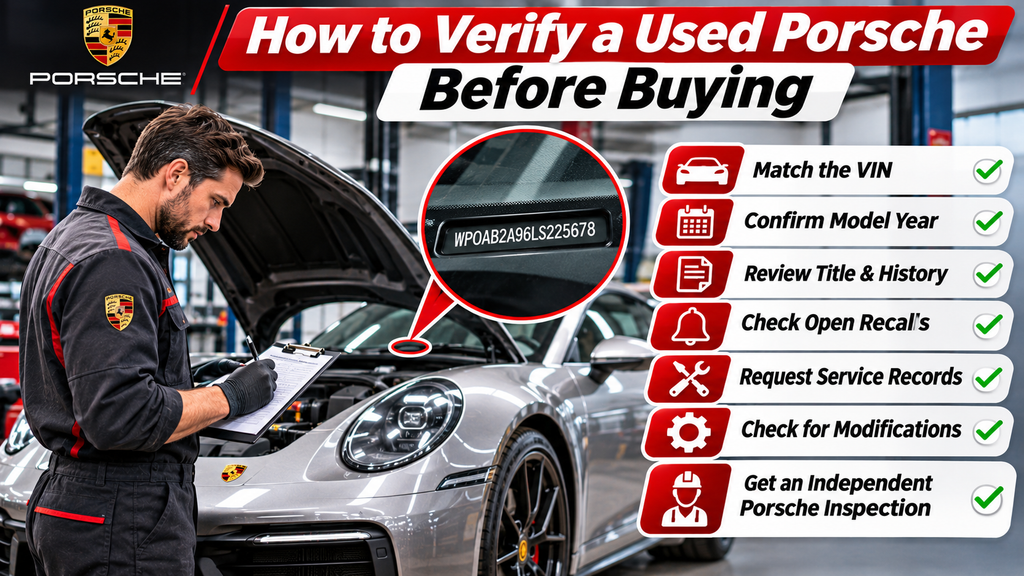
- Compare the VIN on the car against the title and registration.
- Confirm the model year and investigate any inconsistency.
- Review title and vehicle history while recognizing that databases may be incomplete.
- Check open recalls using the appropriate official lookup.
- Request service invoices and information about major repairs.
- Look for modifications that could affect parts, reliability, or value.
- Arrange an independent Porsche inspection before committing to purchase.
Important: A clean history report does not establish that a vehicle has never been damaged. Some incidents and repairs are never reported to a database.
Why a Porsche VIN May Not Decode Correctly
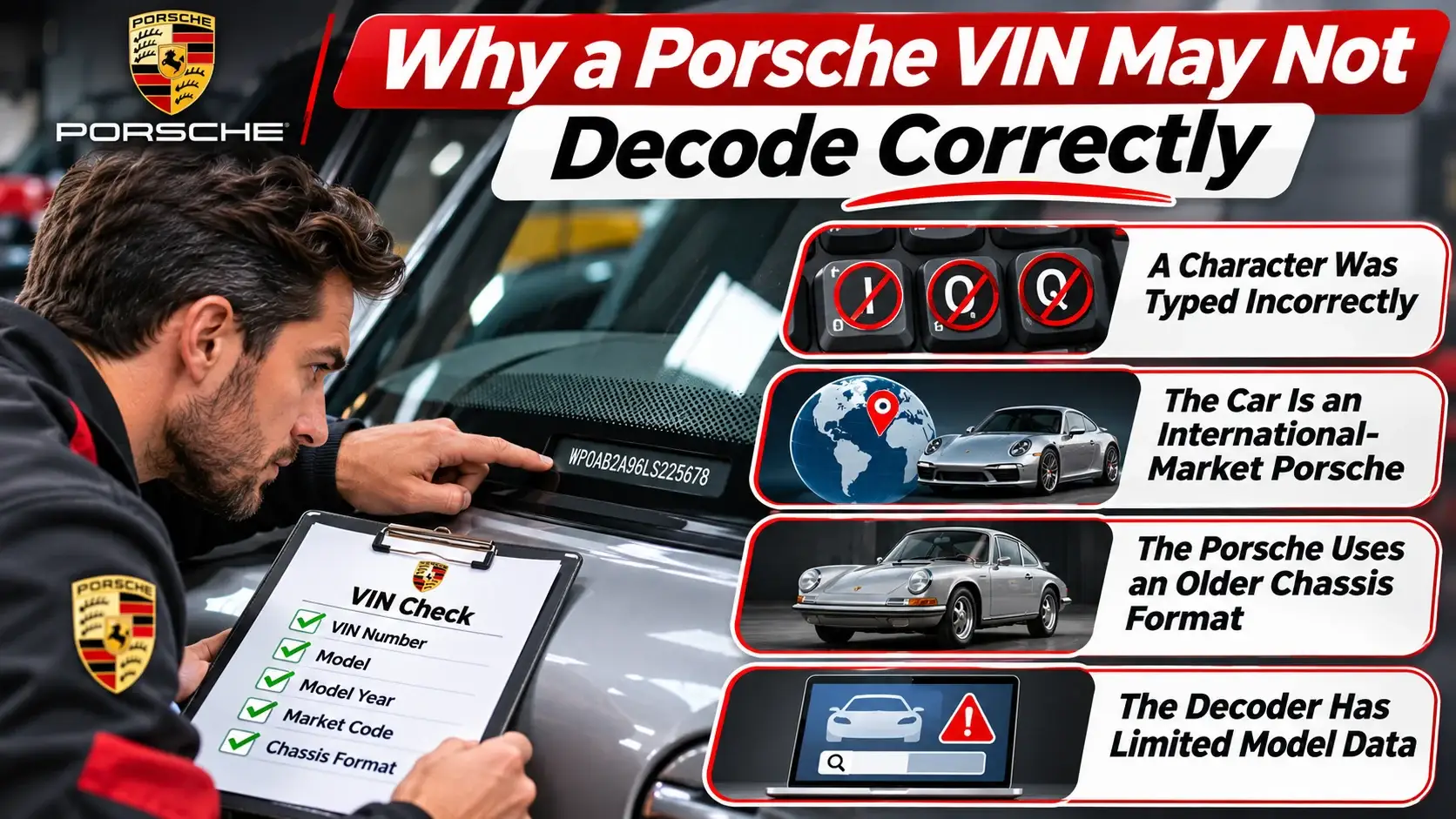
A Character Was Typed Incorrectly
Check for numbers mistaken for letters. Standardized modern VINs do not use I, O, or Q.
The Car Is an International-Market Porsche
Some international VIN conventions differ from U.S. check-digit rules. Choose references that support the vehicle’s original market.
The Porsche Uses an Older Chassis Format
Some classic cars need historical chassis-number documentation rather than a modern VIN tool.
The Decoder Has Limited Model Data
A general database might not show the exact trim, engine, or equipment. Verify important information through appropriate factory records.
Frequently Asked Questions
Can I decode a Porsche VIN for free?
Yes. Free public VIN databases can show available identification details. Information may be limited for older or non-U.S. vehicles.
How many characters are in a Porsche VIN?
Modern Porsche VINs generally contain 17 characters. Some vehicles built before 1981 use different chassis-number lengths.
What does WP0 mean in a Porsche VIN?
It is a World Manufacturer Identifier associated with Porsche passenger cars, not a complete description of the vehicle.
Where is the Porsche 911 VIN located?
On many modern 911s, look at the lower driver’s side of the dashboard through the windshield. Locations can differ by generation.
Is the chassis number the same as a VIN?
The terms are often used similarly for modern cars. Older Porsche chassis numbers can follow different manufacturer-specific systems.
Can I determine a Porsche’s exact engine from the VIN?
Some manufacturer-specific databases can show engine-related information. Confirm critical parts and engine claims with factory information and physical inspection.
Does a Porsche VIN reveal accidents?
No. A VIN identifies the car; separate history records may show some reported events, but those records may not be complete.
What should I do if my VIN is not recognized?
Recheck every character, confirm the market and model year, and use a Porsche reference appropriate to the vehicle’s generation.
Final Thoughts
A Porsche identification number can help you confirm the manufacturer’s identity, assigned model year, and other vehicle information. Older Porsche chassis numbers may require more specialized historical research.
For a used-car purchase, use decoding as a starting point—not a condition report. Compare the VIN and documents, investigate available records, and arrange a proper inspection before deciding.