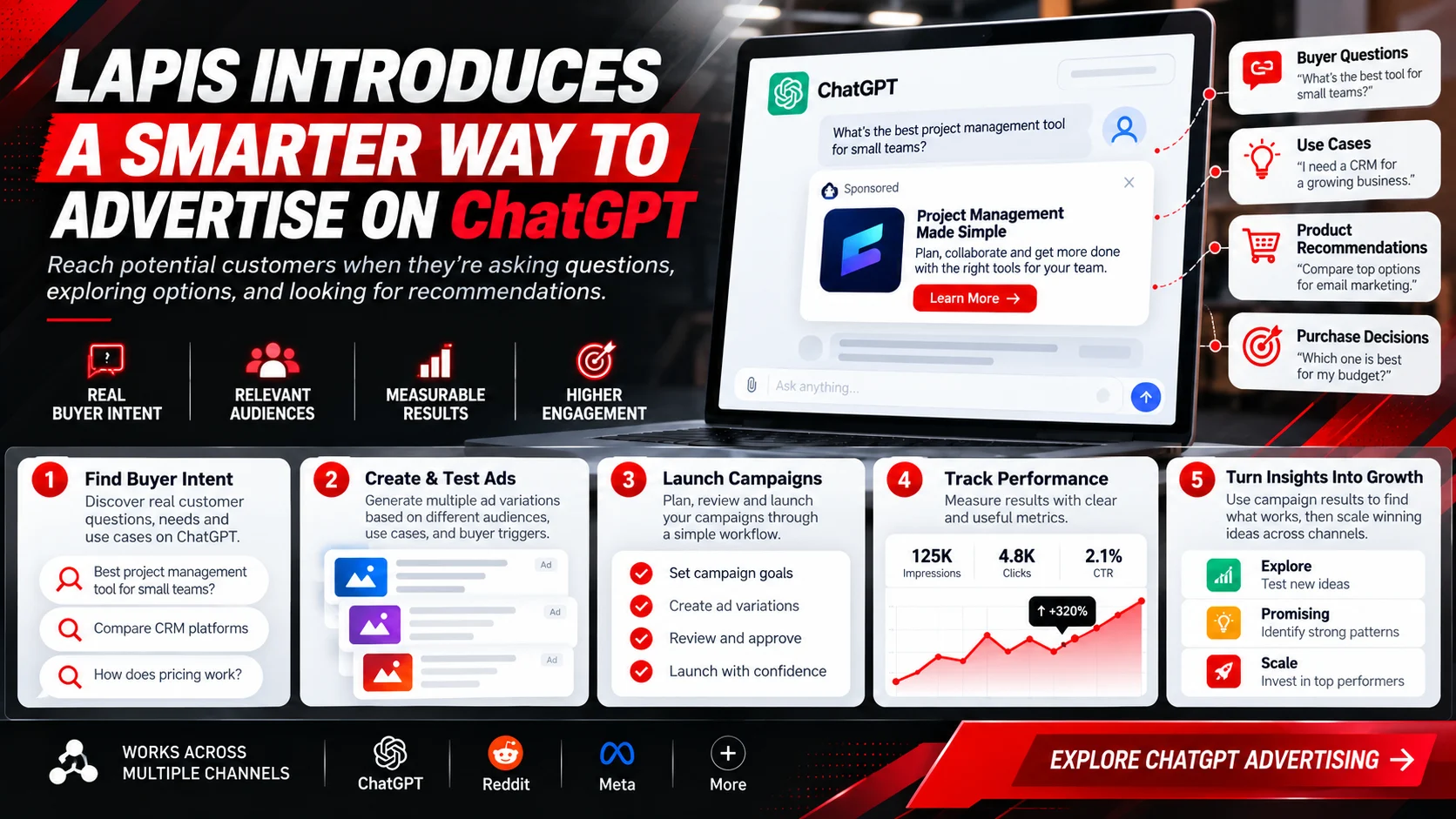
As people increasingly use AI conversations to research products, compare solutions, and find recommendations, businesses are looking for new ways to reach potential customers during these interactions. Lapis is helping businesses explore this opportunity through ChatSense, a system built to create, test, launch, and optimize advertising campaigns on ChatGPT.
Rather than focusing only on traditional search keywords, Lapis uses buyer questions, needs, use cases, and conversational context to help businesses develop more relevant advertising campaigns.
Advertising Around Buyer Intent
People often use ChatGPT differently from traditional search engines. Instead of entering short keywords, they may explain a problem, ask for product recommendations, compare different options, or describe exactly what they need.
Lapis is designed around these conversational behaviors. Its ChatSense system helps advertisers identify buyer questions and situations that may indicate commercial intent. These insights can then be used to develop advertising experiments around different audiences, use cases, and purchasing triggers.
This approach gives businesses more ways to understand how their potential customers think about a product. Instead of creating one generic message for everyone, advertisers can test different messages based on the needs and situations of specific audiences.
Creating and Testing Multiple Ad Variations
A major part of the Lapis approach is structured creative testing. The system can generate multiple variations of advertising titles, descriptions, and images based on different buyer intents.
Each variation can be organized around factors such as audience, use case, buyer trigger, product positioning, and message style. This makes it easier for marketing teams to understand which ideas are generating engagement.
For businesses using a ChatGPT ads platform, structured testing can help turn advertising into a measurable process rather than relying on a single creative concept. Lapis allows advertisers to test different ideas, review campaign data, and identify patterns that can guide future campaigns.
This can be especially useful for businesses running many creative variations. Instead of examining every advertisement separately, teams can analyze broader themes and determine which messages deserve additional testing.
From Campaign Creation to Launch
Lapis supports the advertising workflow from campaign planning through launch. Businesses can define their product, audience, advertising objectives, and campaign requirements before developing the campaign.
The system can then create advertising variations based on the selected buyer intents and campaign strategy. Advertisers can review the proposed campaign before launch, allowing them to check the messaging, creative assets, budgets, and other campaign details.
After approval, Lapis can prepare and submit the campaign through the connected advertising workflow and track its launch status. This reduces the amount of repetitive work involved in preparing and managing multiple advertising campaigns.
The process keeps advertisers involved in important decisions while providing automation for many operational tasks.
Measuring Campaign Performance
Creating advertisements is only one part of an effective advertising strategy. Understanding how those advertisements perform is equally important.
Lapis provides campaign reporting based on performance metrics such as impressions, clicks, spend, click-through rate, cost per click, and cost per thousand impressions. Conversion information can also be included when appropriate tracking is configured.
These metrics help advertisers understand how campaigns are performing and identify areas that require further testing.
Lapis also looks beyond individual advertisements by analyzing the themes and buyer intents connected to campaign performance. This allows businesses to examine whether certain messages, audiences, or use cases consistently generate stronger engagement.
Turning Results Into the Next Campaign
One of the key ideas behind ChatSense is continuous learning. Instead of treating every advertising campaign as a separate project, Lapis uses campaign results to inform future experiments.
The system organizes ideas through an Explore, Promising, and Scale lifecycle. New advertising concepts can be tested, promising patterns can be identified, and ideas with stronger evidence can receive further attention.
For example, if several advertisements built around a particular customer need generate strong engagement, that theme can become the basis for additional creative testing. Similarly, weaker concepts can be reduced or replaced.
This creates a feedback loop where campaign data helps shape future advertising decisions.
Connecting Insights Across Advertising Channels
Lapis is also designed to help marketers apply advertising insights across multiple channels. Campaign themes and experiment results can be analyzed across supported advertising environments, including ChatGPT, Reddit, and Meta.
This gives businesses an opportunity to identify creative ideas that can be tested in different environments. A message that performs well in one channel can provide a useful starting point for another campaign while allowing marketers to adapt it to the relevant audience and context.
The result is a more connected approach to creative testing and campaign management.
A New Approach to AI Advertising
Conversational AI is creating new opportunities for businesses to reach customers while they are actively researching products and solutions. This makes contextual relevance increasingly important for advertisers.
Lapis approaches this opportunity by combining buyer-intent research, advertising creation, creative testing, campaign management, performance measurement, and continuous optimization through ChatSense.
By connecting campaign execution with performance insights, Lapis gives businesses a structured way to experiment with advertising on ChatGPT and use campaign results to guide future campaigns.
As AI-powered conversations become a larger part of product discovery, approaches that connect advertising with customer intent and measurable performance can provide businesses with new ways to engage potential customers.