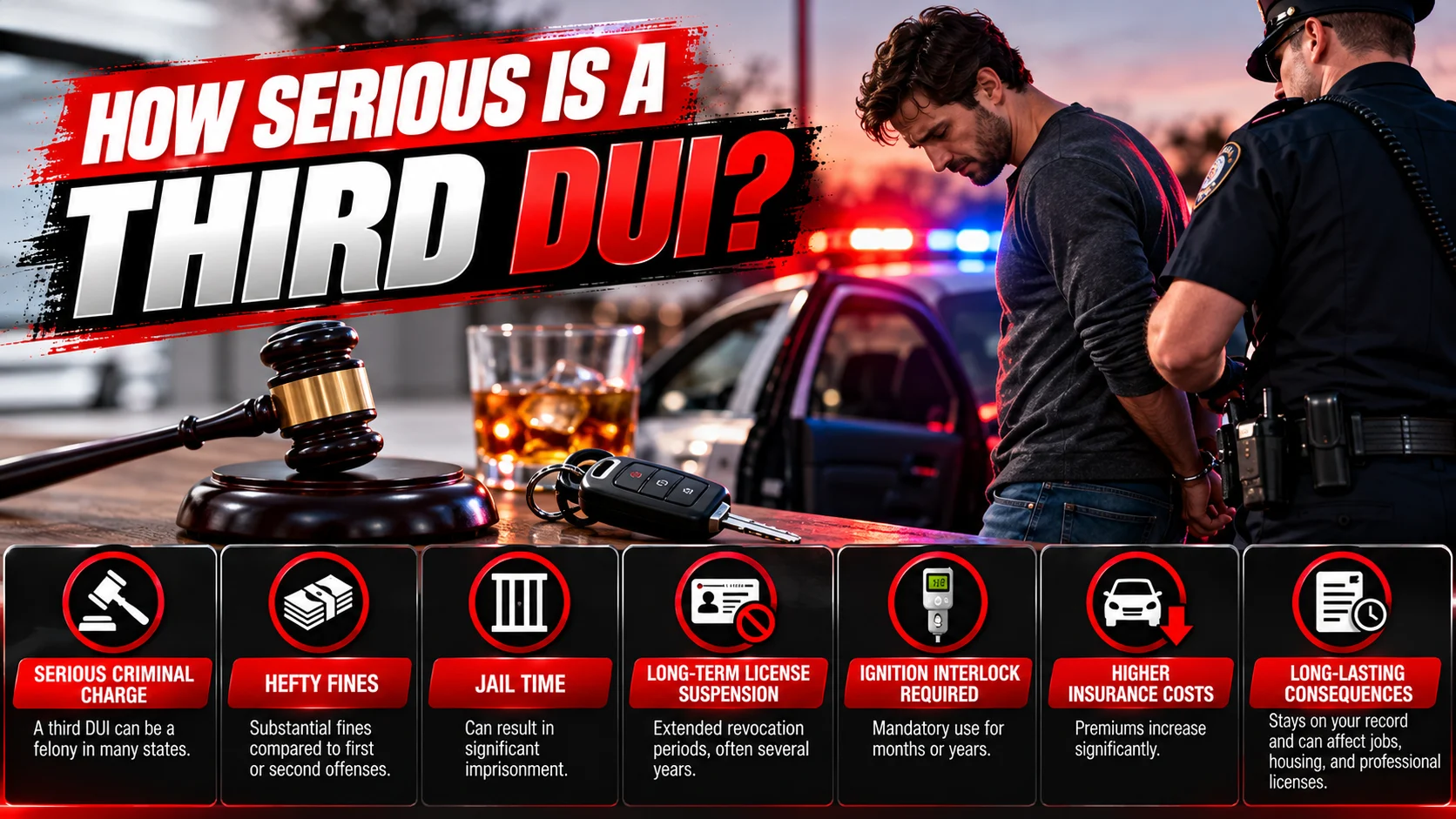
Third DUI, or Third Driving While Intoxicated (DWI), is typically considered a serious crime in the US. Such an offense will usually bring about hefty fines, long-term license suspension, mandatory use of an ignition interlock device, and even imprisonment.
Depending on the timeframe between previous offenses and other factors, a third DUI offense could be classified as a felony. In 2024, the National Highway Traffic Safety Administration reported 11,904 fatalities involving crashes with alcohol-impaired drivers. This figure was 30 percent of the traffic deaths in the United States.
The National Highway Traffic Safety Administration reported that drivers with 0.08 percent or greater BAC who are involved in fatal crashes are three times more likely to have a prior DWI conviction than sober drivers.
These statistics highlight the dangers of repeat impaired driving and the serious legal consequences that may follow a third DWI or DUI.
Let’s take a closer look at how severe a third DUI can be.
The Hardest Question Is Which Priors Count
Before anyone can say how serious a third offense is, someone has to establish that it is indeed a third offense.
The states determine the lookback period, otherwise known as the washout period. This period is used to determine the time frame for the prior conviction that will enhance the sentence. The lookback period differs in its length and measurement.
Some run from the date of the earlier conviction and others from the date of the earlier offense, and the gap between those two dates can stretch past a year in a contested case.
Out-of-state convictions can either count as a prior or not, but it depends on the rules of the state in question. A reckless driving charge may be considered a prior offense in some states and not others. The same applies to priors that fell outside the criminal look back period, as DMV license calculations may be based on a different schedule.
National third offense rules vary too widely to provide any real information on how individual states punish third offenders, as state-level third offense laws can provide different details on punishments, rules, and penalties. Information regarding individual state third offense rules can help guide those interested.
Florida’s tiered DUI penalties, including how revocation and impoundment periods step up across first, second, third, and subsequent convictions, are outlined in resources from West Palm Beach DUI lawyer Nellie L. King. The same resources also note a not-guilty result in a DUI matter involving a breath reading above 0.20. In Florida, a third conviction within 10 years triggers the 90-day impoundment tier and a 10-year minimum revocation.
The Felony Line Is Not in the Same Place Everywhere
What matters most in determining the severity of the case is if a third offense can be classified as a felony.
Some states classify it as such if it occurs within the timeframe defined by the lookback period, while others only consider a fourth offense a felony. Others, including Texas, classify a third offense as a felony regardless of when the earlier convictions occurred.
The designation carries more weight than the actual penalty itself. A felony conviction can limit the ability to obtain a professional license, apply for housing, immigrate, and possess a firearm.
The License Case Runs Separately From the Criminal Case
The legal consequences of one arrest can be split into two proceedings. An arrest triggers both criminal and administrative licensing actions. Each proceeding is unique in its timing, standards, and consequences. This distinction means that winning one will not resolve the other.
The administrative side often acts first and has a short deadline. At a third offense the revocation periods tend to run long enough that transportation, rather than incarceration, becomes the defining daily problem for whoever is living through it.
Interlocks Are the Default Now
Ignition interlock requirements have spread further than most people realize. NHTSA reports that interlocks are mandatory for all convicted offenders, including first offenders, in 34 states and the District of Columbia, and mandatory for certain offenders, including high-BAC and repeat offenders, in 14 more.
The driver must give a breath sample below the set value, commonly 0.02, or the car will not start. The results of the analysis from a review of 15 studies revealed that the re-arrest recidivism rate for the subjects dropped by a median of 67 percent while the device was installed compared to similar people without interlocks.
The same review concluded that once removed, the device’s effectiveness mostly vanishes and that interlock drivers and comparison drivers tend to relapse in a similar way, which is why the device is best paired with treatment.
What Outlasts the Sentence
The conviction is the durable part. CDL driving regulations make life after a first CDL disqualification tricky, but a second offense of similar nature can lead to a lifetime CDL disqualification. A driver’s record is also reviewed in hiring, insurance, and professional licensing decisions.
DUI convictions usually remain on criminal records until expunged or sealed, while driving record retention ranges from several years to permanent depending on the state. DUI convictions can still show up in record searches for other purposes and cause problems, despite not being counted in some jurisdictions’ sentencing.
The gravity of a third DUI depends, primarily, on things that don’t even concern the incident itself. The number of prior convictions and their dates will determine whether the charge will be a misdemeanor and require only some minimum jail time or a felony, which will follow the individual for their whole life.