A ticking sound near the engine, an unusual exhaust smell, or black soot around the cylinder head could make you suspect a problem with the exhaust manifold. But these clues do not automatically mean the manifold is cracked. A damaged gasket, loose hardware, or another exhaust connection can produce similar symptoms.
The exhaust manifold is an important part of your vehicle’s exhaust system. It collects hot exhaust gases from the engine cylinders and directs them toward the rest of the exhaust system. When a leak develops, it may cause noise, affect engine operation, and create a potential exhaust-exposure hazard.
This guide explains how an exhaust manifold works, where it is located, common signs of failure, safe diagnostic approaches, repair options, and the factors that influence replacement costs.
Quick Answer: What Is an Exhaust Manifold?
An exhaust manifold is an engine component that collects exhaust gases leaving the cylinder head and channels them into the downstream exhaust system. It is commonly manufactured from cast iron, cast steel, or fabricated metal tubing. Depending on the engine, it may connect to an exhaust pipe, catalytic converter, or turbocharger.
Common potential leak symptoms include cold-start ticking, exhaust noise, soot around a joint, or unusual exhaust odors. However, the leak location must be confirmed before deciding whether to replace a gasket, repair hardware, or replace the manifold.
What Is an Exhaust Manifold?
An exhaust manifold is the component that receives exhaust gases directly from the exhaust ports of an engine’s cylinder head. Its individual passages combine the exhaust flow and direct it into another part of the exhaust system.
In many conventional four-cylinder engines, a single manifold handles the exhaust from all cylinders. V6 and V8 engines commonly have a manifold on each cylinder bank, although configurations vary.
Exhaust manifolds are designed to withstand repeated exposure to very high temperatures and substantial thermal expansion. Their shape, materials, and location depend on the vehicle’s engine design.

Main Parts of an Exhaust Manifold Assembly
- Exhaust runners: Individual passages that receive exhaust gases from the engine’s cylinders.
- Collector or outlet: The area where exhaust flow is combined or directed into the next component.
- Mounting flange: The mating surface used to attach the manifold to the cylinder head.
- Exhaust manifold gasket: A seal used on many engines to prevent gas leakage between the manifold and cylinder head.
- Studs, bolts, and nuts: Hardware that secures the manifold according to the manufacturer’s specified procedure.
- Heat shields: Protective components used on many vehicles to reduce heat exposure to nearby parts.
Some engines integrate the exhaust manifold into the cylinder head, while others use manifold assemblies that incorporate a catalytic converter or connect directly to a turbocharger. These designs can make repair costs and service procedures significantly different.
What Does an Exhaust Manifold Do and How Does It Work?
During engine operation, fuel combustion produces high-temperature gases. When an exhaust valve opens, these gases leave the combustion chamber through an exhaust port in the cylinder head.
The exhaust manifold receives those gases and guides them toward downstream exhaust components. The system then handles emissions treatment and noise reduction before releasing exhaust gases through the tailpipe.
The Exhaust Gas Flow Process
- Combustion: The engine burns its air-fuel mixture and produces exhaust gases.
- Exhaust valve opening: Gases exit the cylinder through the exhaust port.
- Manifold collection: Exhaust enters the manifold’s passages.
- Downstream flow: Gases travel to the catalytic converter, turbocharger where applicable, or other exhaust components.
- Emissions and sound management: The exhaust system treats emissions and reduces noise before gases leave the tailpipe.
Why Is the Exhaust Manifold Important?
A properly sealed manifold helps contain hot exhaust gases and route them away from the engine compartment. It also supports the exhaust-system configuration designed for the engine.
A leak upstream of an oxygen or air-fuel ratio sensor can sometimes affect sensor readings and fuel-control behavior. The effects depend on where the leak occurs, the engine design, and how its sensors are positioned.
Important distinction: An exhaust manifold carries exhaust gases out of the engine. An intake manifold distributes incoming air, or an air-fuel mixture on certain engines, to the cylinders. These components perform different jobs.
Where Is the Exhaust Manifold Located?
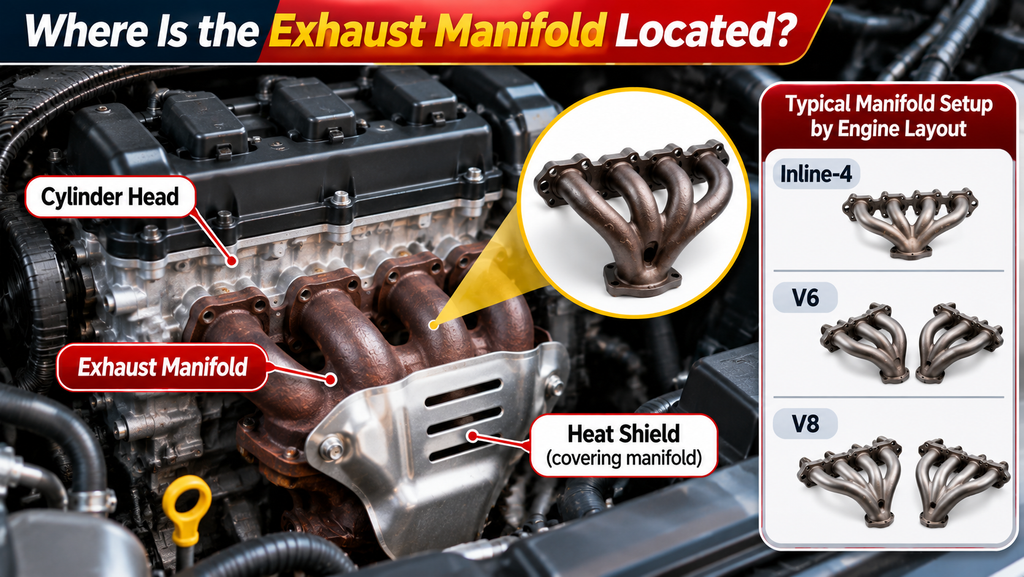
The exhaust manifold mounts to the exhaust side of the engine’s cylinder head. It is often partially covered by a metal heat shield, which can make it difficult to identify without an engine diagram.
Its position varies with engine configuration, vehicle layout, and available space.
| Engine Layout | Typical Manifold Arrangement |
|---|---|
| Inline-four | Commonly one manifold attached to the cylinder head. |
| Inline-six | May use one manifold or multiple exhaust sections. |
| V6 | Usually one exhaust manifold per cylinder bank. |
| V8 | Usually two manifolds, one for each cylinder bank. |
| Turbocharged engine | May use an integrated manifold or a manifold connected to the turbine housing. |
For your exact vehicle, consult its model-specific service information. Do not remove heat shields or touch manifold components until the engine and exhaust system are fully cooled.
Types of Exhaust Manifolds
Manufacturers use several manifold designs depending on packaging space, emissions requirements, cost, durability, and engine performance objectives.
1. Cast-Iron Exhaust Manifold
Cast-iron manifolds are common on many production vehicles. They are durable, compact, and well suited to high-temperature operation. However, repeated heat cycling, corrosion, or mechanical stress can eventually contribute to cracking.
2. Fabricated Tubular Exhaust Manifold
Tubular manifolds use individual metal tubes or runners joined together. They may be found on performance applications and certain original equipment engines. Their design can influence exhaust pulse behavior, packaging, and flow.
3. Integrated Exhaust Manifold
Some modern engines incorporate exhaust passages into the cylinder head or combine the manifold with another component. This can improve packaging and thermal management, but it also changes the diagnostic and repair process.
7 Common Exhaust Manifold Leak Symptoms
An exhaust manifold leak occurs when exhaust gases escape before reaching their intended downstream path. The source may be a cracked manifold, a failed gasket, broken mounting hardware, or a leaking connection.
The following symptoms can justify an inspection, but they are not sufficient to confirm a manifold leak on their own.

1. Ticking or Tapping Noise During Cold Starts
A rhythmic ticking sound near the exhaust side of the engine is one of the more recognizable clues. It may be most noticeable immediately after a cold start and become quieter as components heat up.
Thermal expansion can change the size of a leak opening, which may affect the sound. However, fuel injectors, valvetrain components, and other mechanical parts can also make ticking noises.
2. Louder Exhaust Noise During Acceleration
A leaking manifold or connection can create a hissing, puffing, or unusually loud exhaust sound. The noise may change with engine speed and load.
3. Exhaust Odor Near the Engine or Inside the Cabin
Escaping exhaust may produce noticeable odors around the engine compartment. Exhaust entering the passenger area presents a particularly serious concern because exhaust gases can contain carbon monoxide.
Safety Warning: Carbon monoxide is colorless and odorless. Do not assume the absence of an exhaust smell means the vehicle is safe. If you suspect exhaust is entering the cabin, stop in a safe outdoor location, shut off the engine, and arrange professional inspection. If anyone experiences headache, dizziness, nausea, confusion, or other possible exposure symptoms, move to fresh air and seek urgent medical help.
4. Black Soot Around the Manifold or Gasket
Dark deposits near a manifold flange, gasket, crack, or connection may be evidence of escaping exhaust. A technician should determine whether the deposits actually indicate an active leak.
5. Check Engine Light
A leak in certain locations can affect exhaust sensor readings and contribute to a diagnostic trouble code. However, many unrelated engine and emissions problems can illuminate the check engine light.
A trouble code identifies a condition the vehicle has detected. It does not automatically prove the manifold itself needs replacement.
6. Reduced Engine Performance or Fuel Economy
Depending on the engine and leak location, exhaust leakage may contribute to inefficient fuel control, poor response, or reduced performance. These symptoms have many possible causes and should be investigated systematically.
7. Visible Cracks, Damaged Gaskets, or Broken Fasteners
A visible crack, missing fastener, damaged gasket area, or broken manifold stud may reveal the reason gases are escaping. Some cracks are difficult to see without removing heat shields or other parts.
Exhaust Manifold Symptoms at a Glance
| Symptom | Possible Explanation | What to Do |
|---|---|---|
| Cold-start ticking | Manifold or gasket leak; other engine noises possible | Arrange a targeted noise and leak inspection. |
| Hissing or puffing | Escaping exhaust at a joint or damaged component | Have the leak location confirmed. |
| Exhaust odor | Exhaust escaping near the engine or entering the cabin | Treat suspected cabin intrusion as a safety concern. |
| Black soot | Possible leakage near a flange or joint | Inspect for evidence of active leakage. |
| Check engine light | Possible sensor or fuel-control effect | Read codes and diagnose their actual cause. |
| Visible crack | Manifold casting or tubing damage | Evaluate the need for component replacement. |
What Causes an Exhaust Manifold to Crack or Leak?
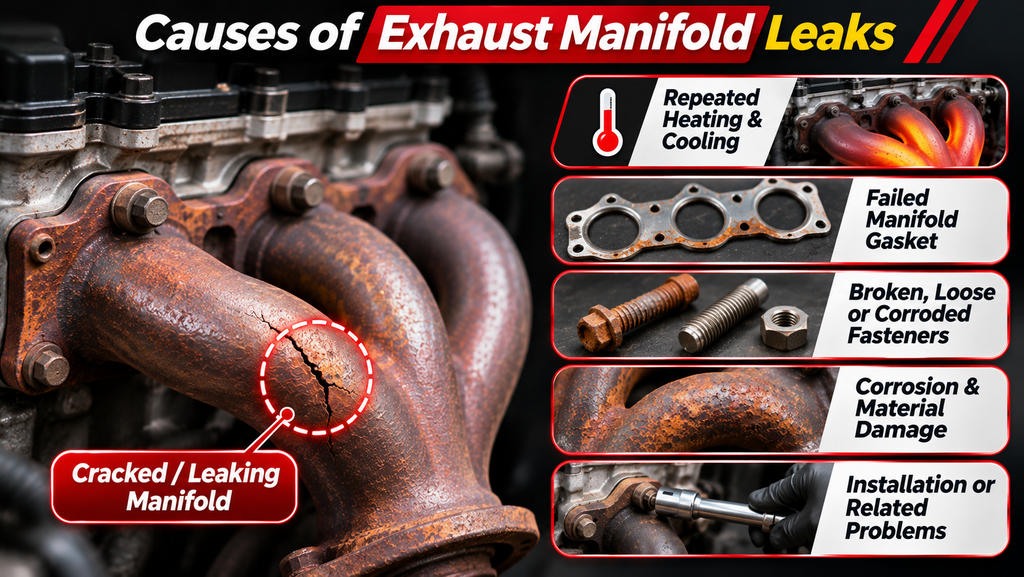
Repeated Heating and Cooling
Exhaust components expand when heated and contract as they cool. Over many operating cycles, these changes can contribute to material fatigue or distortion, particularly when other stresses exist.
Failed Exhaust Manifold Gasket
A gasket may lose its ability to seal because of deterioration, uneven clamping, damaged mating surfaces, or hardware problems. Replacing only the gasket may not solve the problem if an underlying condition remains.
Broken, Loose, or Corroded Fasteners
The studs, bolts, and nuts that secure the manifold can deteriorate or break. When clamping force is lost, a gap may develop between the manifold and cylinder head.
Corrosion and Material Damage
Exposure to moisture, road salt, high temperatures, and aging can contribute to corrosion and structural damage. The severity varies by material, vehicle use, and climate.
Installation or Related Mechanical Problems
Incorrect installation, unsuitable replacement parts, damaged mounting surfaces, or excessive stress from misaligned exhaust components can contribute to repeat failures.
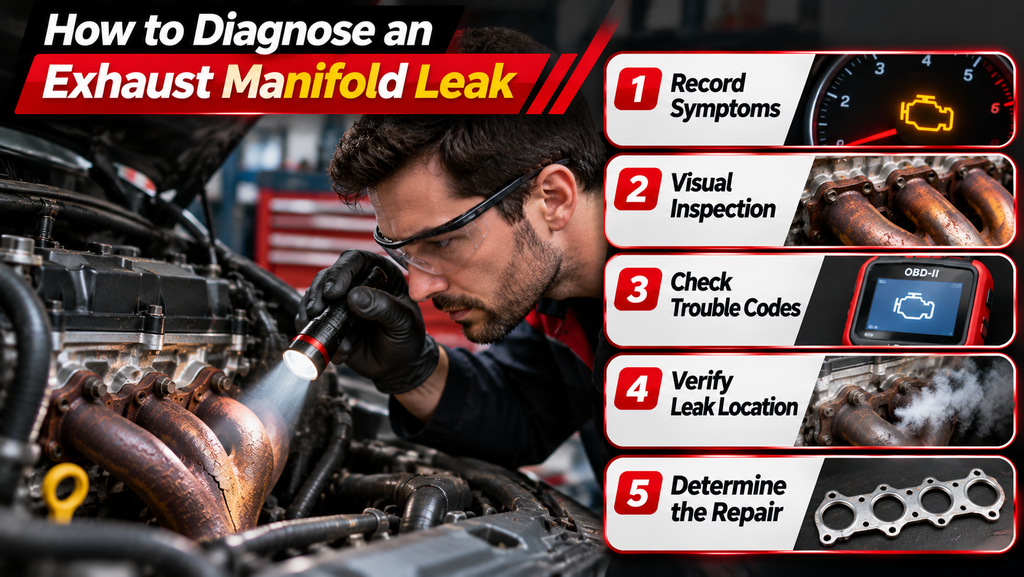
How to Diagnose an Exhaust Manifold Leak
Before replacing an exhaust manifold, it is important to identify the exact source of the noise or escaping gas. A correct diagnosis can help avoid unnecessary parts and labor.
Step 1: Record When the Symptoms Occur
Notice whether the sound is most apparent during a cold start, acceleration, idle, or after the engine warms up. Also record any warning lights or changes in vehicle performance.
Step 2: Perform a Safe Engine-Off Visual Check
With the engine switched off and fully cooled, look only at accessible areas for soot, obvious damage, missing fasteners, or displaced heat shields. Do not put your hands near moving or hot components.
Step 3: Check Diagnostic Trouble Codes
If the check engine light is illuminated, an OBD-II scanner may provide useful information. Record the codes and freeze-frame data if available. Do not interpret a code as proof of manifold failure.
Step 4: Have the Leak Location Verified
A qualified technician may use a controlled leak test, appropriate inspection equipment, and vehicle-specific procedures to identify where exhaust is escaping. The technician should inspect nearby joints and connections, not only the manifold casting.
Step 5: Determine the Correct Repair
Once the failed component is identified, check the mounting surfaces, gaskets, hardware, related components, and manufacturer service instructions before selecting replacement parts.
Diagnostic safety: Do not place hands near the manifold to feel for escaping gases, block the exhaust outlet, or spray combustible products onto hot exhaust components. Vehicle-specific professional procedures are safer than improvised leak tests.
Exhaust Manifold Leak vs. Other Engine Noises
| Possible Source | Common Clues |
|---|---|
| Exhaust manifold leak | Ticking or puffing near exhaust ports, sometimes with soot. |
| Fuel injector operation | Regular clicking that may be normal for the engine. |
| Valvetrain problem | Mechanical tapping that changes with engine speed. |
| Loose heat shield | Metallic rattling at certain engine speeds. |
| Downstream exhaust leak | Hissing or exhaust noise from a pipe, flange, or flex joint. |
Can You Drive With an Exhaust Manifold Leak?
Driving with a suspected exhaust manifold leak is not recommended until its location and severity are assessed. A small leak may initially seem like a minor noise problem, but the condition can change, and exhaust exposure cannot be judged by noise alone.
Hot escaping gases may also affect nearby wiring, hoses, or other components, depending on the location of the leak.
When Should You Stop Driving?
- Exhaust gases or fumes may be entering the passenger cabin.
- Someone in the vehicle develops symptoms consistent with exhaust exposure.
- The vehicle develops an unusually loud exhaust leak or visible heat damage.
- Engine performance changes substantially or the vehicle becomes unsafe to operate.
- A check engine light flashes, indicating a potentially serious engine condition.
Stop in a safe outdoor location, shut off the engine, and arrange professional assistance. If carbon monoxide exposure is suspected, move into fresh air immediately and seek medical help. Towing may be the appropriate option rather than driving the vehicle to a repair shop.
Exhaust Manifold Repair vs. Replacement
The best repair depends on the exact failure. An exhaust manifold leak does not always require a new manifold, but replacing a gasket alone will not repair a cracked casting.
| Confirmed Problem | Possible Repair | Important Consideration |
|---|---|---|
| Failed gasket | Replace gasket and required hardware | Check sealing surfaces and clamping condition. |
| Broken stud | Professional extraction and hardware repair | Access and cylinder-head damage affect complexity. |
| Cracked manifold | Usually replace the damaged manifold | Specialized repair is not always practical or durable. |
| Warped mounting surface | Evaluate replacement or approved machining | A new gasket alone may not seal correctly. |
| Leaking exhaust joint | Repair the joint, flange, or seal | The manifold itself may be serviceable. |
Can You Weld a Cracked Exhaust Manifold?
Certain exhaust manifold cracks may be repairable using specialized methods, depending on the material, location, and condition of the component. However, high heat cycling and the difficulty of repairing cast materials can make welding unreliable or uneconomical.
For many ordinary passenger-vehicle applications, replacement is the more practical long-term solution when the manifold itself has cracked. Follow applicable manufacturer guidance.
Do Exhaust Manifold Sealants Work?
Temporary sealing products should not be treated as an equivalent to a verified mechanical repair. Suitability varies by product and application. They cannot reliably solve every cracked manifold, failed mounting surface, or broken fastener.
Avoid relying on an unapproved sealant where exhaust leakage may create a safety risk.
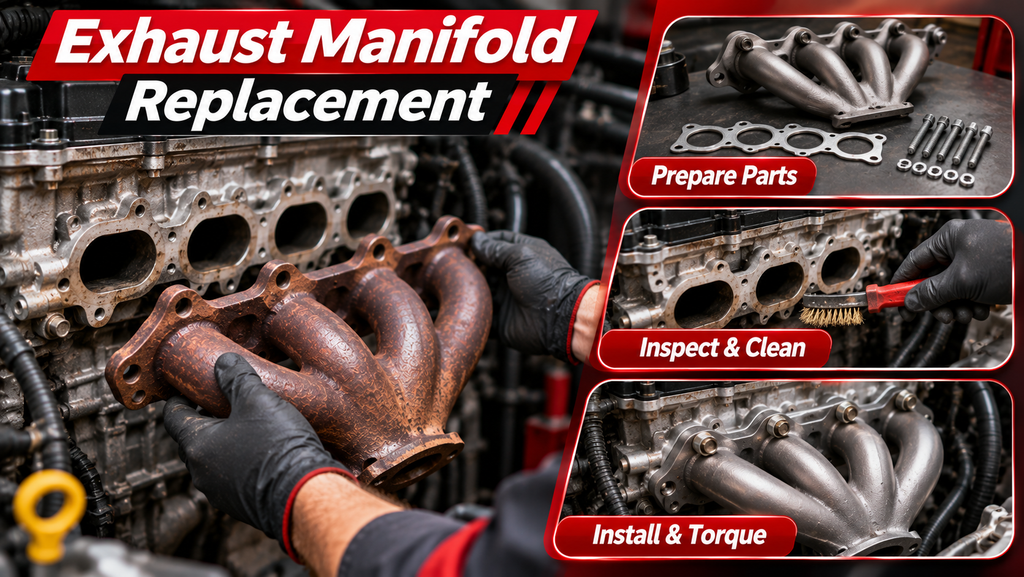
How Is an Exhaust Manifold Replaced?
Exhaust manifold replacement ranges from a moderately involved repair to a complex job, depending on engine layout, corrosion, access, and the location of related components.
The following is an overview of a professional replacement process, not a universal service procedure or a substitute for model-specific repair instructions.
- Confirm the diagnosis: Verify the failed manifold or sealing component.
- Prepare the vehicle: Allow the exhaust to cool completely, follow manufacturer safety precautions, and support the vehicle correctly if underbody access is needed.
- Remove obstructing components: Depending on the vehicle, this may include heat shields, brackets, pipes, or other service items.
- Disconnect the exhaust assembly: Separate relevant connections according to the vehicle’s service procedure.
- Remove manifold hardware: Follow the correct removal procedure while accounting for corroded or damaged fasteners.
- Inspect mounting surfaces: Check for damage, distortion, broken studs, and other underlying causes.
- Install the replacement: Use specified gaskets, hardware, tightening sequence, and torque values.
- Verify the repair: Recheck the exhaust connections, inspect for leaks, and confirm that the original complaint has been resolved.
Is Exhaust Manifold Replacement a DIY Job?
Some experienced DIY mechanics may be equipped to handle this repair on accessible engines. However, seized bolts, broken studs, tight engine-bay packaging, hot exhaust components, and specialized procedures can make it difficult.
A broken stud inside the cylinder head can substantially increase repair complexity. If you lack suitable equipment, vehicle-specific instructions, or the required experience, professional service is the safer choice.
How Much Does Exhaust Manifold Repair or Replacement Cost?
Exhaust manifold repair costs vary considerably by vehicle, region, parts availability, and the failure that needs to be corrected. A gasket replacement may cost much less in parts than an entire manifold assembly, but labor can still be substantial.
As a broad US-market reference, RepairPal’s September 2026 national estimates placed exhaust manifold gasket replacement at approximately $417–$596 and complete exhaust manifold replacement at approximately $1,514–$1,724. These are national estimator figures, not quotes for every vehicle, and exclude taxes, fees, location differences, and potentially related repairs.
Repair Cost Comparison
| Repair Type | Expected Cost Considerations |
|---|---|
| Exhaust manifold gasket replacement | Usually lower parts cost; labor depends on access and fastener condition. |
| Broken stud extraction | Highly variable; drilling, extraction, and thread repair may add substantial labor. |
| Complete manifold replacement | Includes manifold, gaskets, labor, and potentially additional hardware. |
| Integrated manifold/catalytic converter assembly | May be considerably more expensive because of the combined component. |
Frequently Asked Questions About Exhaust Manifolds
What is the main purpose of an exhaust manifold?
The exhaust manifold collects gases leaving the engine cylinders and directs them into the downstream exhaust system. It helps contain and route hot exhaust gases away from the engine.
What are the most common exhaust manifold leak symptoms?
Possible signs include ticking during cold starts, puffing or hissing sounds, soot near exhaust joints, unusual exhaust odors, and sometimes a check engine light. These symptoms require diagnosis because other problems can produce similar signs.
Can a bad exhaust manifold cause a check engine light?
Yes, certain exhaust leaks can affect upstream sensor readings and engine control. However, a check engine light has many possible causes, and fault codes alone do not prove a manifold is damaged.
Can an exhaust manifold leak affect fuel economy?
It can in some vehicles, particularly if the leak influences fuel-control sensor readings. Fuel economy changes also have many unrelated causes.
Can you drive with a cracked exhaust manifold?
Driving with a suspected cracked manifold is not recommended before professional assessment. Exhaust exposure and nearby heat damage can create safety risks. If exhaust may be entering the cabin, stop driving and arrange assistance.
Is it better to repair or replace an exhaust manifold?
The correct choice depends on the confirmed failure. A failed gasket or damaged fastener may be repaired without replacing a sound manifold. A cracked or severely damaged manifold commonly requires replacement.
How long does an exhaust manifold last?
Many original exhaust manifolds last for years and can remain serviceable for much of a vehicle’s life. Actual lifespan varies with material, operating temperatures, corrosion, engine design, and mechanical stress. There is no universal replacement interval.
How much does exhaust manifold replacement cost?
Costs vary widely. RepairPal’s September 2026 national estimate for complete manifold replacement was approximately $1,514–$1,724. A vehicle-specific estimate is necessary because parts, labor, and related repairs can significantly change the total.
Final Thoughts
The exhaust manifold is a vital part of an engine’s exhaust system. It collects hot gases from the cylinders and routes them toward downstream exhaust components.
Ticking noises, soot, hissing, or unusual exhaust odors may suggest a manifold-related problem, but they do not confirm the source of a leak. A damaged gasket, broken stud, cracked casting, or nearby exhaust connection may require a different repair.
The safest and most cost-effective approach is to identify the actual failure, follow manufacturer repair instructions, and address potential exhaust exposure promptly.