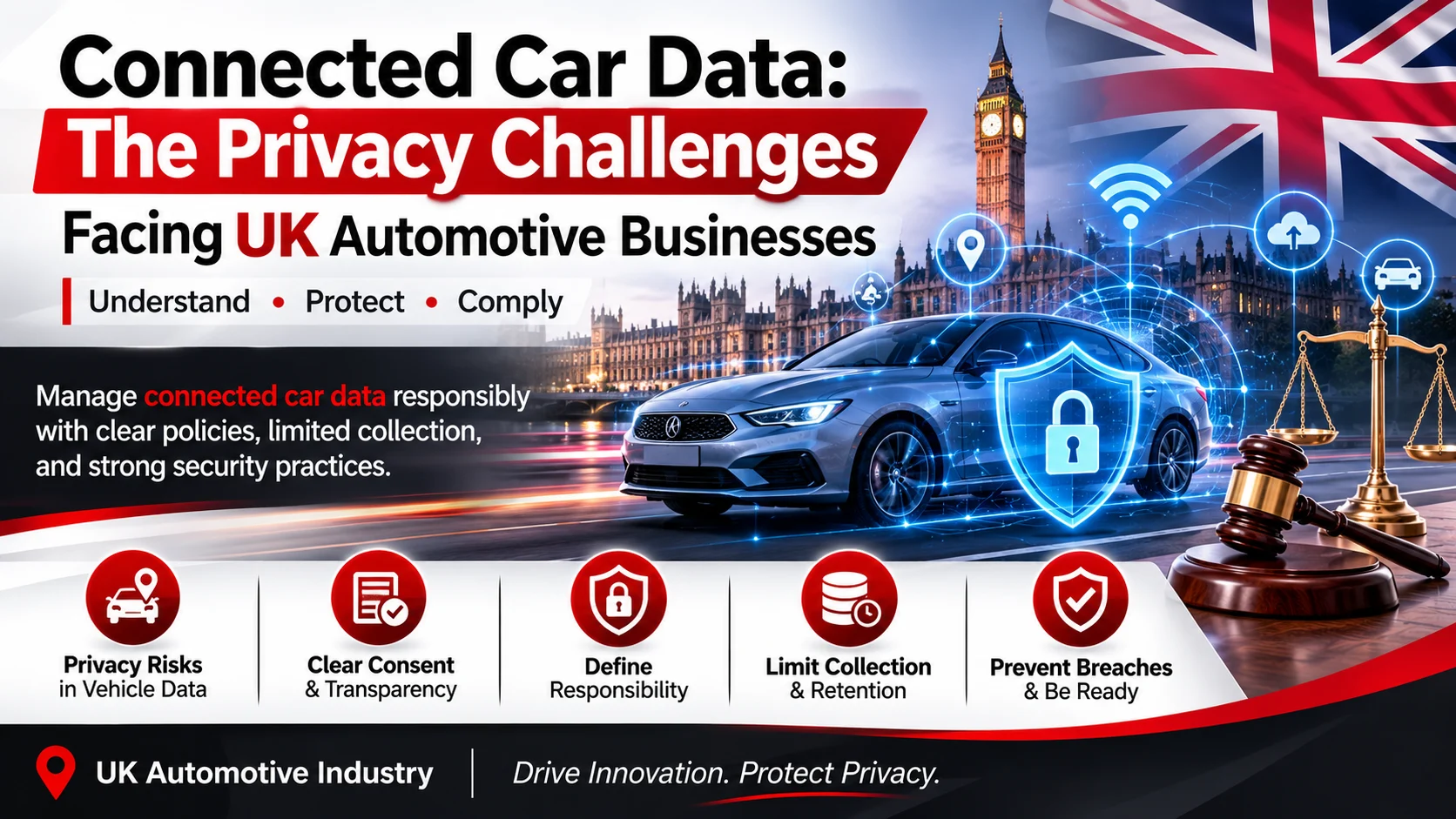

Connected vehicles can reveal where someone travels, how they drive, and which devices they connect. For UK automotive businesses, the privacy challenge is understanding when that information identifies people and controlling how it is collected, shared, and reused.
Useful services often depend on vehicle data, but access does not justify every possible use. Businesses need to distinguish necessary processing from optional collection and establish responsibility wherever information moves between organizations.
Why Connected Car Data Creates Privacy Risks
Location histories can reveal a person’s home, workplace, relationships, and routines. A vehicle identifier may also become personal data when linked to an identifiable owner or driver, even if the record contains no name.
Combining datasets increases the exposure. Journey records connected with account details can reveal more about someone than either dataset alone, while information collected during one person’s journey may also concern passengers.
Concerns extend beyond hackers. Even authorized access can create privacy problems when collection is disproportionate or information is reused for an incompatible purpose.
A security assessment and a privacy assessment therefore answer different questions. Protecting a database against intrusion does not establish whether the business should hold its contents.
Explain Collection Without Treating Consent as a Shortcut
Drivers cannot make meaningful choices if explanations hide important processing behind broad references to “improving services.” Notices should distinguish the information needed for a requested function from collection supporting separate purposes.
Businesses should identify an appropriate lawful basis for each activity rather than assuming consent covers everything. Where consent is needed, the choice should explain the processing and provide a usable way to withdraw it.
A review should identify:
- Which information each feature collects
- Why each use is necessary
- Which organizations receive the information
Research published by UCL in 2024 explored automotive privacy preferences through interviews with 15 drivers. Its findings underline the importance of understandable explanations and usable controls, although the small sample cannot represent all UK drivers.
Establish Responsibility Across the Data Chain
Vehicle information may pass through onboard systems, apps, cloud platforms, and external service providers. Businesses should map those transfers rather than treating the vehicle as the boundary of their responsibility.
The map should identify what each organization receives, why it receives it, and whether it determines its own purposes for processing. A supplier handling information solely on instructions raises different responsibilities from a recipient using it for independent commercial purposes.
Contracts should reflect the actual arrangement, including permitted uses, security expectations, subcontracting, and incident reporting. Labels alone cannot resolve a mismatch between an agreement and what happens operationally.
Cross-border access also belongs on the map. Teams need to establish where information is hosted and accessed, not simply where their immediate supplier has an office.
Limit Collection and Retention at the Source
Collecting everything “in case it becomes useful” expands both exposure and the work required to manage it. Each data field should have a defined purpose, with less intrusive alternatives considered before detailed collection becomes the default.
For example, a service may need a vehicle’s current location without needing a permanent journey history. Teams should test that distinction rather than assuming the most detailed dataset is necessary.
Retention rules should cover copies held in apps, internal systems, and supplier platforms. Removing information from one interface is not a reliable deletion process unless the underlying records are also addressed.
Prevent Leaks and Prepare for Incidents
Prevention and response should be designed together so teams can both restrict exposure and act when controls fail. A documented plan should identify decision makers, technical contacts, and supplier escalation routes before an incident occurs.
Reduce Opportunities for Exposure
Recommended safeguards? They include limiting access by job role, requiring strong authentication, encrypting sensitive information, and reviewing connections between systems.
Teams should also remove obsolete accounts and test whether access ends when an employee or supplier relationship changes.
Monitoring should make unusual access detectable without creating unnecessary new records about individuals. Regular exercises can test whether staff recognize an incident and know where to report it.
Investigate and Assess Notification Duties
An initial response should restrict compromised access, preserve evidence, and establish which information and individuals may be affected. Investigators should distinguish confirmed findings from assumptions as the incident develops.
According to the ICO, notifiable personal data breaches must be reported without undue delay and within 72 hours of awareness; high-risk breaches also require notification to affected individuals without undue delay.
Businesses should document their assessment even when notification is unnecessary.
To prepare for incidents and handle those incidents that do happen, it’s best to consult a local lawyer.
For example, a London cybersecurity lawyer can help with data breaches and incident response, as well as other data privacy and cybersecurity management needs.
Keep Connected Car Data Within Clear Boundaries
Managing connected car data means defining justified uses, understanding recipients, and limiting how long information remains available. Incident readiness supports those controls but cannot replace them.
Hopefully this article has been helpful. If it has been, then take a moment to explore some of our other insightful content.