
A two-post lift turns a weekend brake job from crawling around on your back into standing-up work. It also puts thousands of pounds of steel and a raised vehicle into a space that was built for parking. Whether that works depends on numbers you can measure in an afternoon.
Before you shop for 2 post car lifts, measure your garage. The ceiling, the door, the floor width, the concrete and the power supply can each rule out a model, and a couple of them can rule out a lift altogether.
The six measurements that decide it
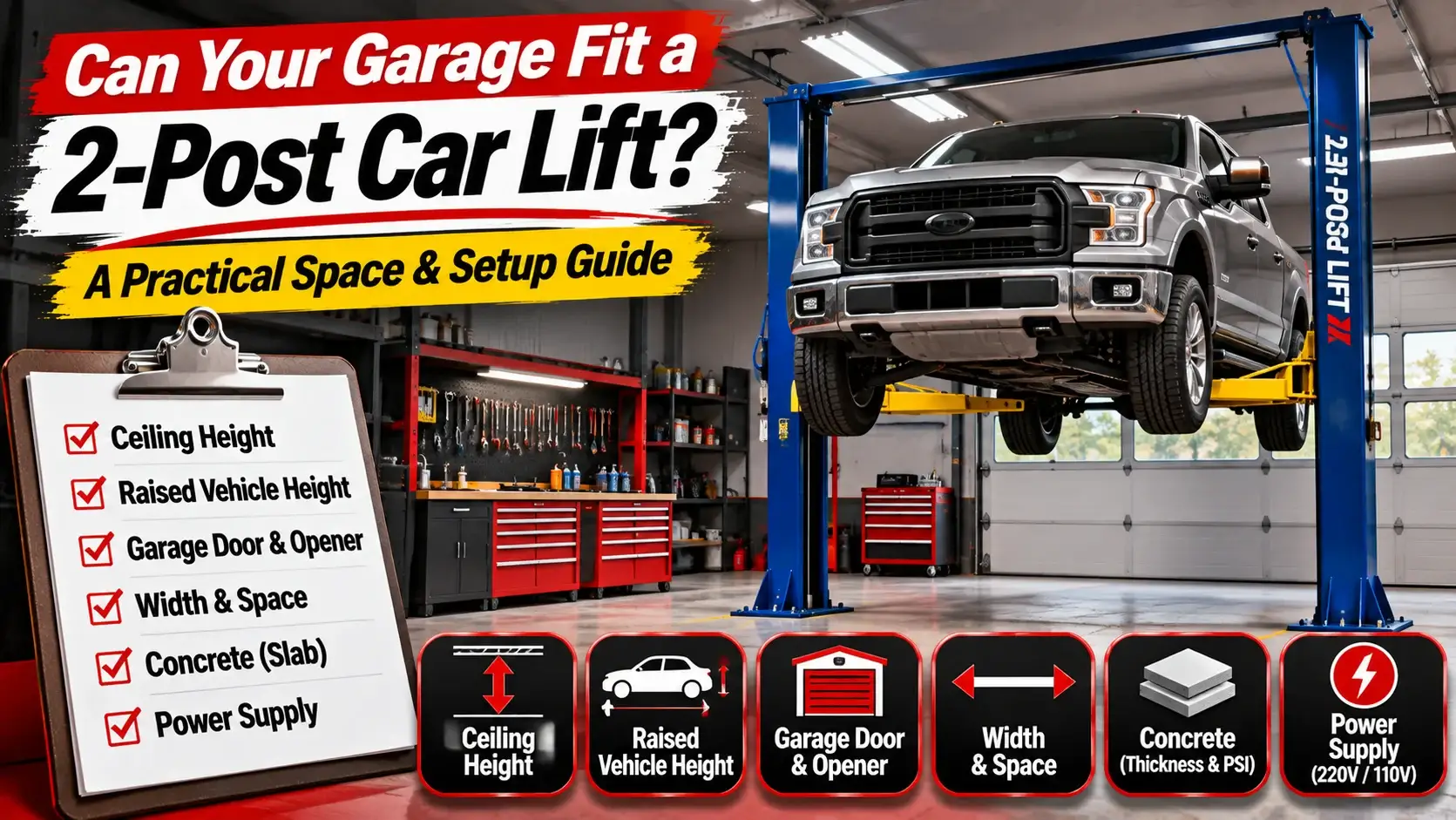
Measure these six things before you compare spec sheets. The figures come from one major maker’s published specs for a 10,000-pound two-post lift, so use them as a guide and check the numbers for the lift you buy. The sections below explain each one.
| What to check | Typical figure (10,000 lb two-post) | Red flag |
| Ceiling height | About 148 in (12 ft 4 in) for a clearfloor model, plus at least 1 in of clearance. One short-rise floorplate model is only 93.5 in. | The lowest beam, light or duct sits below the lift’s height plus 1 in |
| Raised vehicle height | About 76.5 in to the pads at full rise, plus your vehicle’s height. A 70 in tall SUV reaches about 146.5 in. | The roof or a roof rack would meet the ceiling, door or opener |
| Garage door and opener | Measure from the floor to the lowest point of the open door, its track and the opener. | Any of them sits lower than the raised roof |
| Width | About 137.5 in (11.5 ft) overall, with about 103 in of drive-through clearance between the columns. | Your bay is narrower than the lift plus room to walk around both columns |
| Concrete | At least 4¼ in of 3,000 PSI concrete. Heavier lifts need more, 6 in at 12,000 lb and 8 in at 15,000 lb and up. Anchors at least 6 in from any joint. | A thinner slab, cracks or joints at a column, or a post-tension slab |
| Power | A 208 to 230V single-phase power unit on its own circuit, with the breaker size from the nameplate. | Only a shared outlet, or a voltage or breaker that doesn’t match the nameplate |
Decide which kind of lift you need first
A two-post lift leaves the wheels hanging free, which is ideal for brakes, suspension, exhaust and transmission work. If you mostly want to store a second car above your daily driver, a four-post lift may suit you better. For an occasional oil change, good jack stands may still be enough.
Even with a lift, keep a pair of quality stands and follow the same jack stand safety rules you use on the floor. Tall stands earn their place once the car is in the air and you start removing heavy parts.
Ceiling height decides more than anything else
Two-post lifts come in two basic layouts. A clearfloor (overhead) lift ties its columns together with a beam across the top, so the floor between the posts stays flat. A floorplate lift runs its hydraulic lines and cables through a low plate on the ground instead, which lets the columns be shorter.
Clearfloor models are tall. One 10,000-pound clearfloor model on the market has an overall height of 148 inches, a little over 12 feet. Manufacturer guidance puts the overhead assembly at as much as 10 to 12 inches of extra height beyond the columns, and recommends at least an inch of clearance between any lift and the ceiling.
The column height is only half the sum. You also need room for the vehicle once it’s up. Take the lift’s maximum lifting height from its spec sheet, add the height of the tallest vehicle you’ll put on it, and compare that to your ceiling. The clearfloor model above lifts to 76.5 inches at the pads. Put a vehicle that stands 70 inches tall on it and the roof reaches about 146.5 inches at full height, before you allow for the pad adapters or a roof rack.
If the numbers don’t work, you have three options.
- Choose a floorplate model, which usually has shorter columns.
- Stop the lift below full height. You can lower the vehicle onto a lower lock position, and clearfloor lifts have an overhead shutoff bar that stops the lift if the roof touches it.
- Look at a short-rise or mid-rise lift if you mostly do wheel and brake work and don’t need to stand under the car.
Walk the ceiling with a tape measure rather than trusting the house plans. Lights, beams, ductwork and sprinkler heads usually sit lower than the drywall.
The garage door is part of the ceiling
The garage door and its opener are often the first things in the way. A standard track and roll-up door hang right where a raised vehicle’s roof wants to be. A ceiling-mounted opener sits in the middle of the bay at about the same height.
There are two common fixes. A high-lift track conversion moves the door up the wall so it opens closer to the ceiling. A wall-mounted jackshaft opener sits beside the door instead of in the middle of the ceiling. Either one can free up the space a lift needs, but price them in before you pick a model, because they change the total cost of the project.
Measure the floor width and the working space
Two-post lifts are wide. The 10,000-pound model above is 137.5 inches wide overall, which is more than 11 feet. You also need room to walk around both columns, open the doors of the car on the lift, and roll a toolbox, a transmission jack or an engine hoist or gantry crane up beside it.
Check the spec sheet for the drive-through clearance between the columns too. That’s the space you’ll have to drive the vehicle through, and on a wide pickup it can be tight. Mark the column footprints on the floor with tape and park the car between them before you order anything.
Check the concrete under each column
A two-post lift holds the whole vehicle on two columns, and each column is held to the floor by anchor bolts. The concrete under those anchors carries the load, so it has to meet the manufacturer’s spec for that model.
One major lift maker’s concrete spec calls for at least 4¼ inches of 3,000 PSI concrete with rebar under its 10,000-pound-class two-post lifts, 6 inches for its 12,000-pound models and 8 inches for its heaviest. Treat those figures as a starting point only. The manual for the exact lift you buy has the final word on thickness, strength, rebar and cure time.
Unless you poured it yourself, you probably don’t know how thick your garage slab is. Lift manufacturers recommend test drilling an existing floor to confirm the slab thickness rather than trusting the building drawings. Installation guidance also rules out cracked concrete, expansion joints and hand-mixed concrete, and some makers want each anchor at least 6 inches from any joint or seam. Check for a post-tension slab before anyone drills. Some homes have steel cables under high tension inside the slab, and cutting one can cause serious injury. Look for a warning stamp in the garage, or ask your local building department.
If the slab is too thin or cracked where the columns would sit, the usual fix is to cut out those areas and pour new reinforced footings to the manufacturer’s spec. A concrete contractor can quote that once you know the column positions.
Plan the power supply
Most full-size two-post lifts use a 220V single-phase hydraulic power unit. Some models offer a 110V unit. It runs on household voltage, but it can still need its own circuit and breaker, so check its rating before assuming any outlet will do.
Check the power unit’s nameplate or manual for the breaker size it needs. Plan for a dedicated circuit rather than sharing one with an air compressor, welder or heater, because a lift starting under load draws the most current. Unless you’re qualified to do the wiring yourself, have a licensed electrician run it. Put the outlet on the column that holds the power unit so the cord doesn’t trail across the bay.