
The best pole saw is not automatically the longest or most powerful model. It is the one that gives you enough reach and cutting capacity for routine pruning while still feeling controllable when the pole is extended.
A pole saw can make seasonal tree care more practical by helping you prune from the ground instead of reaching from a ladder. The right choice Sdepends on the branch diameters you actually cut, your property size, the power platform you already own, and how comfortably you can control a tool at full extension.
Quick verdict: the best pole saws to shortlist
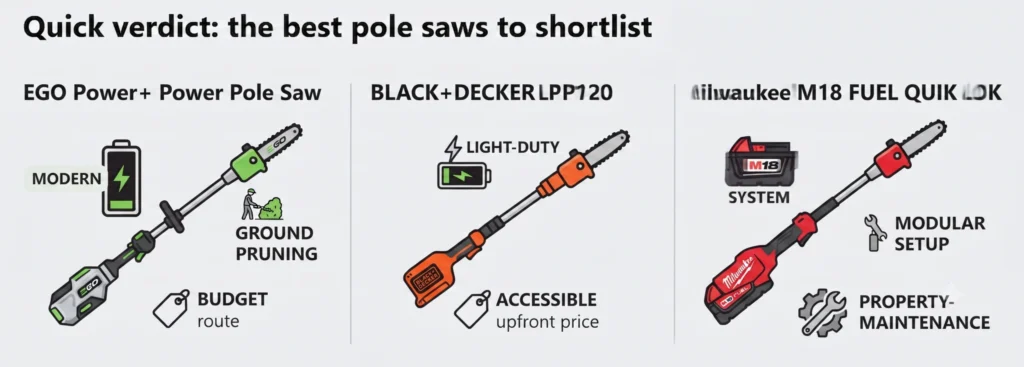
EGO Power+ Power Pole Saw
A strong cordless starting point for homeowners who want a modern battery platform, ground-based pruning convenience, and an option to compare alongside compatible EGO outdoor tools.Budget route
BLACK+DECKER LPP120
A sensible model to compare when light-duty pruning and an accessible upfront price matter more than tackling repeated cuts in dense hardwood.Battery platform pick
Milwaukee M18 FUEL QUIK-LOK
Most compelling for property-maintenance users already invested in the M18 system and looking for a modular outdoor-power setup.
Best pole saw comparison
These are buying-fit comparisons rather than universal performance rankings. A model that suits light annual pruning can be a poor match for repeated heavy cuts, a long rural driveway, or a user who finds front-heavy tools difficult to control.
| Model family | Best fit | Power approach | Check before buying |
|---|---|---|---|
| EGO Power+ Power Pole Saw | Routine homeowner pruning and EGO battery users | Cordless battery platform | Exact kit battery, pole configuration, and total working weight |
| Milwaukee M18 FUEL QUIK-LOK | M18 users and modular outdoor-tool ownership | Cordless modular attachment system | Battery capacity, attachment compatibility, and overhead balance |
| STIHL HT 105 | Demanding property work and professional maintenance | Gas-powered telescoping pole pruner | Fuel care, noise, emissions, weight, and local dealer support |
| Greenworks 80V Pole Saw | Larger residential properties with cordless preference | High-voltage cordless battery platform | Battery and charger inclusion, reach, and replacement parts |
| BLACK+DECKER LPP120 | Light pruning and budget-conscious buyers | Compact cordless pole saw | Realistic branch diameter expectations and runtime |
Manufacturer-reported reach can include user height or a general working-height estimate. Compare the physical tool length first, then consider your stance, branch angle, terrain, and the clearance needed to move safely away from a falling limb.
Individual recommendations
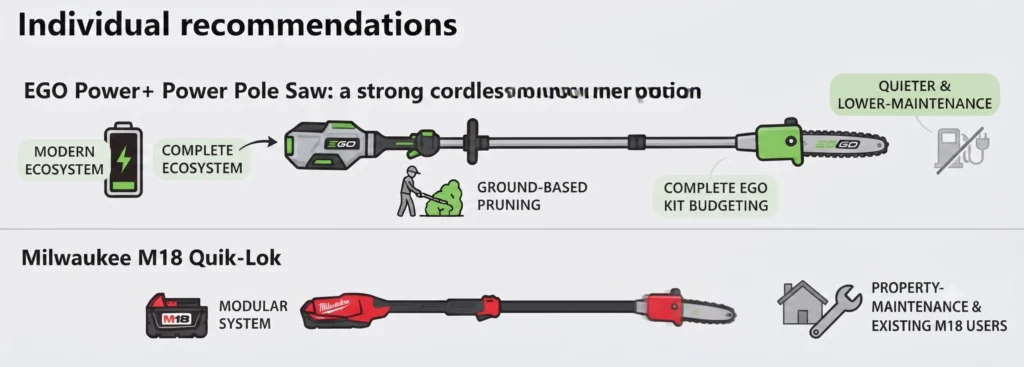
EGO Power+ Power Pole Saw: a strong cordless homeowner option
EGO’s pole-saw range is worth comparing when you want cordless convenience without starting a new battery ecosystem for every outdoor tool. Check the exact kit, bar length, pole arrangement, and included battery capacity rather than relying on a headline runtime claim.
Shortlist it if you want a quieter, lower-maintenance route for regular pruning and are comfortable budgeting for the complete battery kit.Best for existing M18 users
Milwaukee M18 FUEL QUIK-LOK: best for a compatible tool platform
A modular pole-saw attachment makes most sense when you already own compatible M18 batteries and want to consolidate chargers, packs, and service support. For overhead work, compare the fully assembled length and handling feel—not just bare-tool weight.
Shortlist it if battery compatibility will reduce your total setup cost and the attachment system fits the other outdoor jobs you do.Professional gas option
STIHL HT 105: best for demanding, frequent maintenance work
Gas pole pruners remain relevant for large properties and repeated heavy-duty work where refueling may be easier than managing several battery packs. They also require more maintenance, create more noise, and can become tiring when extended for long periods.
Consider it for frequent, demanding work where a local dealer and routine fuel-system maintenance are acceptable parts of ownership.Cordless long-property option
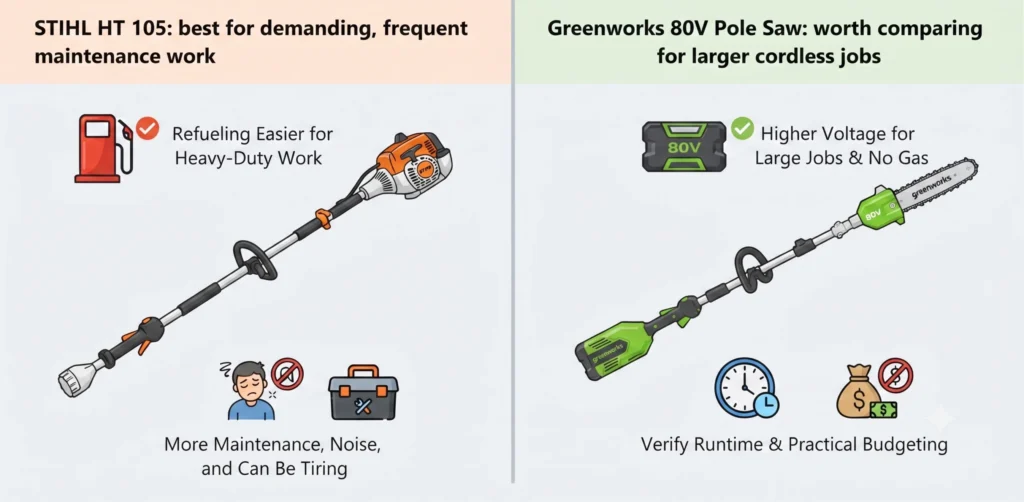
Greenworks 80V Pole Saw: worth comparing for larger cordless jobs
A higher-voltage cordless platform can be attractive for users who want to avoid gas while maintaining a larger garden, orchard, or rental property. Confirm practical runtime based on the battery capacity supplied, the wood density you expect, and the number of cuts in a session.
Shortlist it if you want a battery-first setup for regular property maintenance and can keep a realistic spare-battery plan.Best light-duty budget route
BLACK+DECKER LPP120: a budget-friendly option for smaller pruning jobs
For occasional light pruning, a compact cordless pole saw can be more approachable than a larger pro-focused tool. It is important to stay within the manufacturer’s stated use guidance and avoid expecting a lighter budget saw to perform like a heavy-duty gas model in thick, dry hardwood.
Shortlist it for occasional, modest pruning when affordability and manageable storage matter most.
How Mister Worker evaluates a pole saw
A useful pole-saw review should identify whether observations came from physical use or official documentation. When testing is available, the most useful notes record branch species and diameter, fresh versus dry wood, the number of cuts completed, pole flex at full extension, cutting speed, chain retention, oiler behavior, vibration, noise, and fatigue during repeated overhead work.
What to assess in a hands-on pole-saw test
Cutting response in fresh softwood, dry limbs, and the hardwood species typical of the property.
Physical pole length, claimed working reach, fully extended balance, flex, grip comfort, and shoulder fatigue.
Chain tensioning, automatic oiler consistency, reservoir visibility, bar access, and replacement-chain availability.
Battery runtime or fuel use in real cutting work, plus the total ownership cost of batteries, charger, oil, chain, and protective equipment.
What matters before you buy a pole saw
Separate pole length from working reach
A claimed working reach is not the same thing as the physical pole length. Marketing figures may include the operator’s height and arm reach. Look for collapsed length, maximum pole length, and whether the tool uses a fixed shaft, extension section, or telescoping mechanism. Then allow room to stand clear of the drop zone rather than reaching directly beneath the limb.
How thick can a pole saw cut?
Bar length does not equal a maximum safe branch diameter. A branch’s species, dryness, angle, tension, and ability to move while cutting can matter as much as its width. For routine pruning, many homeowners work mainly in the 2–6 inch range, while thicker branches may require more time, more control, multiple cuts, or professional assessment. Stop when the branch is too large, unstable, tensioned, near a structure, or beyond your comfortable control.
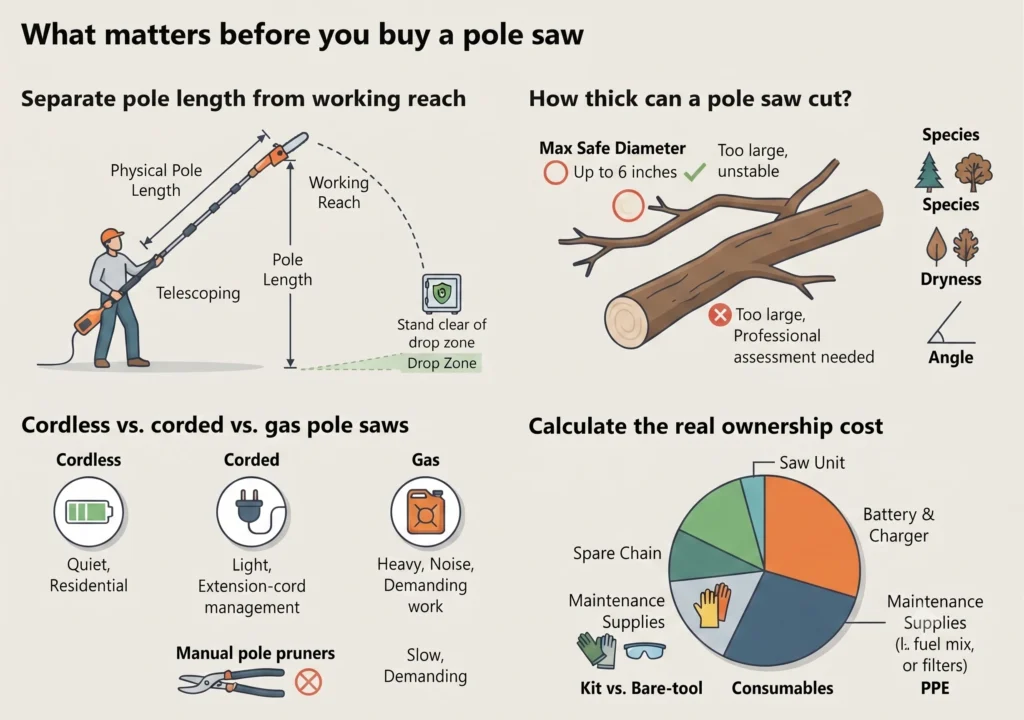
Cordless vs. corded vs. gas pole saws
Cordless pole saws are quiet, convenient, and suitable for most residential pruning, especially if you already own the batteries. Corded electric models can be affordable and relatively light but require careful extension-cord management. Gas models suit demanding, frequent work but bring weight, noise, fuel care, and maintenance. Manual pole pruners remain useful for small, clean pruning cuts but are slower and physically demanding.
Calculate the real ownership cost
Compare complete kits, not bare-tool prices. Include the saw, battery and charger where applicable, bar-and-chain oil, spare or replacement chain, bar, shoulder strap, extension pieces, fuel and maintenance supplies for gas models, and personal protective equipment. Package contents and model numbers can vary by retailer and region.
Essential pole-saw safety guidance
Extra reach does not make every elevated branch safe to remove. Read the manufacturer manual before assembly, oiling, chain adjustment, extension, or cutting. If a branch is large, hung up, storm-damaged, under tension, near a roof, or anywhere near power lines, stop and contact a qualified arborist or tree professional.
- Never stand directly underneath the branch you are cutting. Keep a clear escape route and keep people and pets outside the work area.
- Do not use a pole saw from a ladder. Work from stable ground and stop if terrain, weather, or footing makes control uncertain.
- Wear eye protection, head protection, hearing protection where required, gloves, sturdy footwear, and suitable leg protection according to the tool manual.
- Avoid power lines completely. Do not cut branches close to energized conductors, and do not operate in rain unless the manufacturer explicitly permits it.
Pole saw questions buyers ask
What is the best pole saw for thick branches?
For thicker routine branches, prioritize chain condition, power source, bar-and-chain quality, balance, and control at full extension over a single advertised diameter claim. Gas and higher-capacity cordless models may have more sustained cutting capability, but a large, unstable, tensioned, or awkwardly positioned branch should be assessed by a professional rather than forced through with a more powerful saw.
How much pole-saw reach do I need?
Measure the typical height of the branches you plan to prune, then select a pole that reaches them while you remain outside the likely fall zone. Do not treat advertised working reach as the pole’s physical length, and avoid choosing maximum extension if it makes the saw too heavy or unstable for you to control.
Do pole saws need chain oil?
Most chainsaw-style pole saws use bar-and-chain oil to reduce friction and wear. Check the reservoir before each session, use the oil specified in the manual, and inspect the oiler’s output. Clean sawdust from the bar area after use, and follow the manufacturer guidance for storage because some tools may seep oil when parked.