
A steady verdict in plain English — no forum rabbit holes, no guesswork about whether to pull over or keep driving.
What the AT Oil Temp Light Actually Is
AT stands for Automatic Transmission. The oil temp light — sometimes labeled A/T OIL TEMP, sometimes shown as a thermometer icon — monitors the temperature of your automatic transmission fluid (ATF). When ATF gets too hot or drops too low, friction inside the transmission multiplies fast and internal components start wearing in minutes, not miles.
Normal ATF operating temperature runs between 175°F and 225°F (80–107°C). Most transmission control modules trigger the warning light somewhere between 260°F and 300°F (127–149°C) depending on the vehicle. At sustained temperatures above 300°F, ATF begins to oxidize, lose viscosity, and deposit varnish on valve body passages — the beginning of a chain that ends in a failed transmission.
ATF temperature zones. The light turns on at the green-amber boundary. Sustained operation in the red zone oxidizes the fluid and begins to damage clutch packs and valve bodies.
Unlike the engine oil light, which is primarily a pressure warning, the AT oil temp light is purely thermal. It does not tell you the fluid is dirty, low, or degraded — only that it is currently too hot (or, on some Subarus, that it is still warming up from cold).
Subaru-Specific Behavior – Why Your Car Is Different
Two completely different scenarios, same light. Left: Subaru cold-start behavior — normal, self-clearing, no fault. Right: thermal fault during driving — needs immediate attention.
5 Causes — Ranked Most to Least Likely
The AT oil temp light has a short list of real causes. Below they’re ranked by how often they actually show up in diagnosis, based on shop records — not forum speculation.
| # | Cause | How Common | Safe to Drive? | Typical Fix |
|---|---|---|---|---|
| 1 | Overheated ATF from load (towing, grades, stop-and-go in heat) | Very common | Idle + cool | Rest, check fluid, fluid change if degraded |
| 2 | Cold-start informational (Subaru only) | Very common on Subaru | Yes — normal | None required |
| 3 | Low ATF level (leak or long service interval) | Common | No — stop | Find leak source, top up or change ATF |
| 4 | Failed or clogged transmission cooler | Moderate | No — stop | Flush cooler lines, replace cooler if blocked |
| 5 | Internal transmission fault (slipping clutch packs, failing torque converter) | Less common | No — stop | Professional diagnosis, possible rebuild or replacement |
1. Overheated ATF from load
Towing a trailer, climbing a long mountain grade, or crawling through stop-and-go traffic for 45 minutes on a 95°F day all add thermal load your transmission cooler may not keep up with. This is the most common trigger — and the most benign if you catch it early. Pull over, shift to Park, let the engine idle (idling keeps the cooler running, turning off the engine stops coolant flow through the transmission cooler on most vehicles), and wait 10–15 minutes. If the light clears and the ATF doesn’t smell burned, you’re likely fine to continue at a reduced pace.
2. Cold-start informational (Subaru)
Covered in detail above. Brief, self-clearing, normal. If you are a Subaru owner and the light clears within two minutes of driving, this is almost certainly the explanation.
3. Low ATF level
Low fluid means the transmission fluid is doing more work per molecule — it cycles through the torque converter and valve body faster, heats up faster, and can’t dissipate heat as efficiently. A transmission with fluid at half-level can overheat on a drive that wouldn’t trouble a full-level unit. Causes include external leaks (front pump seal, pan gasket, cooler line fittings) and simply being well past the service interval. Many Subaru owners are surprised to learn their ATF hasn’t been changed since the dealership did it at 30,000 miles.
4. Failed or clogged transmission cooler
The transmission cooler — typically a small radiator either integrated into the main radiator or mounted as a standalone unit near the front of the vehicle — removes heat from the ATF before it returns to the transmission. A clogged cooler (from internally degraded ATF or external debris) cuts cooling efficiency and sends hot fluid right back in. A failed cooler can also allow engine coolant to mix with ATF, which creates a chocolate-milkshake fluid that destroys the transmission quickly. If you see reddish-brown milky fluid on the dipstick or via the fill plug, this is a serious emergency.
5. Internal transmission fault
Slipping clutch packs, a failing torque converter clutch, or a stuck pressure regulator valve all create excess heat internally — the transmission works harder than it should to do the same job. This cause is typically accompanied by other symptoms: slipping between gears, shuddering at highway cruise speed, delayed engagement from Park to Drive, or abnormal RPM behavior. A persistent AT oil temp light with no obvious load-related trigger and no external fluid issue warrants a transmission scan at a shop with OBD-II transmission codes, not just the generic check-engine reader.
Decision tree for the three most common scenarios. When in doubt, treat any unresolved AT oil temp light as a stop condition — transmission repairs cost far more than a tow.
How to Check Transmission Fluid on a Subaru
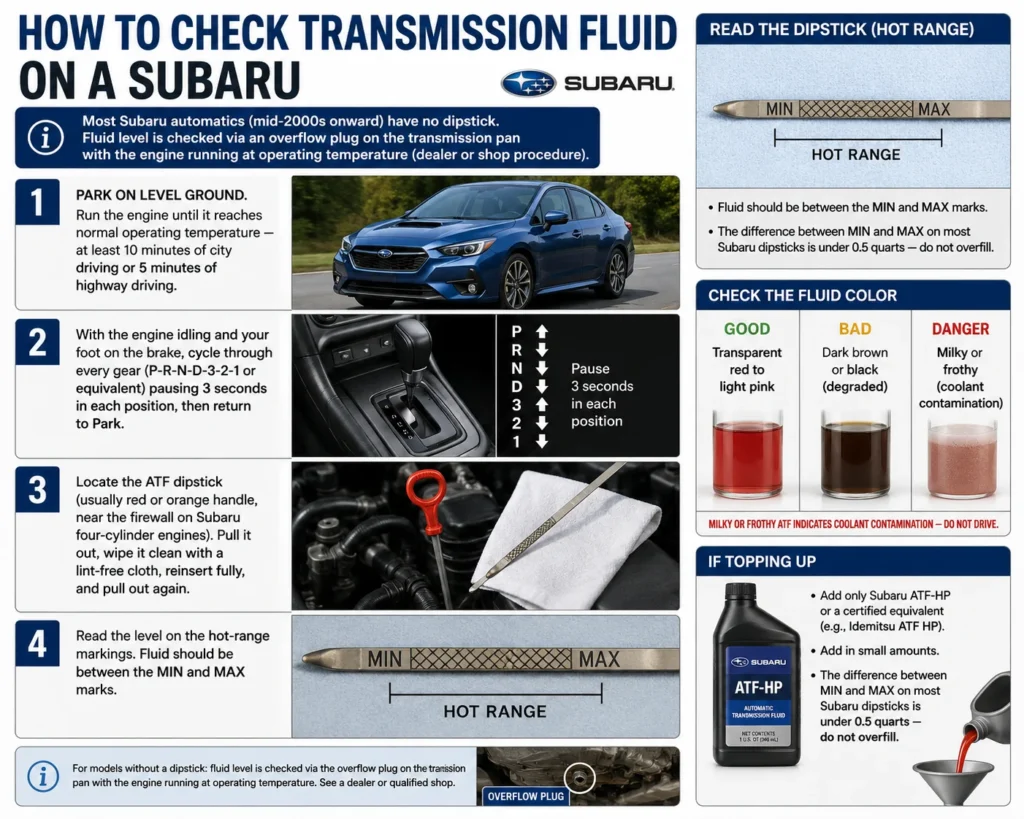
Most Subaru automatics made from the mid-2000s onward have no user-accessible dipstick. The fluid level is checked via an overflow plug on the transmission pan with the engine running at operating temperature — a dealer or shop procedure. If you own an older Subaru or a model with a dipstick, here is the correct process:
Park on a level surface. Run the engine until it reaches normal operating temperature — at least 10 minutes of city driving or 5 minutes of highway driving.
With the engine idling and your foot on the brake, cycle through every gear (P-R-N-D-3-2-1 or equivalent) pausing 3 seconds in each position, then return to Park.
Locate the ATF dipstick (usually red or orange handle, near the firewall on Subaru four-cylinder engines). Pull it out, wipe it clean with a lint-free cloth, reinsert fully, and pull out again.
Read the level on the hot-range markings. Fluid should be between the MIN and MAX marks. Note the color: healthy ATF is transparent red to light pink. Dark brown or black ATF is degraded and should be changed. Milky or frothy ATF indicates coolant contamination — do not drive.
If topping up, add only Subaru ATF-HP or a certified equivalent (e.g., Idemitsu ATF HP) in small amounts. The difference between MIN and MAX on most Subaru dipsticks is under 0.5 quarts — do not overfill.
What you can do yourself
If you own a Subaru and the light clears at cold start: nothing. That’s normal behavior.
If the light came on during towing or sustained highway climbing and cleared after resting: check ATF level and condition. If the fluid is dark, schedule a drain-and-fill. If the level is correct and fluid looks good, reduce towing load and monitor.
When to call a shop
Take it to a shop if any of these apply:
- Light came on during normal driving with no obvious heat trigger
- Light came on and did not clear after 15 minutes of idling
- ATF looks milky, brown-black, or smells burned
- Light keeps coming back across multiple drives
- Any additional symptoms: slipping, shuddering, delayed shifts, RPM flare
- No dipstick access on your Subaru model (needs lift and fill-plug check)
Realistic Repair Costs
Cost estimates below are based on US national averages for 2025–2026. Dealer pricing runs 20–35% higher than independent shops in most markets.
The cost hierarchy is stark: a $150 fluid change today versus a potential $3,500 rebuild if you drive on degraded or overheated ATF for months. Most AT oil temp situations that are caught early require only a fluid service.
Frequently Asked Questions
Is it safe to drive with the AT oil temp light on?
Only if it came on at cold start and cleared within 60–90 seconds on a Subaru — that’s normal behavior. Any other scenario (light during driving, light that doesn’t clear, light after towing) means pull over, idle, and assess before continuing. Driving on overheated ATF accelerates internal wear rapidly.
What does AT oil temp mean on a Subaru specifically?
On Subarus it can mean one of two things: a brief cold-start informational indicator (normal, self-clearing) or a genuine thermal overheat warning during driving (not normal, requires immediate attention). The timing tells you which one you’re dealing with — startup vs. mid-drive is the key distinction.
My AT oil temp light came on while towing. Did I damage my transmission?
Not necessarily. If you pulled over and let it idle until the light cleared, the fluid likely just spiked from load and recovered. Check the ATF color — if it’s still red or pink with no burnt smell, it probably survived. If it’s dark brown or smells like burnt toast, a fluid change is due and you should have it inspected before towing again.
How do I check transmission fluid on a Subaru?
Most mid-2000s-onward Subarus have no user-accessible ATF dipstick. Fluid level requires a fill plug check via lift with the engine at operating temperature — a shop procedure. If your model has a dipstick, check it warm, in Park, on a level surface, and look for the hot-range MIN/MAX markings. Use only Subaru ATF-HP or a verified equivalent when topping up.
How much does a Subaru transmission fluid change cost?
A drain-and-fill at a Subaru dealership runs $160–$250 depending on model and region. Independent shops typically charge $100–$160. Subaru specifies ATF-HP fluid, which costs more than generic ATF — avoid shops offering budget fluid to undercut the price.
What if the AT oil temp light comes on every time I drive, not just at cold start?
That’s a problem. Likely causes are low ATF level, a degraded fluid that can’t handle normal thermal cycling, a failing transmission cooler, or an internal fault generating excess heat. Have it diagnosed with a full transmission scan, not just a generic OBD-II reader — many AT codes don’t surface on consumer scanners.