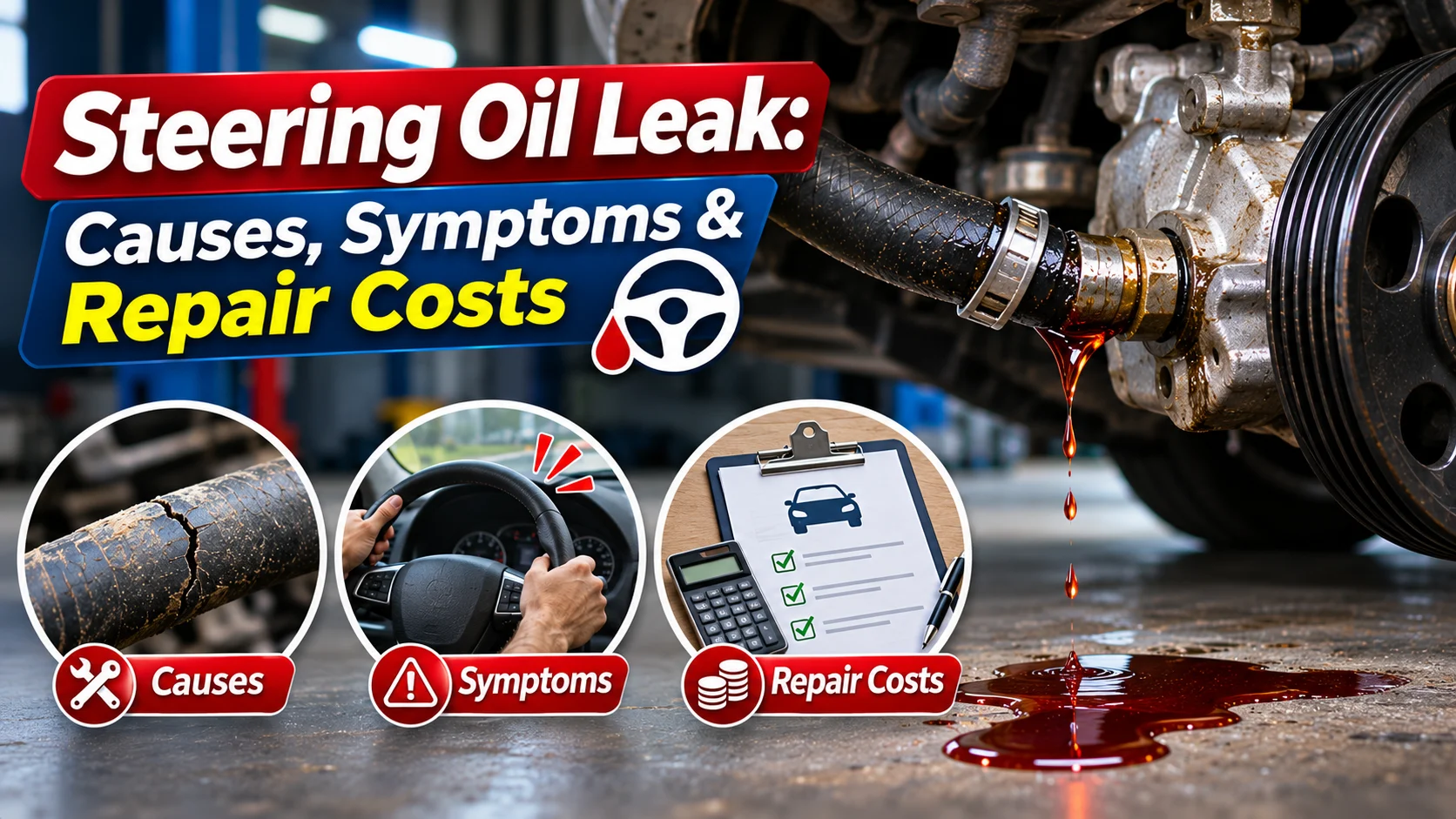
A steering oil leak can start with a few drops beneath your car and develop into a problem that makes steering much harder. You might notice a whining noise when turning, a falling power steering fluid level, or oily residue around the steering pump and hoses. The important question is whether the leak is minor, where it originates, and whether your car is safe to drive.
A steering oil leak, more accurately called a power steering fluid leak, occurs when hydraulic fluid escapes through a damaged hose, worn seal, leaking pump, reservoir, or steering rack. Repairs range from relatively simple connection or hose repairs to expensive steering rack replacements. The correct repair depends on finding the actual leak rather than replacing parts based on symptoms alone.
Quick Answer
The most common sources of hydraulic power steering leaks are hoses, fittings, pump seals, the fluid reservoir, and steering rack seals. Warning signs include low fluid, oily puddles, whining noises, and increased steering effort. A rapid leak or sudden change in steering assistance requires immediate attention. In September 2026 US national estimates, replacement averages were approximately $711–$793 for a power steering hose, $841–$940 for a pump, and $2,307–$2,572 for a rack-and-pinion assembly. These are job-specific averages, not fixed prices for every vehicle.
What Is a Steering Oil Leak?
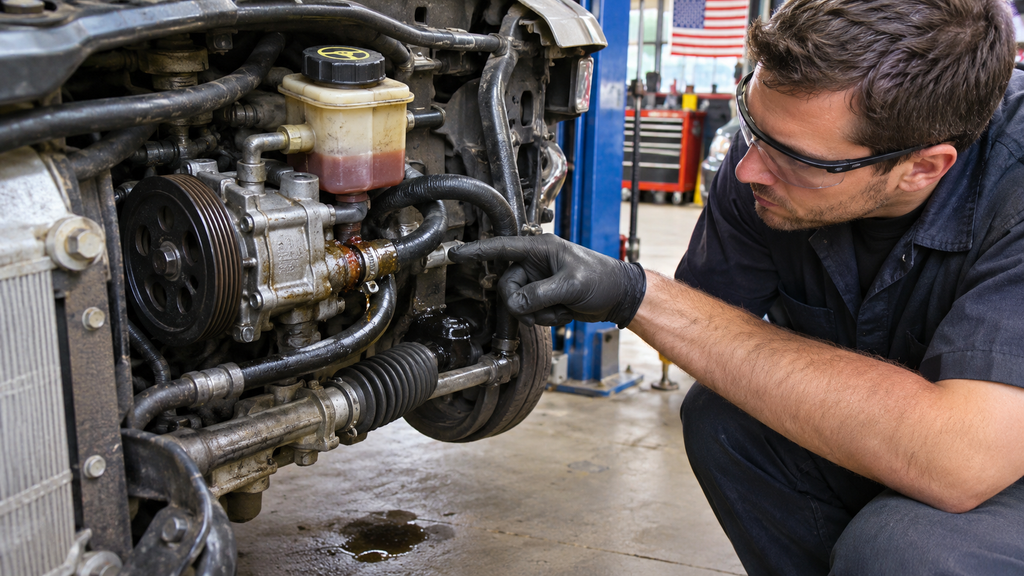
A steering oil leak happens when fluid escapes from a vehicle’s hydraulic power steering system. This system uses pressurized fluid to reduce the effort needed to turn the steering wheel, especially when parking or driving at low speeds.
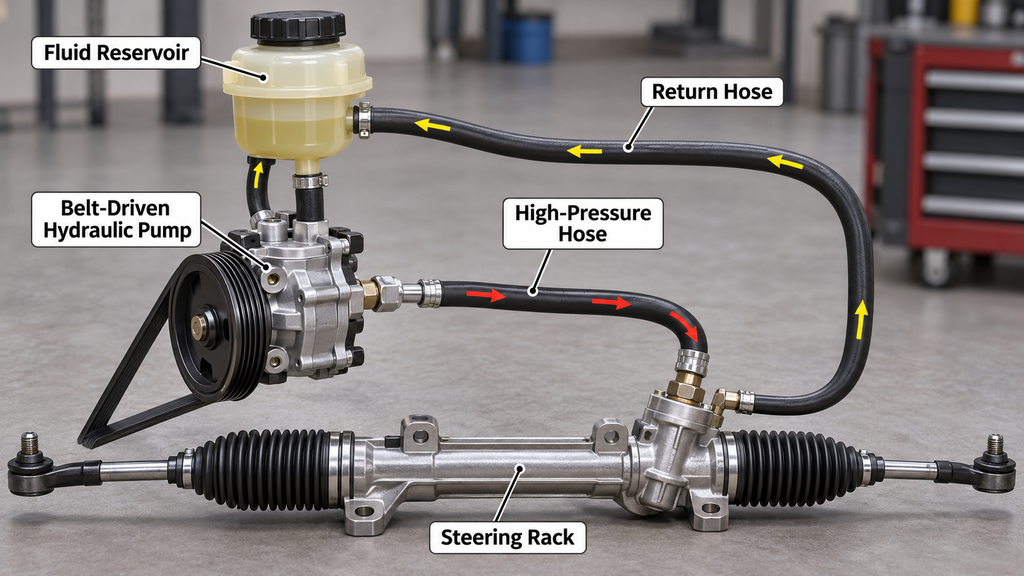
In a conventional hydraulic system, the power steering pump moves fluid through high-pressure lines to the steering gear or rack. Fluid then returns to the reservoir. Seals, hoses, and fittings keep this circuit closed. When one of these parts deteriorates or becomes damaged, fluid can escape and reduce the system’s ability to provide assistance.
How Does Hydraulic Power Steering Work?
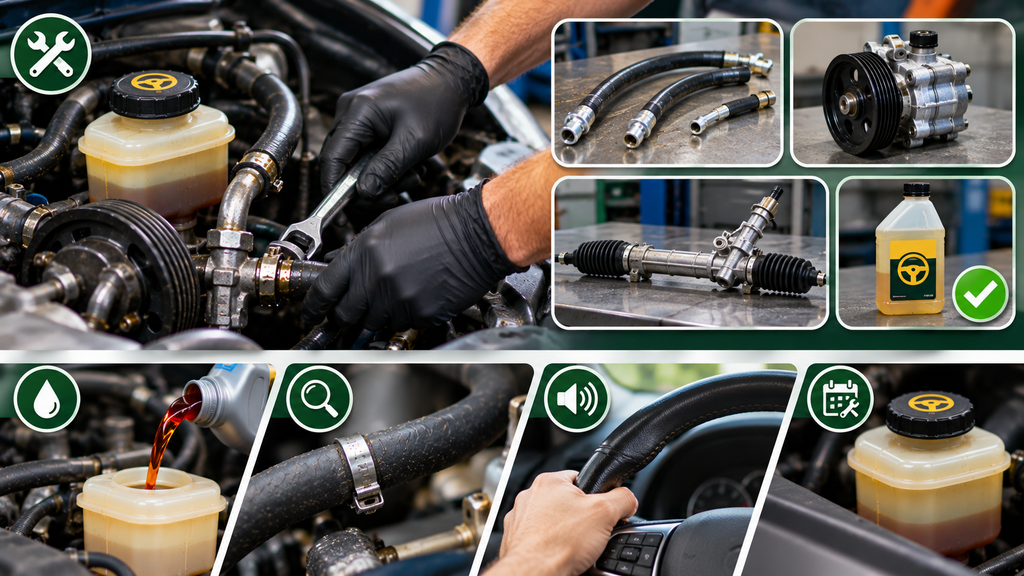
A typical hydraulic power steering system includes several main components:
- Power steering pump: Creates hydraulic pressure to assist steering.
- Fluid reservoir: Stores the power steering fluid.
- High-pressure hose: Carries pressurized fluid toward the steering gear.
- Return hose: Carries fluid back to the reservoir.
- Steering rack or gearbox: Uses hydraulic pressure to help move the steering mechanism.
- Seals and fittings: Prevent fluid from escaping at connections and moving components.
Do All Cars Have Power Steering Fluid?
No. Many newer vehicles use electric power steering (EPS), which uses an electric motor rather than a hydraulic pump and fluid circuit to provide steering assistance. A vehicle with purely electric power steering has no power steering fluid to leak.
Some vehicles use electro-hydraulic power steering, where an electric motor drives a hydraulic pump. These systems still contain fluid and can leak. Check your owner’s manual or vehicle-specific service information before looking for a reservoir or purchasing fluid.
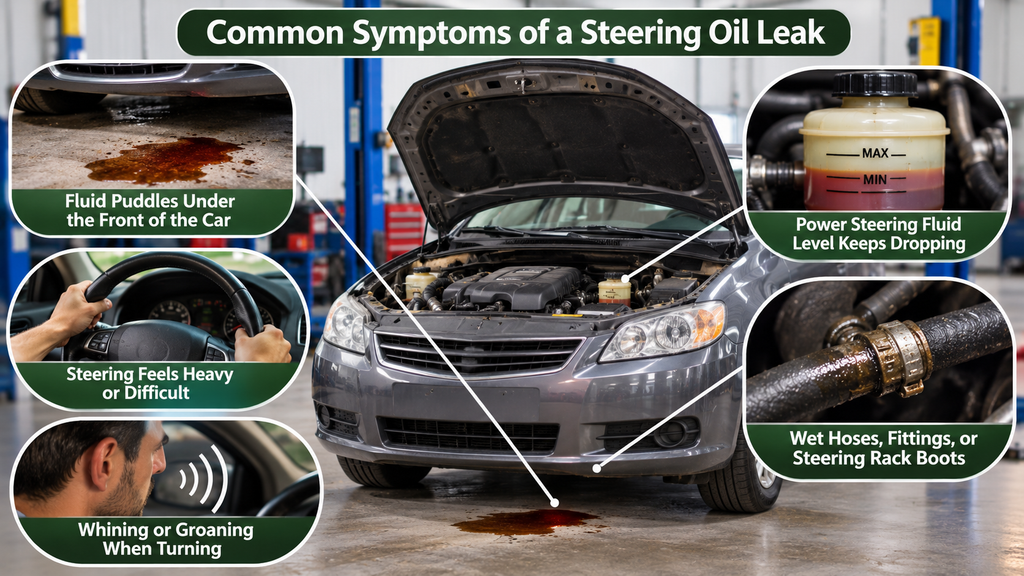
Common Symptoms of a Steering Oil Leak
Power steering fluid leaks do not always produce obvious symptoms immediately. A small leak may leave only a damp fitting, while a larger leak may cause noise, low fluid levels, and a noticeable reduction in steering assistance.
1. Fluid Puddles Under the Front of the Car
One of the most visible warning signs is an oily spot beneath the engine bay or front steering components. Depending on the manufacturer’s fluid specification and its condition, power steering fluid may appear reddish, amber, clear, or brown.
Color alone cannot identify the source. Transmission fluid and some other automotive fluids can look similar. A leak may also run along a hose, subframe, or protective panel before dripping onto the ground, so the puddle’s location is not necessarily the location of the failed component.
2. Whining or Groaning When Turning
A hydraulic power steering pump may produce a whining or groaning sound when the fluid level is low or air enters the system. The noise may become more noticeable when turning at low speed.
However, steering noise can also result from belt problems, a worn pump, or other mechanical faults. A sound alone does not confirm a fluid leak.
3. Steering Feels Heavy or Difficult
Hydraulic assistance helps the driver turn the steering wheel. If the system loses too much fluid or pressure, steering effort may increase, particularly during parking maneuvers.
A sudden increase in steering effort is a safety concern. Pull over safely and arrange professional assistance rather than continuing to drive with uncertain steering performance.
4. Power Steering Fluid Level Keeps Dropping
A reservoir that repeatedly falls below its specified level may indicate a leak. Hydraulic power steering systems are generally closed circuits, so fluid should not disappear through normal consumption.
Follow the manufacturer’s instructions when checking fluid levels. Some reservoirs have separate hot and cold markings, and checking procedures differ by vehicle.
5. Wet Hoses, Fittings, or Steering Rack Boots
Oily residue on a hose or fitting can indicate fluid escaping from a connection. If the steering rack boots are swollen or contain hydraulic fluid, an internal rack seal may be leaking.
A mechanic should determine whether the fluid originated inside the rack or traveled from a nearby component before recommending replacement.
| Symptom | Possible explanation | Recommended action |
|---|---|---|
| Small oily spot | Hose, fitting, pump or rack leak | Identify the fluid and inspect promptly |
| Whining while turning | Low fluid, air or pump fault | Check system condition; avoid prolonged operation |
| Heavy steering | Reduced assist or other steering fault | Stop safely and seek professional assistance |
| Repeated fluid loss | Ongoing external or internal leakage | Arrange leak diagnosis |
| Fluid inside rack boot | Possible internal rack seal failure | Professional steering rack inspection |
What Causes a Power Steering Fluid Leak?
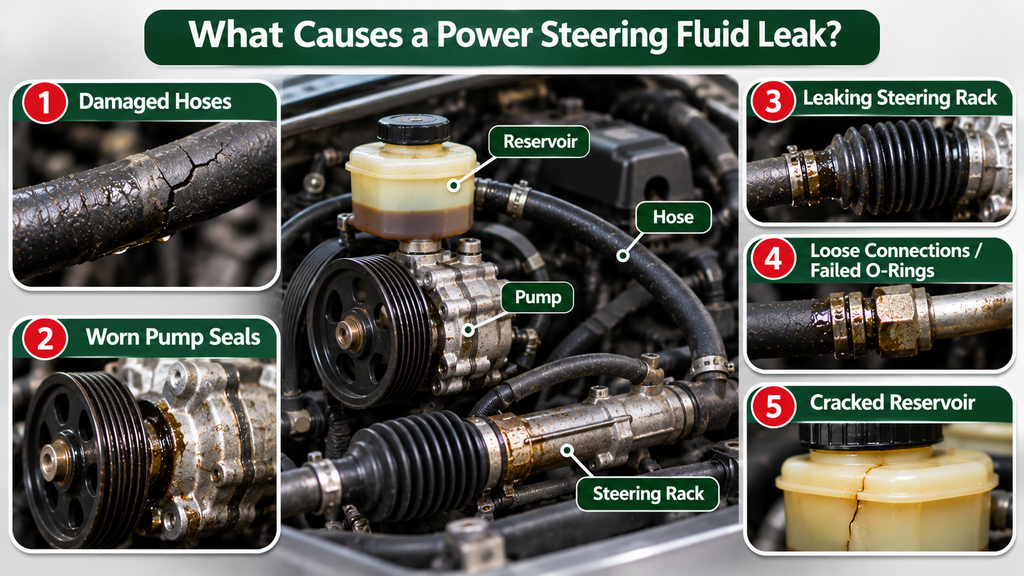
A hydraulic steering system contains multiple seals, rubber hoses, metal lines, and connections. Over time, exposure to heat, pressure, vibration, road debris, and age can contribute to leaks.
1. Damaged Power Steering Hoses
Power steering hoses are among the common places to investigate when hydraulic fluid is escaping. A high-pressure hose may leak at its crimped fitting, while a low-pressure return hose can deteriorate or develop a leak around a connection.
What to look for
Look for damp hose surfaces, deteriorated rubber, visible cracks, oily fittings, or fluid accumulation beneath a hose connection. The high-pressure side should never be checked with bare hands while the system is operating.
2. Worn Power Steering Pump Seals
Power steering pumps contain seals that retain hydraulic fluid. As these seals wear, leakage may appear around the pump shaft or housing.
A leaking pump may also produce noise if the fluid level becomes low, but pump noise alone is not proof that the pump needs replacing. A technician should examine the reservoir, hoses, belt condition, and other components before making that decision.
3. Leaking Steering Rack or Gearbox
The hydraulic steering rack contains internal seals designed to retain pressurized fluid. When these seals fail, fluid can escape around the rack or accumulate inside the protective bellows boots.
Rack replacement can be expensive because the repair may involve removing steering components, disconnecting lines, and carrying out a wheel alignment afterward. A wet rack exterior does not automatically prove that its internal seals have failed.
4. Loose Connections and Failed O-Rings
Fluid lines often connect to pumps and steering gears using threaded fittings and seals. An aged or incorrectly installed O-ring can allow fluid to escape.
A connection leak may sometimes be repaired without replacing an entire steering assembly. However, fittings must be inspected and serviced according to the manufacturer’s procedures, not tightened indiscriminately.
5. Cracked Fluid Reservoir
Depending on the vehicle, the fluid reservoir may be made from plastic or metal. Damage, aged material, or a leaking outlet connection can allow fluid to escape.
Fluid around the reservoir should be traced carefully because spilled fluid from previous servicing can resemble an active leak.
How to Find a Steering Oil Leak
Identifying the actual source of a steering oil leak is essential because replacing the wrong component can result in an expensive repair that does not solve the problem.
Safety first
Perform basic visual checks only while the vehicle is parked on level ground, with the engine off and components cool. Never put your hands near rotating belts, reach into a pressurized leak, or crawl beneath a vehicle supported only by a jack.
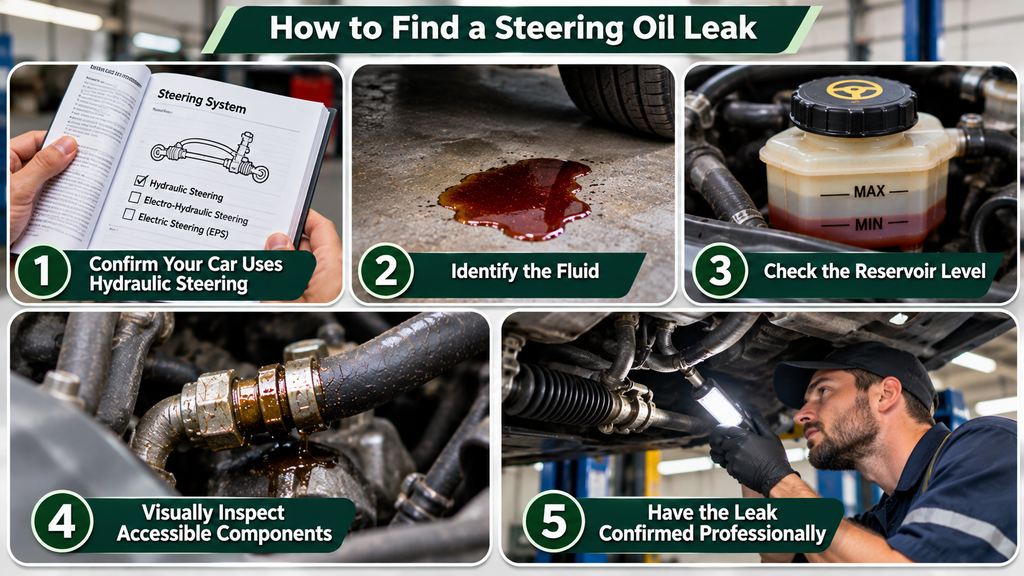
Step 1: Confirm Your Car Uses Hydraulic Steering
Consult your owner’s manual to determine whether the vehicle has conventional hydraulic, electro-hydraulic, or electric steering. If it uses purely electric steering, any fluid beneath the vehicle must come from another source.
Step 2: Identify the Fluid
Note the puddle’s location, color, consistency, and quantity without touching or tasting it. Do not assume red fluid is necessarily from the steering system. Other possible sources include automatic transmission fluid, engine oil, coolant, and brake fluid.
Step 3: Check the Reservoir Level
If the manufacturer provides an accessible power steering reservoir, follow its specified fluid-level inspection procedure. Note whether the level is below the appropriate marking.
Do not overfill the reservoir or add an unfamiliar product. Different vehicles may require different power steering fluids or manufacturer-approved automatic transmission fluids.
Step 4: Visually Inspect Accessible Components
With the engine off, look for wet hoses, oily connections, residue around the pump, or fluid near the reservoir. Avoid removing protective components or performing underbody work without proper equipment and training.
Step 5: Have the Leak Confirmed Professionally
If the source is unclear, a qualified technician can clean the affected area, inspect the system using appropriate equipment, and identify the first point where fresh fluid appears.
Depending on the vehicle and service procedure, professional diagnosis may involve checking the hydraulic system, examining steering rack boots, and using an approved leak-detection method. High-pressure fluid can penetrate skin, so pressurized testing is not an appropriate casual DIY inspection.
Steering Oil Leak Repair Cost in 2026
The cost of repairing a steering oil leak depends primarily on which component has failed, your vehicle’s make and model, labor rates, and whether the repair requires additional work.
A leaking seal or connection may be repairable without a major component replacement. A failed pump or internal steering rack seal can result in a substantially higher bill.
Average US Power Steering Repair Costs
The following national estimates are from RepairPal’s September 3, 2026 updates. They represent average replacement jobs, including parts and labor, rather than prices for every possible leak repair.
| Repair | National estimate | What it covers |
|---|---|---|
| Power steering hose replacement | $711–$793 | Replacement hose, associated parts and labor |
| Power steering pump replacement | $841–$940 | Replacement pump and installation labor |
| Rack-and-pinion replacement | $2,307–$2,572 | Steering rack assembly and replacement labor |
Pricing note: Estimates exclude applicable taxes and fees, location-specific price differences, and potentially related repairs. Vehicle-specific quotes can be much lower or higher. Source: RepairPal hose estimate, pump estimate, and rack estimate.
Why Are Some Steering Leak Repairs More Expensive?
A small external connection leak may require fewer parts than an internal rack failure. But even an apparently simple leak can become costly if the damaged component is difficult to access.
Vehicle design and accessibility
Some pumps and hoses can be reached relatively easily. Others require removal of nearby engine or chassis components.
Parts selection
Original-equipment, aftermarket, and remanufactured parts may carry different prices and warranties. Not every option is available or appropriate for every vehicle.
Additional required work
Fluid replacement, bleeding air from the system, related hose repairs, and wheel alignment after steering rack removal may add to the total cost.
How to Avoid Paying for Unnecessary Repairs
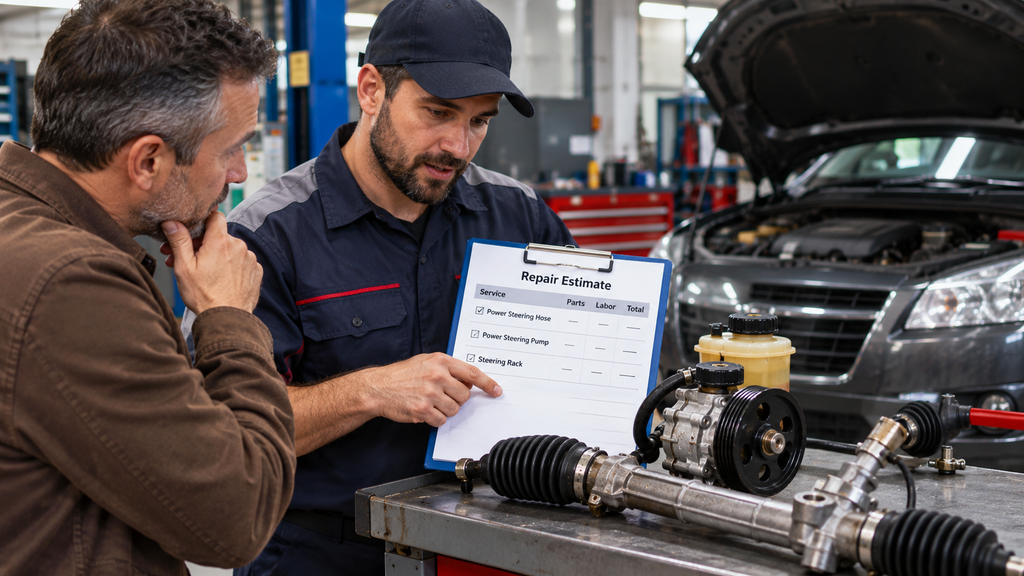
Before authorizing a major replacement, request an itemized estimate. Ask the shop to identify the failed component and explain how the leak was confirmed.
- Request separate parts and labor costs.
- Ask whether an individual seal, connection, or hose can be repaired according to manufacturer procedures.
- Compare equivalent parts and warranty coverage.
- Confirm whether fluid service and alignment are included.
- Seek a second diagnosis if an expensive rack replacement is recommended without a clear explanation.
Can You Drive With a Steering Oil Leak?
Driving with a power steering fluid leak can be unsafe because continued fluid loss may reduce or eliminate hydraulic steering assistance. Even if the car remains mechanically steerable, the steering wheel may require significantly more effort to turn.
There is no reliable rule that makes every small leak safe for a short journey. The amount of fluid remaining, how quickly it is escaping, the vehicle’s steering condition, and whether fluid reaches other components all matter.
When to Stop Driving
- The steering suddenly becomes unusually heavy.
- Steering assistance is intermittent or appears lost.
- Fluid is leaking rapidly or the reservoir is nearly empty.
- The pump makes severe or persistent abnormal noise.
- Fluid is reaching a hot component or the leak creates another immediate hazard.
- Steering behavior becomes unpredictable or difficult to control.
Move to a safe location if you can control the vehicle, stop the engine, and arrange professional assistance or towing.
What Happens if You Ignore a Power Steering Leak?
Continued operation with insufficient fluid can allow air into the hydraulic system, cause pump noise, reduce steering assistance, and contribute to pump damage. A leaking hose or seal can also deteriorate until fluid loss becomes more severe.
Ignoring the leak may turn a relatively limited repair into a more expensive one. The safest approach is to identify the source promptly rather than repeatedly topping up the reservoir as a substitute for repair.
How to Fix a Power Steering Fluid Leak
The correct repair depends on which component is leaking. A sound diagnosis should come before selecting replacement parts.
Repair or Replace a Leaking Hose
If the hose itself is deteriorated, cracked, or leaking from a permanently crimped connection, replacement is often the appropriate solution. A separate leaking fitting or seal may require a more limited repair when approved by the vehicle manufacturer.
Repair a Leaking Connection or O-Ring
A worn sealing ring can sometimes be replaced without installing a new pump or steering rack. The technician must inspect the mating surfaces, use the specified replacement seal, and follow the proper assembly and torque requirements.
Replace a Leaking Power Steering Pump
When a pump has a confirmed seal or housing failure and an approved individual repair is unavailable or impractical, replacing the pump may be necessary.
The technician should also inspect the connected hoses, reservoir, and fluid condition so that an unresolved fault does not affect the replacement component.
Replace or Professionally Repair the Steering Rack
A confirmed internal rack seal leak may require specialist rebuilding or rack replacement, depending on the design, available parts, and manufacturer’s service recommendations.
Rack replacement is usually a professional job because steering connections, mounting components, fluid lines, and sometimes the front subframe must be handled correctly. A wheel alignment is commonly required after replacement.
Can Power Steering Stop-Leak Products Fix the Problem?
Stop-leak additives are marketed as temporary solutions for certain seal leaks, but they cannot repair a ruptured hose, cracked reservoir, damaged fitting, or mechanically failed steering component.
Additives are not universally compatible with every power steering system. Do not use one without confirming the manufacturer’s fluid requirements and product suitability. An additive should never replace the diagnosis of a leak that affects steering safety.
Should You Repair a Steering Oil Leak Yourself?
Basic checks such as inspecting the fluid level or looking for accessible residue may be reasonable for a careful owner following the manual. Repairing high-pressure hydraulic lines, replacing a steering pump, or removing a rack requires appropriate tools, procedures, and experience.
After repairs, the system must be filled with the correct fluid, bled according to the vehicle’s service procedure, and checked for leaks and proper steering operation. Incorrect repairs to steering components can create serious safety risks.
How to Prevent Future Power Steering Fluid Leaks
Not every leak can be prevented, especially when components age internally. However, appropriate maintenance and prompt inspections can reduce the likelihood of avoidable damage.
Use the Correct Power Steering Fluid
Always follow your vehicle manufacturer’s fluid specification. Some hydraulic steering systems use dedicated power steering fluid, while others require a particular transmission fluid or proprietary hydraulic fluid.
Inspect Hoses and Connections During Service
Have visible hoses, clamps, fittings, and the reservoir checked during routine vehicle maintenance, especially on older or high-mileage vehicles.
Address Unusual Steering Noises Promptly
A new whining or groaning noise is a reason to investigate. Identifying low fluid, a failing belt, or a developing pump problem early may help prevent additional damage.
Avoid Ignoring Small Fluid Losses
A small wet spot may be the earliest sign of a deteriorating seal or hose. Document the symptom and have it assessed instead of assuming that occasional fluid top-ups will solve the problem.
Frequently Asked Questions About Steering Oil Leaks
What is the most common cause of a power steering fluid leak?
Hoses, fittings, pump seals, and steering rack seals are common leak locations. The actual source varies by vehicle, age, and condition. Inspection is necessary before identifying a particular component as the cause.
How much does it cost to fix a steering oil leak?
Costs depend on the failed component. A connection repair can be less expensive than a major replacement. September 2026 US estimates from RepairPal average $711–$793 for power steering hose replacement, $841–$940 for pump replacement, and $2,307–$2,572 for rack-and-pinion replacement, excluding taxes, fees, and related repairs.
Can I drive with a small power steering leak?
A small visible leak does not guarantee that continued driving is safe. Fluid loss may accelerate and affect steering assistance. Arrange prompt diagnosis, and stop safely if steering effort changes, fluid loss becomes rapid, or the system behaves abnormally.
Will a power steering leak stop on its own?
A genuine leak caused by a damaged hose, failed seal, or cracked component generally requires repair. A stain may appear to stop if the system runs low on fluid, but that does not mean the problem is resolved.
How do I know if my power steering rack is leaking?
Possible signs include fluid collecting near the steering rack, a falling reservoir level, and hydraulic fluid inside a rack boot. Because fluid can travel from nearby hoses or fittings, a technician should confirm the rack itself is leaking.
Can I use transmission fluid instead of power steering fluid?
Only if the vehicle manufacturer specifically approves that type of transmission fluid for its power steering system. Fluid requirements differ, and using an unapproved substitute can harm seals or system operation.
Can a power steering leak damage the pump?
Yes. Continued operation with insufficient hydraulic fluid can introduce air, reduce lubrication, create pump noise, and contribute to pump failure. Repairing the leak before the fluid level becomes critically low can help prevent additional damage.
Final Thoughts: Don’t Ignore a Steering Oil Leak
A steering oil leak may begin with a small fluid stain, but it deserves attention because hydraulic fluid is essential for power steering assistance. Worn hoses, leaking pump seals, loose fittings, and failing steering rack seals are all possible causes.
The best approach is to identify the source before replacing parts. A qualified diagnosis can prevent unnecessary repairs and help determine whether the problem requires a simple connection repair, hose replacement, pump replacement, or steering rack work.
If your steering becomes unusually heavy, fluid is escaping rapidly, or steering performance changes unexpectedly, stop safely and seek professional assistance. Maintaining predictable steering control is more important than postponing a repair.