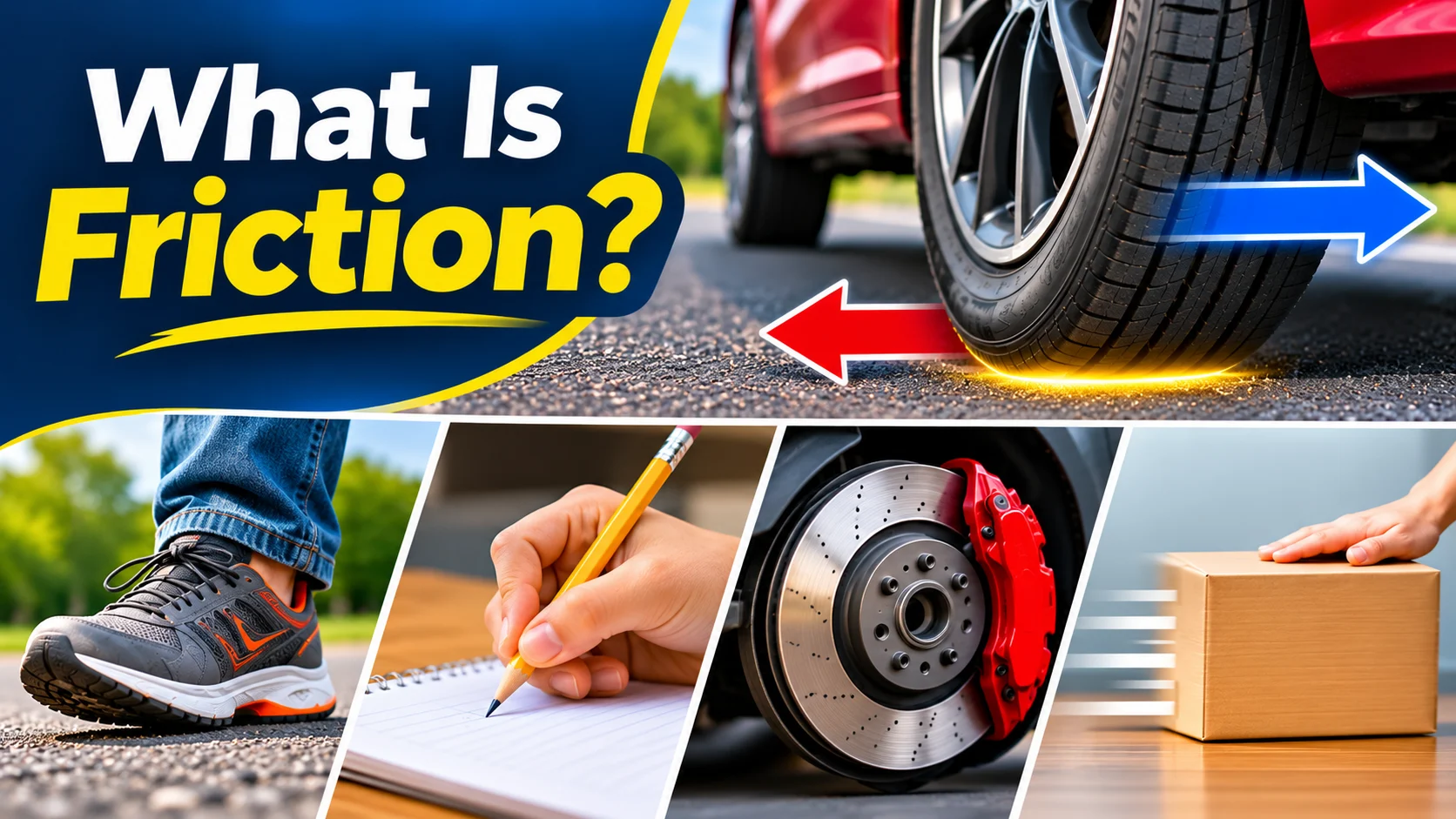
Have you ever wondered why you can walk without slipping, why a bicycle slows down when you stop pedaling, or how car brakes help a vehicle stop? These everyday activities involve a force called friction.
Friction is one of the most important forces in everyday life. It helps us grip objects, write with pencils, walk on the ground, and control vehicles. However, friction can also produce unwanted heat, cause mechanical wear, and reduce efficiency.
In this guide, you’ll learn what friction is, how it works, the main types of friction, real-life examples, and its practical applications in science, transportation, and machinery.
Quick Answer: What Is Friction?
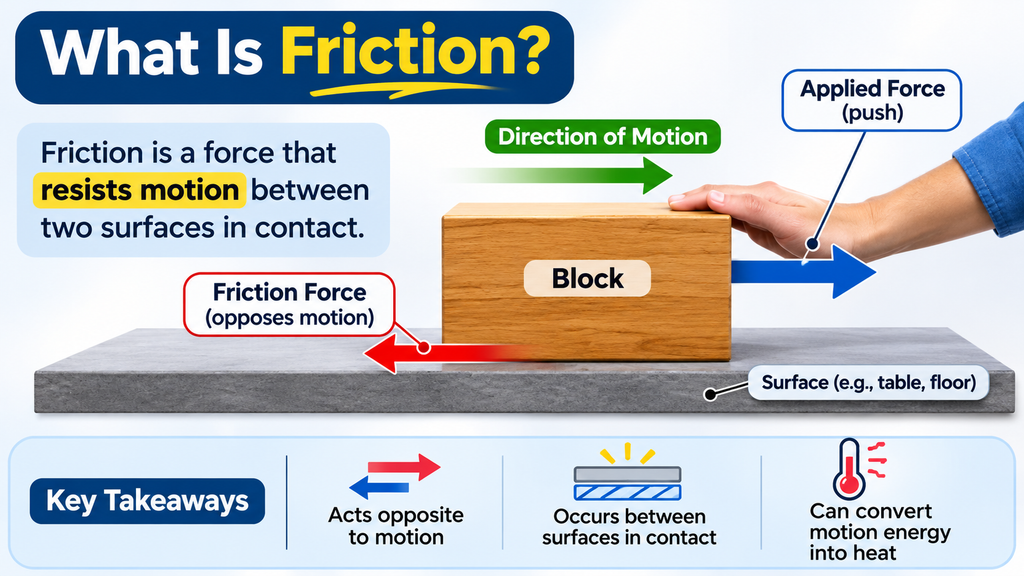
Friction is a force that resists relative motion or attempted relative motion between surfaces in contact. It acts along the contact surface and opposes the slipping, or tendency to slip, between those surfaces.
For example, friction helps your shoes grip the ground while walking and slows a book sliding across a table.
The four types commonly introduced in school science are static friction, sliding friction, rolling resistance, and fluid friction.
What Is Friction in Simple Words?
In simple words, friction is the force that makes it harder for two surfaces to slide past each other.
Imagine placing a book on a table and pushing it forward. The table exerts a frictional force on the book in the opposite direction of its sliding motion.
Because of this force, the book slows down and eventually stops unless another force continues to push it.
Key Characteristics of Friction
- It acts at the interface between contacting surfaces.
- It resists sliding or attempted sliding.
- Its magnitude depends on the materials, contact conditions, and forces involved.
- It may prevent motion or slow sliding motion.
- Sliding friction commonly converts mechanical energy into heat.
- It is essential for many everyday activities.
Friction is not always harmful. Without sufficient friction between your shoes and the ground, walking would be extremely difficult.
How Does Friction Work?
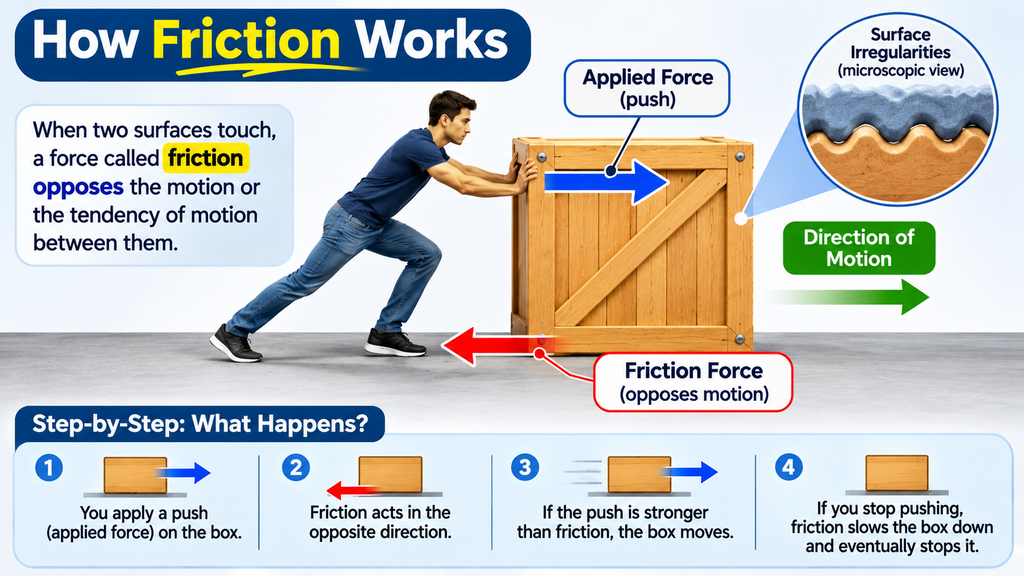
When two surfaces touch, their microscopic structures and interactions influence how easily they can move relative to each other.
Even surfaces that look perfectly smooth can have tiny irregularities. At the microscopic level, surface deformation, adhesion, and other material interactions can contribute to friction.
Consider pushing a heavy box across a floor:
- You apply a horizontal force to the box.
- Static friction initially resists the box’s tendency to slide.
- If your push exceeds the maximum available static friction, the box starts sliding.
- Sliding friction then acts against the relative motion.
- If you stop pushing, friction usually causes the box to slow down.
The direction of friction depends on the relative motion or attempted slipping at the contact, not simply the direction an object is traveling.
What Causes Friction?
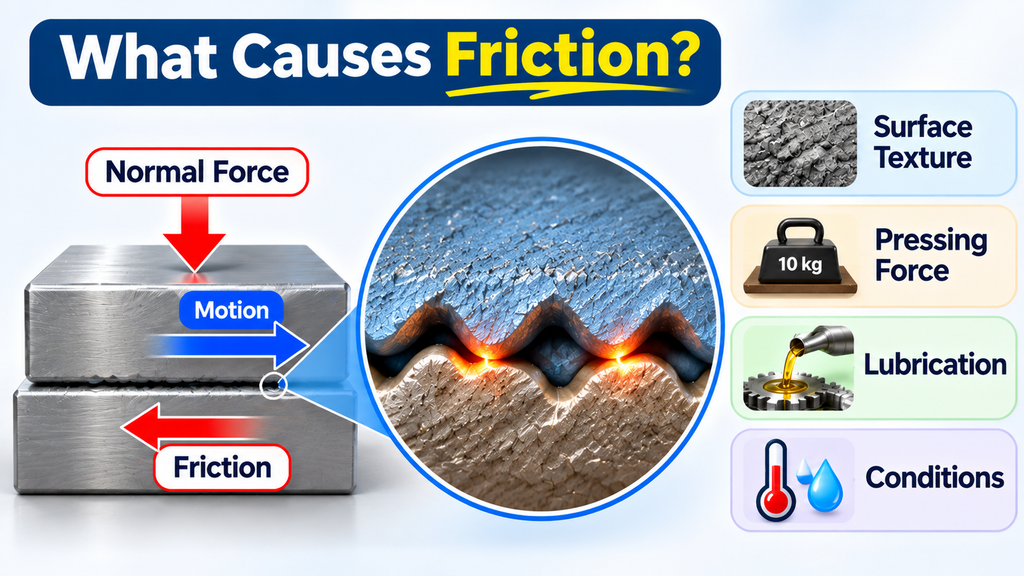
Friction results from interactions between contacting surfaces. Several factors affect how much friction develops.
Transmits Force
Combustion pressure acts on the piston crown. The connecting rod transfers that force to the crankshaft.
Compresses the Charge
As the piston moves upward during compression, it reduces the space above it, increasing pressure and temperature.
Lubrication
Oil and grease can separate moving surfaces and reduce direct contact, wear, and resistance.
Contact Conditions
Temperature, moisture, contamination, and surface wear can change frictional behavior.
Important: Rough surfaces do not always produce more friction than smooth surfaces. Friction depends on materials and conditions, not roughness alone.
What Are the Main Types of Friction?
Understanding the types of friction helps explain why some objects remain stationary, others slide, and moving vehicles experience different forms of resistance.
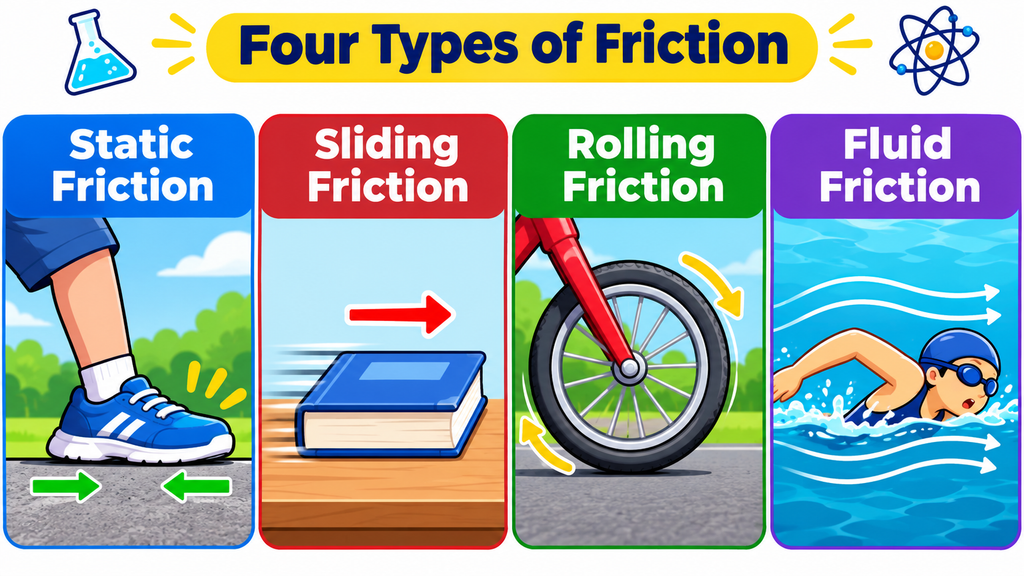
Four types are commonly discussed in introductory science lessons.
01. Static
Prevents slipping when surfaces are not sliding relative to one another.
02. Sliding
Resists motion when surfaces slide across each other.
03. Rolling
Describes resistance encountered during rolling motion.
04. Fluid
Describes resistance to motion through liquids or gases.
Rolling resistance and fluid drag involve mechanisms beyond the basic model of sliding friction between solid surfaces, but they are commonly grouped with friction in school-level science explanations.
1. Static Friction
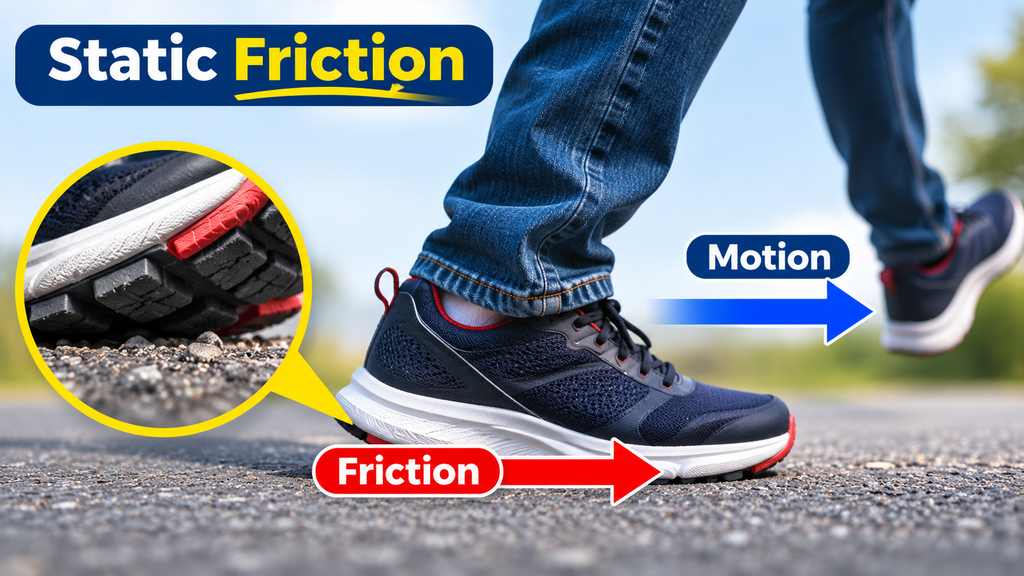
Static friction acts between contacting surfaces that are not sliding relative to each other. It resists a tendency for slipping to begin.
Imagine trying to push a heavy cabinet. If it does not move, static friction may be balancing your horizontal push.
Static friction also helps when you walk. Your foot pushes backward against the ground, and friction from the ground can act forward on your foot, helping you move.
- Walking without your shoes slipping.
- A parked vehicle remaining stationary on a gentle slope.
- A heavy box resisting a small push.
- A tire gripping the road while rolling without slipping.
Static friction can increase as needed up to a maximum value. It does not automatically act at its maximum whenever two surfaces touch.
2. Sliding Friction
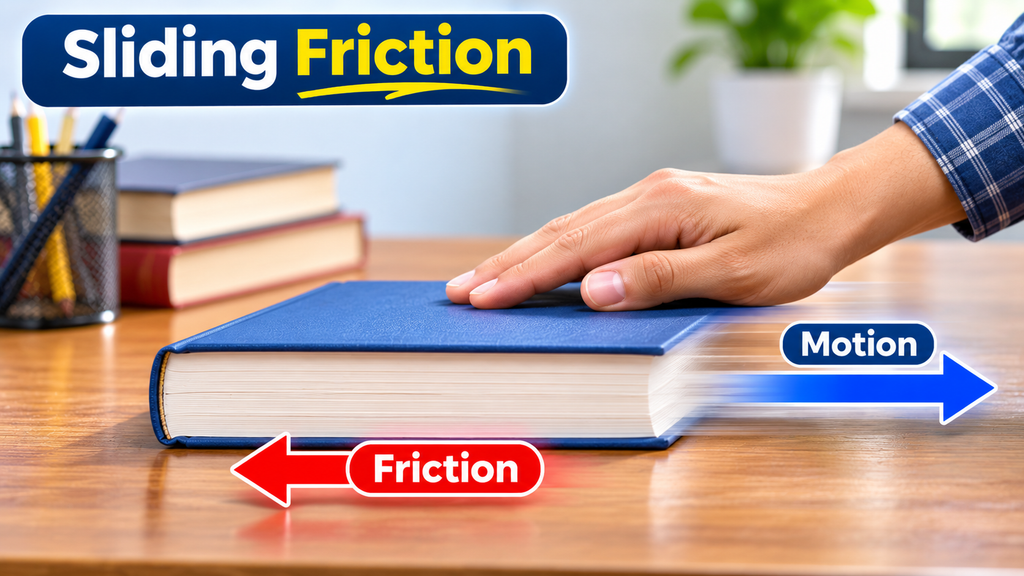
Sliding friction occurs when two solid surfaces move across each other. It is a form of kinetic friction.
When you slide a book across a desk, the frictional force on the book acts opposite its relative sliding direction.
Sliding friction can convert mechanical energy into thermal energy, causing the moving object to slow down.
Examples of Sliding Friction
- A book sliding across a wooden desk.
- A sled sliding over snow.
- An eraser rubbing against paper.
- A brake pad rubbing against a rotating brake rotor.
Sliding friction is useful in braking systems, but unwanted sliding between machinery parts can cause heat and wear.
3. Rolling Friction or Rolling Resistance
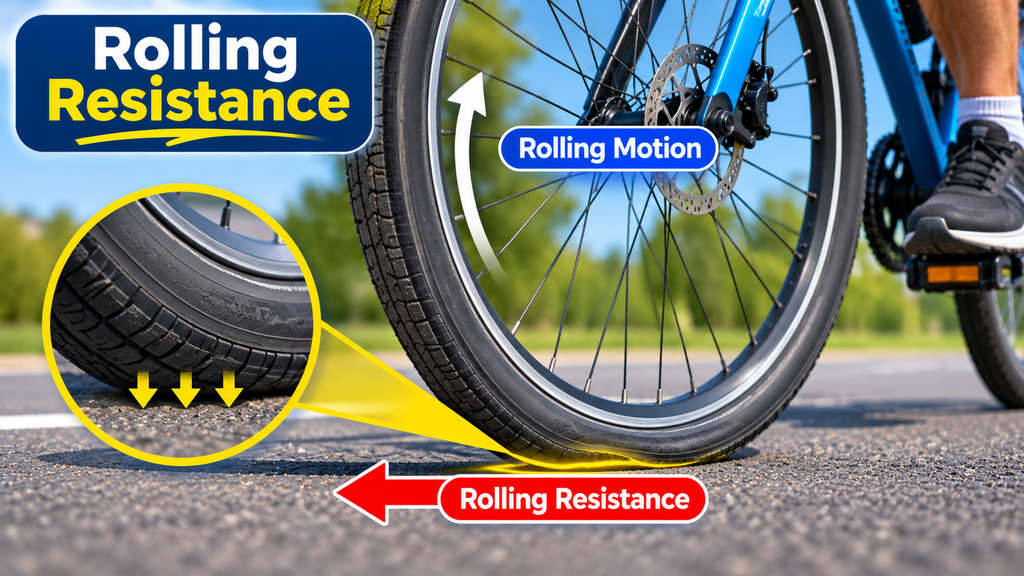
Rolling resistance is the resistance that opposes an object as it rolls across a surface.
Unlike simple sliding friction, rolling resistance often results from deformation of the wheel, tire, or surface, along with other energy losses.
A bicycle tire deforms slightly as it rolls along the road. Some energy is lost during repeated deformation.
Examples of Rolling Resistance
- A bicycle moving along a road.
- A shopping cart rolling through a store.
- A car tire rolling over pavement.
- A ball rolling across grass.
Rolling resistance is often smaller than the resistance associated with sliding the same load across a surface, which is one reason wheels are useful.
However, the friction that supplies tire grip while rolling without slipping is generally static friction at the tire-road contact.
4. Fluid Friction
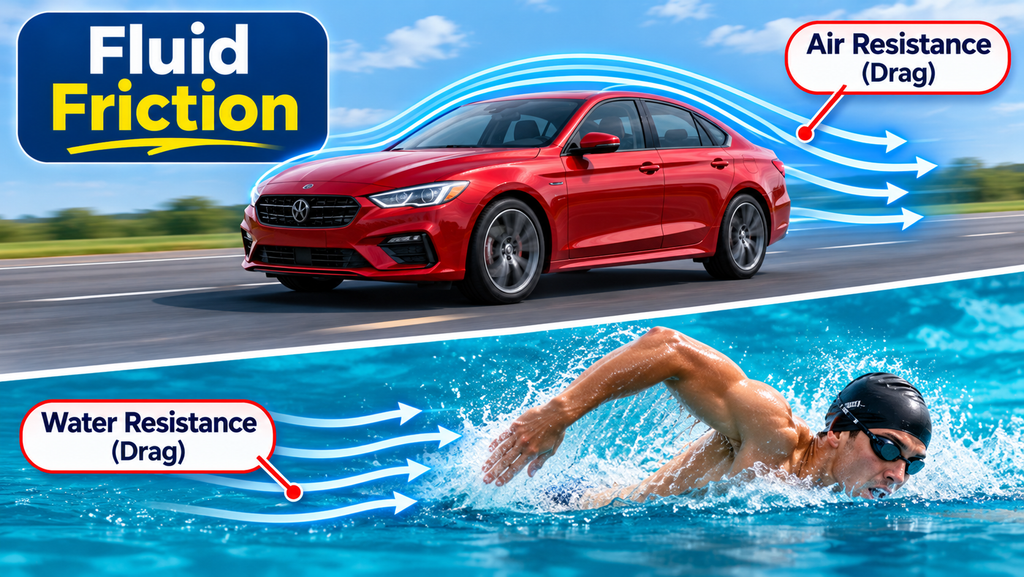
Fluid friction is resistance associated with movement through a fluid, such as air or water. It is often discussed in terms of drag.
When a car moves through the air, aerodynamic drag acts against its motion relative to the surrounding air.
Similarly, swimmers experience resistance as they move through water.
Examples of Fluid Friction
- A swimmer moving through water.
- A vehicle experiencing air resistance.
- A parachute descending through the atmosphere.
- A boat moving through water.
Fluid drag depends on factors such as speed, fluid properties, and an object’s shape. It cannot always be described using the same equations as dry surface friction.
Types of Friction: Comparison Table
The table below summarizes the differences between the four commonly taught categories.
| Type | When It Occurs | Example | Main Role |
|---|---|---|---|
| Static | No sliding at contact | Walking | Prevents slipping |
| Sliding | Surfaces slide relative to each other | Book sliding | Resists sliding |
| Rolling Resistance | An object rolls over a surface | Bicycle tire | Resists rolling |
| Fluid Drag | Object moves relative to air or liquid | Swimmer | Resists motion through fluid |
Note: Rolling resistance and fluid drag are commonly grouped with friction for educational purposes, although their physical mechanisms differ from dry sliding friction.
Examples of Friction in Everyday Life
Friction affects nearly everything we do. Some examples are easy to notice, while others occur inside machinery and transportation systems.
10 Common Examples of Friction
- Walking: Static friction helps shoes grip the ground.
- Writing with a pencil: Friction helps graphite transfer to paper.
- Erasing pencil marks: Rubbing helps remove graphite from paper.
- Car braking: Brake-pad friction converts motion energy into heat.
- Holding objects: Friction between fingers and objects helps prevent slipping.
- Sliding furniture: Sliding friction resists movement across the floor.
- Riding a bicycle: Tires use grip for steering and braking, while rolling resistance causes energy loss.
- Striking a match: Rubbing can generate heat needed for ignition.
- Swimming: Water drag resists movement through the pool.
- Moving machine parts: Contact friction can generate heat and wear.
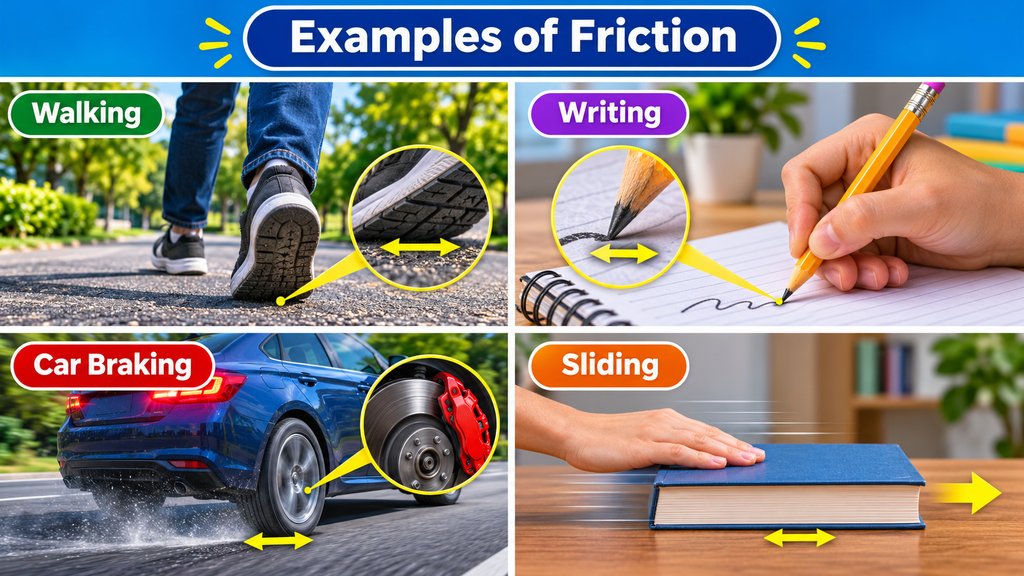
What Are Two Examples of Friction?
1. Walking on the ground: Static friction between shoes and the ground helps prevent slipping and makes walking possible.
2. Sliding a book across a table: Sliding friction acts against the book’s relative motion, causing it to slow down.
Advantages and Disadvantages of Friction
Friction can be helpful or harmful depending on the situation. Engineers often increase friction where grip matters and reduce it where friction causes unnecessary energy loss.
Advantages
- Helps people walk safely.
- Provides tire grip on roads.
- Enables friction braking.
- Helps people hold objects.
- Supports writing and erasing.
- Allows clutches to transmit torque
Disadvantages
- Can cause mechanical wear.
- May generate unwanted heat.
- Can reduce machine efficiency.
- May increase energy consumption.
- Can damage poorly lubricated parts.
- Can contribute to noise and vibration.
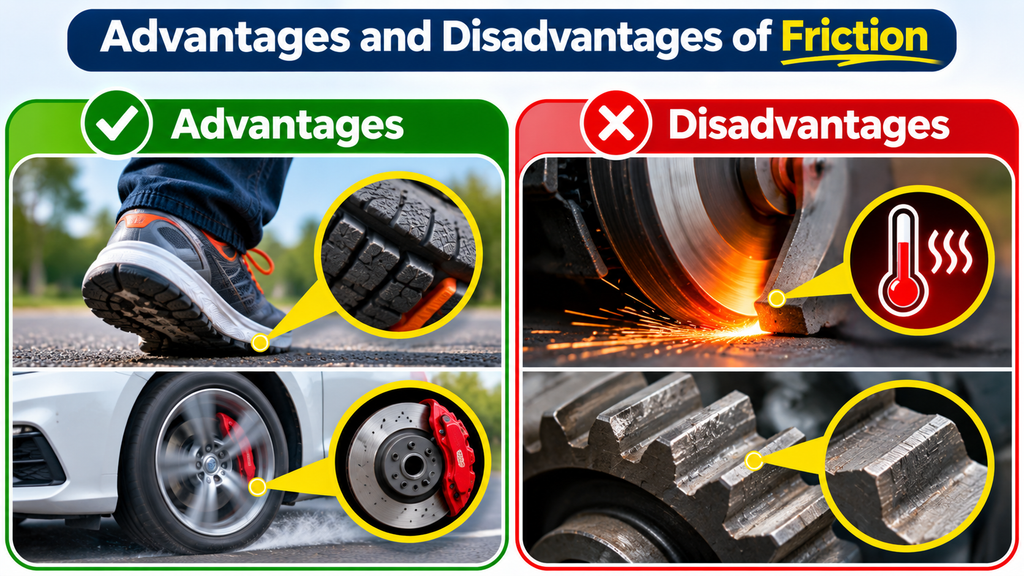
The goal is not to eliminate friction everywhere. It is to control friction according to its intended purpose.
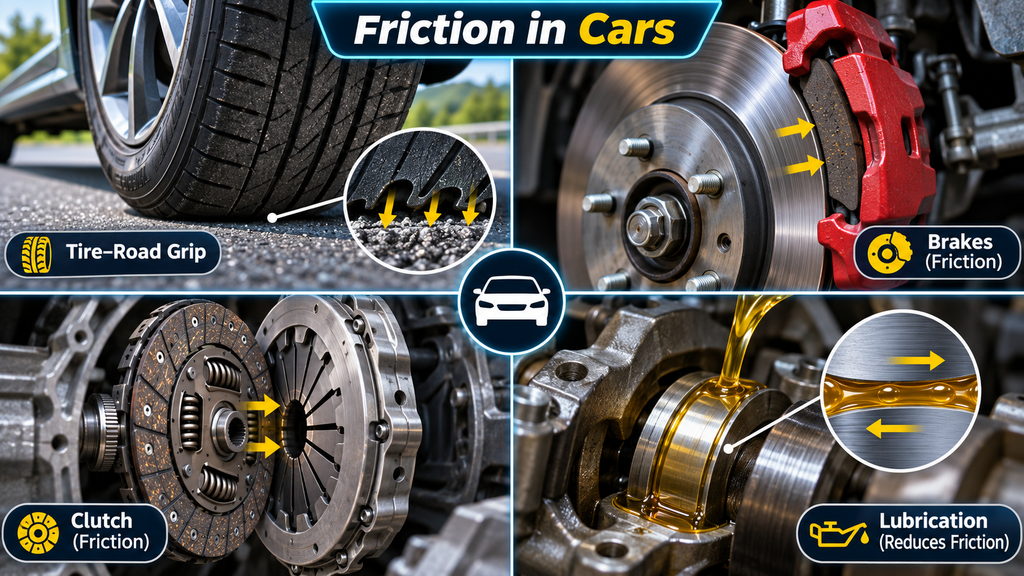
Applications of Friction in Cars and Transportation
Friction plays a major role in vehicle control, braking, acceleration, and mechanical efficiency.
1. Tire Grip
Car tires rely on friction with the road to accelerate, brake, and turn.
When a tire rolls without slipping, static friction at the contact patch allows forces to transfer between the tire and road.
Tire condition, road surface, temperature, and moisture affect available grip.
2. Brake Pads and Rotors
Most conventional friction brakes work by pressing brake pads against rotating discs or drums.
This creates friction that converts a vehicle’s kinetic energy into thermal energy.
Friction at the brake pad and rotor is different from the tire-road friction that allows braking forces to slow the vehicle.
3. Clutch Systems
In manual-transmission cars, a clutch uses friction between mating surfaces to connect and disconnect engine torque from the transmission.
A slipping clutch can generate excessive heat and wear when its friction surfaces do not maintain adequate grip.
4. Engine Bearings
Engine components contain moving parts that must operate efficiently under demanding conditions.
Suitable lubrication helps separate surfaces, control friction, and reduce wear.
5. Aerodynamic Drag
Vehicles also experience resistance from air moving around their bodies.
Manufacturers use aerodynamic design to manage drag and improve efficiency, particularly at higher speeds.
Automotive Safety Note: Tire-road grip is essential for vehicle control. Worn tires, contaminated surfaces, and wet or icy conditions can reduce available traction. Never test traction limits on public roads.
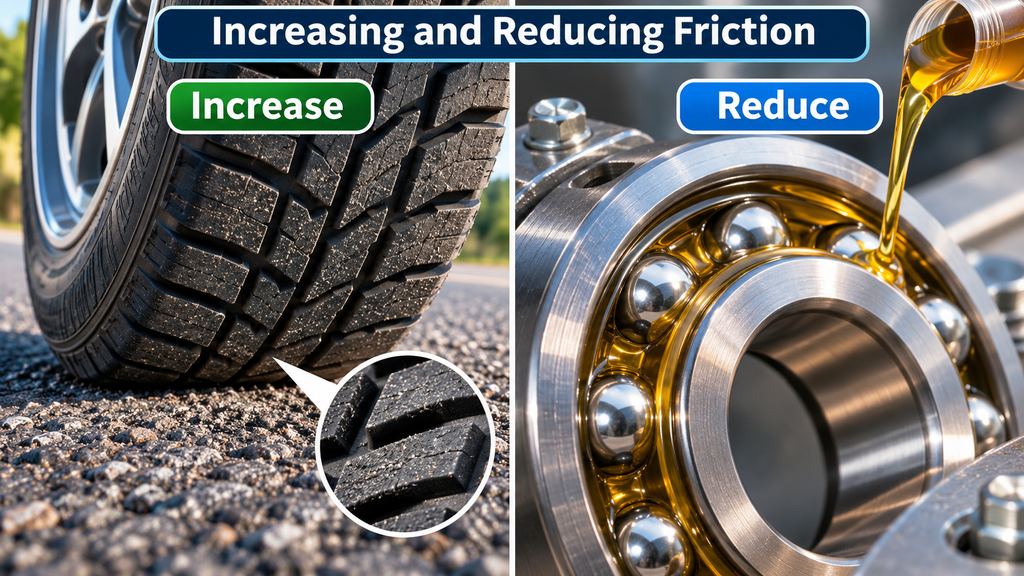
How Can We Increase or Reduce Friction?
Friction can be managed by changing materials, contact conditions, or the design of a mechanical system.
Ways to Increase Useful Friction
- Choose suitable materials: Rubber compounds and friction materials are designed for specific gripping applications.
- Maintain contact surfaces: Clean, dry surfaces can provide better grip in many everyday situations.
- Maintain tire condition: Correct tire condition is essential for road traction.
- Use suitable footwear: Shoes designed for an environment can reduce slipping.
- Increase normal force where appropriate: In simple dry-friction models, pressing surfaces together more strongly increases their maximum available friction.
Ways to Reduce Unwanted Friction
- Lubrication: Oil and grease can reduce surface contact and wear in appropriate mechanisms.
- Bearings: Rolling-element bearings often reduce resistance in rotating machinery.
- Surface finishes: Appropriate engineering finishes improve mechanical contact behavior.
- Material selection: Some material combinations are chosen specifically for low-friction applications.
- Proper alignment: Correct alignment prevents unnecessary rubbing and wear.
Whether friction should be increased or reduced depends on the application. Brakes require reliable friction, while engine bearings are designed to minimize unwanted contact.
How Is Friction Calculated?
In introductory physics, simplified dry-friction models relate friction force to the normal force between contacting surfaces.
KINETIC FRICTION MODEL
fk ≈ μkN
Friction force ≈ Kinetic friction coefficient × Normal force
For static friction, the force adjusts up to a maximum value:
|fs| ≤ μsN
In these expressions:
- fk: Magnitude of kinetic friction.
- fs: Magnitude of static friction.
- μk: Coefficient of kinetic friction.
- μs: Coefficient of static friction.
- N: Normal force between surfaces.
Simple Calculation Example
Suppose a box experiences a normal force of 100 newtons and has a coefficient of kinetic friction of 0.30.
fk ≈ 0.30 × 100 = 30 N
The model predicts a sliding friction force of approximately 30 newtons.
These equations are simplified models. Real friction can also depend on materials, temperature, speed, lubrication, and surface conditions.
Simple Friction Experiments for Students
These classroom experiments help students understand static, sliding, and rolling friction using everyday materials.
Experiment 1: Sliding on Different Surfaces
Materials: A small wooden block, a smooth desk, a textured mat, and an optional spring scale.
- Place the block on a smooth desk.
- Pull it gently and observe how easily it moves.
- Repeat using a textured mat beneath the block.
- Compare the resistance on each surface.
What you learn: Material and contact conditions influence friction.
Experiment 2: Rolling vs. Sliding
Materials: A small load, a toy cart or wheeled platform, and a flat surface.
- Move the load across a flat surface without wheels.
- Place the same load on the wheeled platform.
- Move it again under similar conditions.
- Compare the force or effort required.
What you learn: Wheels often make transportation easier because rolling resistance can be smaller than sliding resistance.
Experiment 3: Static Friction on an Inclined Surface
Materials: A book or board, a small block, and a stable work area.
- Place the block on the horizontal board.
- Raise one end of the board gradually.
- Observe when the block first starts sliding.
- Repeat using another suitable surface material.
What you learn: Static friction prevents slipping up to a limit.
Safety: Use stable tables and lightweight objects. Keep fingers clear of moving loads and avoid experiments involving moving cars, hot surfaces, or powered machinery.
Common Misconceptions About Friction
| Misconception | Correct Understanding |
|---|---|
| Friction always slows an object. | Static friction can also help accelerate objects, such as a person walking. |
| Rougher surfaces always create more friction. | Material interactions and conditions matter, not roughness alone. |
| Static friction always acts at maximum strength. | Static friction adjusts up to a limiting value. |
| All friction is harmful. | Many activities require friction, including braking and gripping. |
Frequently Asked Questions About Friction
Friction is a force that resists sliding or attempted sliding between two surfaces in contact. For example, friction helps your shoes grip the ground while walking and slows a book sliding across a table.
2. What are the main types of friction?
The four types commonly taught in basic science are:
- Static friction: Prevents surfaces from slipping.
- Sliding friction: Resists movement when two surfaces slide against each other.
- Rolling resistance: Opposes the rolling motion of wheels, balls, and other objects.
- Fluid friction: Resists movement through liquids or gases, such as water and air.
3. What are two examples of friction?
Two everyday examples of friction are walking and sliding a book across a table. Static friction between shoes and the ground helps prevent slipping, while sliding friction slows a book moving across a desk.
4. What is the difference between static and sliding friction?
Static friction acts when two contacting surfaces are not sliding relative to each other. Sliding friction occurs when those surfaces move across one another. Static friction can prevent motion from starting, while sliding friction resists ongoing sliding.
5. Is friction a contact force?
Yes. Friction is classified as a contact force because it results from interactions between contacting surfaces. Fluid friction, or drag, occurs when an object moves relative to a surrounding liquid or gas.
6. Why is friction important in everyday life?
Friction makes many everyday activities possible, including walking, writing, holding objects, and braking vehicles. Without sufficient friction, people would struggle to maintain grip, and vehicles would have difficulty accelerating, turning, or stopping safely.
7. Is friction always harmful?
No. Friction can be helpful or harmful depending on the situation. It provides grip for walking and braking, but unwanted friction in machinery can generate heat, increase wear, and reduce energy efficiency.
8. How can friction be reduced?
Friction can be reduced by using appropriate lubricants, bearings, suitable materials, properly finished surfaces, and correct mechanical alignment. The best method depends on the surfaces and application.
9. How does friction help cars stop?
Friction helps cars stop in two important ways. Brake pads rub against brake rotors to convert kinetic energy into heat. At the same time, friction between the tires and road allows braking forces to slow the vehicle.
10. What factors affect friction?
Friction depends on several factors, including the materials in contact, the normal force pressing them together, surface conditions, lubrication, temperature, moisture, and contamination. Different combinations of materials can produce significantly different friction levels.
11. What is the difference between friction and air resistance?
Friction usually refers to resistance between contacting surfaces, while air resistance is a form of fluid drag caused by an object moving relative to air. Both can oppose relative motion, but they arise through different physical mechanisms.
12. Can friction produce heat?
Yes. Sliding friction can convert mechanical energy into thermal energy. For example, rubbing your hands together makes them warmer, and brake pads generate heat when slowing a moving vehicle.
13. Which type of friction is used when walking?
Walking normally relies on static friction between your shoes and the ground. When your foot pushes backward against the ground, static friction can act forward on your foot, helping you move without slipping.
14. What is the formula for friction?
For a simplified dry-friction model, kinetic friction is calculated using:
\[ f_k \approx \mu_k N \]
Where \(f_k\) is kinetic friction, \(\mu_k\) is the coefficient of kinetic friction, and \(N\) is the normal force.
Static friction follows a related relationship, but its actual value adjusts up to a maximum:
\[ |f_s| \leq \mu_s N \]
15. What are the applications of friction?
Friction has many practical applications, including vehicle braking, tire traction, writing, walking, gripping tools, clutch operation, belt drives, and industrial manufacturing. Engineers control friction to improve safety, performance, and mechanical efficiency.
Final Thoughts
Friction is an essential force affecting movement, grip, safety, and mechanical efficiency. It can prevent slipping, slow sliding objects, and help machines transmit forces.
The four commonly taught categories are static friction, sliding friction, rolling resistance, and fluid friction. Each explains a different aspect of how objects interact with surfaces or move through fluids.
From walking and writing to tire traction and vehicle braking, understanding friction helps explain how many everyday activities and modern technologies work.