You order an aftermarket bracket, adapter, or wheel spacer that’s supposed to fit your car. The part number matches, and everything looks right until you try to install it.
One bolt lines up, but another hole is slightly off. The mounting surface doesn’t sit flush, and you find yourself tightening the bolts just to pull the part into position.
Or maybe it installs without much trouble, only to develop rattling, vibration, or unusual wear a few months later.
It’s easy to blame cheap aftermarket parts. But sometimes the real issue isn’t one incorrect measurement. It’s how multiple holes, mounting surfaces, and locating features line up with one another.
Why Aftermarket Parts Don’t Always Fit
Most aftermarket components rely on several mounting points working together.
Take a custom suspension bracket. It may have multiple bolt holes, a flat mounting surface, and a locating feature that must align with another component.
Each part has its own manufacturing tolerances. The vehicle’s mounting points have tolerances, too.
Even when individual dimensions meet their specifications, small variations can add up across an assembly. Engineers call this tolerance stack-up.
The result? A bracket that looks correct on paper but doesn’t quite line up during installation.
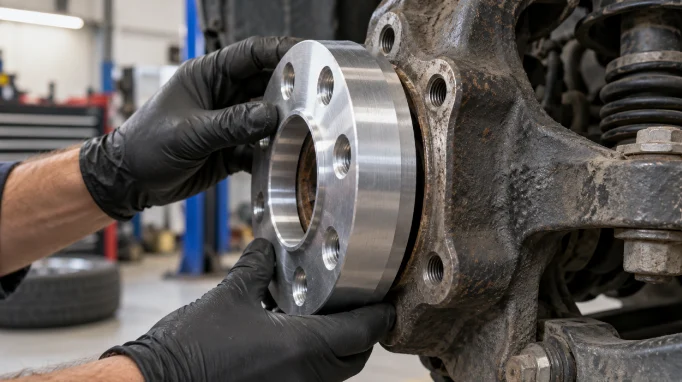
Wheel spacers are another example. If rust, debris, incorrect dimensions, or poor centering prevent a spacer from sitting properly against the hub, tightening the fasteners won’t necessarily fix the problem.
Just because the bolts go in doesn’t mean the part fits correctly.
The important question is whether the mounting surfaces, holes, and locating features work together as intended.
How Manufacturing Accuracy Affects Fitment
Not every dimension on a custom automotive part needs an extremely tight tolerance.
What matters most are the features that control how the part fits and functions.
These often include bolt-hole locations, mounting surface flatness, bearing bores, and the angles between critical surfaces.
A decorative edge doesn’t need the same precision as a bearing housing or mounting hole. Applying tight tolerances everywhere only increases manufacturing costs.
The bigger challenge comes when critical features are located on different sides of a complex component.
With conventional three-axis machining, the workpiece may need to be repositioned several times to access those features. Each additional setup introduces another opportunity for positioning error.
For complex automotive brackets, adapters, and housings, 5 Axis CNC Machining Services can help reduce those setup changes by allowing the cutting tool to approach the workpiece from multiple directions.
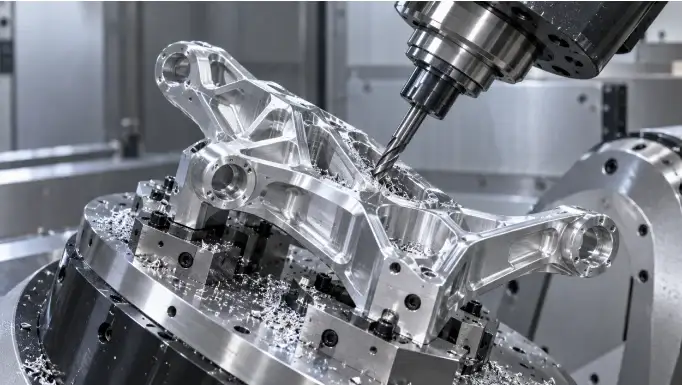
This makes it easier to maintain consistent relationships between mounting holes, angled surfaces, and other critical features, provided the machining process is properly controlled.
That doesn’t mean every part needs five-axis machining. Simple brackets, spacers, and shafts can often be produced accurately and more economically using three-axis milling or CNC turning.
The right machining process depends on the part’s geometry, not how advanced the machine sounds.
Why Some Aftermarket Parts Fail Prematurely
Some fitment problems become obvious during installation. Others take months to show up.
A mounting surface that doesn’t seat properly can create uneven loading. Under repeated vibration, this may contribute to movement, loosening, or wear.
A misaligned bearing housing can place additional loads on the bearing, leading to noise, friction, and premature wear.
And forcing a poorly fitting bracket into position may introduce stresses the original design never intended.
But machining accuracy isn’t the only factor.
Poor material selection, inadequate heat treatment, sharp internal corners, corrosion, and loads beyond the component’s design limits can also cause early failure.
Even a perfectly machined part can fail if the material or design isn’t suitable for its intended application.
That’s why reliable aftermarket components require the right combination of design, materials, manufacturing accuracy, and installation.
Which Automotive Parts Benefit From Precision Machining?
Some aftermarket components are more sensitive to dimensional errors than others.
For example:
- Suspension brackets and steering uprights: Multiple mounting points must maintain accurate positional relationships.
- Brake caliper adapters: Mounting features must support proper alignment with the intended brake assembly.
- Transmission and motor housings: Mating surfaces and bearing bores require controlled dimensions and alignment.
- Custom motorsport components: Complex geometries and demanding operating conditions often require careful machining and inspection.
These parts don’t automatically require five-axis machining. However, complex designs with critical features on several faces can benefit from fewer setups and better access during manufacturing.
How to Avoid Aftermarket Fitment Problems
Before installing a custom or aftermarket component, a few basic checks can prevent expensive mistakes.
1. Confirm exact vehicle compatibility. Check the model year, trim, drivetrain, and relevant factory options. Parts that look identical may have different mounting requirements.
2. Inspect mounting surfaces. Rust, dirt, burrs, or damaged surfaces can prevent proper seating even when the replacement part is dimensionally correct.
3. Check alignment before tightening. Mounting holes should line up as specified without forcing the component into position. If something doesn’t fit, investigate rather than using bolt tension to pull it into place.
4. Ask about manufacturing inspection. For custom machined parts, dimensional reports can help verify critical hole locations, bearing bores, and mounting surfaces.
5. Avoid modifying safety-critical parts to make them fit. Drilling, grinding, or forcing steering, suspension, brake, or wheel-related components into place can create serious safety risks. Consult the manufacturer or a qualified technician when fitment is uncertain.
For one-off custom parts, testing a prototype before ordering a larger batch can also help uncover compatibility issues early.
Final Thoughts
When aftermarket parts don’t fit or wear out too quickly, the problem isn’t always one incorrect dimension.
Sometimes it’s the relationship between several critical features. Other times, the issue comes down to materials, design, compatibility, or installation.
Understanding those differences helps you choose better components and avoid unnecessary repairs.
A properly designed and manufactured part should fit as intended, without being forced into place.