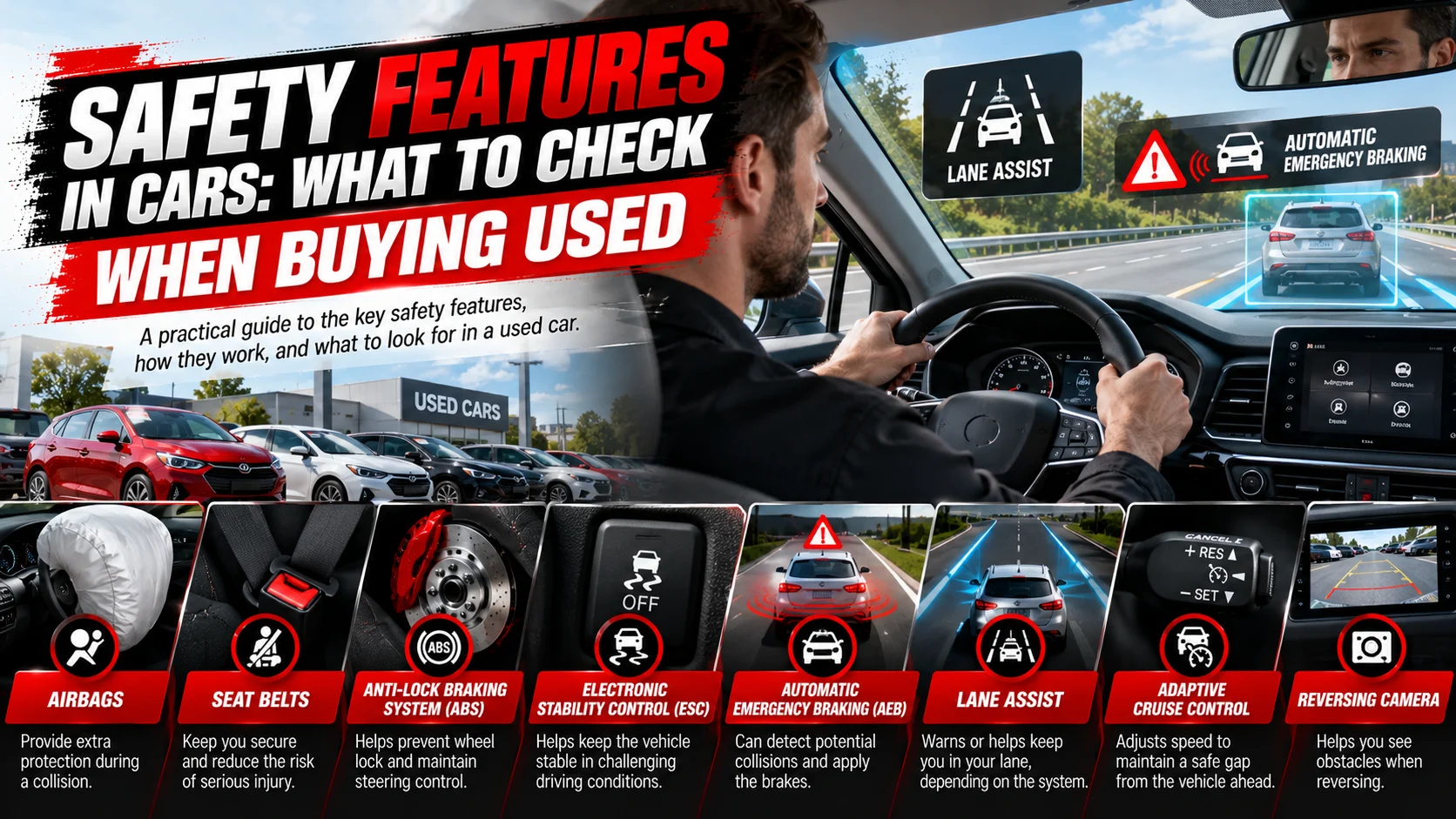
“Lane assist” in an advert could mean a warning, corrective steering or a broader package of functions. The name alone tells you little about how the system behaves.
For a used-car buyer, the useful comparison is between the equipment fitted to individual vehicles, not the length of their feature lists.
Establish what is fitted
Used cars on finance can share a model name yet have different safety equipment. A feature might be standard on one trim, optional on another or introduced later in production, so check the year, trim and options of each vehicle on your shortlist.
Start with the seller’s specification and ask for supporting information tied to that car. Manufacturer or dealer confirmation of its original equipment can help clarify optional features. A brochure shows what was available across a range, rather than what a particular car received.
The handbook serves a different purpose: explaining operation. It may cover several versions and describe features as “if equipped”, so use it alongside the vehicle-specific specification.
Keep crash protection in view
Passive safety is protection designed to reduce injury during a collision. Its foundations include seat belts, airbags and the vehicle’s structure.
Seat belts restrain occupants, airbags provide supplementary protection, and crumple zones absorb energy through controlled deformation during an impact. Airbags work alongside correctly worn seat belts, rather than replacing them.
Head restraints also deserve attention. During a viewing, check that the seat and restraint adjust to suit your height.
Understand braking and driver assistance
Active safety helps prevent collisions or reduce their severity. Anti-lock braking, electronic stability control and autonomous emergency braking perform different jobs.
Anti-lock braking, usually called ABS, helps prevent wheels locking under braking and helps preserve steering control. Electronic stability control, or ESC, can brake individual wheels to help correct a loss of stability. Both operate within the available tyre grip.
Autonomous emergency braking, or AEB, monitors for potential collisions and can apply the brakes automatically. Forward collision warning alerts the driver; automatic braking is a separate capability. Check which obstacles the particular AEB system can detect, including whether pedestrian or cyclist detection is fitted.
The distinction between warning and intervention applies to lane support too. Lane-departure warning alerts you to an unintended departure from your lane. Lane-keeping assistance can provide corrective steering within its operating limits.
Adaptive cruise control adjusts speed to help maintain a selected gap from traffic ahead. It remains driver assistance, not autonomous driving. A reversing camera similarly supplements observation around the vehicle.
Capabilities and operating conditions vary. Poor visibility, obscured sensors or unclear road markings can affect relevant functions; consult the handbook for the restrictions that apply to that car. You remain responsible for steering, braking and observation, including when assistance is active.
Put safety ratings in context
Look up the model’s full assessment on the Euro NCAP website, paying attention to the test date and equipment covered as well as the stars.
Assessment criteria develop over time, so matching star counts from different testing years are not automatically equivalent. Some models also have separate ratings for standard equipment and an optional safety pack. Match the assessment to the specification you are considering.
The rating describes the assessed specification. The present condition of an individual used car needs separate consideration.
Use the viewing to resolve questions
Ask the seller to explain the assistance menus, controls and symbols while the car is parked. Check that you can read the instruments and see the road clearly from your adjusted driving position.
Use a normal test drive to assess usability. Never deliberately approach an obstacle or drift out of a lane to discover whether an intervention works.
Before deciding, establish:
- Which safety features are fitted to the vehicle.
- Where their operating instructions and limitations are explained.
- Whether any warnings or reported faults remain unresolved.
A dashboard free of warnings offers only part of the picture, not confirmation that every system functions correctly. If a warning appears, ask for an explanation and appropriate investigation by a qualified technician before proceeding, rather than accepting an assumption that it is a harmless sensor issue.