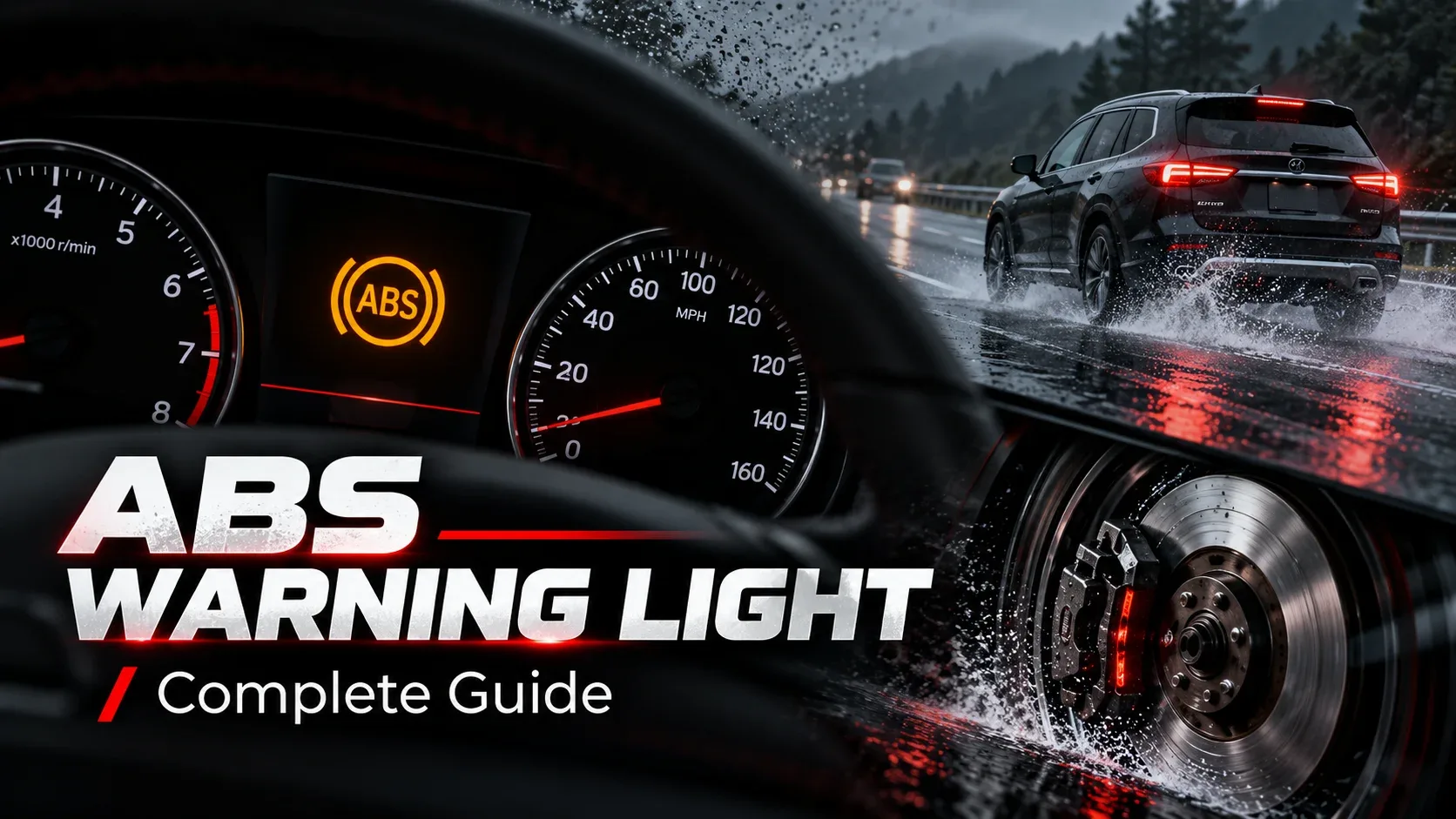
You’re driving to work on a rainy morning when an amber ABS warning light suddenly appears on your dashboard. Your car still seems to brake normally, but the warning refuses to disappear.
Is it safe to continue driving? Are your brakes about to fail? And could this warning result in an expensive repair?
These are exactly the questions Daniel Mitchell asks when the ABS light illuminates in his SUV during his morning commute.
He pulls into a safe parking area, checks his dashboard, and searches for anti lock ABS light to understand what happened.
Like many drivers, Daniel knows ABS has something to do with braking, but he doesn’t know what the warning means or how urgently it needs attention.
This guide explains what the anti-lock braking system does, why the warning appears, how to distinguish routine warning behavior from potentially dangerous brake problems, and what diagnosis and repair may involve.
You’ll also learn how to avoid replacing expensive ABS components before confirming the actual fault.
What Does the Anti Lock ABS Light Mean?
An illuminated anti lock ABS light usually means the vehicle has detected a problem with its anti-lock braking system.
The anti-lock function may be limited or unavailable, even though conventional braking can continue to operate in some vehicles.
ABS helps prevent wheel lockup during hard braking, helping the driver maintain steering control in many emergency situations.
If ABS is unavailable, wheels may lock during severe braking, particularly on wet or slippery roads.
An amber ABS warning alone does not always mean complete brake failure. However, if a red brake warning is also illuminated, braking performance changes, the pedal feels abnormal, or brake fluid is leaking, stop safely and seek professional assistance. Do not continue driving with impaired brakes.
Understanding the ABS Warning Light on Your Dashboard
When Daniel starts his SUV, several warning lights briefly illuminate during the vehicle’s normal instrument-cluster self-check.
Most turn off after the vehicle completes its initial checks.
However, when the ABS warning stays illuminated after startup or appears while driving, the braking-system controller may have detected a malfunction.
What Does the ABS Symbol Look Like?
In many vehicles, the ABS warning appears as the letters ABS inside a circle, sometimes with curved brackets on either side.
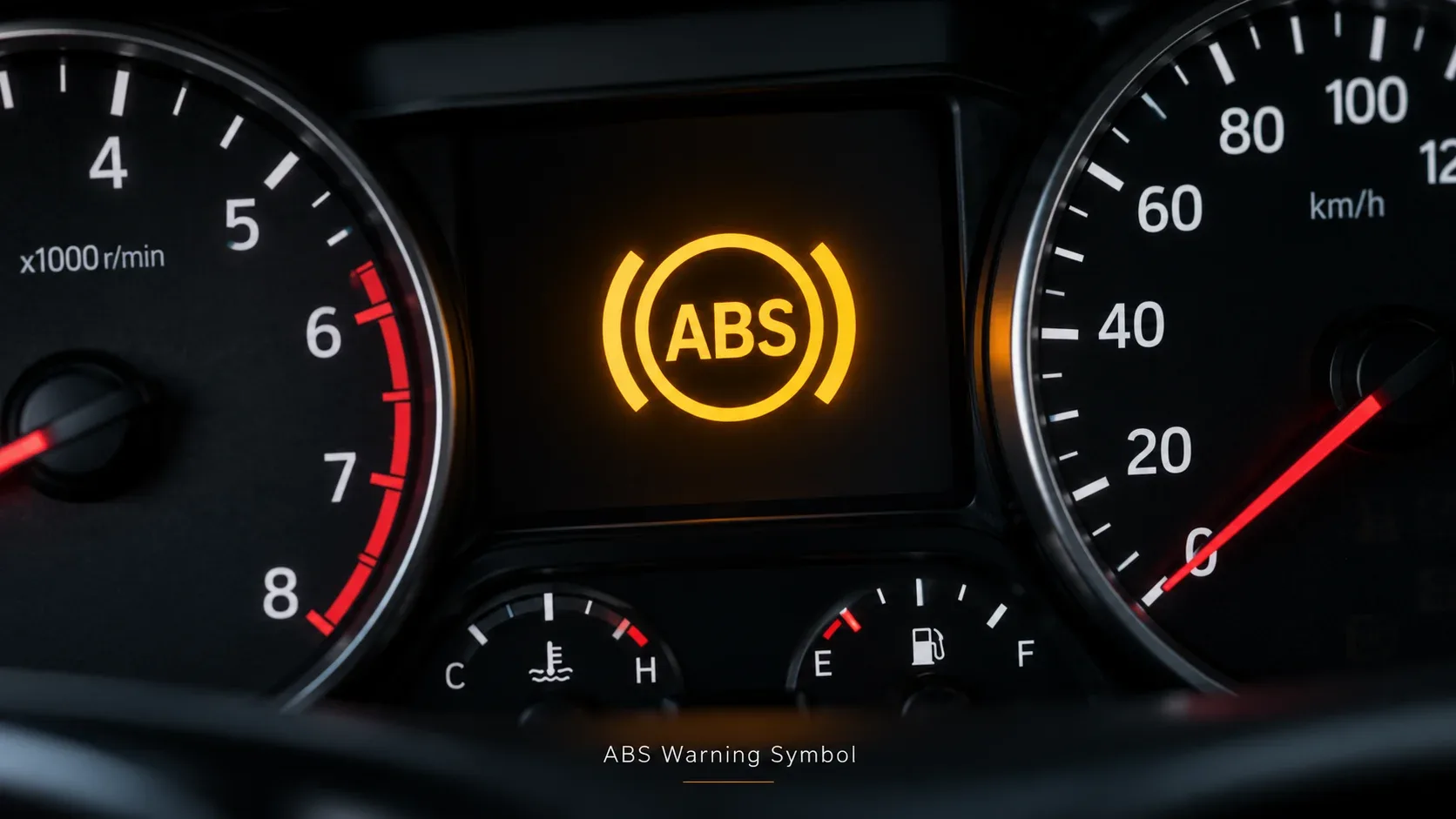
The exact appearance varies by manufacturer. Some vehicles display messages such as “ABS Malfunction,” “Check ABS,” or “Service Anti-Lock Brake System.”
The warning identifies a detected system issue, not necessarily the specific component responsible.
Why Does the ABS Light Turn On Briefly at Startup?
A brief warning light during startup is normally part of the vehicle’s electrical and system self-check.
What matters is whether the warning turns off as expected.
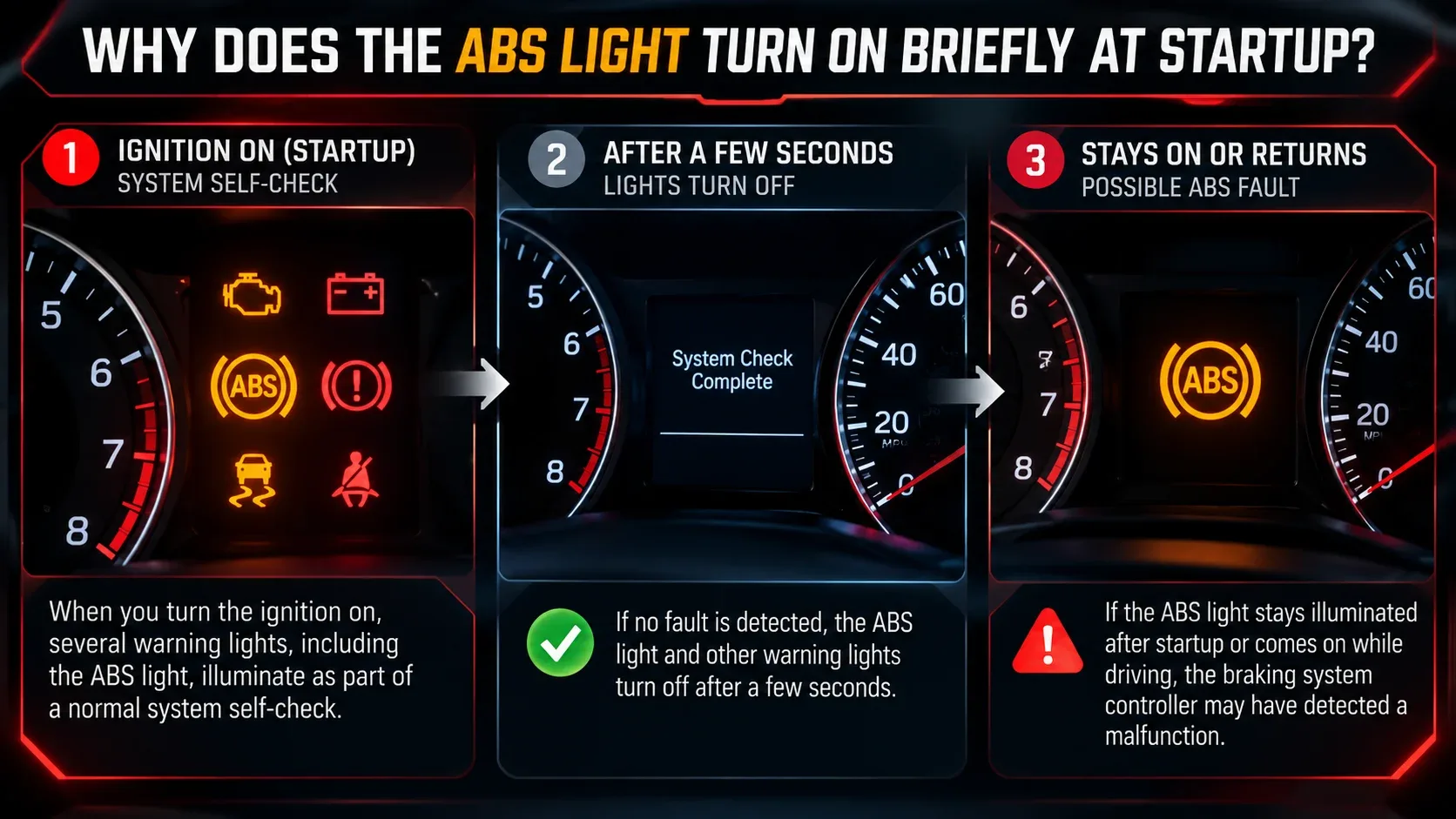
If the warning remains illuminated or returns while driving, consult the owner’s manual and arrange appropriate diagnosis.
What Is an Anti-Lock Braking System (ABS)?
The anti-lock braking system is an automotive safety system designed to help prevent wheels from locking during hard braking.
When wheels lock and slide across the road, steering control can be reduced.
ABS monitors wheel-speed information and automatically adjusts brake pressure when it detects conditions associated with impending wheel lock.
This is particularly useful during emergency braking, although performance depends on the vehicle, tires, road surface and conditions.
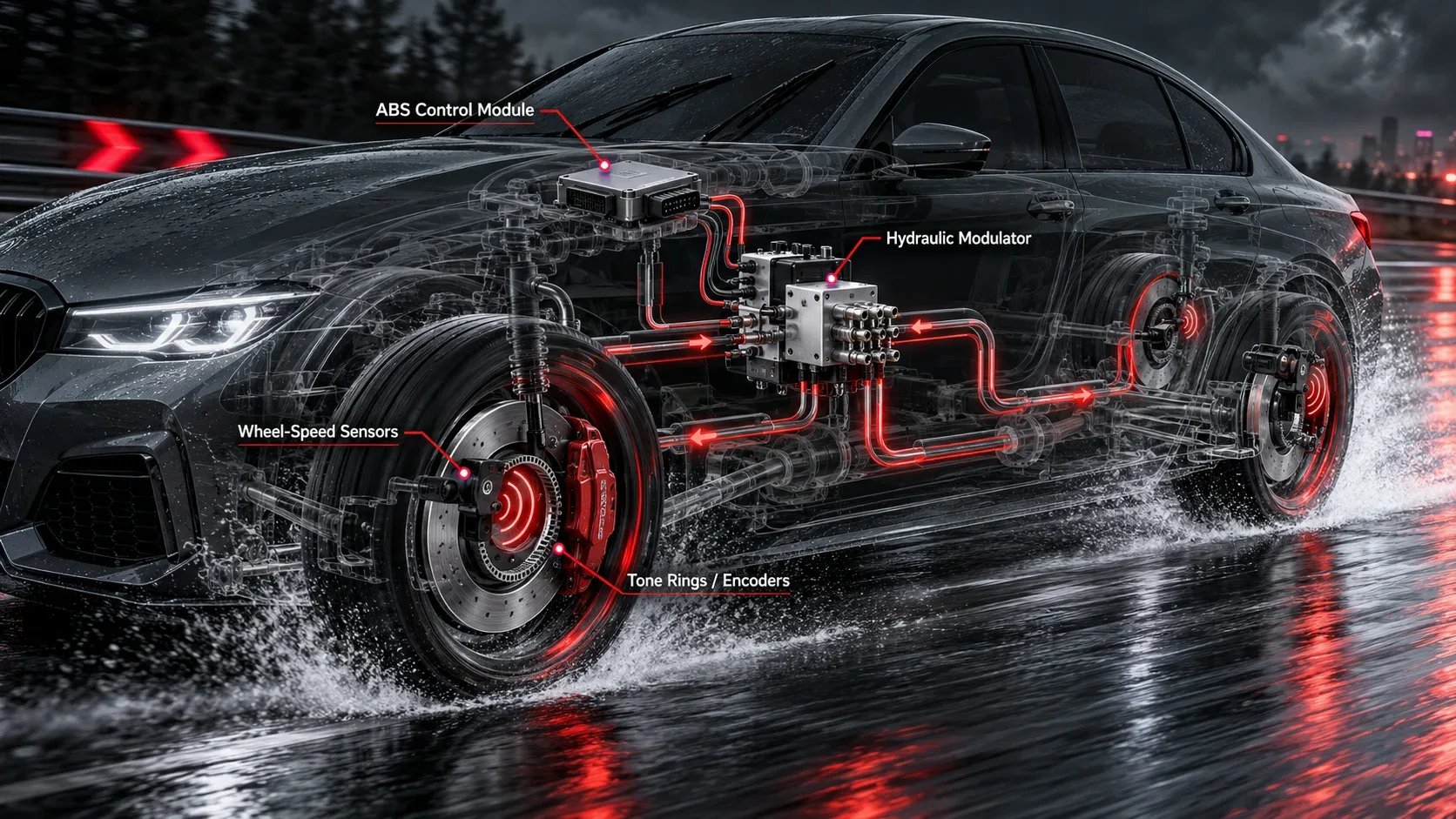
Main Components of an ABS System
Monitor wheel rotation and provide signals to the controller.
Analyzes sensor information and controls anti-lock braking functions.
Uses valves and, where applicable, a pump to regulate brake pressure.
Provide wheel-speed information detectable by compatible sensors.
These components work together. A wheel-speed signal problem can also affect traction or stability systems that rely on the same information.
How Does ABS Work During Emergency Braking?
Imagine Daniel suddenly encounters stopped traffic on a wet road.
He presses the brake pedal firmly. Without functioning ABS, sufficiently hard braking may cause wheels to lock.
With properly operating ABS, the controller monitors changes in wheel speed and modulates hydraulic pressure when wheel lock is about to occur.
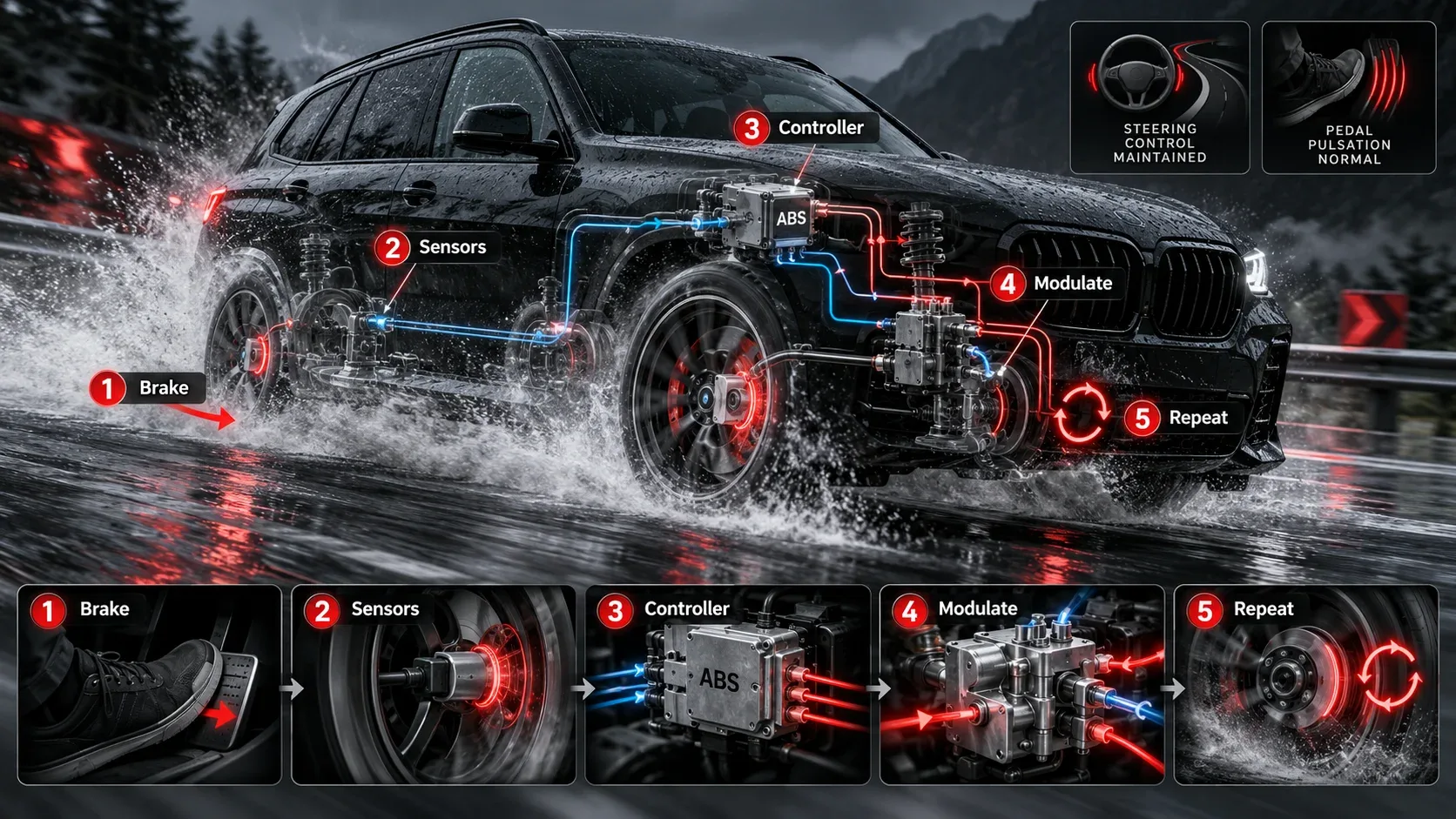
What Happens in Sequence?
- The driver applies strong braking pressure.
- Wheel-speed sensors transmit information to the ABS controller.
- The controller detects wheel deceleration suggesting impending lockup.
- The hydraulic system adjusts pressure at affected wheels.
- The controller continues monitoring and adjusting pressure as needed.
These pressure adjustments happen repeatedly and quickly. During ABS activation, the driver may feel brake-pedal pulsation or hear mechanical noises.
Those sensations can be normal during an ABS-controlled stop.
ABS does not guarantee shorter stopping distances on every road surface. On loose gravel, deep snow or certain other surfaces, stopping distance can differ. ABS primarily helps preserve steering control during hard braking.
Why Is My Anti Lock ABS Light On?
Daniel wants to know whether the warning means his SUV has a failed ABS module.
That is possible, but numerous other issues can illuminate the light. Understanding the possible causes helps you avoid assuming the most expensive component has failed.
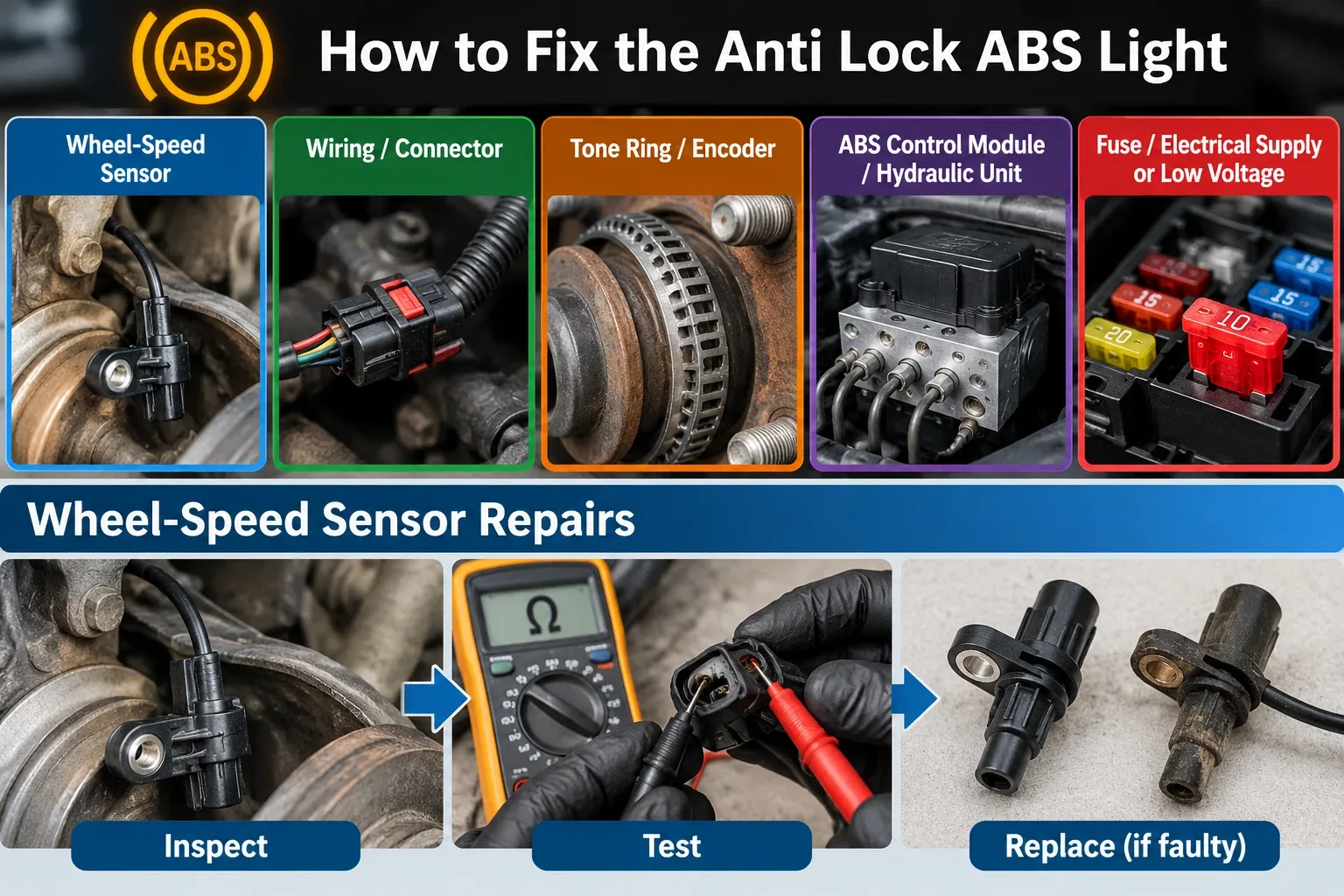
Faulty Wheel-Speed Sensor
Wheel-speed sensors provide essential information to the ABS controller. If a sensor fails or sends an unreliable signal, the controller may disable certain functions and illuminate the warning light.
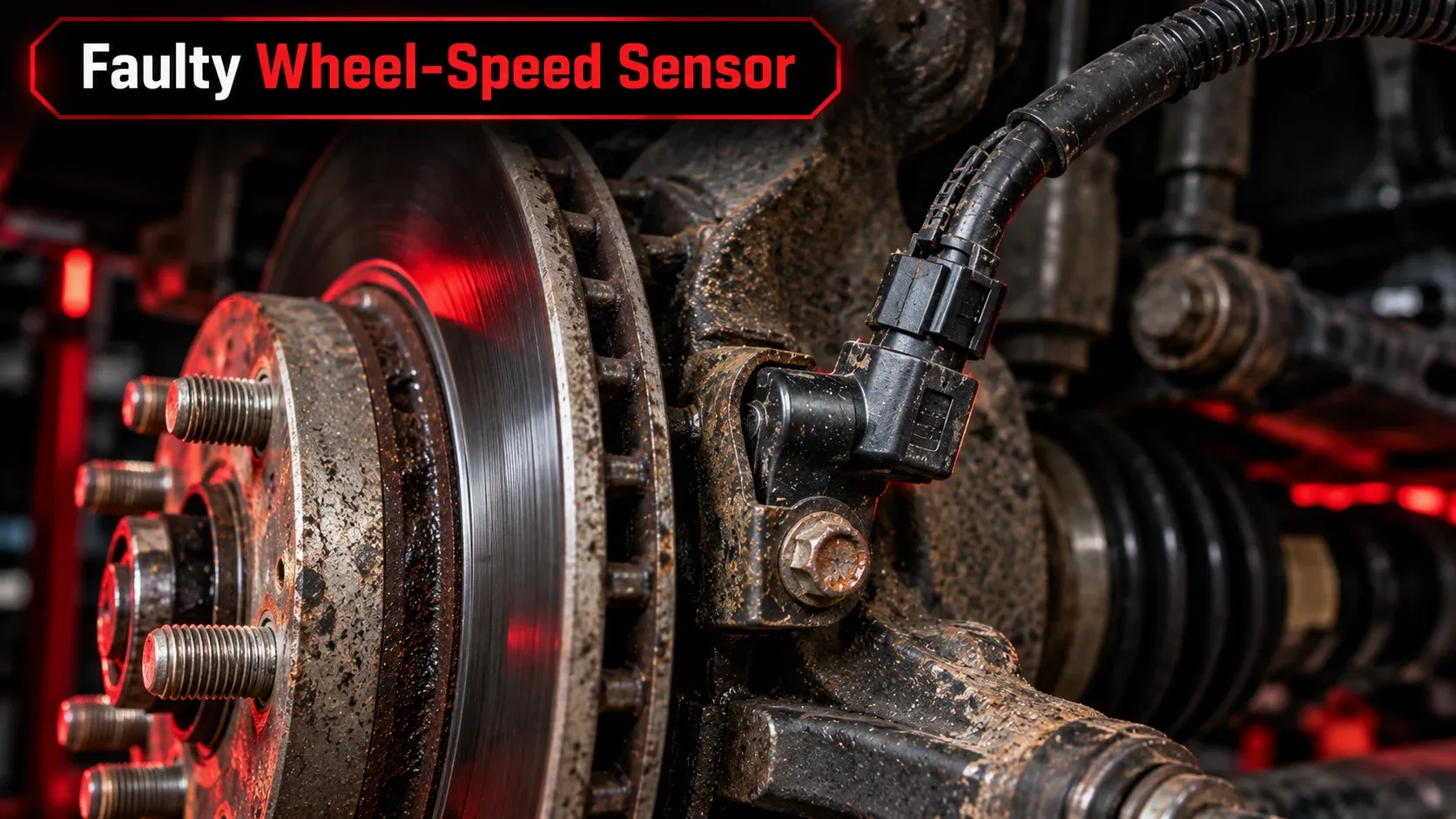
However, a sensor-related diagnostic trouble code does not automatically prove the sensor itself is defective. Wiring, connectors and encoder components must also be considered.
Damaged Wiring or Connectors
Electrical wiring near the wheels can experience vibration, moisture, corrosion and accidental damage during repair work.
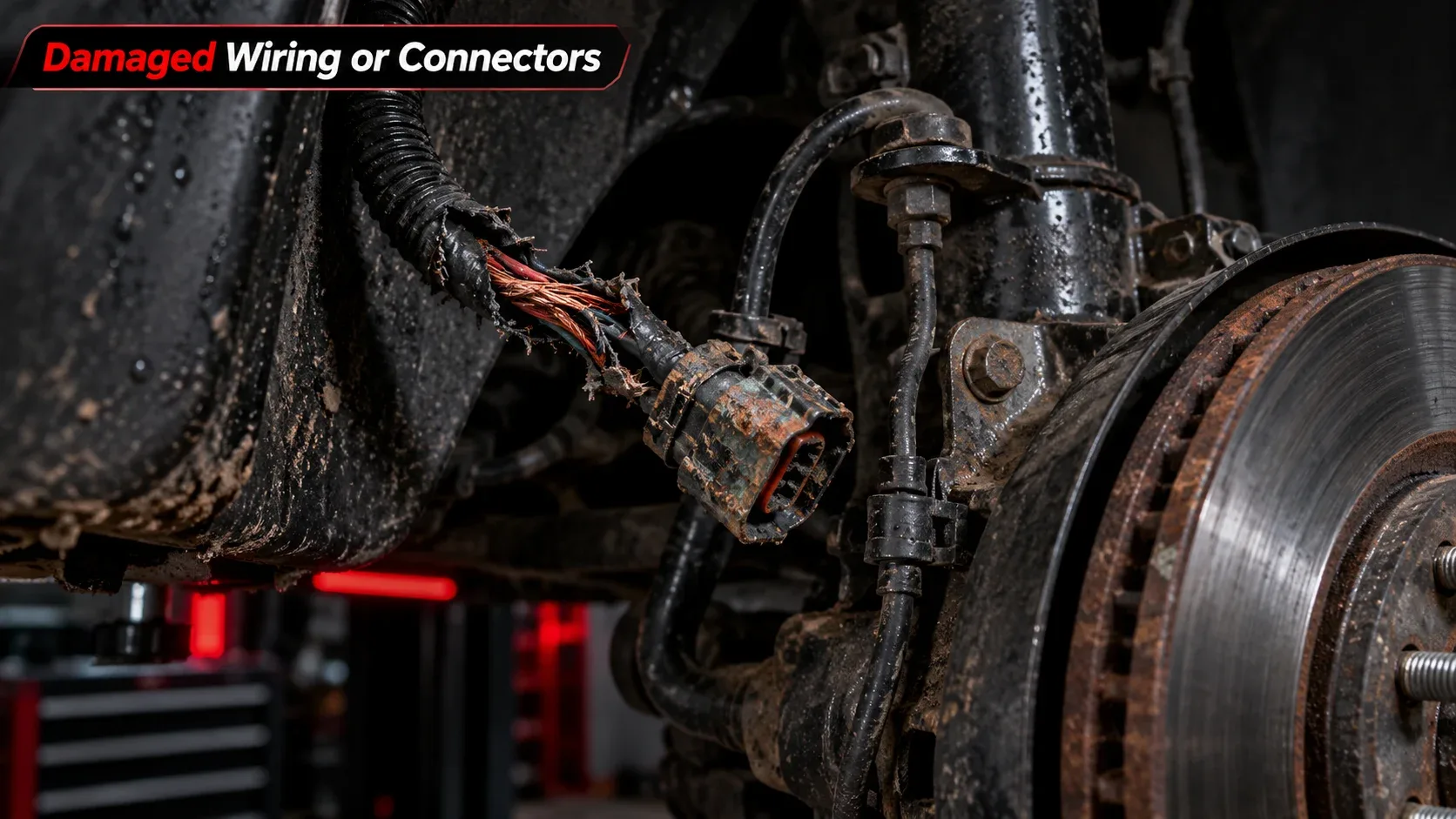
An interrupted or unreliable electrical signal may resemble a failed wheel-speed sensor. Electrical inspection is necessary before replacing components.
Damaged Tone Ring or Magnetic Encoder
Some wheel-speed systems use toothed tone rings or magnetic encoders incorporated into the wheel bearing or hub assembly.
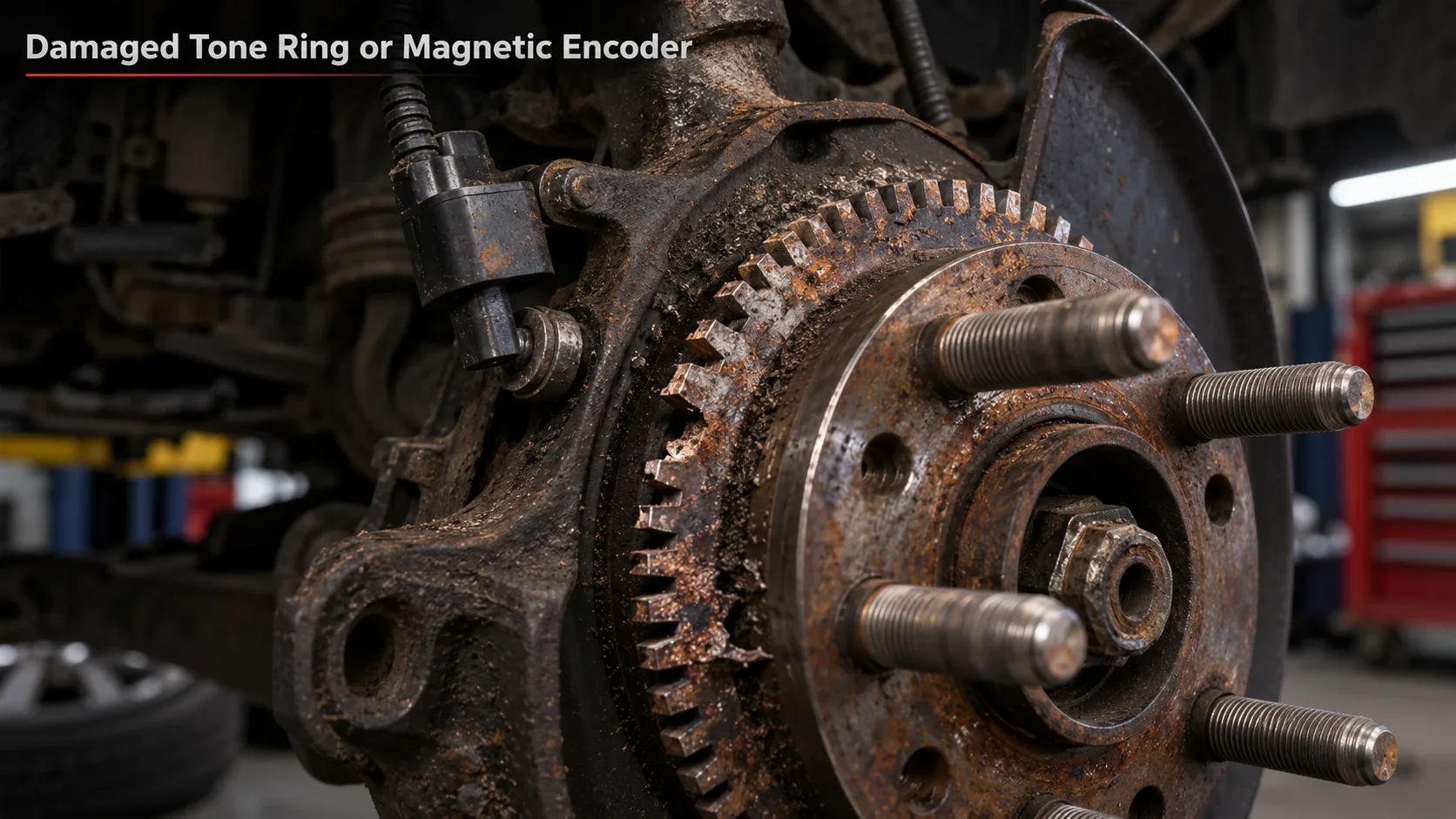
Physical damage, corrosion or wheel-bearing problems can cause inaccurate wheel-speed information, even when the sensor itself remains functional.
ABS Control Module or Hydraulic Unit Fault
An internal electronic problem or hydraulic-unit malfunction can trigger an ABS warning.
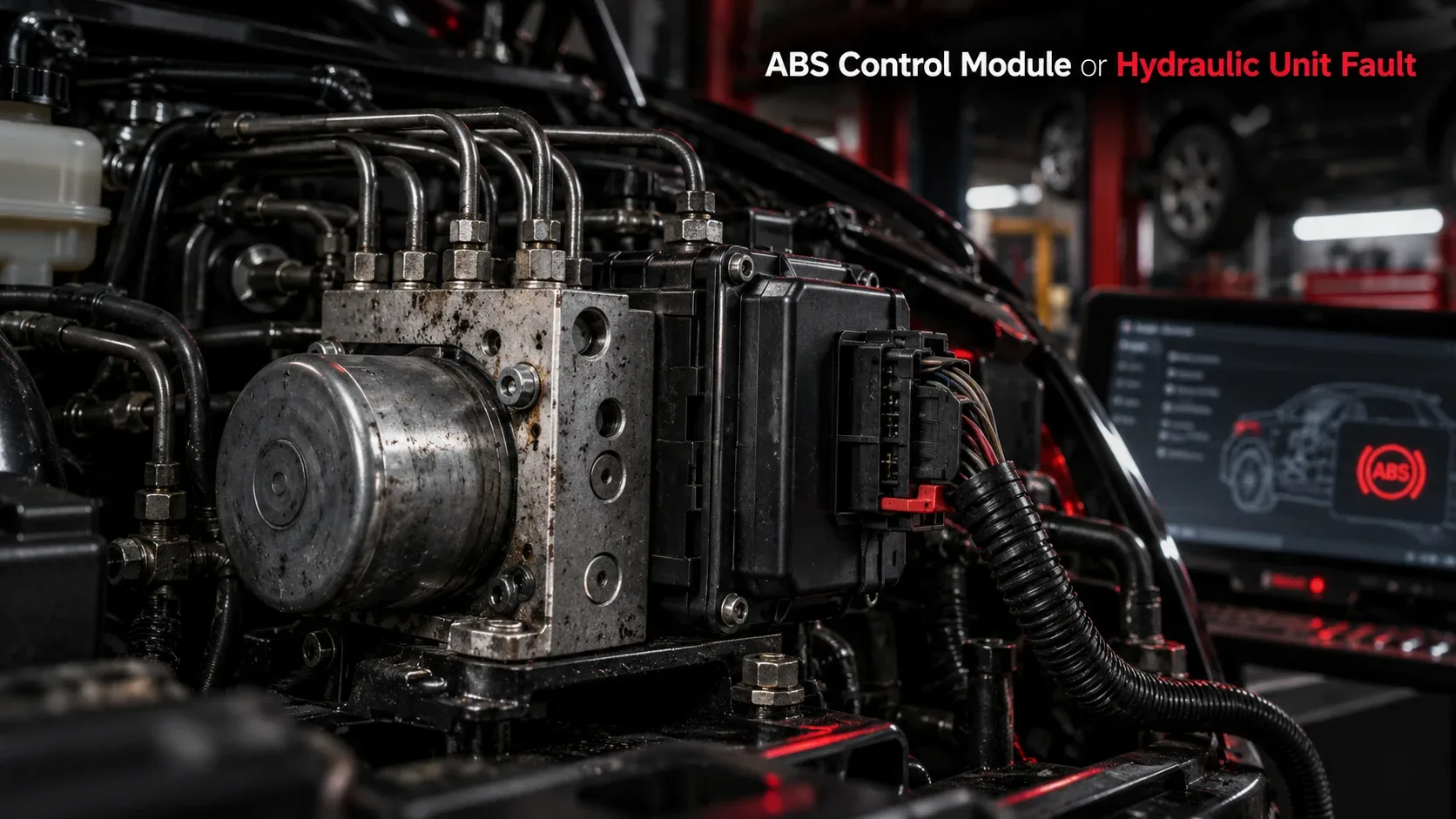
These components may be expensive to diagnose or repair, making confirmation especially important before replacement.
Fuse or Electrical Supply Problem
A blown fuse, poor ground connection or interrupted electrical supply may prevent the ABS controller from operating normally.
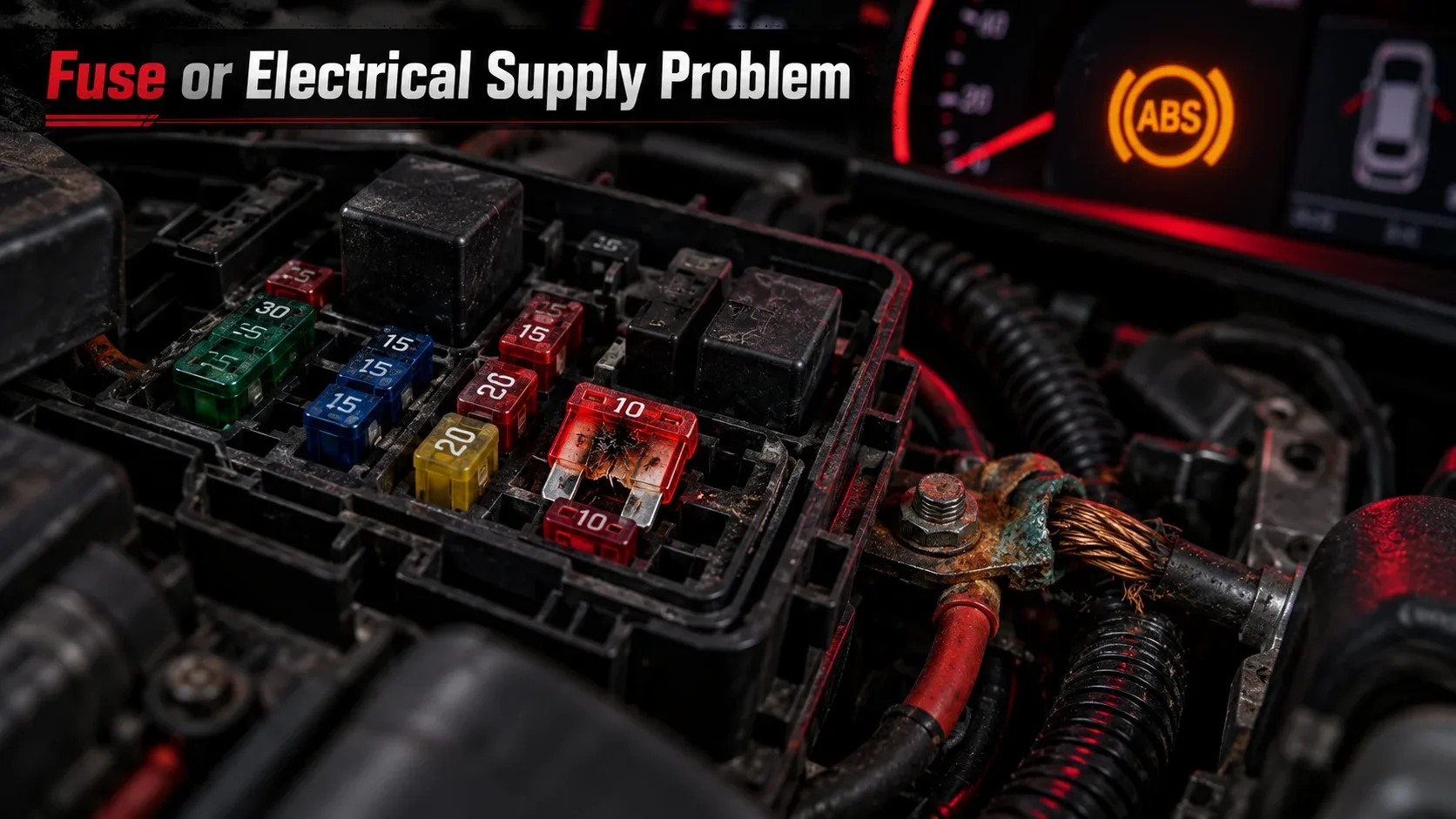
A repeatedly failing fuse requires diagnosis. Installing an oversized fuse or bypassing electrical protection is unsafe.
Low System Voltage or Charging Issues
Low battery voltage, unstable charging or other electrical faults may produce warning lights and stored trouble codes.
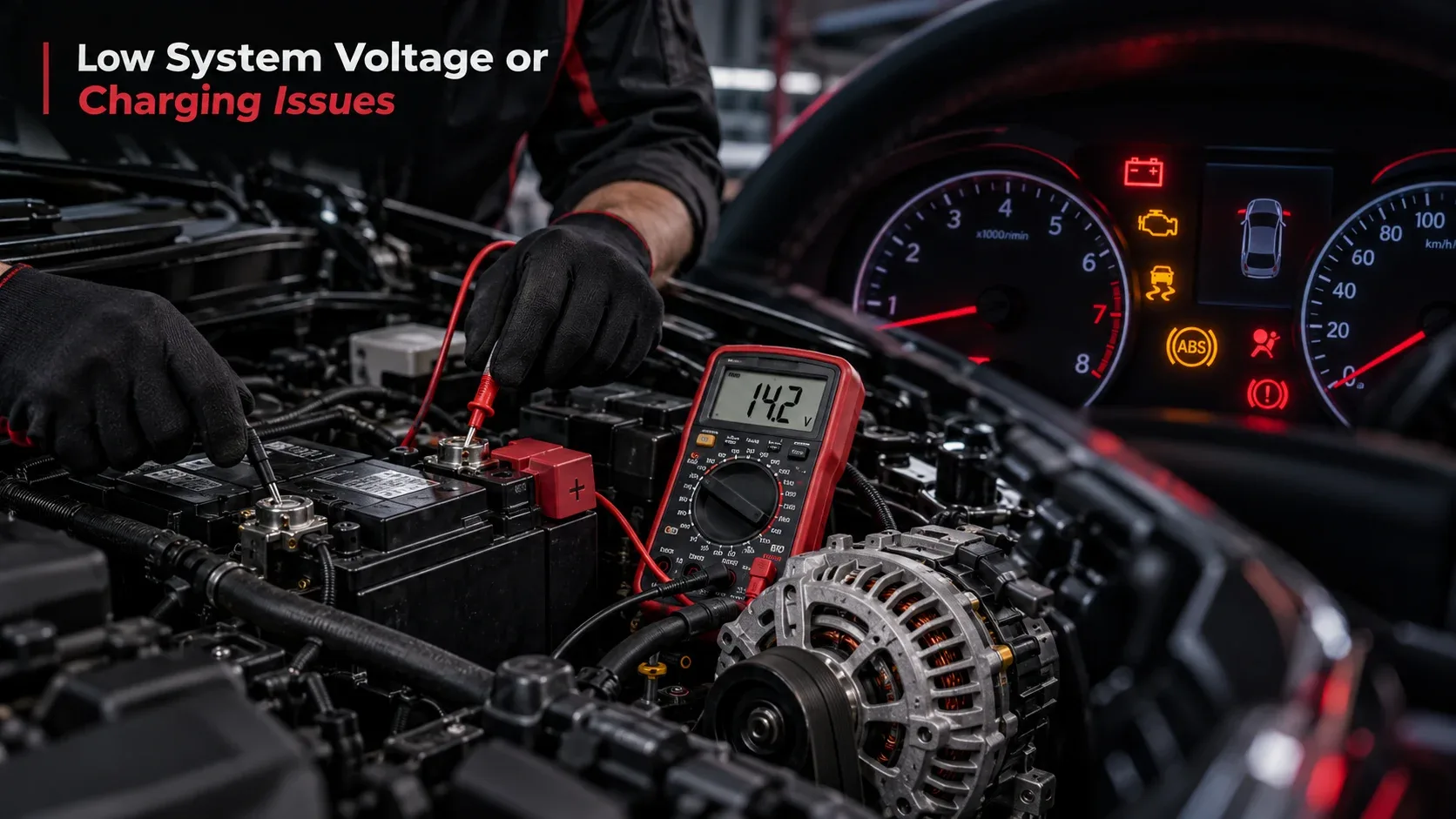
This is why inspecting charging-system operation can be useful when several electronic warnings appear together.
Related Brake-System Problems
Depending on vehicle design, low brake-fluid level, brake-pressure sensing faults or other brake-system issues may appear alongside an ABS warning.
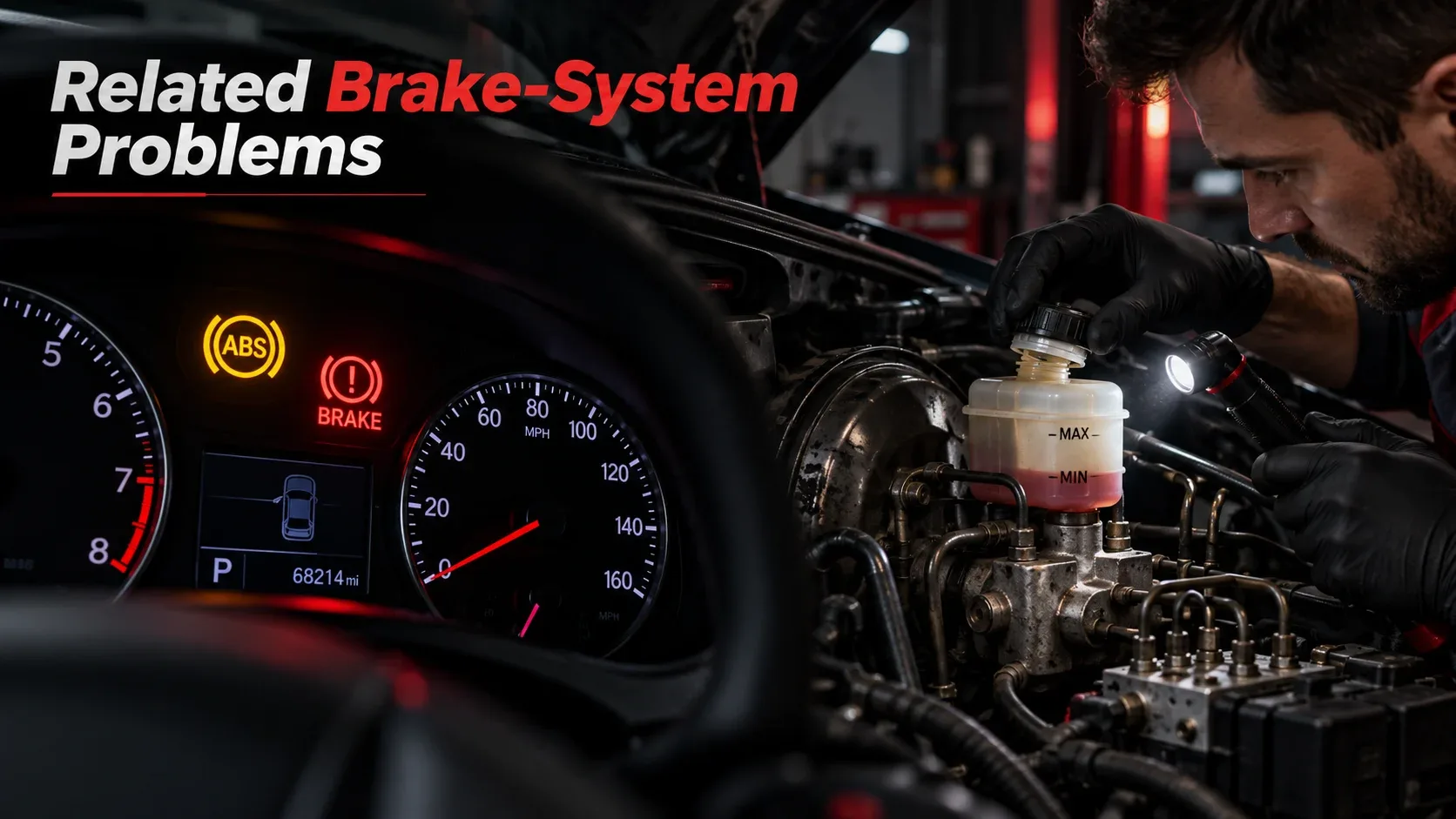
A red brake warning can signal a serious problem. Follow the owner’s manual and obtain professional assistance if the warning remains unexplained or braking is impaired.
Common ABS Faults at a Glance
Several ABS faults can produce similar dashboard warnings. These are common areas investigated during professional diagnosis.
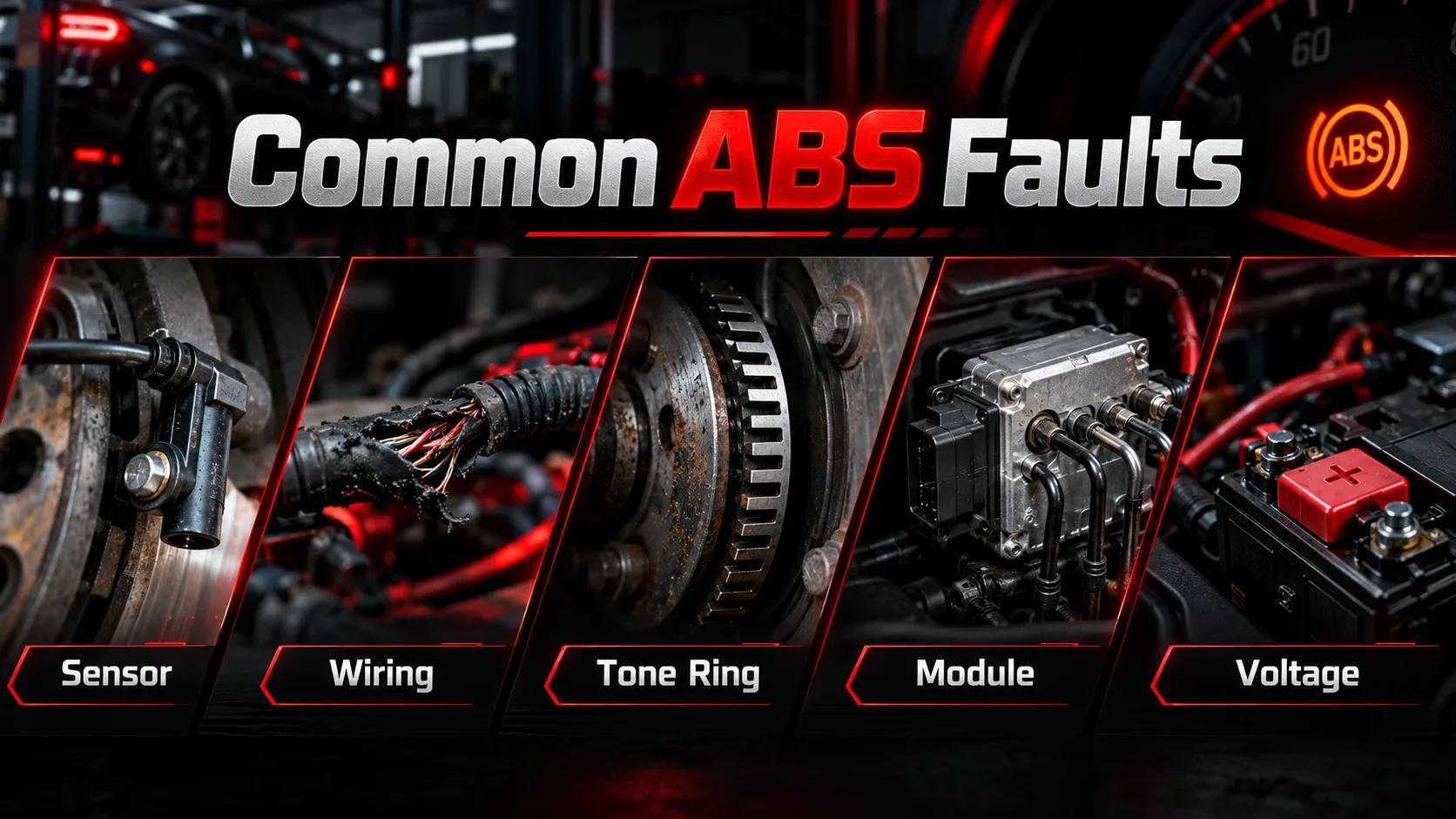
| Possible Cause | Possible Clue | How It Is Checked |
|---|---|---|
| Wheel-speed sensor | Wheel-speed signal fault | ABS codes, live data and circuit testing |
| Damaged wiring | Intermittent ABS warning | Connector and wiring inspection, electrical tests |
| Tone ring or encoder | Irregular wheel-speed reading | Hub inspection and signal analysis |
| Control module | Internal or communication fault | Manufacturer diagnostic procedures |
| Voltage supply | Multiple electronic warnings | Battery, charging and circuit testing |
Symptoms and fault codes guide testing. They should not automatically be treated as proof that a particular component needs replacement.
ABS Light vs Brake Warning Light vs Traction Control Light
Some drivers confuse the amber ABS symbol with the red brake warning or traction-control indicator.
Although these systems may share information, their warnings are not interchangeable.
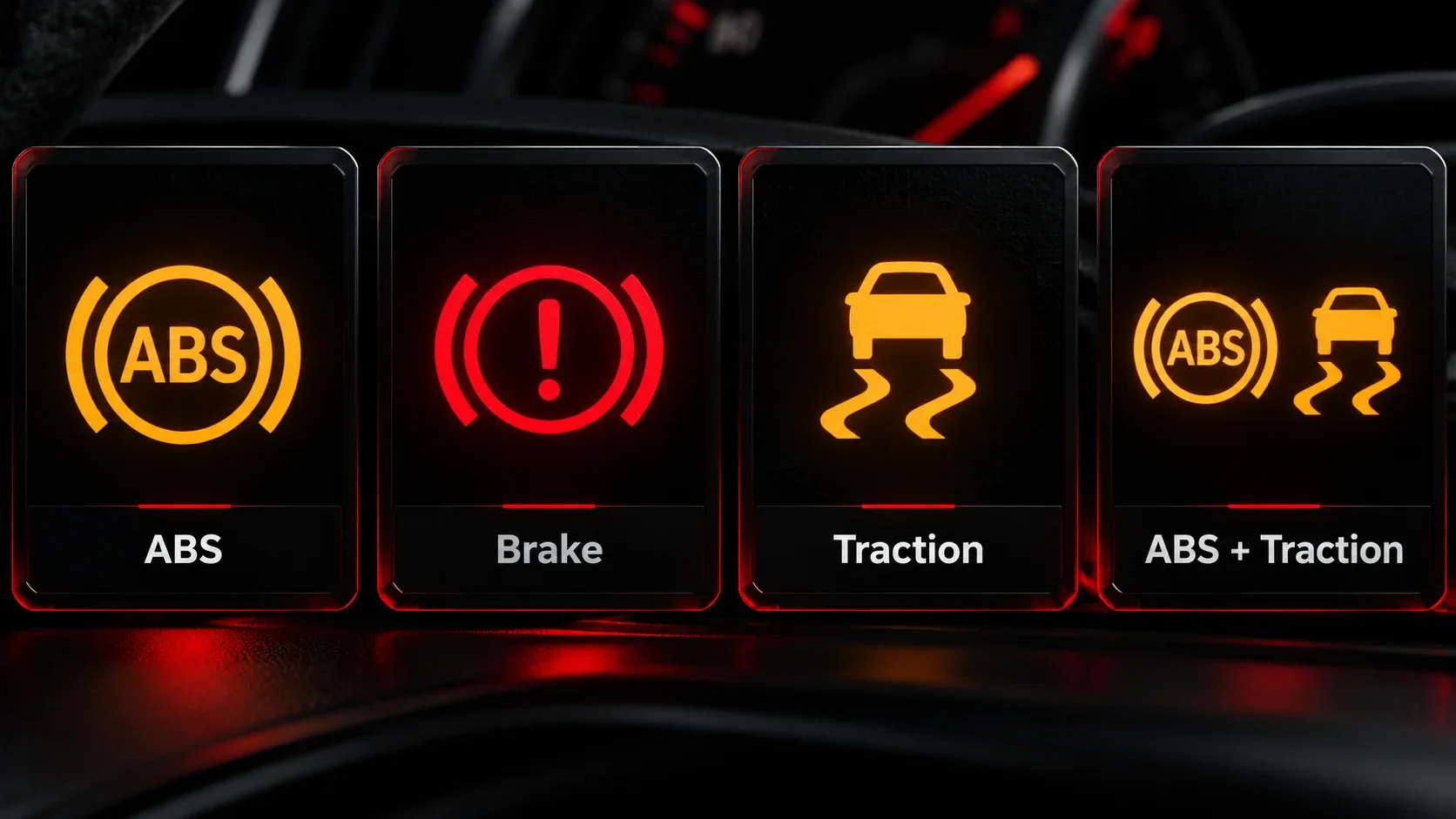
| Warning | Typical Meaning | Recommended Response |
|---|---|---|
| Amber ABS | ABS fault or unavailable function | Check braking behavior and arrange prompt diagnosis |
| Red brake warning | Parking brake engaged or possibly serious brake condition | Check parking brake and manual; if unexplained, stop safely and obtain assistance |
| Traction control | Intervention, deactivation or fault depending on indication | Interpret flashing or steady warnings using the manual |
| ABS and traction | Possible shared sensor or controller issue | Arrange ABS and stability-system diagnosis |
Exact meanings depend on the vehicle. A flashing traction-control light may indicate normal intervention, while a steady light could indicate a fault or manually disabled function.
How to Diagnose an ABS Warning Light
The correct diagnostic process follows evidence rather than replacing parts based on assumptions.
Step 1: Observe When the Warning Appears
Record whether it stays on after startup, appears while driving or comes on intermittently.
Note any other warnings, unusual pedal feel, recent repairs and relevant driving conditions.
Step 2: Check the Owner’s Manual
Manufacturer-specific guidance explains the warning symbol and recommended immediate action.
Step 3: Look for Obvious Problems
With the vehicle safely parked, accessible wiring damage or evidence of fluid leakage may provide useful clues.
Never work beneath an unsupported vehicle, touch moving components or interfere with hydraulic brake parts without proper training.
Step 4: Retrieve ABS Trouble Codes
An ABS-capable diagnostic scanner can access stored braking-system information on supported vehicles.
A basic engine-code reader may not provide ABS diagnostic access.
Step 5: Test the Suspected Circuit
A technician may compare wheel-speed data, inspect connectors, perform electrical tests and evaluate hub or encoder components.
Step 6: Verify the Repair
After correcting the confirmed fault, follow the manufacturer’s verification procedure, including any necessary code clearing and system testing.
A wheel-speed sensor circuit code may involve wiring, connectors, the sensor, an encoder or another related issue. Test before replacing parts.
Interactive ABS Warning Observation Checklist
Daniel can organize his observations before visiting a repair shop. This checklist is not a diagnosis or confirmation that the vehicle is safe to drive.
Share these observations with a qualified technician.
Recording observations may help troubleshooting, but it does not replace professional diagnosis or safety guidance.
How to Fix the Anti Lock ABS Light
The correct repair depends entirely on the diagnosed cause.
Some problems require connector or wheel-speed sensor repairs. Others involve wheel bearings, encoders, control modules or specialist hydraulic-system procedures.
Wheel-Speed Sensor Repairs
A technician may inspect the sensor, connector and signal path. If testing confirms a defective sensor, replacement may resolve the fault.
Wiring and Connector Repairs
Broken wiring, damaged insulation or corroded connectors may need repair according to the vehicle’s electrical service procedures.
Tone Ring or Wheel Hub Repairs
When the sensor works but its signal target is damaged, a tone ring, wheel bearing or hub component may require repair or replacement.
ABS Module or Hydraulic Repairs
Control-module and hydraulic repairs often require advanced diagnostics, special tools, programming or manufacturer-specific bleeding procedures.
Will Resetting the ABS Light Fix It?
Clearing a fault code may temporarily turn off the warning, but an unresolved problem can make it return.
Disconnecting the battery is not a reliable repair and may affect other electronic settings. Correcting the underlying fault is the proper solution.
ABS Light Repair Cost: What Might You Pay?
Daniel wants to know whether he is facing a modest sensor repair or a much more expensive control-unit problem.
Actual costs depend on the vehicle, local labor rates, parts availability and confirmed fault.
The following are broad illustrative U.S. estimates, not verified current repair quotes.
| Repair or Service | Illustrative Cost | Notes |
|---|---|---|
| ABS diagnostic testing | $80–$180+ | Inspection and scanner-based diagnosis |
| Wheel-speed sensor replacement | $120–$350+ | Depends on sensor accessibility |
| Wiring or connector repair | $100–$400+ | Varies with damage and testing time |
| Wheel hub or bearing repair | $250–$700+ | May include an integrated encoder |
| ABS module or hydraulic unit | $500–$1,800+ | Can cost substantially more for some vehicles |
How to Avoid Paying for Unnecessary ABS Repairs
Before approving an expensive repair, ask the shop to explain how it confirmed the fault.
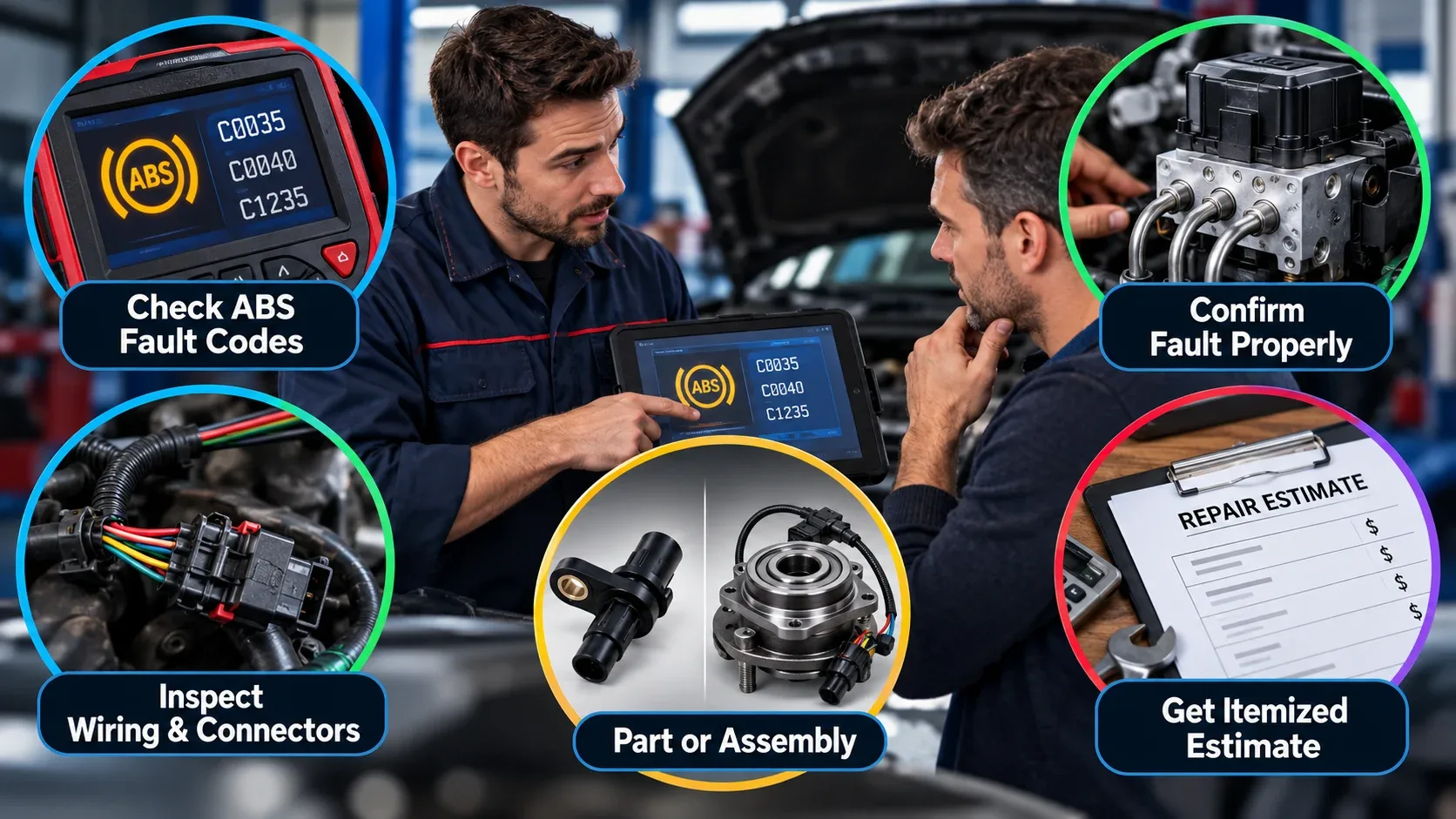
- Ask which ABS diagnostic trouble codes were retrieved.
- Request an explanation of how the fault was confirmed.
- Ask whether wiring and connectors were tested.
- Find out whether the proposed part is sold separately or as an assembly.
- Request an itemized repair estimate.
A clear diagnosis is especially valuable before approving an expensive control-module or hydraulic-unit replacement.
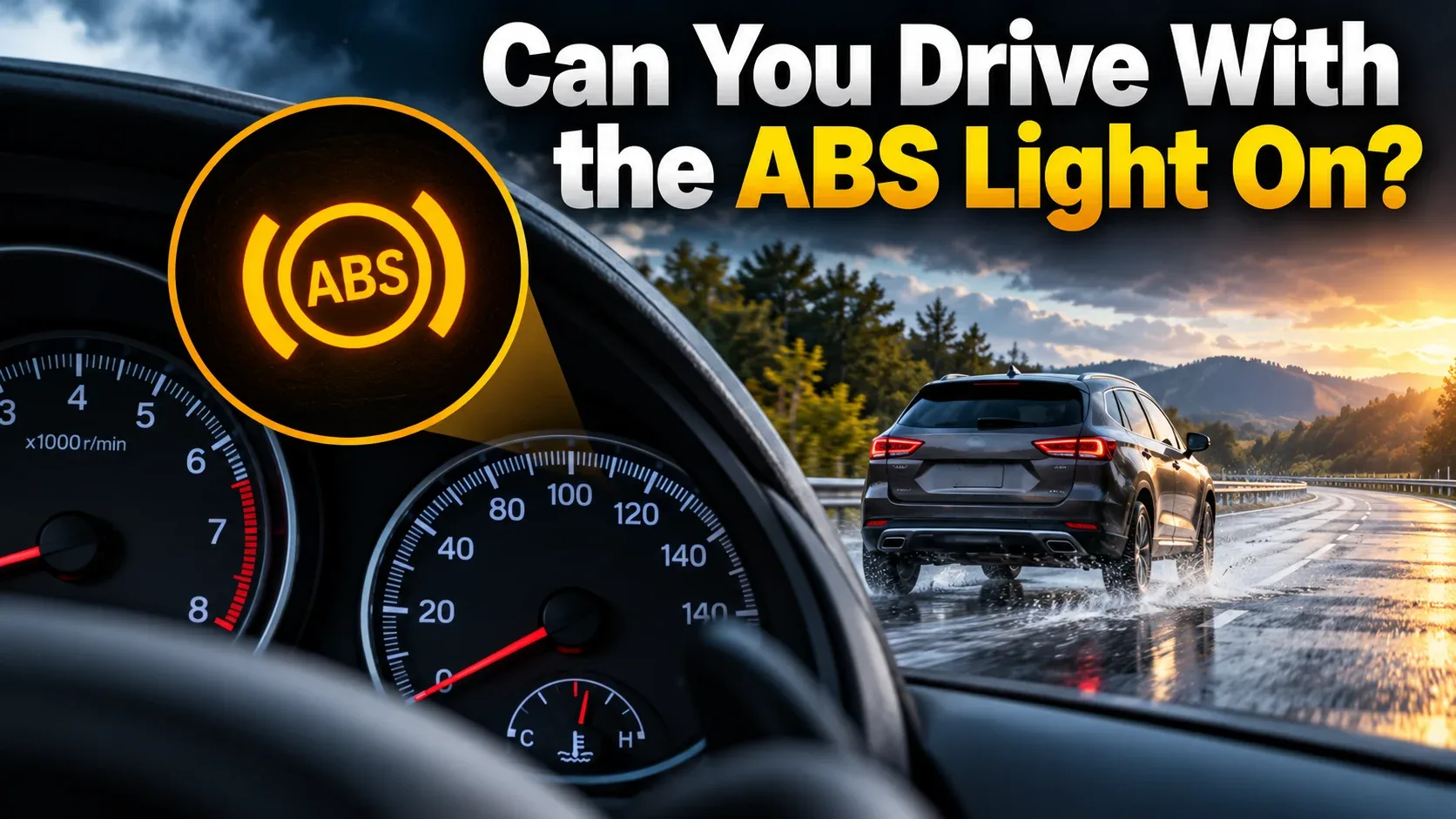
Can You Drive With the ABS Light On?
The answer depends on which warnings are present and how the vehicle brakes.
In some vehicles, an amber ABS warning alone indicates that anti-lock functionality is unavailable while conventional hydraulic braking remains operational.
Even then, emergency braking behavior may be different and the system should be inspected promptly.
ABS Warning Safety Decision Guide
| Situation | What It May Indicate | Recommended Action |
|---|---|---|
| Amber ABS only, braking otherwise normal | Anti-lock function may be unavailable | Follow the manual, avoid unnecessary driving and arrange prompt service |
| ABS and traction-control warnings | Possible shared control or sensor issue | Arrange diagnosis; stability functions may also be affected |
| Unexplained red brake warning | Possible serious brake-system problem | Stop safely and obtain professional assistance |
| Soft pedal, braking change or fluid leak | Potentially unsafe braking system | Do not continue driving; arrange towing or recovery |
Wet, icy and loose-road surfaces can increase the consequences of reduced anti-lock braking performance.
If you’re unsure whether the brakes are functioning correctly, stop in a safe location and seek professional assistance. Do not perform hard braking tests in traffic to check whether ABS is working.
Realistic Example: Diagnosing Daniel’s ABS Warning
Returning to Daniel’s SUV, the amber ABS light remains illuminated after startup. During gentle braking, the vehicle appears to stop normally.
Daniel arranges an inspection rather than assuming the warning is harmless.
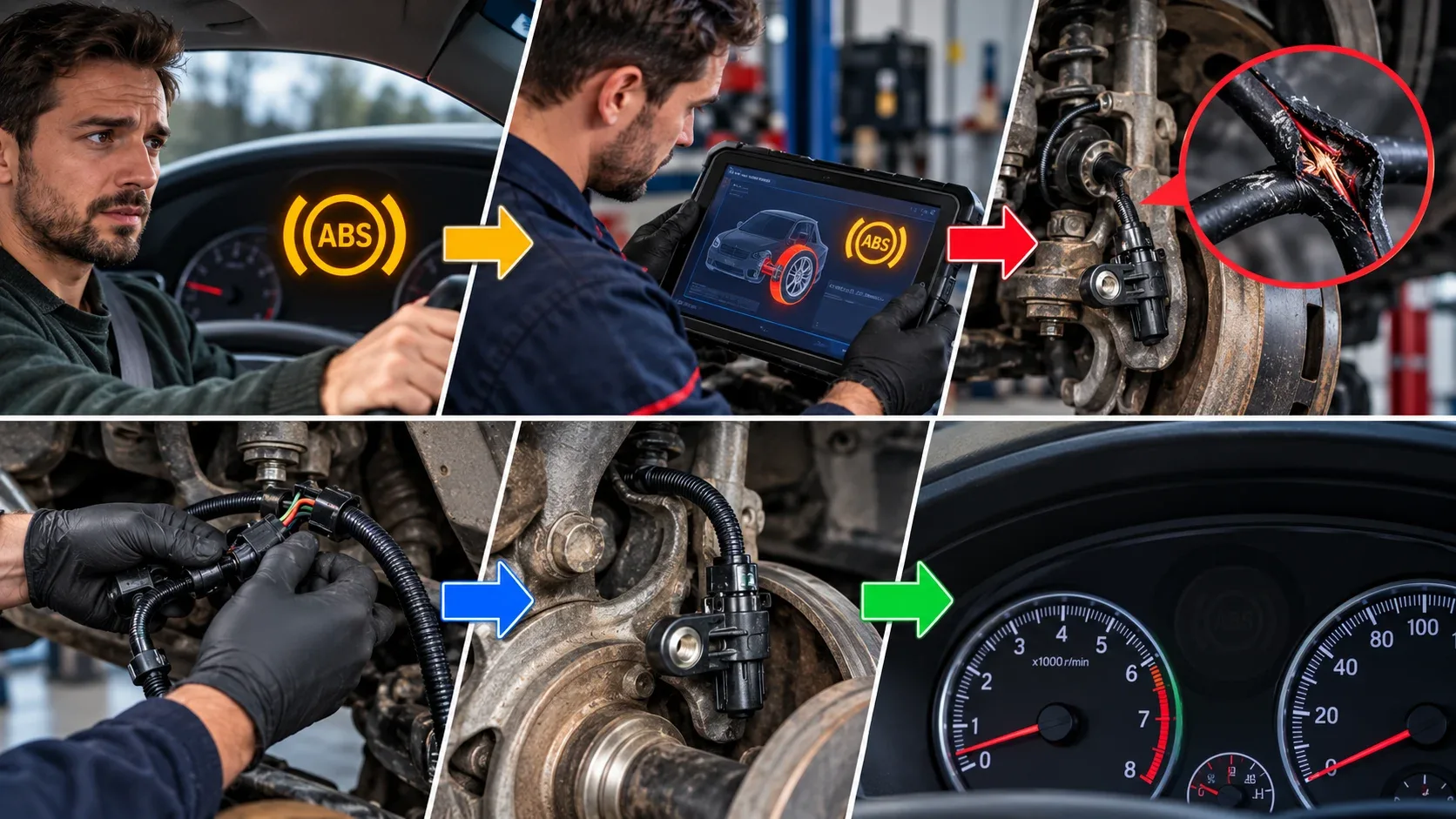
Situation: The ABS warning appears while driving, without immediately noticeable abnormal pedal feel.
Initial assessment: A technician reviews the warning history and scans the ABS control module.
Diagnostic finding: A wheel-speed signal fault is recorded at one wheel.
Further testing: The sensor signal, connector and wiring are examined. A damaged section of wiring is identified.
Outcome: The wiring is repaired following appropriate procedures, and the system is retested to confirm normal operation.
This scenario is illustrative, not a documented repair record.
The lesson is that a wheel-speed fault code does not automatically mean the sensor itself needs replacement.
Proper testing can distinguish sensor failure from wiring, encoder or related faults.
How to Reduce the Risk of ABS Problems
Not every ABS failure is preventable, but sensible vehicle maintenance can reduce some avoidable issues.
- Follow the vehicle manufacturer’s brake inspection and service intervals.
- Investigate unusual brake noises, vibrations or pedal behavior.
- Have damaged wheel-area wiring inspected promptly.
- Use correct procedures when servicing bearings, hubs and brake components.
- Maintain the battery and charging system to avoid voltage-related faults.
- Address warning lights promptly rather than repeatedly clearing them.
Keeping braking components properly maintained does not guarantee an ABS sensor or control unit will never fail, but it supports the reliability of the overall braking system.
Frequently Asked Questions About the ABS Warning Light
What does the anti lock ABS light mean?
It usually indicates a detected fault in the anti-lock braking system. ABS functionality may be limited or unavailable until the fault is corrected.
Is it safe to drive with the ABS light on?
Conventional braking may still operate in some vehicles, but anti-lock functionality could be unavailable. Consult the manual and arrange prompt diagnosis. If braking is impaired, stop safely and seek assistance.
Will my brakes still work when the ABS light is on?
Some ABS faults do not disable conventional hydraulic braking, but braking performance and fault consequences vary. Do not ignore the warning.
Why are my ABS and traction control lights on together?
ABS and traction-control systems may share wheel-speed information. A problem with a shared sensor or controller can illuminate both warnings.
Can a low car battery trigger an ABS warning?
Low voltage or unstable charging can trigger electronic warnings in some vehicles. Battery and charging-system testing may be necessary.
Can low brake fluid cause the ABS light to turn on?
Depending on vehicle design, low brake fluid or related faults can cause ABS or brake warnings. An unexplained red brake warning requires urgent attention.
Can I reset the ABS light myself?
Some ABS-capable scanners can clear stored codes, but the warning may return if the underlying problem remains. Clearing codes is not a repair.
Will disconnecting the battery clear the ABS light?
Disconnecting the battery is not a reliable fix and can cause additional electronic initialization requirements on some vehicles.
How much does ABS sensor replacement cost?
A broad illustrative U.S. range is $120–$350 or more, depending on the model and labor. Confirm the sensor has failed before authorizing replacement.
Can worn brake pads trigger an ABS warning?
Worn pads do not necessarily trigger an ABS fault directly. Some vehicles have separate brake-wear monitoring, while related braking faults may cause additional warnings.
Why does my ABS light come on and disappear?
Intermittent sensor signals, wiring faults, voltage problems or other conditions may cause temporary warnings. Stored codes can help with diagnosis.
Does ABS work on snow or gravel?
ABS can operate on snow and gravel, but stopping performance varies with road conditions. On some loose surfaces, stopping distances may increase even though ABS helps preserve steering control.
Final Thoughts: Don’t Ignore Your ABS Warning
Daniel’s experience shows why an illuminated ABS light deserves attention even when the car seems to brake normally.
The warning may come from sensors, wiring, electronic modules or other brake-related faults. Without diagnosis, it’s difficult to know which repair is necessary.
Understanding the difference between an ABS-only warning and a potentially serious brake-system condition helps drivers make safer decisions.
Prioritize safety, follow your vehicle manufacturer’s guidance, and identify the real fault before replacing expensive parts.