
It’s important to be prepared to handle injuries, health costs, repairs, and the future consequences when you get involved in an accident. One can make more effective decisions after knowing his or her rights following a car accident.
Laws regarding liability and personal injury claims vary from state to state; thus, each case of an accident will determine the possible action to take.
Car accidents lead to significant insurance claims. On average, a bodily injury liability claim made in 2024 cost $28,278. In addition, the average property damage liability claim was $6,770, based on Insurance Services Office figures provided by the Insurance Information Institute. The frequency of bodily injury claims in the same year was about 0.80 claims per 100 insured autos.
After getting involved in an accident, understanding car accident laws is important. Part of the process is the preservation of evidence, notifying the appropriate insurer about the incident and filing the claims within the time limit.
Here are the things you need to know after getting involved in an accident.
The Rights That Do Not Depend on Where You Live
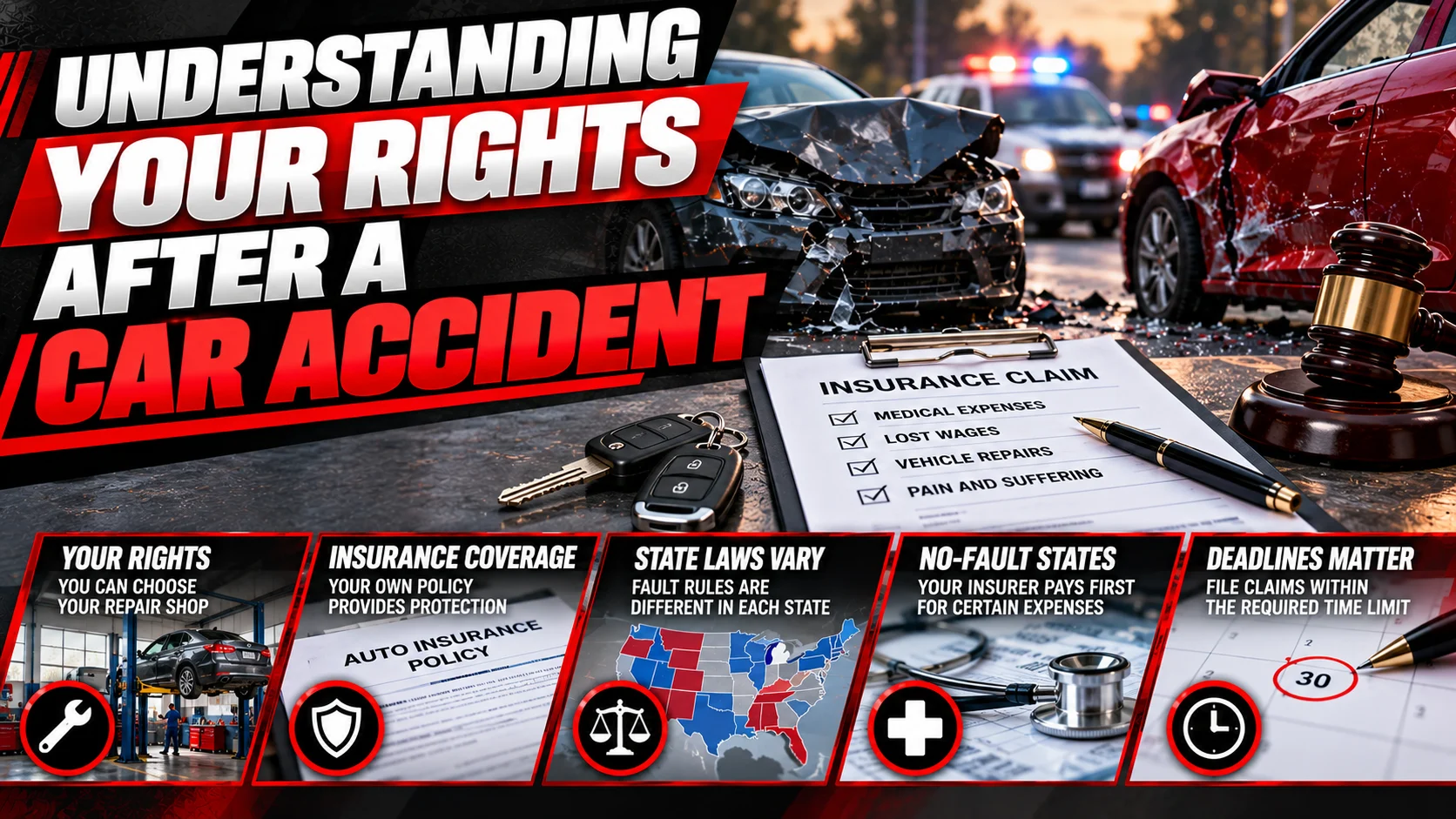
A driver gets to choose who repairs the car. North Carolina’s Department of Insurance puts it flatly, telling consumers that an insurer may recommend a repair shop but the choice belongs to the owner. Most state insurance regulators say some version of the same thing, and complaints about steering show up on consumer pages in state after state.
A driver’s own policy works the same way. Coverage under collision insurance, medical payment insurance, and uninsured motorists insurance is provided on the insurance policy that the driver already pays for. A driver’s own coverage doesn’t depend on another insurer accepting fault.
The duties at the scene are similarly uniform. Stop, check for injuries, exchange information, and do it regardless of who caused the crash.
Everything Else Depends on Your State
North Carolina continues to follow the contributory negligence rule. According to the North Carolina Department of Insurance, a driver whose own negligence contributed to an accident may be barred from recovering damages from another at-fault driver. Even a small degree of contributing negligence can prevent recovery.
The rule, however, is still subject to important legal qualifications. North Carolina recognizes the last clear chance doctrine, allowing an injured person to recover when the defendant had a final opportunity to avoid the injury but failed to exercise reasonable care. Claims involving gross negligence or willful and wanton misconduct may also be treated differently from ordinary negligence claims.
The large majority of states moved to comparative fault, which trims an award by the injured driver’s share rather than erasing it. For example, ten percent of the blame costs a driver ten percent of the recovery in most of the country and the entire claim in a contributory negligence state.
According to a car accident lawyer in the Bronx, collisions can quickly lead to disputes over liability and fault. You can trust a car accident lawyer to manage the claims process in pursuing a fair settlement.
In a No-Fault State Your Own Insurer Pays First
New York follows a no-fault automobile insurance system. Under this rule, eligible individuals injured in a motor accident can seek certain benefits without first proving who caused the crash. According to the New York Department of Financial Services, basic no-fault insurance provides up to $50,000 per eligible person for covered medical expenses, lost earnings, and other reasonable and necessary expenses.
That coverage carries conditions. The department says written notice has to reach the insurer as soon as reasonably practicable and in no event more than 30 days after the accident. No-fault benefits do not reach motorcycle operators or their passengers at all.
A suit against the other driver for pain and suffering requires clearing the serious injury threshold New York insurance law sets, which turns on a finding about the injury rather than on the injured person’s decision to file.
The Rights That Expire Quietly
Different deadlines may apply to the same personal injury case. Each serves a separate purpose. In states with no-fault insurance systems, injured individuals may have to notify their insurers or apply for benefits within specific time limits. A separate statute of limitations determines how long they generally have to file a personal injury lawsuit.
Missing one deadline may affect a claim even if other deadlines have not yet expired. Evidence is not timeless. Car dealerships either repair vehicles and send them off to the repair shops or sell them for salvage, while security cameras have their videos erased days or weeks later, and witnesses, who know everything that happened on a Tuesday, become unavailable the next spring.