
Hard starts, rough idle, weak acceleration, or a fuel smell can point to a pressure problem—but symptoms alone do not prove the regulator is at fault. Learn how to spot the pattern, test safely, and avoid replacing the wrong part.
Symptoms of a bad fuel pressure regulator
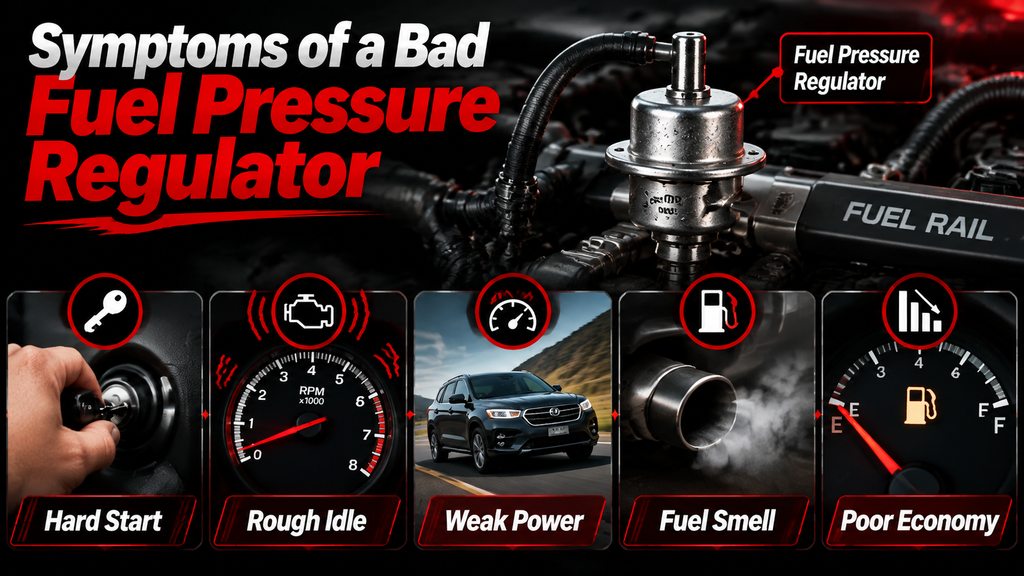
The regulator’s job is to keep fuel pressure in the range the injectors expect. When it sticks, leaks internally, or loses its vacuum reference on older return-style systems, the engine may run rich, lean, or inconsistently. Look for a repeated pattern rather than relying on a single symptom.
Hard starting or long cranking
Pressure that bleeds off too quickly—or fuel delivery that is excessive—can make the engine take longer to catch, especially after sitting.
Rough idle, misfires, or stalling
An incorrect air-fuel mixture can cause shaking at idle, intermittent misfires, stumbling when stopped, or stalling at traffic lights.
Hesitation or reduced acceleration
Low pressure can leave the engine short of fuel under load. It may surge, hesitate, or feel flat while climbing, merging, or passing.
Fuel smell, black smoke, and poor economy
Excess pressure can push too much fuel through the injectors, leaving a gasoline odor, soot at the tailpipe, fouled spark plugs, and higher fuel use.
Before you test: identify the system and the specification
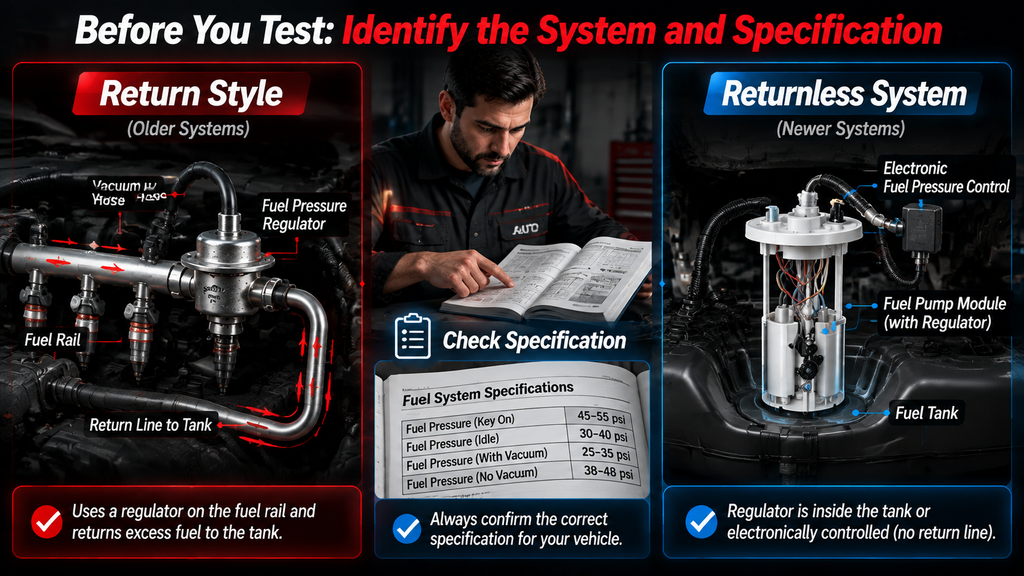
A regulator is not always a separate serviceable part. Older return-style fuel systems may use a vacuum-operated regulator on the fuel rail, while newer returnless systems often regulate pressure in the tank or electronically. Confirm your exact vehicle layout before looking for a vacuum hose or attaching a gauge.
Identify the fuel system
Use the service manual to confirm whether the vehicle uses a rail-mounted, in-tank, or electronically controlled regulator.
Find the correct specification
Fuel-pressure targets vary by engine and operating condition. A generic pressure number is not enough for a reliable diagnosis.
Plan for safe access
Work only at approved test ports or adapters, and follow the vehicle’s pressure-relief procedure before opening a fuel connection.
What does a fuel pressure regulator do?
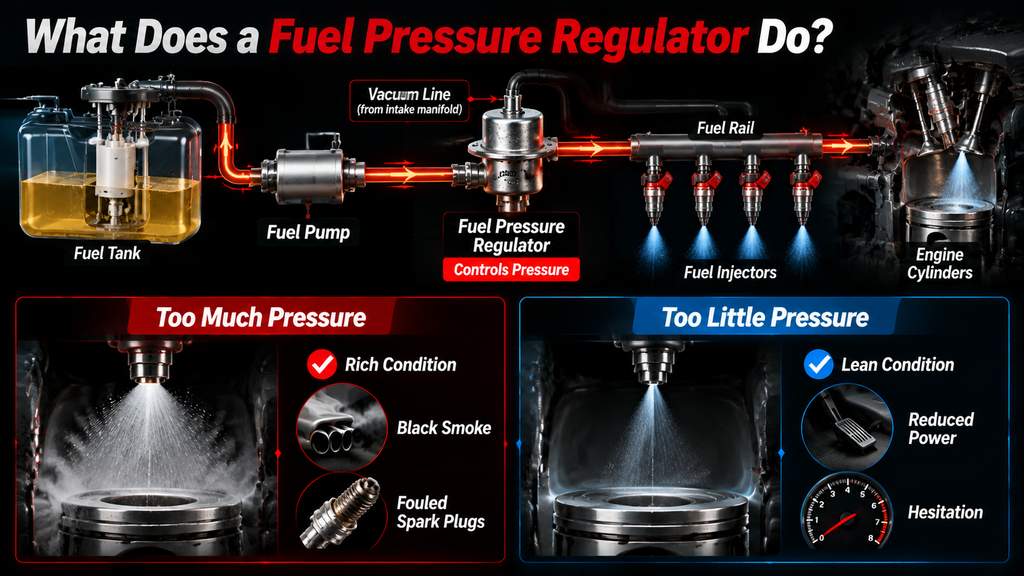
Fuel injectors are calibrated around a specified pressure. A fuel pressure regulator controls that pressure so injector pulse width delivers a predictable amount of fuel. Many older systems use a vacuum-referenced regulator on the fuel rail; many newer returnless systems regulate pressure in or near the fuel tank and may be monitored electronically.
That design difference matters: not every vehicle has a vacuum hose to inspect, and pressure specifications vary widely. Always use service information for your exact year, engine, and fuel system before deciding that the regulator is the cause.
Running rich
Too much fuel pressure
Often brings fuel odor, black exhaust smoke, fouled spark plugs, difficult hot starts, and noticeably worse fuel economy.
Running lean
Too little fuel pressure
More often shows up as hesitation, weak power under load, surging, misfire codes, or a lean condition—though a weak pump can create the same pattern.
How to test a fuel pressure regulator
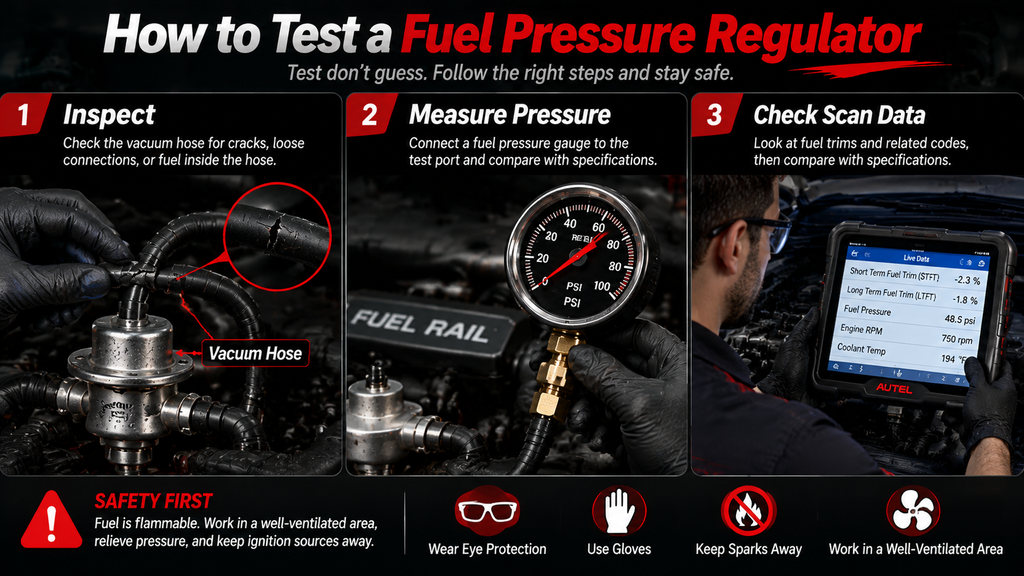
A pressure gauge and a scan tool are more useful than guessing from symptoms. If you are not comfortable working around pressurized gasoline, book a diagnostic inspection instead.
Fuel is flammable. Work outside or in a well-ventilated space, keep ignition sources away, wear eye protection, and follow the vehicle’s approved pressure-relief procedure before disconnecting any fuel line.
- Inspect the vacuum line—if your system has oneWith the engine off, inspect the small hose connected to a vacuum-operated regulator for cracks, loose fittings, or fuel inside the hose. Fuel in that vacuum line is a strong sign the regulator diaphragm has failed and the unit should be replaced.
- Measure fuel pressure against specificationConnect a suitable fuel pressure gauge only at the approved service port or adapter. Compare key-on, idle, and load-related readings with the manufacturer specification. On a vacuum-referenced system, pressure commonly changes when vacuum changes—but use the service manual, not a generic number.
- Use scan data to support the diagnosisLook for stored codes and fuel-trim direction. Persistently negative trims can support a rich condition; persistently positive trims can support a lean condition. Fuel trim is evidence, not a verdict: intake leaks, injectors, sensors, and ignition faults still need to be ruled out.
- Check whether pressure holds after shutdownA rapid pressure drop after the engine is switched off can point to an internal regulator leak, a leaking injector, or a pump check-valve issue. Follow the factory test procedure before assigning the failure to one component.
Fuel pressure regulator vs. other common faults
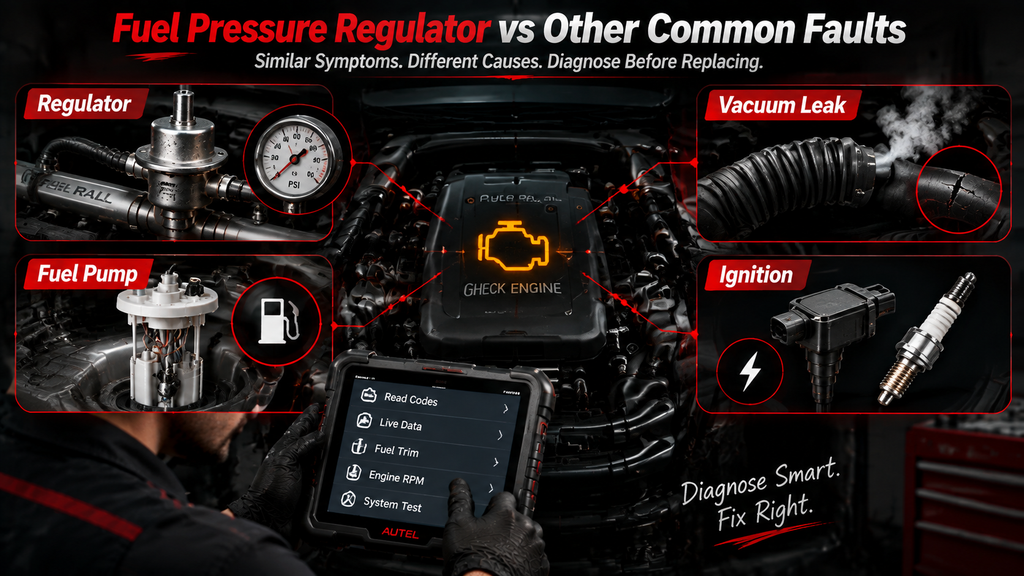
These faults overlap. The goal is not to diagnose from a single symptom; it is to use inspection, specifications, and measurements to eliminate possibilities.
| Possible fault | Typical clue | Best next check |
|---|---|---|
| Pressure regulator | Pressure is consistently too high, too low, or does not respond as specified. | Gauge test; inspect vacuum hose on applicable systems. |
| Fuel pump or restricted supply | Low pressure worsens under load; may include pump noise or low fuel volume. | Pressure and volume testing, wiring checks, service information. |
| Vacuum leak or air-metering issue | Lean trims and rough idle that may improve at higher rpm. | Smoke test, intake inspection, scan-data review. |
| Ignition or spark-plug fault | A distinct misfire may follow one cylinder and worsen under load. | Read misfire data, inspect plugs and coils, verify spark quality. |
Can you drive with a bad fuel pressure regulator?
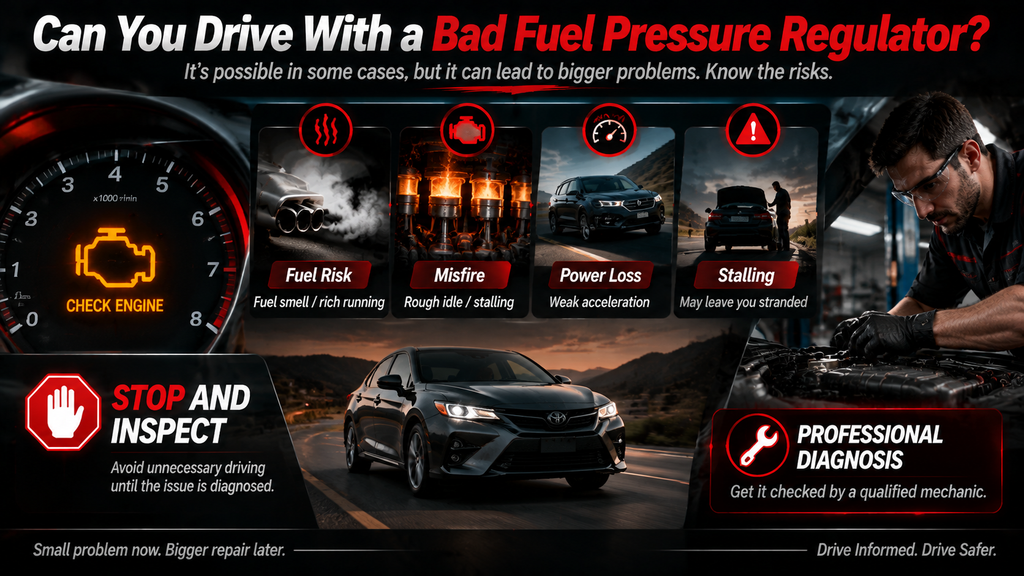
Avoid unnecessary driving until the problem is confirmed. A severe rich condition can damage spark plugs and the catalytic converter; fuel leaks or a strong raw-fuel odor require immediate attention. A lean condition can cause hesitation or stalling in traffic. If the engine is misfiring, losing power, stalling, or smells strongly of fuel, arrange a professional inspection rather than continuing to drive.
Fuel pressure regulator replacement cost
Cost depends heavily on vehicle design. An accessible rail-mounted regulator can be a comparatively modest repair, while an in-tank regulator or complete fuel-pump module takes more labor and can cost considerably more. Ask for diagnosis results, the specified pressure range, and a quote that separates parts from labor before authorizing replacement.
Fuel pressure regulator FAQs
Does a bad fuel pressure regulator cause rough idle?
It can. Incorrect fuel pressure can make the mixture too rich or too lean at idle. But rough idle is also common with vacuum leaks, worn spark plugs or coils, dirty injectors, and air-metering problems, so it needs testing.
Will a bad regulator trigger a Check Engine Light?
Possibly. The engine computer may set rich, lean, misfire, or fuel-pressure-related codes, depending on the vehicle. Read the exact codes and use them as a starting point; a code does not automatically identify the failed part.
Where is the fuel pressure regulator located?
On some older return-style systems it is mounted on the fuel rail and may have a vacuum hose. On many newer vehicles, pressure regulation is integrated with the fuel-pump module or controlled electronically. Consult service information for your specific vehicle.
Can I replace only the regulator?
Sometimes. If your vehicle has a separate rail-mounted unit, the regulator may be replaced on its own. On other vehicles, it is built into a fuel-pump module or fuel-delivery assembly, so the repair may involve replacing a larger component.