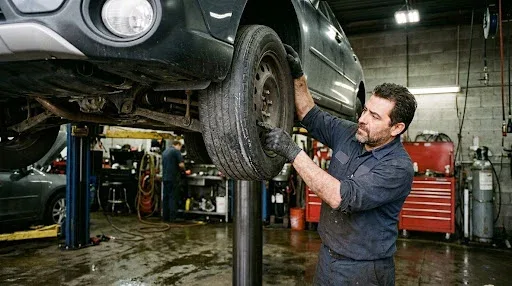
A car that pulls slightly to one side rarely feels urgent. Insurance adjusters know that habit well, and they use it. A skipped alignment appointment sitting in a repair record can quietly shift blame away from the other driver. The person who got hit absorbs that shift.
Wheel alignment sounds like routine upkeep, not evidence. Once a claim opens, maintenance history enters the fight over who caused the crash. It also shapes how much the case is worth.
An Uncorrected Pull Changes How a Car Behaves Under Stress
Misaligned wheels force a driver to fight the steering wheel constantly. That fight gets worse the moment evasive action is needed. A car pulling left under normal conditions can react unpredictably during a sudden swerve or hard brake.
Steering and tire issues show up in a measurable share of pre-crash vehicle factors. Tire problems appear in roughly one in twenty vehicles studied. Defense counsel use that figure aggressively when looking for an alternate explanation. Insurance companies do not need proof the alignment caused the wreck. They only need a plausible alternative explanation for a jury to consider.
The Defense Will Ask for the Full Maintenance Record
Once a lawsuit gets filed, the defense sends discovery requests aimed squarely at service history. Oil changes, tire rotations, and yes, alignment checks all fall inside that net. A gap in that history invites an argument. The defense attorney frames the missing alignment as the plaintiff’s own negligence, not the other driver’s.
Negligence claims require proof of a legal duty owed between the parties. Comparative negligence rules let a defense team argue the plaintiff shares fault for the crash by breaching their own duty of care. A worn or misaligned vehicle becomes Exhibit One. Shop invoices matter here. A dated repair order showing the alignment was addressed and corrected removes the argument before it starts.
When an insurance adjuster tries to use a missing wheel alignment or past maintenance record to shift blame after a crash, standing up to those tactics requires careful preparation. In South Carolina, Stewart Law Offices can help crash victims review service history, gather mechanical evidence, and counter unfair claims across Columbia, Rock Hill, Beaufort, Lexington, Fort Mill, Bluffton, and Lake Wylie. If severe injuries make traveling to an office difficult, their attorneys can meet directly at the client’s location.
A Vehicle Component Failure Rarely Wins the Case for the Defense Alone
Mechanical failures contribute little to crashes compared with driver error. That fact cuts both ways in a claim. Federal crash investigators trace most crashes back to driver behavior, not equipment. Tire and wheel problems stay a minority factor even in vehicle-related crashes. A defense team citing an old alignment note still has to connect that defect to the exact moment of impact.
Correlation is not causation in a courtroom. The defense needs a qualified witness who can trace the pull or drift directly to the collision. Pointing at a service record and implying blame is not enough. That kind of opinion costs money and time. Smaller insurers sometimes raise the alignment argument during settlement talks purely to drive the number down. They know litigating the point is expensive.
Brent Stewart, a South Carolina personal injury lawyer whose firm, https://www.stewartlawoffices.net/, has spent 30 years representing injured clients across SC and holds multiple awards along with listings on LawInfo, Best Lawyers, Lawyers.com, and Attorney at Law Magazine, explains how this tactic aligns with the standard operational goals of insurance carriers: “Insurance companies are businesses. They want to save money. They’re not going to offer you top dollar. They’ll try to do what they can to minimize the claim. They want to get you settled, get your medical care cut off, and send you on your way.”
Photographs and Repair Estimates Do More Work Than Memory
Steering feel fades from memory fast, especially after a traumatic collision. Written and photographic records do not fade the same way.
- Dated repair shop invoices showing when alignment work was last performed
- Photos of tire tread wear patterns taken before the crash, if they exist
- Any pre-crash mechanic notes flagging steering pull, vibration, or drift
- Post-crash repair estimates itemizing steering and suspension damage separately from body damage
A mechanic’s evaluation that explicitly codes steering or suspension wear as pre-existing, rather than collision-related, helps establish the vehicle’s exact pre-crash condition. That separation protects against the defense blending the two into one narrative.
Spoliation Rules Cut Both Directions Once Litigation Starts
Once a lawsuit becomes reasonably foreseeable, both sides must preserve evidence. Courts can impose an adverse inference for destroyed evidence tied to a collision claim. That duty extends to the vehicle itself. Scrapping a damaged car before someone qualified inspects the steering and suspension components hands the other side an opening.
An adverse inference sanction lets a jury assume the destroyed evidence would have hurt the party that lost it. Courts weigh several factors before imposing that sanction. Both intent and real prejudice to the other side matter.
Total-loss vehicles get sold to salvage yards quickly. Anyone with an open claim involving mechanical questions benefits from documenting the vehicle before that transfer happens.
An Alignment Note in a Repair File Is Not Automatic Liability
A single past alignment complaint does not establish that a vehicle caused its own crash. Defense arguments built on thin mechanical inference often collapse once someone qualified examines the physical evidence.
Courts measure conduct against the reasonable person standard, not perfection. Deferring a minor alignment appointment rarely falls below that bar on its own. Every claim still gets evaluated on its specific facts. A driver with a documented, months-old complaint and no repair faces a tougher argument. A driver who fixed the issue quickly does not.