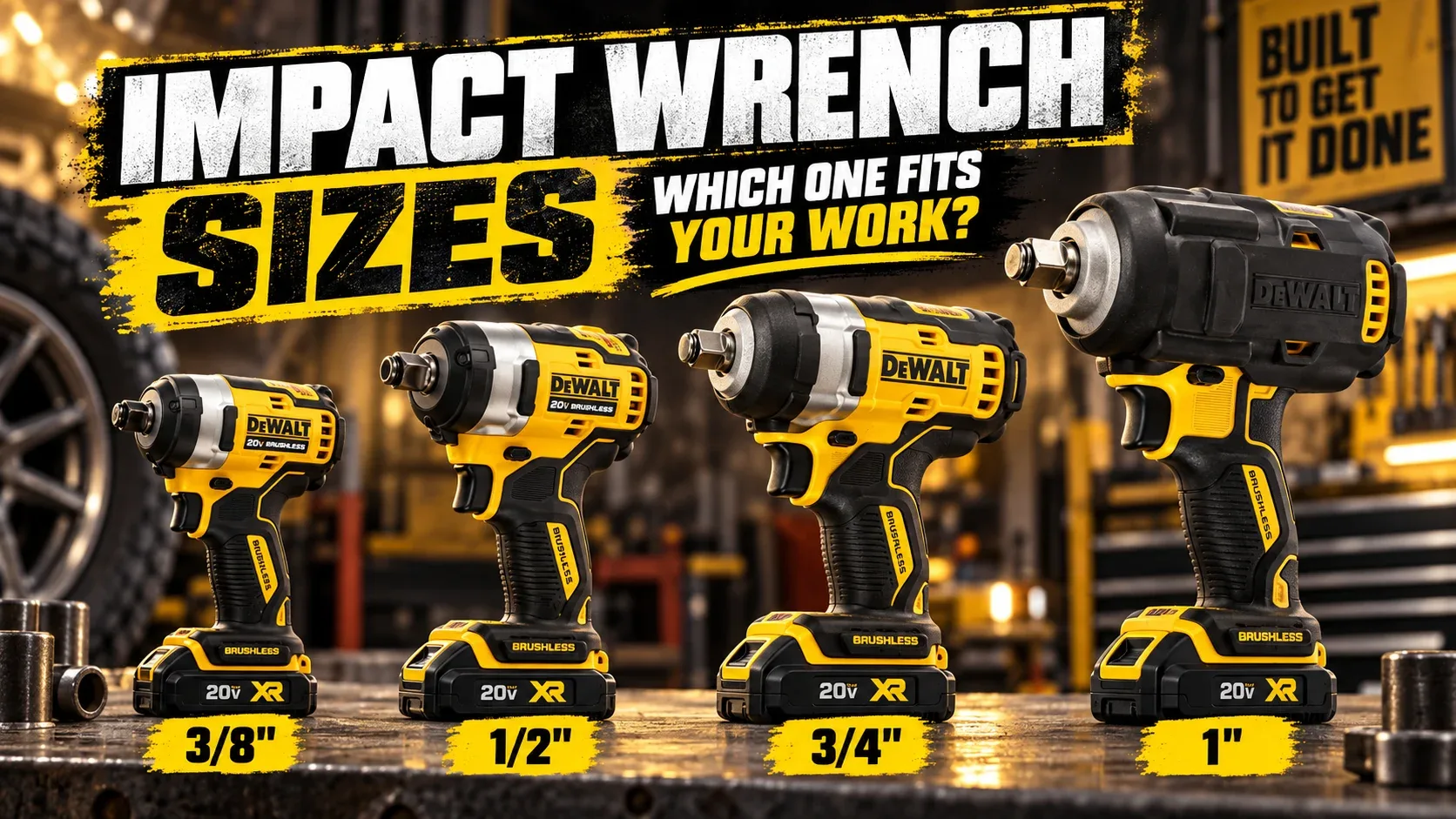
Drive size affects socket compatibility, access and workload—but it does not tell the whole torque story. Use this practical guide to match a DeWalt impact wrench to the fasteners you actually work on.
For most automotive and general workshop users, a 1/2-inch DeWalt impact wrench is the most versatile starting point.
Choose the tool class before chasing the biggest number
A compact 3/8-inch or 1/2-inch wrench often works better in wheel wells and engine bays than a high-torque model. Step up to 3/4-inch only when trucks, equipment, or large regularly seized fasteners are part of your normal workload. A bigger impact is not automatically the better purchase.
Start with the work
What each square-drive size is built to handle
Think of drive size as the socket and workload ecosystem your wrench belongs to. Manufacturer torque ratings still vary dramatically within each size.
3/8 in.
Access first
Best for smaller fasteners, light automotive repair and tight engine-bay work. Current compact DeWalt options reach roughly 250–300 ft-lb fastening torque, depending on model.
1/2 in.
The all-rounder
The most practical choice for lug nuts, brakes, suspension and general repair. DeWalt’s 1/2-inch range spans compact 250 ft-lb models through 1,030+ ft-lb high-torque tools.
3/4 in.
Heavy-duty territory
A better fit for trucks, agricultural equipment, construction hardware and big fasteners. The DCF964 is rated at 1,420 ft-lb fastening and 1,900 ft-lb breakaway torque.
1 in.
Industrial applications
This drive size is typically reserved for commercial vehicles and industrial fastening. No current DeWalt-branded cordless or pneumatic 1-inch square-drive impact wrench appears in the current US lineup.
Compact versus high torque
Why a compact 1/2-inch can be the smarter mechanic’s tool

For most passenger-car work, the best impact wrench is often the one that reaches the fastener cleanly. Compact 1/2-inch tools such as DeWalt’s ATOMIC models can make wheel, brake, suspension and underhood jobs faster without the bulk of a high-torque wrench.
Choose a high-torque 1/2-inch model when you routinely face rusted axle nuts, stubborn suspension hardware, heavy truck wheels, or other fasteners that genuinely demand more breakaway force. Keep in mind that tool weight, battery size and socket access matter on every job.
Read the specifications correctly
Four details that prevent the wrong purchase
Drive size ≠ torque
Two 1/2-inch impact wrenches can be worlds apart. A compact model and a high-torque model share the same socket drive while delivering very different output and physical size.
Fastening torque
This is the manufacturer’s stated maximum torque for driving a fastener. It is useful for comparing tool classes, but it is not a final tightening specification for critical hardware.
Breakaway / nut-busting torque
This describes the maximum force claimed for loosening a stuck fastener. It can be higher than fastening torque, and it is especially relevant for corrosion, seized hardware and heavy service work.
Battery-dependent performance
Published ratings may depend on a particular battery pack and test method. Check the current product documentation for the exact anvil type, battery combination and specification before buying.
Current lineup reference
Representative DeWalt impact wrench options by drive size
| Drive | Example current models | Rated output | Practical fit |
|---|---|---|---|
| 3/8 in. | DCF902 (12V), DCF911 and DCF922 (20V) | 250–300 ft-lb fastening; DCF902 lists 400 ft-lb breakaway | Small fasteners, tight access and light automotive work |
| 1/2 in. | DCF901/903, DCF913, DCF921/923, DCF891/892, DCF900/961 | About 250 to 1,030+ ft-lb fastening; DCF900 lists 1,400 ft-lb breakaway | General automotive repair through high-torque heavy service |
| 3/4 in. | DCF964 (20V XR high-torque) | 1,420 ft-lb fastening; 1,900 ft-lb breakaway | Commercial trucks, machinery, agricultural and construction equipment |
| 1 in. | No current DeWalt-branded cordless or pneumatic square-drive model found | Not applicable in the current US DeWalt lineup reviewed | Typically an industrial and commercial-vehicle drive category |
Specifications are manufacturer-rated maximums and can change by product version, anvil configuration and battery used. Verify the product page and manual before purchase.
Critical fastening safety
An impact wrench is not a final-torque tool
Use an impact wrench to remove fasteners and run them down efficiently. For wheel lug nuts, structural fasteners, flanges and other critical assemblies, finish tightening with an appropriately calibrated torque wrench set to the vehicle or equipment manufacturer’s specification.
Never use a published impact-wrench maximum torque figure as a substitute for a specified final tightening value.
Make the call
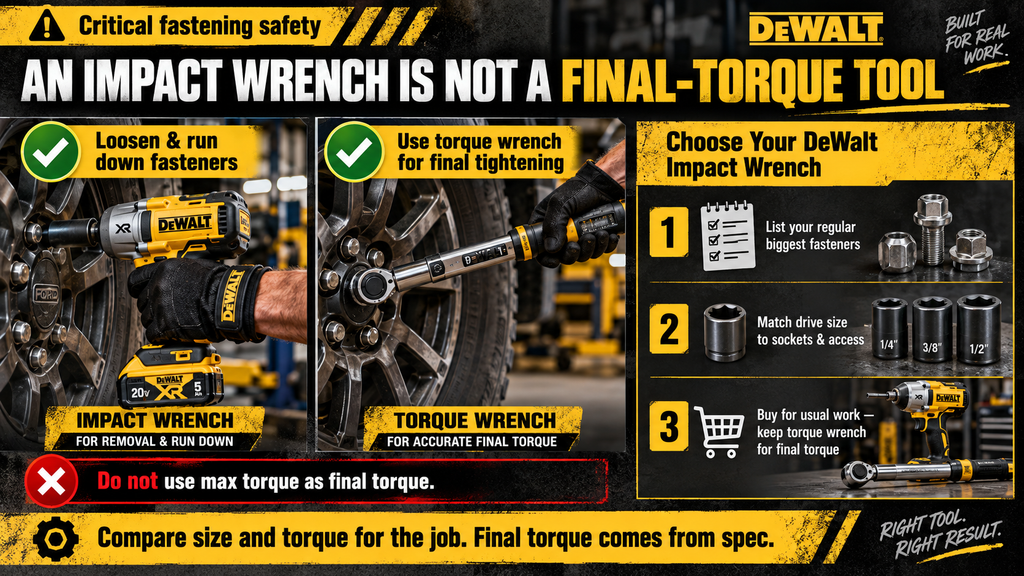
A simple way to choose your DeWalt impact wrench
- 01List the largest and most stubborn fasteners you work on regularly—not once a year.
- 02Choose the drive size that fits your sockets and workspace, then compare torque within that class.
- 03Buy enough capacity for your usual work, and keep a torque wrench for final tightening where specifications matter.
How this guide approaches the choice
Recommendations are based on the practical relationship between access, socket drive, common fastening tasks and manufacturer-published output ratings. Ratings help compare tools, but the correct final torque always comes from the vehicle or equipment manufacturer.
Frequently asked questions
Answers before you choose a drive size
Is 1/2-inch the best size for most automotive work?
For many passenger-car and general workshop jobs, yes. It offers broad socket availability and a useful balance of access, weight and torque. Choose a compact model for tight spaces or a high-torque model for stubborn hardware.
Does a larger drive size always mean more torque?
No. Drive size describes the socket connection and tool category. Output varies widely between models, so compare fastening and breakaway ratings within the drive size that fits your work.
What is the difference between fastening and breakaway torque?
Fastening torque describes driving force, while breakaway torque describes the claimed maximum force for loosening stuck fasteners. Neither rating replaces the manufacturer’s final tightening specification.
Can I use an impact wrench to tighten wheel lug nuts?
You can run lug nuts down carefully, but always finish with a calibrated torque wrench set to the vehicle manufacturer’s specification. Avoid relying on impact settings as the final torque measurement.