

A clear look inside the triangular engine that powered legendary Mazdas what every major part does, how the combustion cycle moves, and why the seals matter.
A Wankel engine diagram, decoded
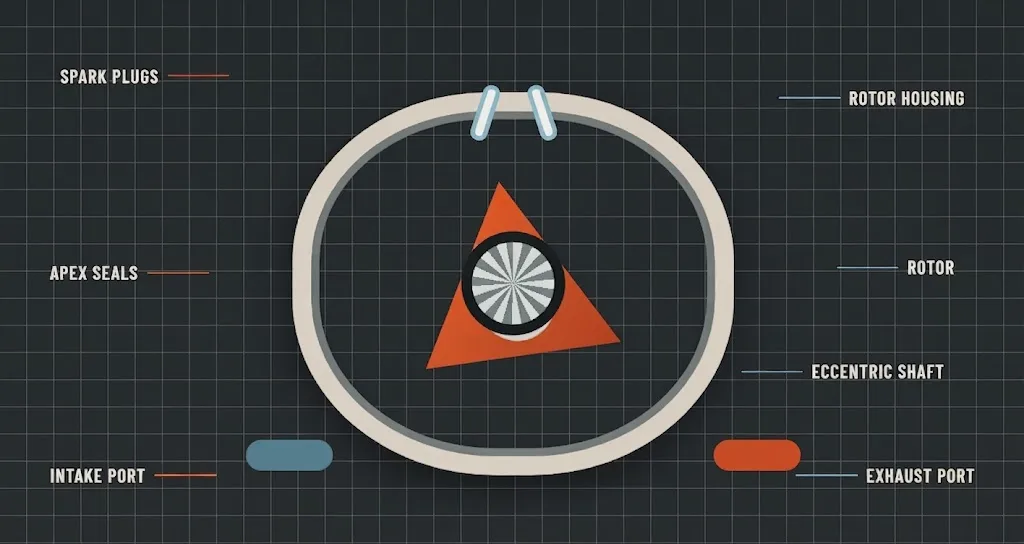
This is a simplified side view of one rotor. The rotor’s three faces continuously create three moving chambers inside the oval-shaped housing.
The six parts that make the diagram click
Think of the rotor as the moving wall of three combustion chambers. Every other major part exists to guide that movement, seal it, feed it, or take power from it.
Rotor
The rounded triangle that turns inside the housing. Its three faces create three separate working chambers at once.
Rotor housing
The oval-like chamber around the rotor. Its special geometry guides the rotor and gives each chamber space to grow and shrink.
Eccentric shaft
The output shaft. It is not a conventional crankshaft: its offset lobes turn the rotor’s orbiting movement into usable rotary motion.
Apex & side seals
Spring-loaded sealing strips at the rotor tips and sides. They separate the chambers so pressure can build where it needs to.
Intake & exhaust ports
Openings in the housing or side plates. Fresh air-fuel charge enters through the intake; spent gases leave through the exhaust.
Spark plugs
Many automotive rotary engines use two plugs per rotor face to ignite the long, moving combustion chamber more completely.
How the rotary combustion cycle works
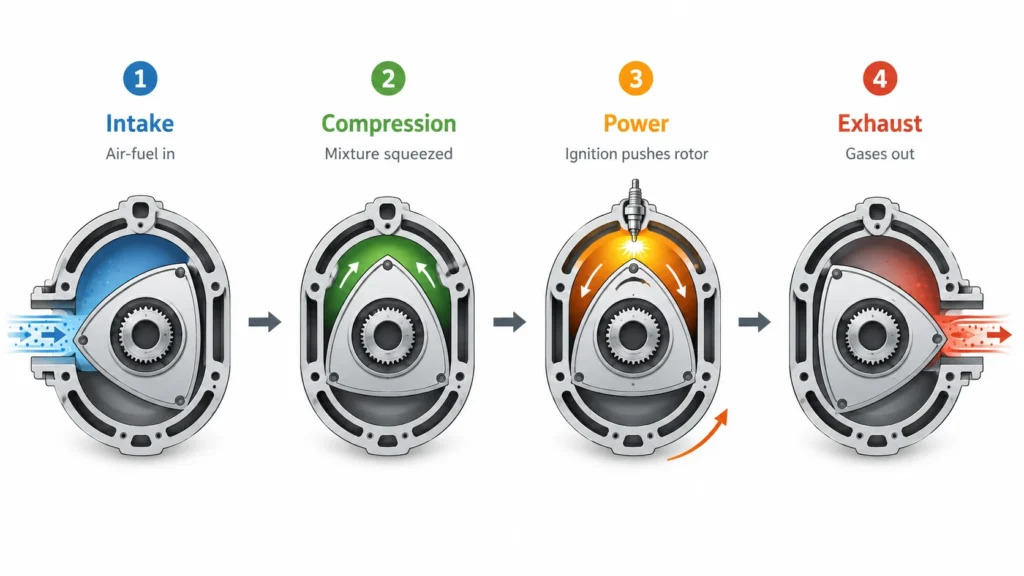
As the rotor travels around the eccentric shaft, the volume behind each rotor face changes. That changing volume performs the same four jobs as a four-stroke piston engine without pistons moving up and down.
Intake
A chamber passes the intake port and grows larger, drawing in the air-fuel charge.
Compression
The rotor keeps moving and the chamber gets smaller, squeezing the charge before ignition.
Combustion / Power
Spark plugs ignite the compressed mixture. Expanding gas pushes on the rotor face and turns the shaft.
Exhaust
The chamber reaches the exhaust port and shrinks again, sweeping combustion gases out.
Three chambers are working at the same time
A single rotor has three faces, so it forms three chambers around the housing. At any instant, one chamber may be taking in charge while another is compressing and a third is delivering power or exhausting. This overlapping work is a key reason a rotary engine can be compact and smooth for its displacement.
Why apex seals matter
Apex seals ride along the housing wall while the rotor moves. They must keep adjacent chambers separated under heat, pressure, and high sliding speed. Seal condition, housing surface condition, lubrication design, tuning, and maintenance all influence how well a rotary engine holds compression.
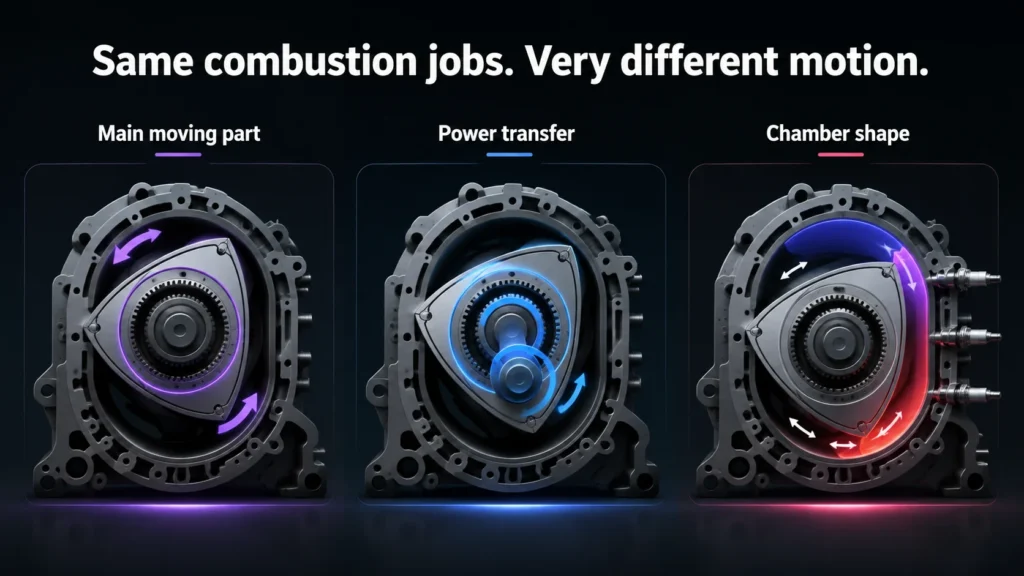
Same combustion jobs. Very different motion.
Main moving part
Triangular rotor orbits and rotates.Pistons reciprocate in cylinders.
Power transfer
Eccentric shaft receives rotor force directly. Connecting rods turn a crankshaft.
Chamber shape
Long, moving chambers around a rotor. Cylindrical chambers above pistons.
Rotary engine diagram FAQs
Why does the rotor look triangular?
The rotor has three curved sides and three apexes. Its shape, paired with the housing geometry, creates three sealed chambers that continuously change volume as it moves.
Does a Wankel engine have a crankshaft?
It uses an eccentric shaft rather than a conventional piston-engine crankshaft. The shaft is offset, allowing it to collect the rotor’s force while the rotor follows its controlled orbit.
Why are rotary engines associated with Mazda?
Mazda invested in rotary development for decades and fitted production rotary engines to vehicles including the Cosmo Sport, RX-7, and RX-8. Its engineering work made the layout especially recognizable to enthusiasts.