
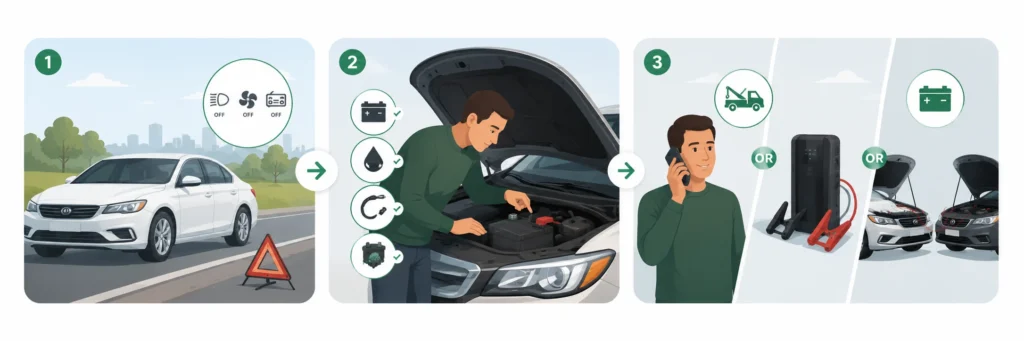
First, get somewhere safe and check for damage. If the battery looks normal and your owner’s manual allows it, you can try a careful jump-start. If it starts but dies again, arrange a battery and charging-system test.
Do not jump-start a damaged battery
Stop and call roadside assistance if the battery is cracked, leaking, swollen, hot, frozen, or smells strongly of rotten eggs. Do not jump-start if you are in an unsafe location, near traffic, or unsure where your vehicle’s approved jump points are.
A dead vehicle battery is one of the most common reasons a car will not start—but it is not the only reason. Rapid clicking, dim lights, or no response at all can point to a weak battery. Use this guide to make a safe decision before you touch the cables.
What to do right now
Make the scene safe
Park safely, shift to Park or Neutral, apply the parking brake, switch off lights and accessories, and keep flames or cigarettes away from the battery.
Inspect before starting
Look for obvious damage, leaks, swelling, loose cables, or heavy corrosion. Check your owner’s manual for the battery or designated terminal locations.
Choose the safest next step
Use roadside assistance if you have it. Otherwise, use a compatible jump pack or donor vehicle only when both vehicles and batteries are suitable.
How to know if your car battery is dead
A battery can be discharged, weak, or at the end of its life. These signs often fit a battery problem, especially after the car has been parked for several days or after lights were left on.
Common signs of a weak or dead battery
Rapid clicking when you turn the key or press Start.
Headlights, cabin lights, or dashboard lights are dim or flickering.
The engine cranks slowly, then will not start—or there is no electrical response.
The car starts after a jump, but later fails to start again.
Battery, alternator, or starter? A quick reality check
The symptoms can overlap. This table is a useful first check, not a substitute for a proper battery and charging-system test.
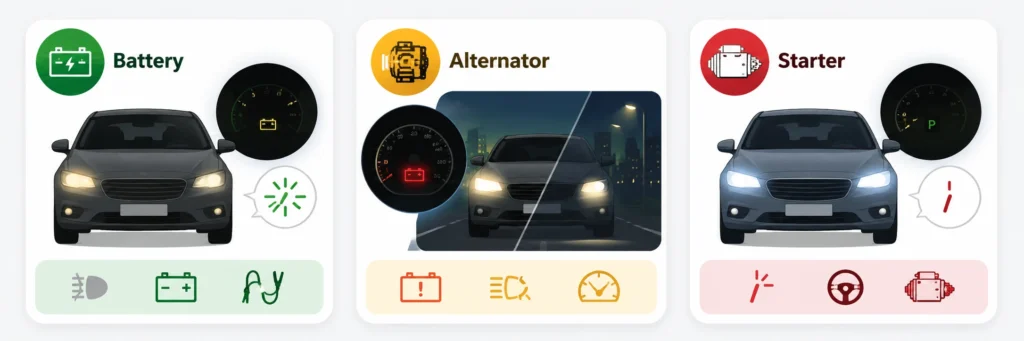
| Possible issue | Typical clues | Best next move |
|---|---|---|
| Weak or dead battery | Rapid clicks, dim lights, slow cranking, or a successful jump-start. | Jump-start only if safe, then have the battery tested. |
| Charging-system fault | Battery warning light while driving; lights dim while the engine runs; car dies soon after a jump. | Avoid a long drive. Get the charging system checked promptly. |
| Starter or connection fault | One solid click, normal bright lights, but no engine cranking. | Arrange diagnosis; a jump may not help. |
A battery warning light usually relates to the charging system while the engine is running—it does not automatically mean the battery alone is bad.
How to jump-start a car safely
Always read your vehicle owner’s manual first. Modern vehicles, hybrids, EVs, start-stop systems, and vehicles with remote battery terminals may have specific procedures. Never connect to a high-voltage hybrid or EV battery.
Prepare both vehicles
Position the vehicles close enough for the cables, but do not let them touch. Turn both ignitions off, place transmissions in Park or Neutral, and set both parking brakes.
Connect red to the dead battery
Attach one red positive clamp to the positive (+) terminal or approved positive jump point on the dead battery.
Connect red to the donor battery
Attach the other red positive clamp to the positive (+) terminal of the donor battery or jump pack.
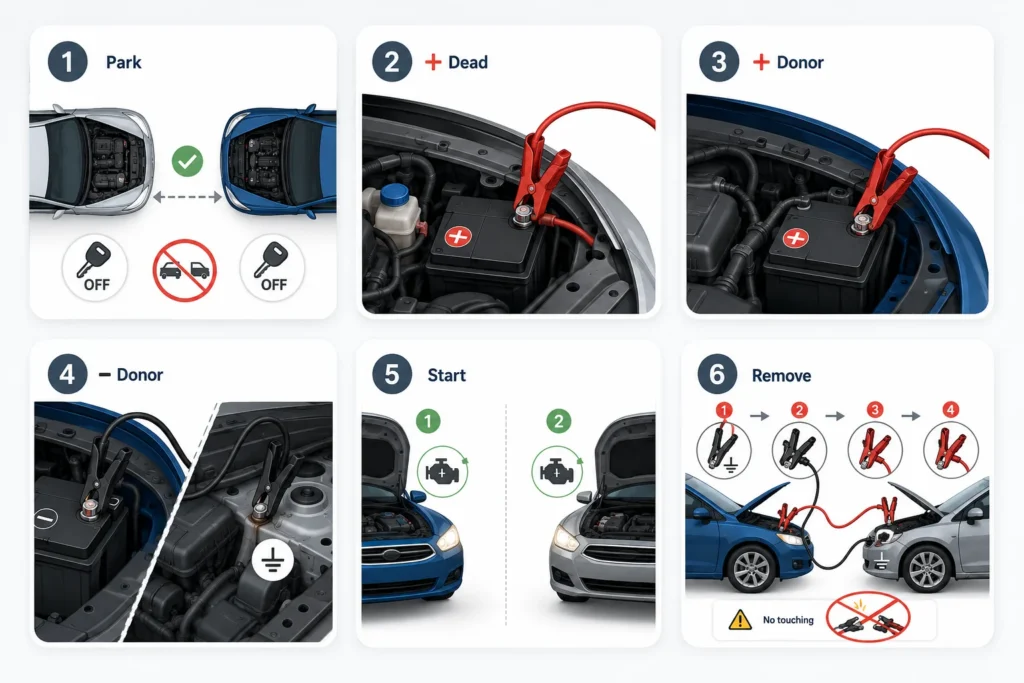
Connect black to the donor, then ground the dead car
Attach one black negative clamp to the donor battery’s negative (−) terminal. Attach the final black clamp to a clean, unpainted metal ground point on the disabled vehicle—away from the battery and fuel system.
Start carefully
Start the donor vehicle if your manual permits, wait a few minutes, then try the disabled vehicle. Do not crank for long periods. If it will not start after a few attempts, stop and seek help.
Disconnect in reverse order
Once the vehicle starts, remove the black ground clamp first, then the other black clamp, then the red donor clamp, and finally the red clamp on the revived vehicle. Keep clamps from touching each other.
After the car starts: drive, charge, or replace?
A 20- to 30-minute drive may help replace some charge, but it may not fully recharge a deeply discharged battery. If possible, take the vehicle to a battery retailer or repair shop for a battery and charging-system test soon after the jump. If the engine stalls, the battery light stays on, or electrical systems fade while driving, pull over safely and call for assistance.
The battery may need replacement when:
- It repeatedly needs a jump-start despite regular use.
- A professional battery test says its capacity is low or it fails a load test.
- It is roughly three to five years old, depending on climate and use.
- The case is swollen, cracked, leaking, or the terminals are badly damaged.
How to avoid another dead battery
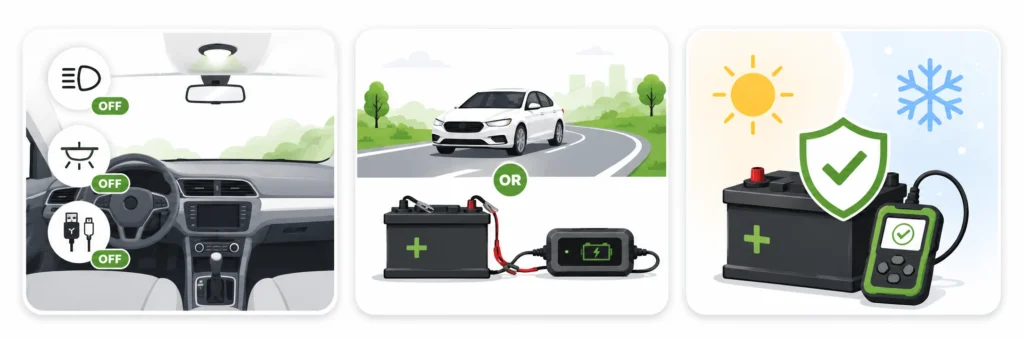
- Turn off interior lights, headlights, chargers, and accessories before leaving the vehicle.
- If the car sits for weeks, drive it regularly or use a manufacturer-approved battery maintainer.
- Have the battery tested before severe summer heat or winter cold, especially once it is more than three years old.
Questions drivers ask when the battery dies
My battery is not under the hood. Can I still jump-start the car?
Many vehicles have approved remote positive and ground terminals under the hood. Use only the manufacturer-designated jump points listed in your owner’s manual; do not guess or remove covers you are unsure about.
Can I push-start a manual car?
Some older manual-transmission petrol or diesel vehicles can be bump-started, but the procedure is not suitable for every vehicle and can be unsafe on traffic roads or slopes. It does not fix the underlying battery problem. Automatic vehicles generally cannot be push-started.
What about hybrids, EVs, and start-stop batteries?
These vehicles may have a separate low-voltage 12-volt battery, specific jump points, or special restrictions. Never touch orange high-voltage cables. Follow the owner’s manual or use professional roadside assistance.