

A bigger voltage number does not automatically mean twice the power or twice the runtime. Here is how to compare 20V and 40V cordless-tool batteries by workload, watt-hours, weight, cost and compatibility.
Choose the workload, then compare the battery system
For drills, drivers, small saws and occasional yard work, a well-designed 20V platform is often the lighter, lower-cost choice. A 40V platform can make more sense for sustained outdoor tools such as high-output blowers, string trimmers, chainsaws and mowers. But voltage is only one part of the story: compare watt-hours, motor design, airflow or cutting specification, battery weight, charger speed and the tools you plan to add next.
Which battery platform suits your work?
These are workload recommendations, not brand rankings. A strong tool-and-battery combination can outperform a weak design with a higher voltage label.
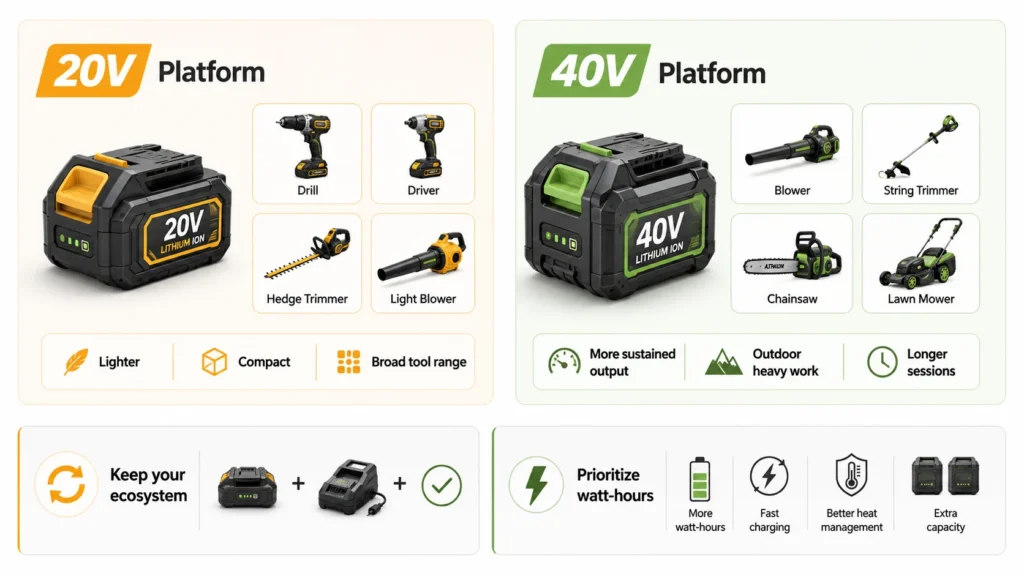
20V platform
A practical fit for drilling, fastening, small repairs, hedge trimming and short leaf-clearing sessions where low weight and a broad tool range matter.
40V platform
Often better suited to tools that need sustained energy delivery, including larger blowers, trimmers, chainsaws and lawn mowers—provided the tool and battery capacity match the job.
Stay with a capable 20V ecosystem
If you already own several 20V batteries and chargers, check whether that platform has the outdoor tool performance you need before starting an expensive second ecosystem.
The system with enough spare energy
For repeated work, prioritize total watt-hours available, rapid-charger support, battery heat management and the cost of a second or third battery—not voltage alone.
20V vs 40V battery: the practical differences
Marketing terms differ between manufacturers. Some packs are labelled with maximum voltage while others use nominal voltage. Use the battery’s stated watt-hours, its compatible tools and the complete tool specification to make a fair comparison.
| Consideration | 20V platform | 40V platform | What matters in practice |
|---|---|---|---|
| Typical tool fit | Drills, impact drivers, compact saws, lights, inflators and many light-duty outdoor tools. | Larger blowers, trimmers, chainsaws, hedge trimmers and mower-oriented equipment. | Tool category is a useful clue, but output depends on motor, controller, gearing and battery design. |
| Power delivery | Can deliver strong performance in compact tools, especially with modern brushless motors. | Can support high-demand outdoor tools with less current needed for the same electrical power. | Voltage does not independently determine cutting speed, torque, airflow or real-world performance. |
| Runtime | Depends on amp-hours, tool load and battery condition. | Also depends on amp-hours, tool load and battery condition. | Compare watt-hours. A 40V battery does not automatically run twice as long as a 20V battery. |
| Weight and handling | Usually easier to keep compact and comfortable for overhead or one-handed work. | Often uses larger packs, which may improve capacity but add weight to handheld equipment. | Balance matters as much as total weight, particularly with trimmers, blowers and saws. |
| Compatibility and ownership cost | Often offers a larger indoor-tool ecosystem and lower entry cost. | May require a dedicated set of batteries and chargers for outdoor equipment. | Batteries are normally not interchangeable across voltage platforms or brands unless the manufacturer explicitly says so. |
Amp-hours tell capacity; watt-hours make comparisons clearer
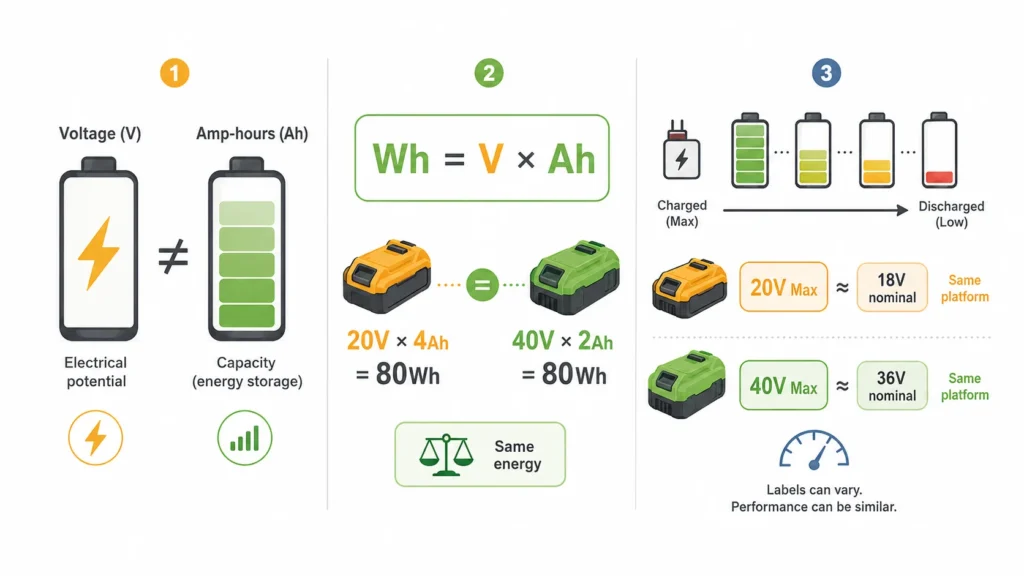
Voltage is electrical potential, while amp-hours (Ah) describe battery capacity. Neither label alone tells you how much stored energy you have. Watt-hours (Wh) combine nominal voltage and amp-hours, making them a more useful starting point for comparing battery energy. Actual usable energy can vary with cell chemistry, battery-management limits, temperature, age and how hard the tool is working.
Why labels can look inconsistent
Lithium-ion cells have a higher voltage immediately after charging and a lower nominal voltage through most of the discharge cycle. That is why closely related platforms may be marketed as 18V or 20V Max, and 36V or 40V Max. Read the manufacturer’s explanation before assuming that one label represents a fundamentally different battery architecture.
Four checks before choosing a cordless battery platform
1. Match the battery to the longest job
Think about your most demanding regular task rather than the occasional five-minute job. A compact 20V drill can be ideal for repair work, while clearing wet leaves, edging a large property or cutting repeated branches may justify a higher-energy outdoor system and spare packs.
2. Compare complete tool specifications
For a blower, compare airflow and air speed. For a trimmer, check cutting swath, line system and weight. For a mower, consider deck width, recommended lawn size and battery count. For drills and saws, examine torque, speed, blade capacity and duty rating. Voltage is only one specification.
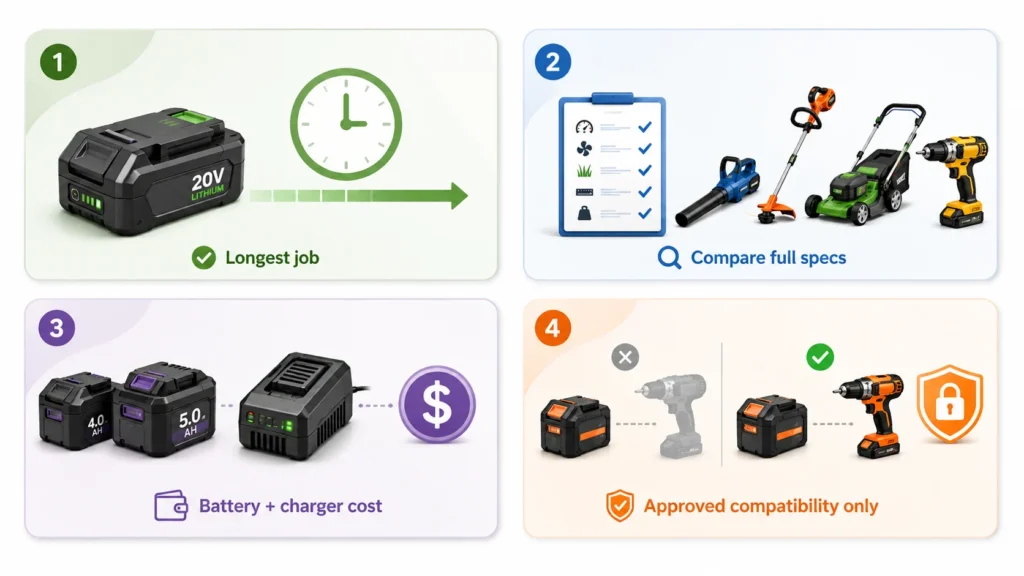
3. Budget for batteries and charging
The bare-tool price is only part of the cost. Price a second battery, a compatible rapid charger and future replacement packs. Frequent users should check charge time, cooling features and whether a charger supports the battery capacities they expect to use.
4. Treat compatibility as brand-specific
A 20V battery should not be forced into a 40V tool, and batteries from different brands are normally incompatible even when their labels look similar. Pack shape, terminals, cell arrangement, communication electronics and battery-management systems vary. Only use combinations approved by the manufacturer.
More battery energy can help—and still feel worse in the hand
A larger battery can reduce interruptions, but it may also make a blower nose-heavy or a trimmer tiring over a long session. Hot weather, dense grass, dull chain cutters and continuously running turbo modes can raise battery and motor temperatures. Modern battery-management systems may reduce output or stop the tool to protect cells, so a spare battery and realistic workload plan can be more valuable than simply choosing the highest-voltage label.
Good reasons to add capacity
- Fewer battery swaps during sustained work
- More useful energy for high-draw tools
- Potentially better fit for larger properties
What to watch for
- Extra mass can increase arm and wrist fatigue
- High-load work can trigger heat protection
- Longer charge time may affect daily workflow
A transparent comparison beats invented runtime claims
Battery performance changes with the tool, battery capacity, motor efficiency, material or yard condition, temperature and user settings. Instead of presenting unverified runtime figures as test results, this guide explains the criteria you can use to compare products fairly and asks you to verify the exact current specifications from official manufacturer documentation.
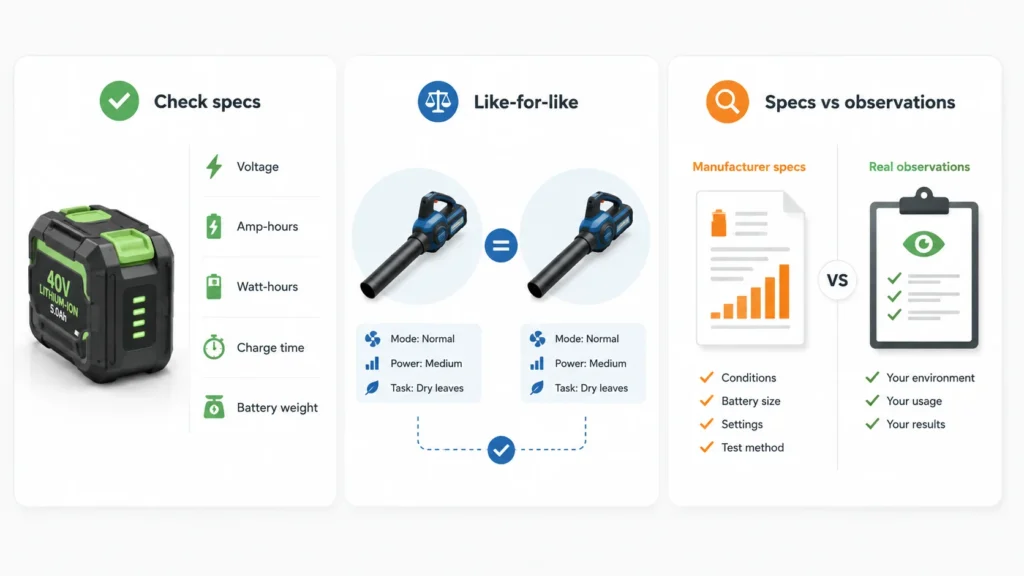
Check the exact battery model
Record the listed voltage, amp-hours, watt-hours, charge time and battery weight. Different batteries in the same platform can change both runtime and handling dramatically.
Compare like-for-like workloads
Compare similar tools on similar tasks. A leaf blower and a drill should not be judged by the same runtime expectation, and a turbo-mode blower cannot be fairly compared with a lower-output setting.
Separate manufacturer data from observations
Treat product claims as manufacturer specifications unless they are tied to a documented independent test method. Look for conditions, battery size, settings and measurement criteria before relying on a number.
20V vs 40V battery FAQ
Is a 40V tool always more powerful than a 20V tool?
No. Higher voltage can help a system deliver a given amount of power with lower current, but real tool performance also depends on motor type, controller programming, gearing, battery cells and the mechanical design of the tool. Compare the actual output specifications relevant to the tool category.
Does a 40V battery provide twice the runtime of a 20V battery?
Not necessarily. Runtime depends on stored energy in watt-hours and on how much power the tool draws. A 40V 2.5Ah battery and a 20V 5Ah battery can both be approximately 100Wh. The tool, setting, workload, temperature and battery age also affect usable runtime.
Can a 20V battery be used in a 40V tool?
Normally, no. Battery platforms use different terminal layouts, electronics and battery-management systems. Do not modify a battery or use unapproved adapters. Use only the batteries and chargers that the tool manufacturer lists as compatible.
Is 20V enough for a leaf blower or string trimmer?
It can be enough for light trimming and quick cleanup, especially on a small property. For wet leaves, dense growth, long edging sessions or frequent commercial-style use, compare the strongest 20V options with 40V systems based on airflow, cutting performance, battery watt-hours, tool weight and the number of spare batteries you can justify.