

Learn the most useful hammer types, the parts that affect how they strike, and when a softer or more specialized tool is the safer choice.
Start with a 16-ounce smooth-face claw hammer for general repairs, a rubber mallet for flooring or delicate assembly, and a compact club hammer only if you regularly use masonry chisels. Add specialty hammers when the work actually demands them.
Parts of a hammer: the names worth knowing
Head shape tells you what a hammer is meant to do. The striking face, opposite end, handle length, and grip material all change the balance, force, and risk of marking the work.
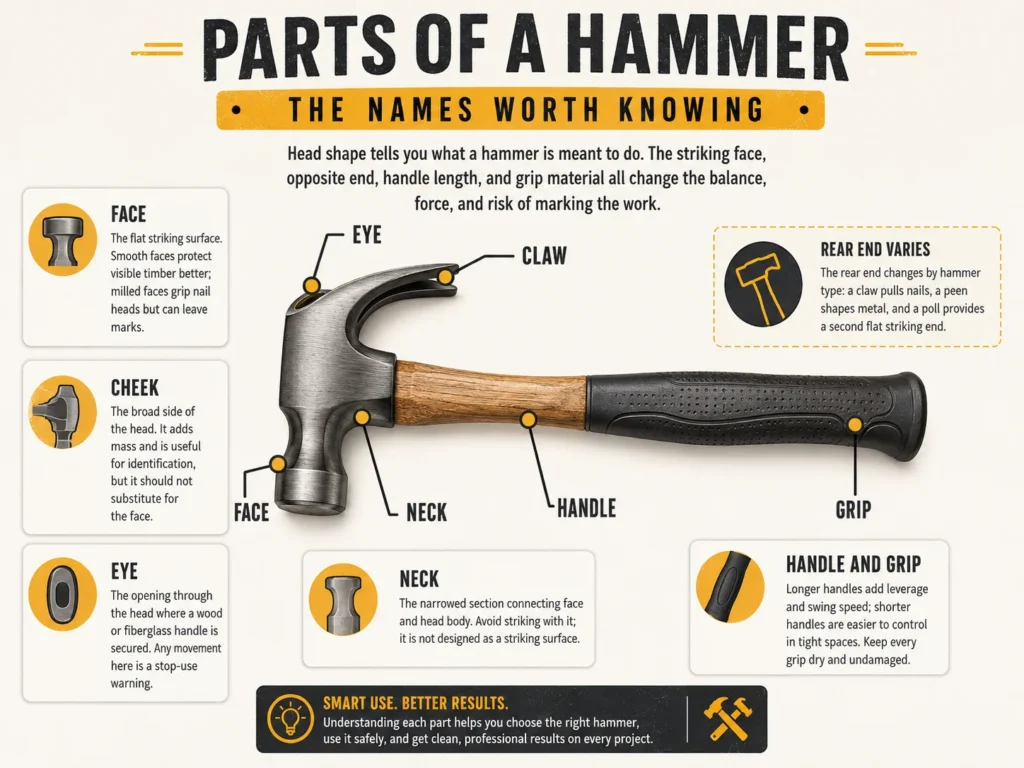
Face
The flat striking surface. Smooth faces protect visible timber better; milled faces grip nail heads but can leave marks.
Neck
The narrowed section connecting face and head body. Avoid striking with it; it is not designed as a striking surface.
Eye
The opening through the head where a wood or fiberglass handle is secured. Any movement here is a stop-use warning.
Cheek
The broad side of the head. It adds mass and is useful for identification, but it should not substitute for the face.
Claw, peen, or poll
The rear end changes by hammer type: a claw pulls nails, a peen shapes metal, and a poll provides a second flat striking end.
Handle and grip
Longer handles add leverage and swing speed; shorter handles are easier to control in tight spaces. Keep every grip dry and undamaged.
10 common types of hammers—and what each is actually for
Use the head shape as your first clue. A hammer designed for nails, masonry, soft materials, or metalwork can look similar from a distance but behave very differently when it lands.
1. Claw hammer
The familiar household hammer: one flat face for driving nails and a curved claw for pulling them. A 16-ounce smooth-face model gives most DIY users a good mix of control and force.
2. Framing hammer
Built for repeated structural work, framing hammers often have a longer handle, straighter claw, heavier head, and milled face. They drive large nails quickly in framing and roofing.
3. Ball-peen hammer
Recognizable by its rounded peen opposite a flat face. Mechanics and metalworkers use it for shaping metal, peening rivets, and striking punches designed for the task.
4. Cross-peen hammer
This hammer has a narrow wedge-shaped peen set across the handle. It helps start small tacks and shape metal in a controlled direction, especially near corners or tight lines.
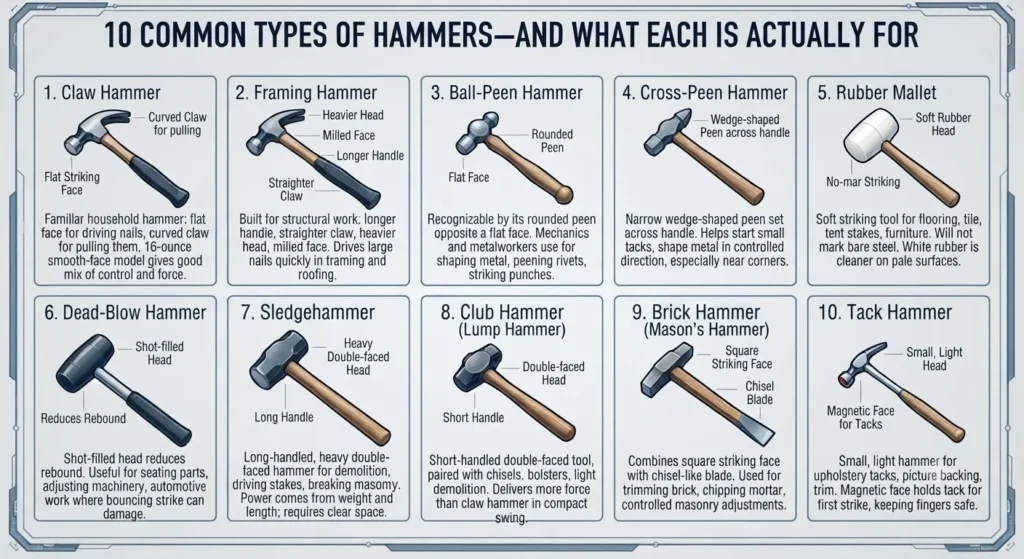
5. Rubber mallet
A soft striking tool for flooring, tile spacers, tent stakes, fitted furniture parts, and other work that should not be marked by bare steel. Black rubber may leave scuffs; white rubber is cleaner on pale surfaces.
6. Dead-blow hammer
A dead-blow hammer has a shot-filled head that reduces rebound. It is useful for seating parts, adjusting machinery, and automotive work where a bouncing strike can damage a component or your control.
7. Sledgehammer
A long-handled, heavy double-faced hammer for demolition, driving stakes, and breaking suitable masonry. Its power comes from head weight and handle length, so it requires clear space and deliberate control.
8. Club hammer
Also called a lump hammer, this short-handled double-faced tool is commonly paired with cold chisels, brick bolsters, and light demolition work. It delivers more force than a claw hammer in a compact swing.
9. Brick hammer
A mason’s hammer combines a square striking face with a chisel-like blade. It is used for trimming brick, chipping mortar, and making small controlled adjustments in masonry work.
10. Tack hammer
A small, light hammer used for upholstery tacks, picture backing, and trim work. Many have a magnetic face that holds a tack for the first light strike, keeping fingers farther from the target.
Specialty hammer types worth knowing
These tools are useful when their specific head shape matches the work. If a specialty hammer is unfamiliar, check the manufacturer’s intended-use guidance before striking.
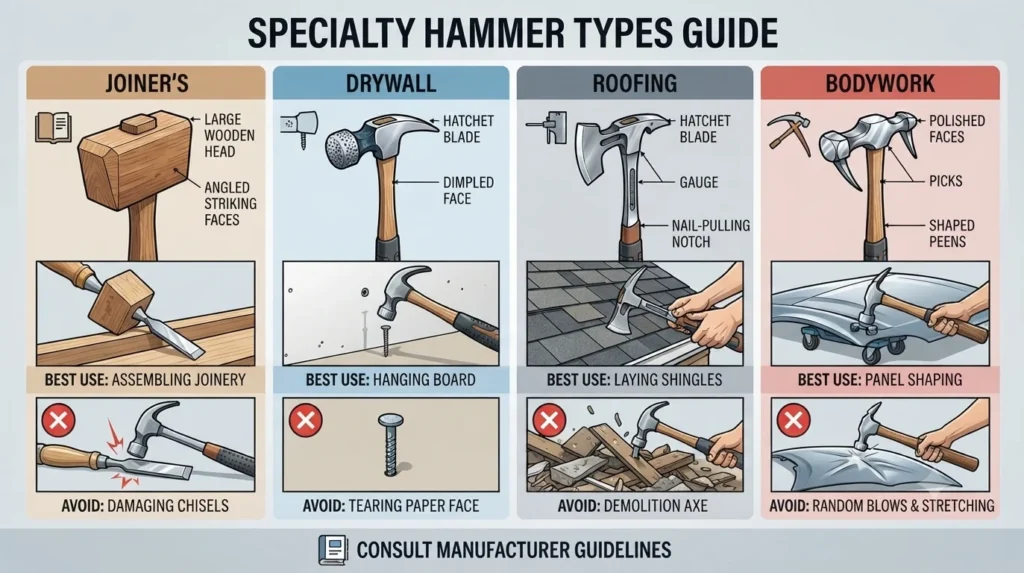
| Tool | Recognize it by | Best use | What to avoid |
|---|---|---|---|
| Wooden joiner’s mallet | Large wood head with angled or cylindrical faces | Striking wood chisels and assembling joinery | Metal hammers can damage chisel handles and mar timber |
| Drywall hammer | Hatchet-style rear blade and dimpled face | Hanging board and setting drywall fasteners | Overdriving fasteners can tear the paper face |
| Roofing / shingle hammer | Hatchet blade, gauge, and nail-pulling notch | Laying shingles and trimming roofing material | Do not use it as a general demolition axe |
| Bodywork hammer | Polished faces, picks, and shaped peens | Controlled automotive panel shaping with a dolly | Random blows can stretch and worsen a panel |
The wrong hammer can damage the work—or turn a small strike into an injury.
Safe striking basics
Wear eye protection when striking metal, masonry, nails, chisels, or any hard surface. Keep fingers and bystanders clear of the swing path. Strike squarely with the intended face, match the hammer size to the task, and never use the side of the head as a shortcut.
When to retire a hammer
Stop using a hammer with a loose head, cracked or splintered handle, oily grip, chipped face, or mushroomed striking end. Worn steel can shed fragments, while a loose head can fly off unexpectedly. Replace it rather than trying to force precise work.
How weight, face, and handle affect the job
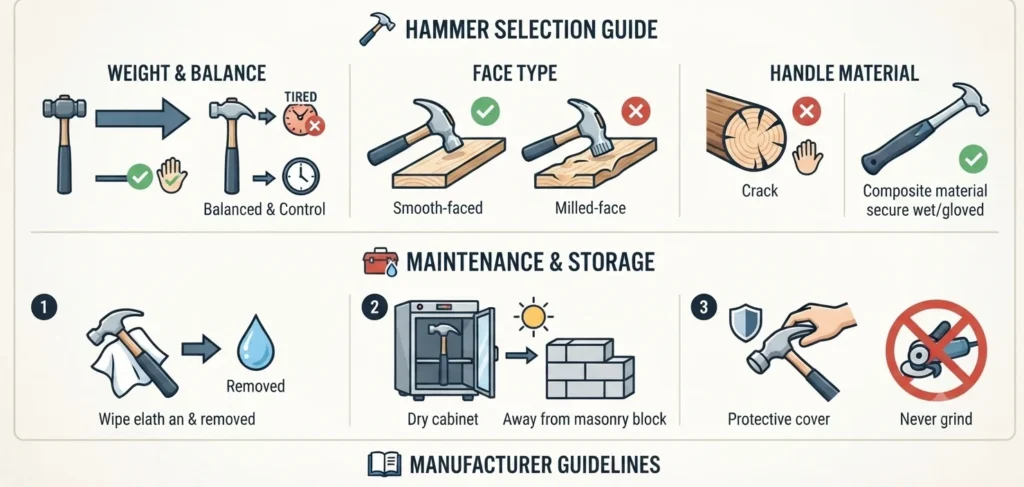
Heavier heads deliver more force but tire the wrist and are easier to overdrive. For household work, control usually matters more than maximum weight. Try the balance if possible: the hammer should feel secure without forcing your grip to compensate.
- • Smooth face: best for trim, furniture, and visible wood surfaces.
- • Wood handle: traditional feel and good vibration damping, but inspect for cracks and drying.
- • Fiberglass or steel handle: durable and weather-resistant; choose a grip that stays secure when hands are sweaty or gloved.
Care and storage
Wipe away moisture and dust after work, especially after masonry or outdoor jobs. Store hammers where handles stay dry, and protect polished faces from unnecessary damage. Never grind or reshape a face unless the manufacturer specifically provides guidance.
Frequently asked questions about hammer types
What is the difference between a claw hammer and a framing hammer?
A claw hammer is a general-purpose tool with a curved nail-pulling claw and often a smooth face. A framing hammer is usually longer, heavier, and built for fast structural nailing; many have a milled face and straight claw for leverage.
When should I use a mallet instead of a metal hammer?
Use a rubber, wooden, or soft-face mallet when you need to move or seat a part without leaving a steel strike mark. Flooring, furniture assembly, tile work, and chisel work are common examples.
What hammer weight is best for a basic home toolbox?
For many homeowners, a 16-ounce smooth-face claw hammer is a versatile starting point. Smaller heads offer more control for light work, while heavier heads make repeated large-nail work easier but can fatigue the user.
Can I still use a hammer with a chipped face or cracked handle?
No. A chipped face can throw metal fragments, a cracked handle can fail under load, and a loose head can detach. Take the tool out of service and replace it.