

A clear, workshop-tested way to identify the different kinds of pliers, choose the right jaws for the job, and avoid damaging wire, fittings, and finishes.
Start with combination or slip-joint pliers for everyday gripping, needle-nose pliers for cramped work, and diagonal cutters for light copper wire and cable ties. Add tongue-and-groove pliers when plumbing jobs become common.
11 common types of pliers—and what each is actually for
Jaw shape tells you more than handle color. Match the gripping surface, pivot, and cutting edge to the material—not just the task you hope the tool can do.
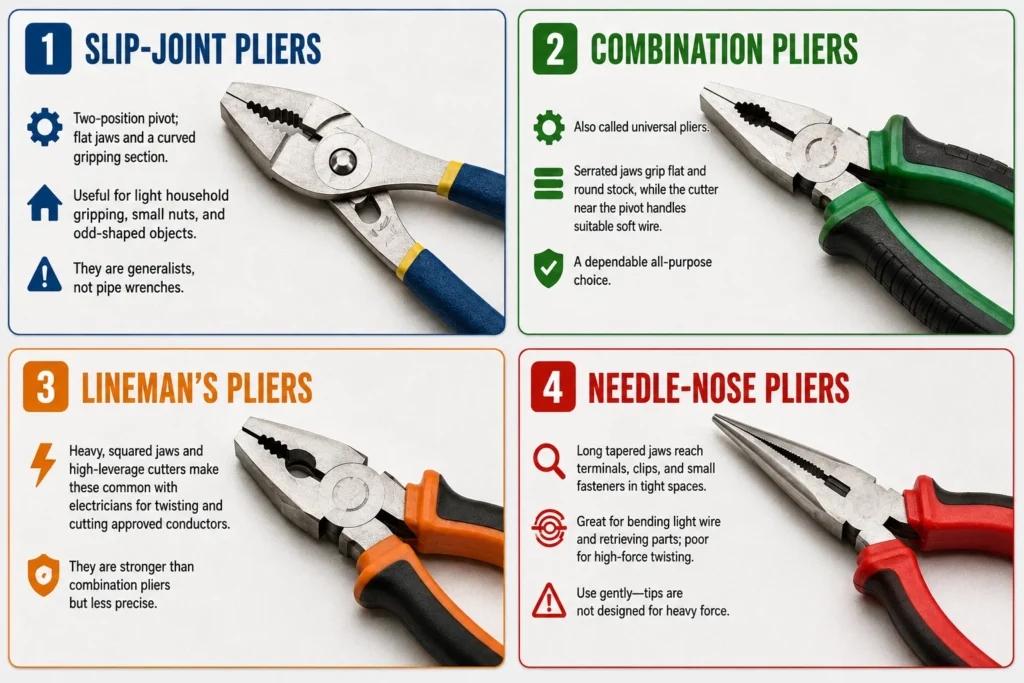
1. Slip-joint pliers
Two-position pivot; flat jaws and a curved gripping section. Useful for light household gripping, small nuts, and odd-shaped objects. They are generalists, not pipe wrenches.
2. Combination pliers
Also called universal pliers. Serrated jaws grip flat and round stock, while the cutter near the pivot handles suitable soft wire. A dependable all-purpose choice.
3. Lineman’s pliers
Heavy, squared jaws and high-leverage cutters make these common with electricians for twisting and cutting approved conductors. They are stronger than combination pliers but less precise.
4. Needle-nose pliers
Long tapered jaws reach terminals, clips, and small fasteners in tight spaces. Great for bending light wire and retrieving parts; poor for high-force twisting.
5. Diagonal-cutting pliers
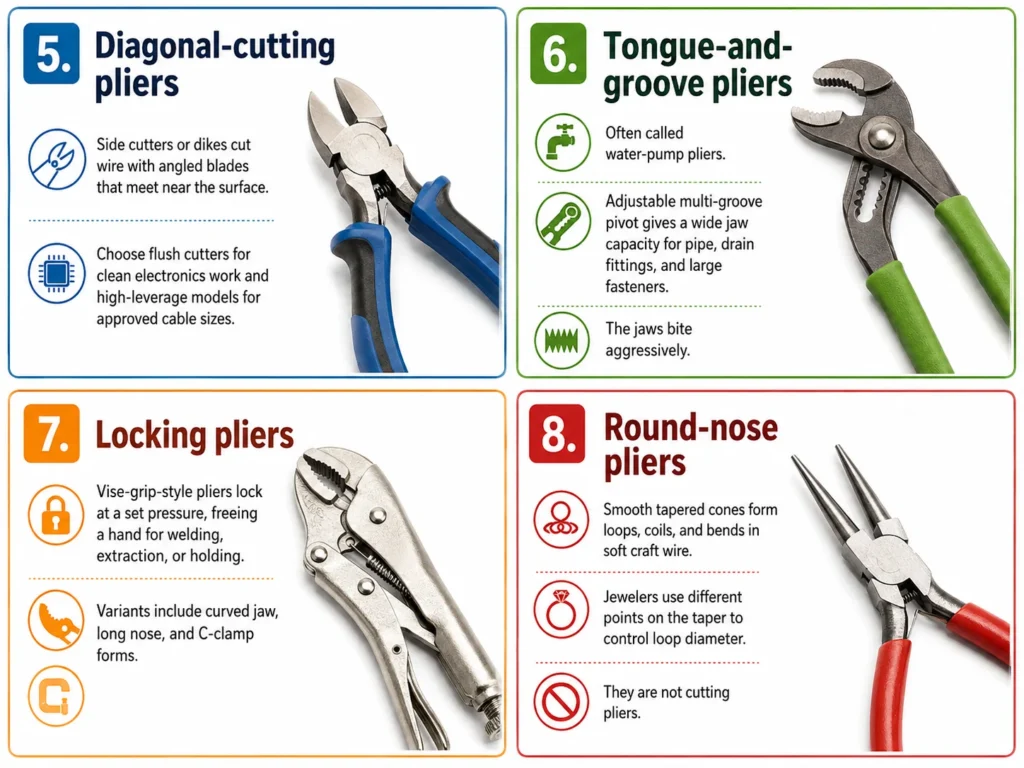
Side cutters or dikes cut wire with angled blades that meet near the surface. Choose flush cutters for clean electronics work and high-leverage models for approved cable sizes.
6. Tongue-and-groove pliers
Often called water-pump pliers. Their adjustable multi-groove pivot gives a wide jaw capacity for pipe, drain fittings, and large fasteners. The jaws bite aggressively.
7. Locking pliers
Vise-grip-style pliers lock at a set pressure, freeing a hand for welding, extraction, or holding. Variants include curved jaw, long nose, and C-clamp forms.
8. Round-nose pliers
Smooth tapered cones form loops, coils, and bends in soft craft wire. Jewelers use different points on the taper to control loop diameter. They are not cutting pliers.
9. Crimping pliers
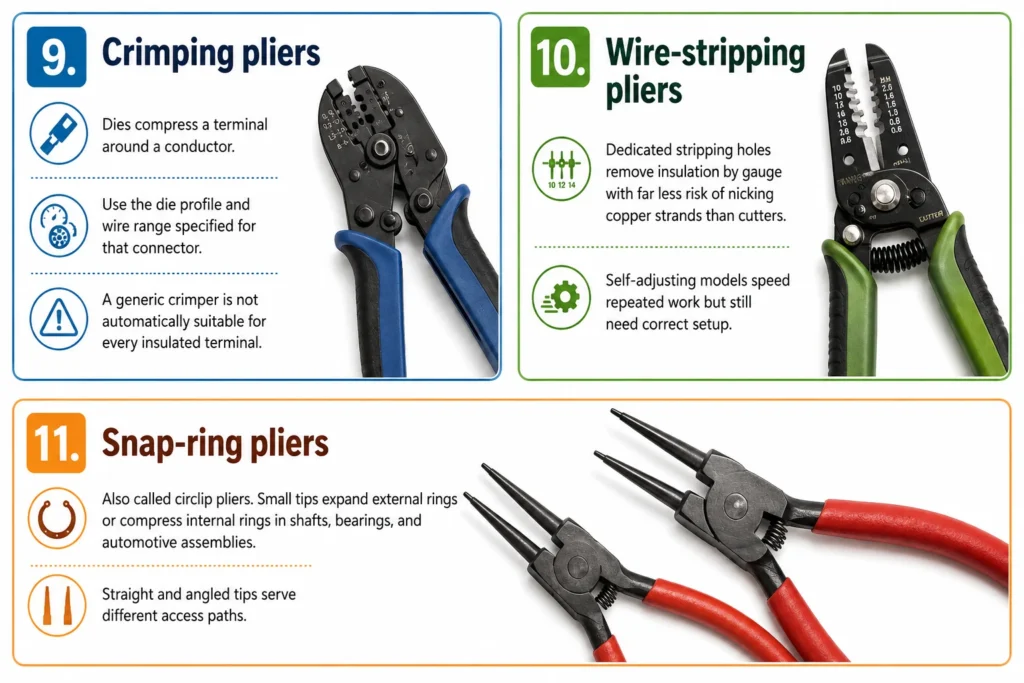
Dies compress a terminal around a conductor. Use the die profile and wire range specified for that connector; a generic crimper is not automatically suitable for every insulated terminal.
10. Wire-stripping pliers
Dedicated stripping holes remove insulation by gauge with far less risk of nicking copper strands than cutters. Self-adjusting models speed repeated work but still need correct setup.
11. Snap-ring pliers
Also called circlip pliers. Small tips expand external rings or compress internal rings in shafts, bearings, and automotive assemblies. Straight and angled tips serve different access paths.
Specialty pliers worth knowing
| Tool | Recognize it by | Best use | Watch out for |
|---|---|---|---|
| Bent-nose / flat-nose | Angled or broad smooth jaws | Guiding wire; holding small flat parts | Broad jaws can mark soft finishes |
| End-cutting / nail-pulling | Cutters face forward at the head | Pulling staples, brads, and finishing nails | Rock gently on a wood block; avoid denting trim |
| Hose-clamp pliers | Long reach, cable, or locking clamp head | Spring hose clamps in cramped engine bays | Match the tool to clamp style and reach |
| Fencing / welding / fishing | Multi-function head, wide jaws, or corrosion-resistant build | Fence staples, welding nozzle work, hooks and split rings | Purpose-built does not mean universal—check capacity |
The wrong pliers can turn a small repair into a damaged part—or an injury.
Five rules before you squeeze
Never use pliers as a hammer or substitute wrench. Do not extend handles with a pipe. Keep fingers clear of cutting jaws. Reject tools with cracked grips, rusted pivots, or loose joints. Most importantly, do not cut material beyond the manufacturer’s rated capacity.
What quality pliers feel like
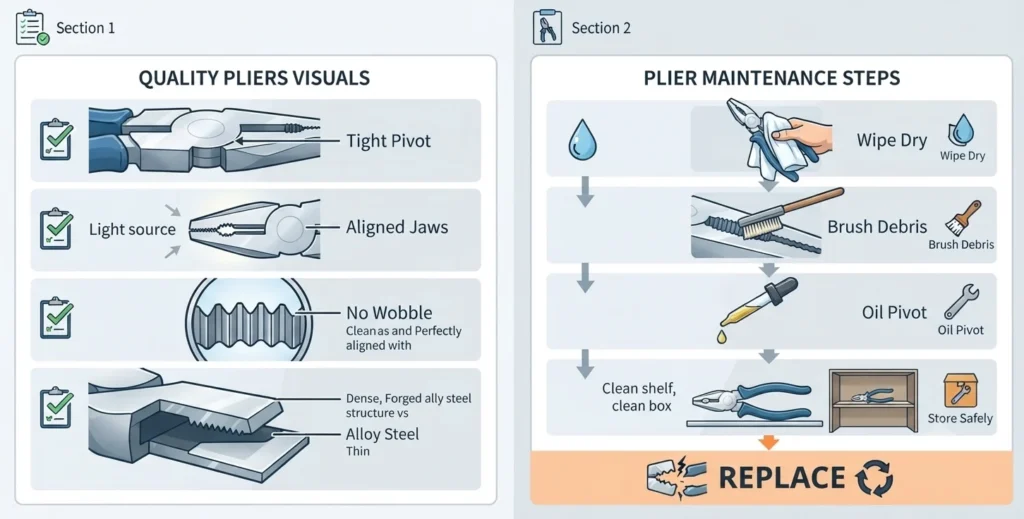
Look for a smooth, tight pivot; evenly meeting jaws; cutters without chips; and handles that sit securely. Forged alloy steel usually withstands workshop use better than thin stamped construction, but the correct design matters more than brand alone.
- • Jaw teeth that meet evenly and do not wobble
- • A stated cutting capacity for the exact wire material
- • A finish and handle material suited to your environment
Keep the pivot working
Wipe tools dry after use, brush debris from serrations, and add a small drop of light oil at the pivot. Store pliers away from damp concrete and chemicals. Clean gripping faces before working on delicate fittings.
If cutters are chipped, jaws are misaligned, or a pivot is loose, replace the tool rather than trying to force precise work.
Quick answers
Can pliers cut hardened steel?
Only if the manufacturer specifically rates that model and cutter geometry for the material. Standard cutters can chip or lose alignment when used on hardened wire, nails, screws, or chain. Use bolt cutters, a cutoff tool, or another rated cutting method when required.
Are tongue-and-groove pliers the same as water-pump pliers?
In common usage, yes. Both names describe adjustable pliers with interlocking grooves that give a wide jaw range. “Channel-lock” is also widely used as a generic term, though it originated as a brand name.
What should I use instead of pliers on a nut?
Use the correct-size wrench or socket whenever possible. Their flats distribute force around the nut and are far less likely to round it. Pliers are a fallback for irregular shapes, damaged hardware, or jobs where a wrench cannot fit.