

For most passenger cars, crossovers, and many SUVs, a 1/2-inch-drive torque wrench is the most practical torque wrench for lug nuts. But the correct final setting is never universal: confirm it in your vehicle, wheel, or wheel-hardware documentation before tightening.
A 1/2-inch-drive wrench is usually the right starting point for wheel lug nuts
Drive size describes the square connection between a wrench and its socket. It does not tell you the socket size that fits your lug nut, and it does not tell you the torque setting your vehicle needs. For ordinary home tire work, a 1/2-inch-drive torque wrench offers a useful combination of leverage, socket availability, and range coverage.
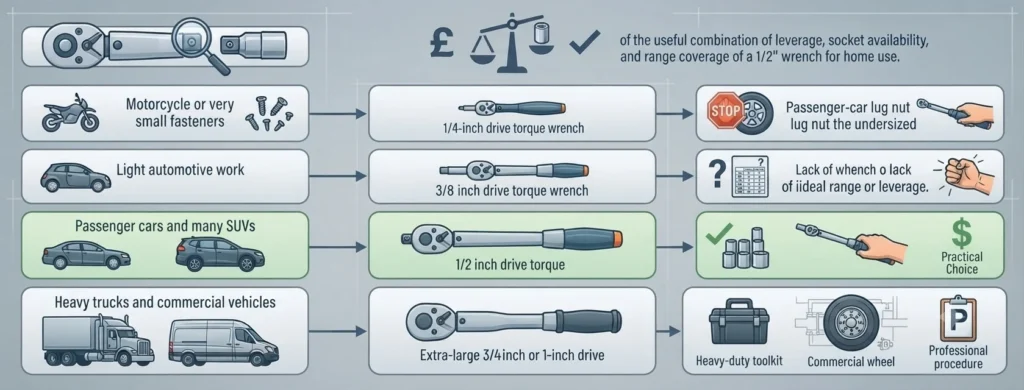
| Vehicle or task | Commonly suitable drive | Buying consideration |
|---|---|---|
| Motorcycle or very small fasteners | 1/4-inch | Usually too small for passenger-car lug nuts. |
| Light automotive work | 3/8-inch | May cover some wheel specifications, but may lack ideal range or leverage. |
| Passenger cars and many SUVs | 1/2-inch | Usually the most practical choice for lug nuts and wheel bolts. |
| Heavy trucks and commercial vehicles | 3/4-inch or 1-inch | Requires heavy-duty equipment and vehicle-specific procedures. |
Drive size, socket size, and torque specification are different things
The torque-wrench drive size is the square anvil where a socket attaches: commonly 3/8 inch, 1/2 inch, or 3/4 inch. A 1/2-inch-drive wrench accepts a socket with a matching 1/2-inch square drive.
The lug-nut socket size is the opening that fits the outside of the nut or wheel bolt head, often 17 mm, 19 mm, 21 mm, 22 mm, 3/4 inch, or 13/16 inch. The torque specification is the final tightening value, expressed in lb-ft or N·m, that must be confirmed from reliable documentation.
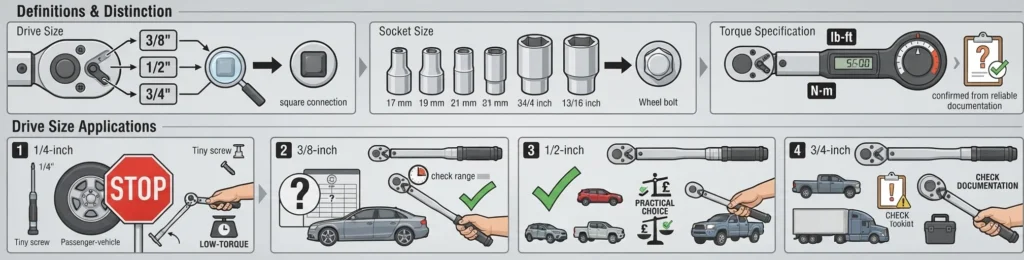
1/4-inch drive: not the usual wheel tool
Best suited to low-torque fasteners. It is typically inappropriate for passenger-vehicle lug nuts because its range and leverage are designed for much smaller work.
3/8-inch drive: possible, but check the range
Some 3/8-inch torque wrenches can reach certain passenger-car specifications. Before using one, verify that your required setting sits comfortably inside the tool’s stated operating range.
1/2-inch drive: the home wheel-work favorite
This is the most versatile option for wheel nut torque wrenches used on cars, crossovers, light trucks, and many SUVs. Compatible sockets are common and the handle length is usually practical for controlled final tightening.
3/4-inch drive: for higher-torque work
Larger drive tools are often used for heavy pickups, trailers, commercial vehicles, and equipment with much higher specified torque. Do not assume your truck needs one without checking its documentation.
Select a torque range around your vehicle’s actual requirement
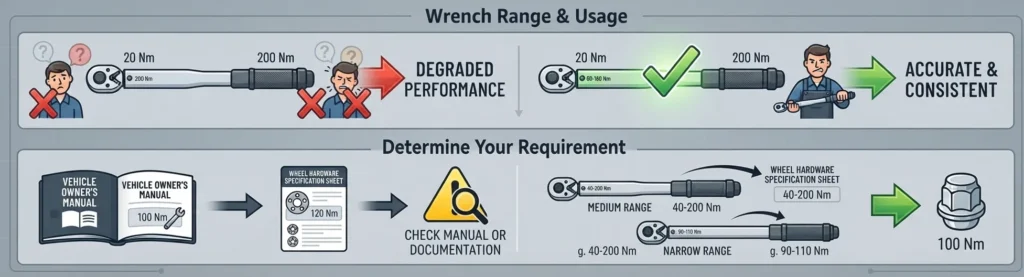
The best torque range for lug nuts is not simply the highest number on the tool. A wrench is easier to set and use consistently when the target value is not pressed against its minimum or maximum marking. Check the working range and instructions for the exact model before purchase.
Many passenger-vehicle owners choose a 1/2-inch wrench with a range intended for common automotive wheel specifications, but the correct choice depends on the number printed in your owner’s manual or wheel documentation. Replacement wheels, spacers, and aftermarket hardware can carry different instructions.
What to look for in a wheel torque wrench
Readable scale
Look for clear lb-ft and N·m markings, or a digital display that is easy to read in a garage or driveway.
Positive signal
A dependable click, split-beam release, or digital alert helps you stop at the set point instead of guessing.
Calibration support
Choose a tool with a manual, stated accuracy, durable case, and realistic access to recalibration or service.
Your owner’s manual is the authority for the final setting
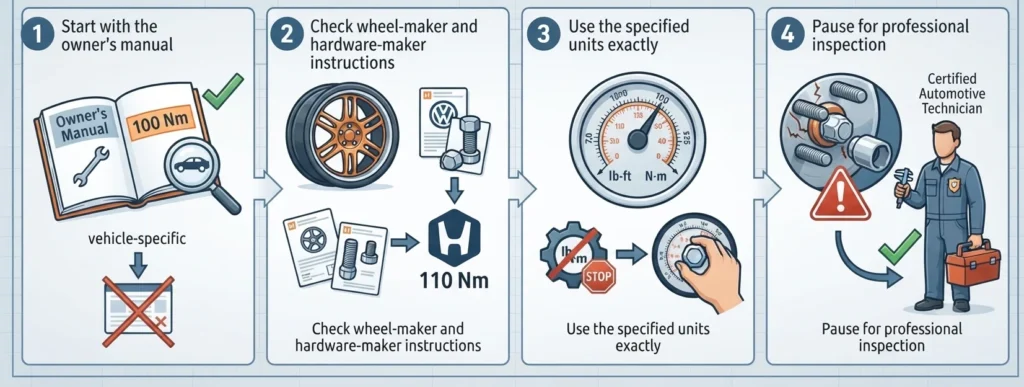
Do not estimate a vehicle’s lug-nut torque from its make, body style, or a generic online chart. Torque can vary with wheel design, fastener type, stud diameter, seating style, and manufacturer procedure. Look for a vehicle-specific wheel installation or tire-change section.
- Start with the owner’s manual, factory service information, or official manufacturer support material.
- Check wheel-maker and hardware-maker instructions when using aftermarket wheels, wheel bolts, nuts, spacers, or adapters.
- Use the specified units exactly and convert only when your torque wrench instructions support the conversion.
- Pause for professional inspection if studs, threads, lug nuts, seats, or sockets are damaged, corroded, or cross-threaded.
Use gradual, even tightening—not one hard pull on each nut
Correct tool selection matters, but technique matters too. Work on a stable, level surface with proper lifting and support equipment. Follow the vehicle maker’s wheel-removal and wheel-installation instructions for your particular vehicle.
- With the wheel correctly seated, start every lug nut or wheel bolt by hand to reduce the risk of cross-threading.
- Snug the fasteners gradually in the manufacturer-recommended star or crisscross pattern, rather than fully tightening one fastener at a time.
- Lower the vehicle according to the manual so the wheel is properly seated and cannot rotate during final torque.
- Set a calibrated torque wrench to the documented specification and tighten in the specified sequence using smooth, controlled force.
- Stop immediately when the wrench clicks, releases, or signals. Do not add an extra pull after the target is reached.
An impact wrench can install a wheel, but it should not replace final torque
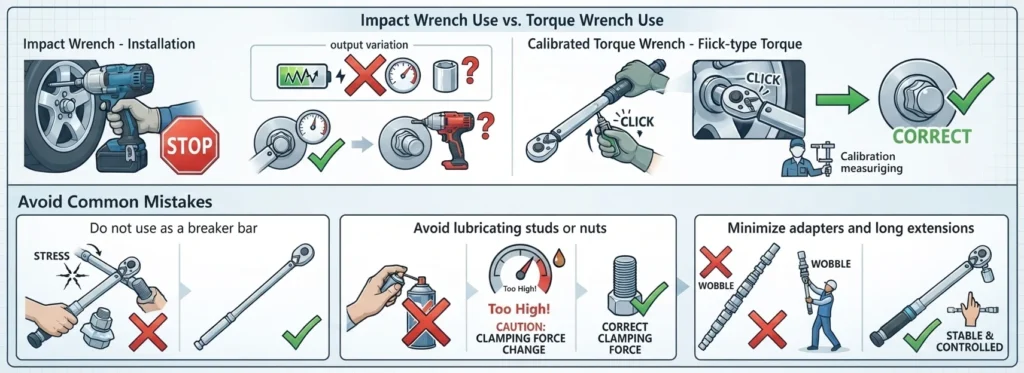
An impact wrench may help remove fasteners or run them down carefully during installation. Its output can vary with battery charge, air pressure, settings, socket fit, fastener condition, and technique. It is not a precise substitute for a calibrated torque wrench when final wheel torque matters.
Avoid these common mistakes
Do not use a torque wrench as a breaker bar. Avoid lubricating studs or nuts unless the manufacturer specifically instructs you to do so, because lubrication can change clamping force. Minimize adapters and long extensions where possible; they can make the tool less stable and harder to control.
Treat a torque wrench as a measuring tool
A torque wrench can lose confidence after damage, overload, poor storage, or heavy use. Follow the instructions that came with your exact model, especially for adjustable spring-loaded click wrenches. A quality wrench is useful only when it is being used within its intended range and condition.
Torque wrench for lug nuts FAQs
Can I use a 3/8-inch torque wrench for lug nuts?
Possibly, if your vehicle’s specified torque falls comfortably within the wrench’s published range and the tool is appropriate for the socket and access needed. For most home wheel work, a 1/2-inch-drive wrench is usually more versatile and easier to pair with common lug-nut sockets.
What socket size do I need for my lug nuts?
The socket must match the outside of your specific lug nut or wheel bolt head. Common sizes include 17 mm, 19 mm, 21 mm, and 22 mm, but you should verify yours before buying. Socket size is separate from the torque wrench’s square drive size.
Should I recheck lug-nut torque after driving?
Follow your vehicle, wheel, tire-shop, or wheel-hardware manufacturer’s recheck guidance. If a recheck is recommended, use the documented torque value and stop at the wrench signal rather than deliberately tightening beyond it.
Do alloy wheels need a different torque setting?
They can. Wheel material, seat design, fasteners, and aftermarket hardware may affect the required procedure. Use the torque specification supplied for the specific vehicle and wheel combination rather than assuming all alloy wheels use the same value.